
Late payment removal depends on whether the entry is wrong or merely damaging. An inaccurate, duplicated or misdated late mark is disputed with dated payment proof through Equifax, Experian and TransUnion and directly with the furnisher under FCRA Section 623. An accurate late payment stays for up to seven years unless the creditor grants a goodwill adjustment.
Key facts
- A payment usually becomes reportable at 30 days past due and can stay seven years from the original delinquency date.
- Bureaus and furnishers generally have up to 30 days to investigate a dispute and must correct unverifiable items.
- Goodwill requests go to customer relations or the executive office, never to collections.
- One cited figure puts goodwill success at about 37 percent with strong surrounding payment history.
Where ContentRemoval.com comes in. ContentRemoval.com works with executives and business owners for whom a credit mark is one part of a broader records and reputation problem, helping separate what is legally removable from what needs an escalation plan or simply time. The finance lead, family office or the person’s counsel is usually the one who makes contact. A free 15-minute Exposure Scan maps the removable items across records and search, and the report is yours to keep. Get a Free, Confidential Exposure Scan or read how our content removal work is done.
You’re staring at a credit report that shouldn’t be hurting you, or at least not the way it is. A single late mark can distort lending decisions, delay approvals, and force unnecessary explanations to underwriters, board members, or internal finance teams. The right response depends on one thing first, whether the entry is wrong, or merely damaging.
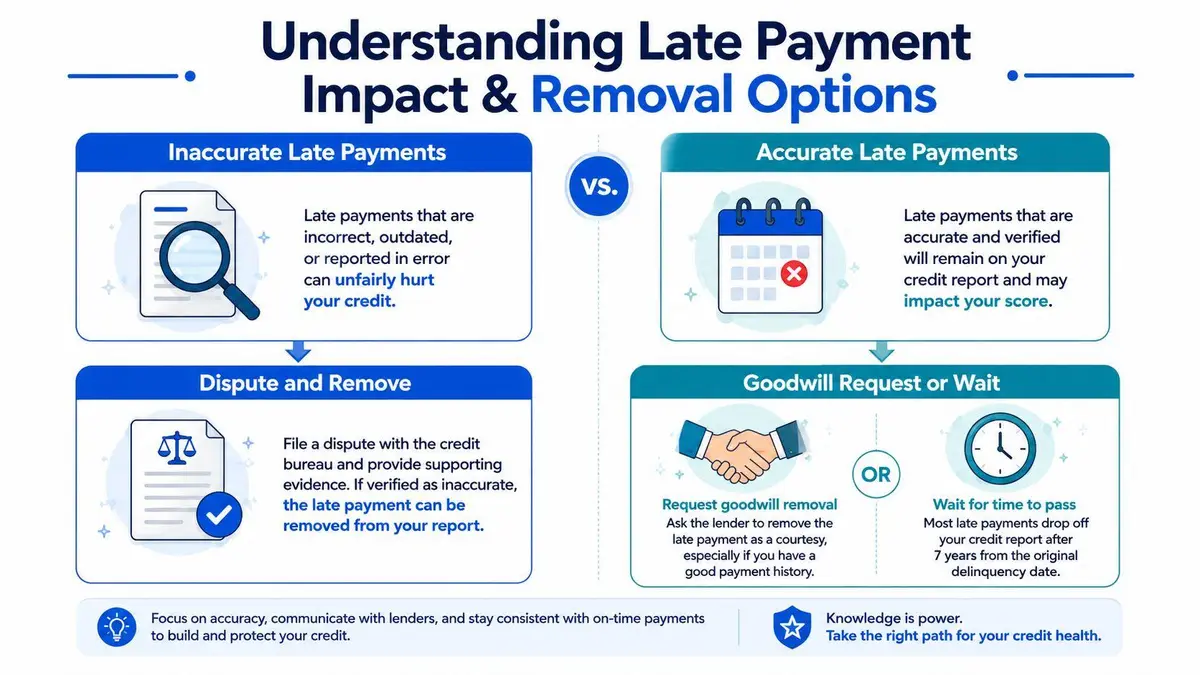
Understanding Late Payment Impact and Removal Options
A late payment usually becomes reportable in major consumer credit markets only after it is 30 days past due. If the entry is accurate, it can remain on the file for up to seven years from the original delinquency date or first missed payment, as noted by Equifax’s guidance on removing late payments and Experian’s explanation of the seven-year rule. That timeline matters because a recent delinquency can change a lender’s view much faster than an old item that is close to aging off.
The scoring effect also depends on severity and recency. A recent 30-day late on an otherwise clean file can disrupt approvals, while older marks usually matter less as they age. According to analysis from Restore.Credit, removing a single recent 30-day late can recover 50 to 100 points, a 90-day late from the past two years can recover 60 to 130 points, and older late payments may recover 20 to 50 points. Those ranges are not a promise, but they show why the same label can lead to very different outcomes.
Practical rule: if the item is inaccurate, move immediately. If it is accurate, removal usually means either waiting out the seven-year reporting period or persuading the creditor to grant a goodwill adjustment.
Executives often face the same choice in background screening. The framework in this strategic guide on handling negative background-check results is useful because the decision is the same, correct the record, or work around a legitimate mark to achieve a better credit score for business.
The decision point is straightforward. Dispute-based removal fits errors, duplicates, wrong dates, identity mix-ups, or any entry that cannot be verified. Goodwill removal fits accurate late payments, where the lender may choose to help but is not required to do so, and escalation becomes the next move when the first request is denied and the file, creditor type, or timeline justifies pressing the issue harder.
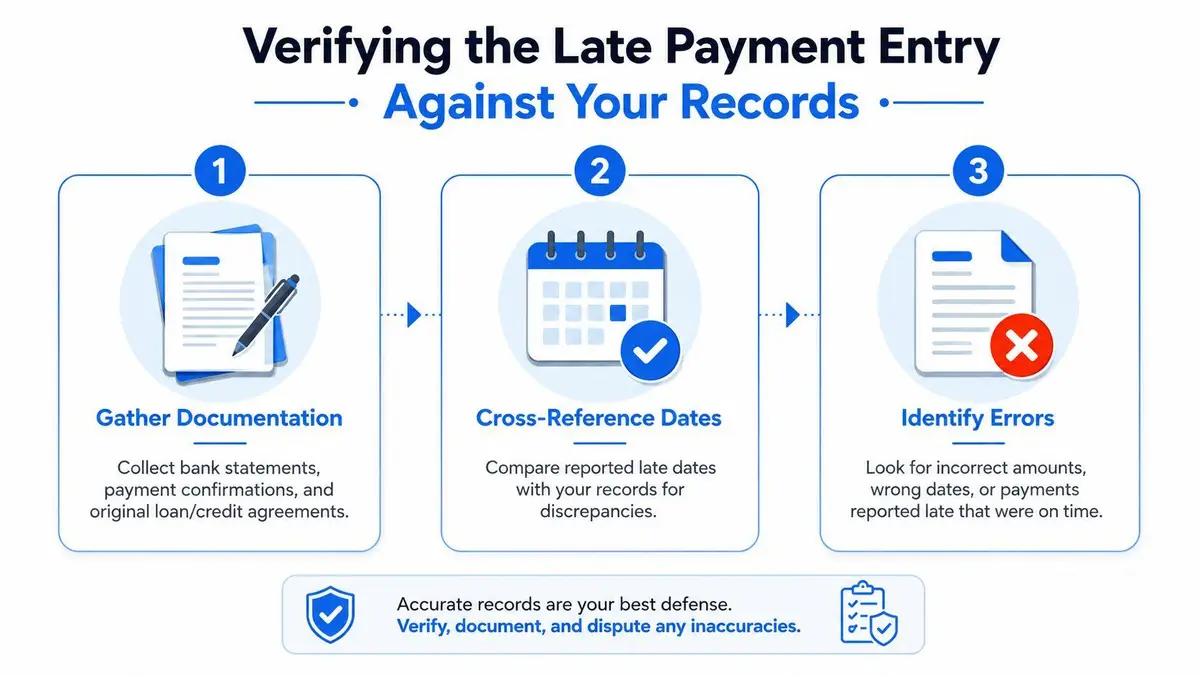
Verifying the Late Payment Entry Against Your Records
Start with the reports, not the story you’ve been telling yourself about the account. Pull all three credit reports, then compare the tradeline line by line against your bank records, payment confirmations, and creditor statements. The goal is to identify whether the late mark is a factual error, a timing issue, or a legitimate delinquency that was reported correctly.
The records that matter
The strongest file is boring and specific. You want dated payment proof, such as a canceled check, transaction confirmation, or bank statement showing the money left the account on time, plus the creditor’s own statement for the same period. If the account is electronic, screenshot the payment portal confirmation and keep the full transaction detail, not just the summary page.
A short written chronology helps too. Note the account number, due date, date the creditor says it was late, and what your records show instead. That comparison is what turns a vague complaint into a credible dispute file.
The red flags that justify a dispute
Look for the problems that usually make a late payment disputable. The entry may be tied to the wrong account, reported under the wrong date, duplicated, or labeled late even though the payment cleared on time. Sometimes the creditor’s own servicing history shows the payment posted within the acceptable window, but the bureau received stale or inaccurate data.
If the date is wrong, the dispute is stronger than any explanation about hardship. Credit reporting is date-sensitive, and date errors are where clean removals happen most often.
A separate issue is aging. Under credit-industry guidance, accurate derogatories can remain for up to 7 years / 84 months from the first missed payment if they’re valid, so date precision matters when you’re deciding whether the item is still inside the reporting window.
The choice branches here. If the entry is wrong, move to a formal dispute. If the entry is accurate, save the credibility you’d spend on a dispute and use that effort for a goodwill request instead.
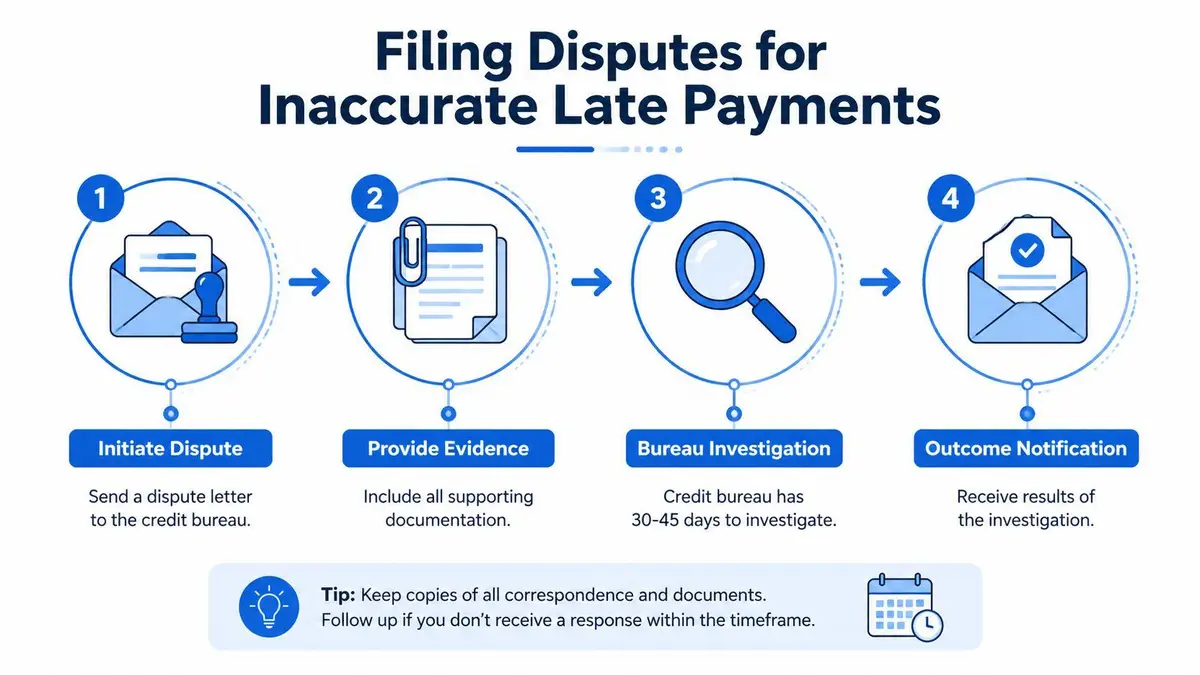
Filing Disputes for Inaccurate Late Payments
A technically sound dispute is document-led, narrow, and repetitive in the right way. Send the dispute to each bureau, Equifax, Experian, and TransUnion, and also to the furnisher under FCRA Section 623 when the creditor’s records are the best source of truth. If the late payment is inaccurate, duplicated, tied to the wrong account, or the product of identity theft, that’s the path with actual legal force.
Build the dispute around evidence, not explanation
The file should include dated payment proof and a concise explanation tied to the exact account and delinquency date. The more item-specific the letter is, the harder it is for a bureau or furnisher to brush it off as a generic complaint. That means no long autobiography, no emotional history lesson, and no unrelated attachments.
What works is a clean sequence. State the account, identify the inaccurate late date, attach the records that contradict it, and ask for correction or deletion. If the account was reported late after it was paid, the documentary contradiction should be obvious from the paper trail.
What happens after filing
Experian says the creditor must conduct a reasonable investigation, which can take up to 30 days, and inaccurate or unverifiable information must be corrected or deleted Experian’s dispute guidance. Credit Karma’s guidance also emphasizes that bureaus generally have 30 days to investigate and that creditors who accept the item is wrong must update or delete it and notify the bureaus they furnished to Credit Karma’s workflow overview.
Track the dispute by account, bureau, and date sent. If one bureau updates the tradeline and another doesn’t, don’t assume the problem is solved. The record has to be corrected everywhere it was furnished.
A vague dispute is the common failure point. The bureau can treat it as frivolous if it doesn’t identify the exact error, and that wastes the one thing you need most, a clean evidentiary record. For cases where the furnisher has the original servicing logs and bureau reinvestigation stalls, a direct furnisher dispute is often the more efficient route.
Operational insight: a bureau dispute tests whether the item can be verified, a furnisher dispute tests whether the creditor will stand behind its own records. Use both when the paper trail supports you.
If the dispute fails because the entry is accurate, stop trying to force a legal correction and pivot to a goodwill request. That’s where discretionary judgment comes into play, not the FCRA.
Pursuing Goodwill Adjustments for Accurate Late Payments
When the late payment is accurate, goodwill is the cleaner bet, but it’s still a favor, not a right. Creditors are not required to remove legitimate late marks, and the success rate depends on their internal policies, the account history, and how you frame the ask. A widely cited figure says goodwill requests succeed about 37% of the time when backed by strong prior and subsequent payment history CRIF High Mark’s discussion of goodwill outcomes.
Who gets traction
The best requests go to the customer relations or executive office, not collections. Collections is built to recover money, not to evaluate whether a past-due mark should be forgiven as a courtesy. The creditor is more likely to consider goodwill when the late payment was isolated, the rest of the file is clean, and the consumer has a long streak of on-time payments.
The request itself should be brief. Own the mistake, explain the extenuating circumstance if there was one, and ask for a courtesy deletion or adjustment. Medical emergencies, job loss, or servicer confusion are the kinds of facts that matter because they make the event understandable without sounding evasive.
What weakens the ask
Over-arguing usually backfires. If you flood the letter with excuses or unverifiable claims, the creditor has less reason to act and more reason to disengage. A documentary-first tone works better than a plea.
Keep the letter short enough that a senior reviewer can scan it in a minute. If the point needs five paragraphs, the request is already too diluted.
The practical limit is simple. A goodwill adjustment can be powerful when the delinquency was a one-time hardship and the rest of the relationship is solid, but it won’t reliably save an account that already looks chronically risky. When the late mark is accurate and the creditor has no incentive to help, the remaining options are escalation or time.
For executives dealing with reputation sensitivity on multiple fronts, the same discipline applies to financial records and public-facing material. A useful comparison point is the guide by BDJ Express Law, which reflects the same reality, accurate negative information usually doesn’t disappear because someone asks nicely.
Escalation Paths When Initial Attempts Fail
When the first dispute or goodwill request gets denied, don’t keep repeating the same submission. Escalation works only when the next move changes the pressure point, the evidence set, or the forum. The three credible options are a CFPB complaint, a renewed furnisher dispute under FCRA Section 623, or legal counsel for a serious violation.
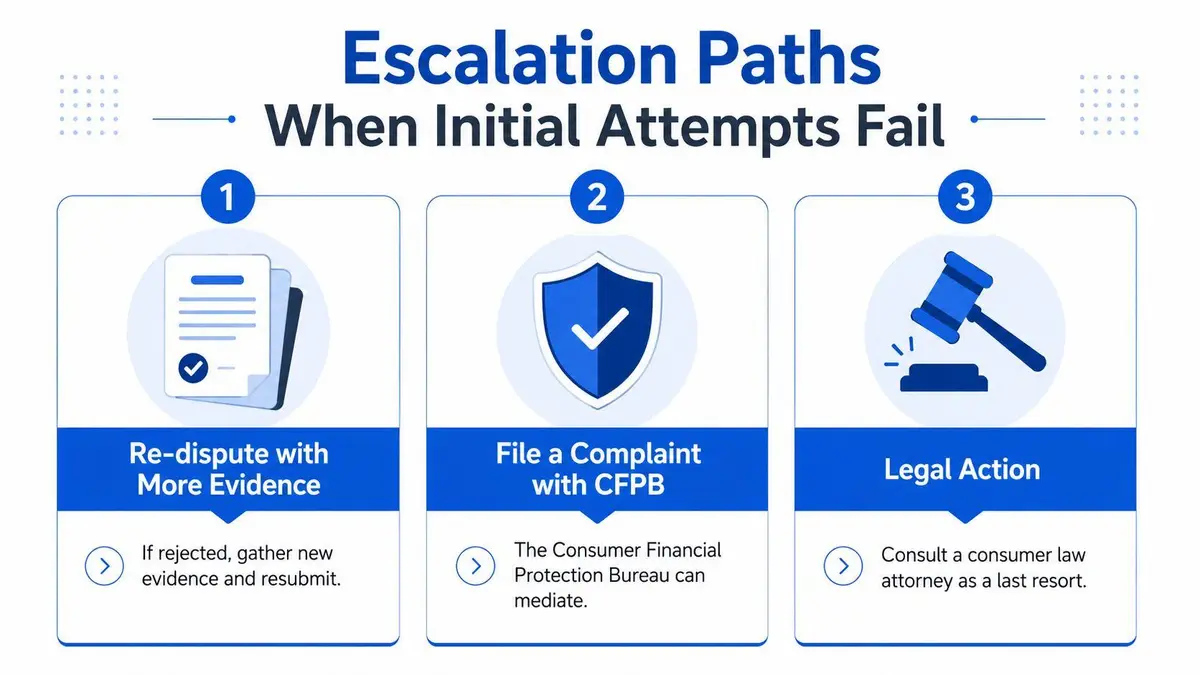
CFPB complaints and direct furnisher disputes
A complaint to the Consumer Financial Protection Bureau can pressure a creditor to review the file again, but it doesn’t guarantee deletion. It works best when the bureau dispute was sloppy, the creditor ignored clear evidence, or the account reflects inconsistent servicing. If the furnisher has the original servicing logs, a renewed direct dispute may produce a better result than another generic bureau filing.
The reason this path has value is access. The furnisher often has the best view of payment posting, reversals, grace periods, and system errors. If bureau staff missed the point, the creditor’s own records can still correct it.
When legal counsel makes sense
Legal action is the last resort, not because it’s weak, but because it’s expensive and targeted. It makes sense when there’s clear FCRA misconduct, repeated failure to investigate, or demonstrable harm tied to a provably incorrect tradeline. For an isolated, accurate late payment, litigation is usually the wrong use of time and resources.
A practical lens helps here. If the item is close to dropping off, the seven-year wait may be cheaper than a sustained escalation campaign. If the item is recent and materially distorting a financing decision, continued pressure can still be justified.
For executives balancing privacy, reputation, and records management, the escalation logic mirrors other removal strategies, including the approach in this executive-focused guide to public-record removal. The common thread is to escalate only when the next step changes the odds.
Decision point: if the file is clearly wrong, escalate evidence. If the file is accurate, escalate leverage. If neither changes the outcome, wait out the reporting clock.
Choosing the Right Removal Strategy for Your Situation
The right strategy depends on three questions, is the late payment accurate, how old is it, and how much time do you have. If it’s inaccurate, dispute first and document everything. If it’s accurate, move straight to goodwill and aim the request at the right department.
Match the remedy to the fact pattern
Recent entries justify more urgency because they hit harder, especially when the rest of the file is otherwise clean. That same recency, though, often means the creditor still remembers the account and may be less inclined to erase a valid mark. Older entries are the opposite, they’re less damaging on score impact, but sometimes not worth the effort unless they’re still distorting a major transaction.
Creditor type matters too. A lender with a customer relations team and a history of courtesy adjustments is a better goodwill target than a strict servicer that rarely reverses anything. If the account was paid off, settled, or brought current after a one-time lapse, the tone of the ask changes, but the rule doesn’t, accuracy still controls the legal path.
Use urgency as a filter, not a panic trigger
If a financing decision is imminent, a dispute can be worth filing even when you’re not certain the item will be removed, because a documented investigation may help clarify the file. If the item is accurate and the closing date is near, a goodwill request is the only realistic chance of early removal. If neither path has a credible basis, you’re better off planning around the seven-year aging period than throwing weak filings at the bureaus.
That’s the part many high-pressure clients miss. Not every late payment deserves a fight. A carefully chosen non-action can be smarter than a noisy but weak campaign.
For a broader reputation strategy that stays cost-conscious, the affordable reputation management overview provides a useful lens on prioritizing high-impact fixes over scattered effort. The same principle applies here, direct your time toward the marks that are both removable and consequential.
The final test is simple. If the record is wrong, build a dispute file. If the record is right, build a goodwill case. If the clock is the only thing on your side, let time do the work and preserve your credibility for the accounts that merit escalation.
If you need a discreet, results-focused team to assess a damaging credit mark alongside the broader reputation risk it creates, ContentRemoval.com can help you separate what’s legally removable from what just needs a smarter escalation plan. Visit ContentRemoval.com to request a confidential assessment and get a clear next step for your situation.
Frequently asked questions
Can a late payment be removed from my credit report if it is accurate?
Only at the creditor’s discretion through a goodwill adjustment, which is a favor rather than a right. It works best when the late payment was isolated, the rest of the file is clean and the request is short, owns the mistake and goes to customer relations or the executive office. Otherwise the mark ages off after seven years.
What evidence do I need to dispute a late payment?
Dated proof that the money left on time, such as a canceled check, transaction confirmation or bank statement, alongside the creditor’s own statement for the same period and a short chronology of the due date, the reported late date and what your records show. Date errors are where clean removals happen most often.
What can I do if my credit dispute is denied?
Change the pressure point rather than resending the same filing. A CFPB complaint can force another review, a renewed direct dispute to the furnisher under FCRA Section 623 uses the creditor’s own servicing logs, and legal counsel is reserved for clear FCRA misconduct or repeated failure to investigate. If the item is close to aging off, waiting may be the better option.