
Removing personal information online is a three-stage security discipline: audit every exposure with advanced search operators and data broker searches, submit takedown requests to the hosting sites and de-indexing requests to Google’s Results about you tool, then monitor so the data does not resurface. For unlawful content such as defamation, stolen images or intimate imagery, legal notices replace polite requests.
Key facts
- Search operators like a name plus city minus your own profiles isolate unauthorized data exposures.
- DIY data broker opt-outs typically take two to eight weeks and often need follow-up correspondence.
- Google’s Results about you tool covers ID numbers, home addresses and contact details in search results.
- California’s DROP platform lets residents send one deletion request to over 500 registered data brokers.
Where ContentRemoval.com comes in. ContentRemoval.com removes exposed addresses, phone numbers, family details and stolen images for executives and public figures whose security team or chief of staff has flagged the exposure. We run the audit across the surface, deep and dark web, submit takedowns at scale and escalate legally where a host refuses. A free 15-minute Exposure Scan maps what is removable, and the report is yours to keep. Get a Free, Confidential Exposure Scan or read how our content removal work is done.
Removing your personal information from the internet is not a trivial task; it is a continuous security discipline. The process requires a systematic approach: first, a comprehensive audit to identify all points of data exposure. Second, methodical takedown and de-indexing requests directed at individual websites and search engines. Finally, persistent monitoring to ensure the data does not resurface. This is not a single action but an ongoing component of personal and corporate risk management.
The Executive Imperative for Digital Anonymity

For executives, public figures, or high-net-worth individuals, the removal of personal information online transcends simple privacy. It is a foundational element of a comprehensive security strategy, protecting both the individual and their organization. Your exposed home address, phone number, and family details are not digital noise; they are tactical assets for malicious actors.
This information is the currency of a dark economy where adversaries can acquire the necessary components for sophisticated attacks. The risks are concrete, extending far beyond nuisance robocalls or junk mail.
The Real-World Consequences of Data Exposure
When your personal data is readily accessible, it becomes the predicate for a spectrum of threats. These are not hypothetical scenarios; they are the active situations our firm mitigates for clients daily.
The direct consequences of publicly available information include:
- Targeted Phishing and Spear-Phishing: Adversaries leverage personal details (a spouse’s name, a recent vacation) to craft highly credible emails designed to bypass corporate security filters. A single click can lead to stolen credentials or a full-scale network breach.
- Reputational Attacks: A disgruntled former employee, an aggressive competitor, or an online activist can weaponize your personal information. This may involve creating fraudulent social media accounts or using your data to harass you and your family.
- Physical Security Risks: The threat is direct and severe. A publicly listed address places a physical target on your residence, exposing you and your family to stalking, harassment, or direct physical harm.
- AI-Driven Deepfakes and Impersonation: Minimal public imagery and voice recordings are now sufficient for AI tools to generate convincing deepfakes. These can be deployed for financial fraud or to fabricate compromising content. There are documented cases of AI agents autonomously publishing personalized attack articles, signaling a new era of automated reputational warfare.
Your personal information provides the context that makes these attacks credible and effective. By removing this data, you disrupt the critical reconnaissance phase that precedes nearly every significant personal or corporate security incident.
The Alarming Gap Between Awareness and Action
Despite the palpable dangers, a significant disconnect exists between awareness of the problem and the implementation of a solution. This inaction leaves high-value targets dangerously exposed.
Consider the data. In a marketplace where phone numbers and home addresses are sold as commodities, only 6% of American adults, approximately 15 million people, have engaged a data removal service. A 2026 Security.org study on data removal service usage revealed that while 42% of individuals are aware such services exist, the vast majority have not taken defensive action.
This inertia is a liability. Proactive management of your digital footprint is not paranoia; it is a necessary defense when your reputation is a primary asset. By controlling your public-facing information, you control the narrative and dismantle threats before they materialize. For a more detailed analysis, we have prepared a guide on protecting your online identity with a strategic framework.
Conducting Your Digital Footprint Audit
Before initiating removal, you must first conduct a forensic audit to map the full extent of your online exposure. This is not a casual search. It is a deep-dive reconnaissance mission to establish a comprehensive understanding of your digital footprint.
The objective is to move beyond superficial search results and uncover the latent data trails left across the web, including old forum posts, forgotten profiles on obscure data broker sites, and information persisting on websites long after being altered. Only with this complete intelligence can you construct an effective takedown strategy.
Advanced Search Engine Reconnaissance
A simple name search is insufficient. To conduct a thorough investigation, you must employ advanced search operators, commands that direct search engines like Google to perform highly specific queries, unearthing otherwise buried information.
Begin by combining these operators to zero in on specific data points. For instance, a potent query might be:
"Jane Smith" AND "Chicago" -site:linkedin.com -site:facebook.com
This command instructs Google to find the exact phrase “Jane Smith” in conjunction with “Chicago,” while explicitly excluding results from LinkedIn and Facebook. By systematically filtering out profiles you control, you begin to isolate the unauthorized data exposures.
Employ methodical creativity. Use variations of your name, including common misspellings or professional titles. Combine your name with:
- Past and present addresses
- Current and former email addresses
- Names of family members
- Previous employers or educational institutions
The key is to adopt the mindset of an adversary. What data points could be pieced together to construct a profile? This approach transforms a simple search into a strategic security audit.
Locating Your Profile on Data Broker Sites
Data brokers are a primary source of exposed personal data. These entities exist to aggregate and sell your information. Identifying your profiles on their platforms is a critical, non-negotiable step in your audit.
Begin by targeting the most prominent brokers. Use specific search queries such as:
"Jane Smith" site:spokeo.com
"Jane Smith" "Chicago" site:whitepages.com
Maintain a precise log of every site that holds your profile, including the exact URL for each. This documentation is essential for the removal phase. Be aware that many of these sites are owned by the same parent corporations, and their removal processes are often deliberately convoluted. Our comprehensive guide on a full digital footprint cleanup details advanced tactics for engaging these entities.
Uncovering Hidden Data and Physical Asset Risks
Your audit must extend beyond live websites to include archived content and physical devices. Google’s cache, for example, can retain a snapshot of a webpage long after the original content has been modified or deleted. Use the cache: operator (e.g., cache:example.com/your-profile) to inspect these saved versions.
This forensic mindset applies to legacy hardware. A disposed computer, phone, or external hard drive can be a source of data for adversaries if it was not properly sanitized. Understanding how to completely clean a hard drive is a fundamental security measure to prevent physical data recovery.
Finally, leverage available tools. Google’s “Results about you” feature can help monitor for sensitive information like driver’s license or passport numbers and guide you through removal requests. Over 10 million people have used this tool. This initial audit provides the blueprint for a systematic removal campaign, converting a general sense of exposure into a clear, actionable plan.
Having audited your digital footprint and compiled a prioritized list of removal targets, you can now proceed with direct action. The process involves a two-pronged attack: first, submitting takedown requests directly to the websites hosting your data. Second, issuing deindexing requests to search engines. A takedown deletes the content from the source, while deindexing removes the link from search results. Both are necessary for a comprehensive removal.
The foundational work of identifying and prioritizing this data underpins the entire operation.
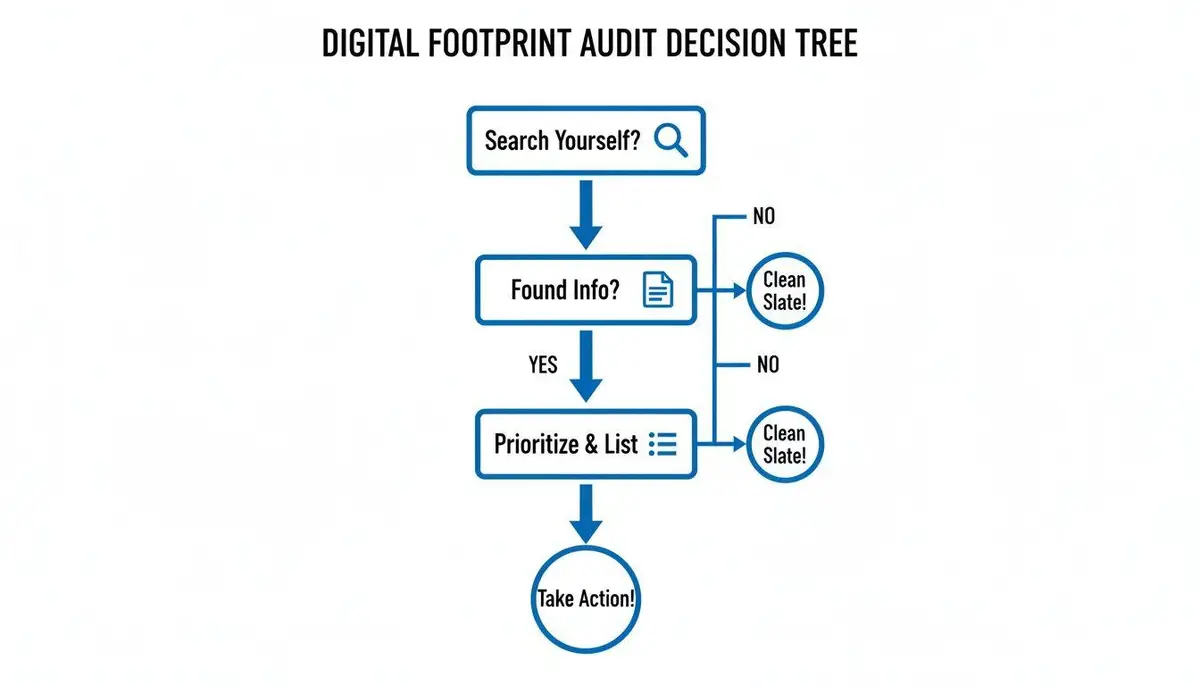
This flowchart outlines the critical first steps, guiding you from discovery to a concrete, prioritized action plan.
Going Straight to the Source: Direct Website Takedowns
The most effective approach is to start with the source website hosting the information. If you can achieve removal at the source, the data is permanently gone. The method depends on the nature of the site.
With data brokers, most maintain a dedicated opt-out page. These are often intentionally complex. You must locate your profile, verify your identity, and adhere to their specific removal protocol. Document every step; some brokers require follow-up correspondence to finalize the removal.
For corporate or news sites, locate a “Contact Us,” “Privacy Policy,” or “Terms of Service” page. These pages typically contain an email address for the site administrator or legal department.
Your communication must be professional and precise. State your name, provide the exact URL where your data appears, and specify what information you require removed. Frame the request as a matter of personal privacy and safety. An emotional or aggressive email is easily dismissed; a clear, fact-based request demands attention.
Making It Disappear: Deindexing with Search Engines
Even after a website removes your information, a cached version can persist in search results for days or weeks. This makes deindexing a critical second step. Google provides specific tools for this purpose.
A deindexing request will not remove the content from the source website, but it makes it exceptionally difficult for the public to find. For most privacy threats, severing the public pathway to the data is sufficient to neutralize it.
Google’s “Results about you” tool is the primary mechanism for requesting the removal of search results containing personal information, including government ID numbers, home addresses, and contact details. Over 10 million people have utilized this tool. The content must meet Google’s specific criteria for action. For a full analysis, you can learn more about strategic URL de-indexing.
If the website owner has already removed the content but it still appears in search, use Google’s “Remove outdated content” tool. This prompts Google to recrawl the page, verify the information is gone, and update its search index more rapidly.
Data Removal Method Efficacy Comparison
Selecting the correct removal method is critical, as not all strategies produce the same results. The optimal path depends on the data type, its location, and the urgency of removal. This table analyzes what you can realistically expect from each strategy.
| Method | Effectiveness | Typical Timeframe | Scope of Removal | Ideal For |
|---|---|---|---|---|
| DIY Data Broker Opt-Out | Moderate | 2-8 weeks | Limited to specific sites | Basic digital hygiene and low-risk data cleanup. |
| Direct Webmaster Request | Varies widely | 24 hours to never | Source-level removal | One-off removals from cooperative websites. |
| Search Engine Deindexing | High for search visibility | 1-7 days | Link removal only | Making sensitive info hard to find quickly. |
| Professional Removal Service | Very High | 24-48 hours to start | Comprehensive | Urgent, complex, or high-volume removal needs. |
A DIY approach can be effective for initial cleanup of data broker profiles, but it frequently stalls when encountering unresponsive webmasters or complex issues. While direct requests and deindexing are essential skills, they can devolve into a time-consuming and frustrating endeavor. Professional services excel in these scenarios, cutting through bureaucracy to secure rapid results when the stakes are high.
When standard takedown requests are ignored or refused, you have reached a critical juncture. For persistent or malicious content (such as defamatory statements, copyright infringement, or harassment) it is time to escalate from polite requests to forceful demands. This requires a shift to a more assertive strategy, employing specific legal frameworks to compel the removal of content that is not merely unwanted, but unlawful.
This is not a matter of disputing a negative opinion. The critical distinction is between content that is offensive and content that is legally actionable. A negative review may be damaging, but a fabricated review accusing you of criminal activity is defamation. Understanding this distinction is crucial for building a strong case and determining when to engage legal counsel.
Pursuing Defamation and Copyright Claims
Defamation is a potent legal tool for removing false statements of fact that damage your reputation. If a blog post, social media comment, or online article makes a provably false assertion about you (for instance, an accusation of fraud) you may have a strong case for defamation.
The initial step is often a formal cease and desist letter from legal counsel. This action is frequently effective. Website hosts and owners seek to avoid legal liability, and a letter from an attorney demonstrates serious intent, often prompting swift compliance.
The Digital Millennium Copyright Act (DMCA) is another essential instrument. If an individual or entity has used your copyrighted photographs, videos, or written content without authorization, you can file a DMCA takedown notice directly with the website’s hosting provider. Most hosts comply immediately to maintain their “safe harbor” status, resulting in the removal of infringing content without prolonged legal proceedings. This is particularly effective against stolen profile pictures or the unauthorized use of professional headshots.
We frequently encounter this with impersonation accounts. An adversary will scrape a client’s name and photos to create a fraudulent social media profile. The most efficient countermeasure is often a dual approach: a DMCA notice for the stolen images and a platform-specific report for impersonation.
Addressing Non-Consensual Intimate Imagery (NCII)
The unauthorized distribution of private, intimate images, often termed “revenge porn,” is a severe violation that demands an immediate and aggressive response. Most jurisdictions now have specific laws against Non-consensual Intimate Imagery (NCII), and all major online platforms maintain zero-tolerance policies.
In cases of NCII, you are not required to prove the content is false or that it damaged your reputation. The violation is the act of distribution without consent. A legal team can pursue action against both the individual who shared the content and the platforms hosting it. This approach often secures rapid removal while simultaneously pursuing civil or criminal penalties against the perpetrator.
Attempting to manage such a crisis alone is a strategic error. This is a high-stakes situation where professional intervention is not merely recommended. It is essential.
The New Frontier: Automated Mass Opt-Outs
The privacy landscape is evolving to grant individuals greater control. A significant development is forthcoming in California under the DELETE Act, passed in 2023.
Beginning January 1, 2026, California residents can utilize the Data-broker Registration and Opt-out Platform (DROP). This system will permit an individual to submit a single, verified request to have their personal information erased from the records of over 500 data brokers simultaneously. It represents a major advancement, creating a scalable solution for what was once an arduous manual process. Complete details are available directly from the California Privacy Protection Agency.
While the focus is on online data, do not neglect the information stored on legacy physical devices. The same principles of rendering data unrecoverable apply. For an overview of corporate best practices, consult this complete guide to secure data destruction.
Ultimately, knowing which legal lever to pull, and the precise moment to do so, is what separates a successful removal from a protracted and frustrating failure.
Engaging Professional Services for Certainty and Speed

Attempting to remove your personal information from the internet yourself is a logical first step, but it often becomes a frustrating and unwinnable battle. Takedown requests are ignored. A data broker profile you remove reappears weeks later. It is an exhausting cycle.
Inevitably, you will encounter a point of diminishing returns. The time and effort invested no longer justify the results, and the risk of continued exposure becomes more significant than the satisfaction of a DIY approach.
At this juncture, engaging a professional firm is not just an option. It is the correct strategic decision. For high-stakes situations that demand a guaranteed outcome, it is the only viable path.
The Limits of a DIY Approach
The primary limitation of manual removal is the sheer scale of the digital ecosystem and the persistence required to maintain a clean slate. The internet’s architecture is designed to share and monetize your data, not facilitate its deletion.
Consider the data broker industry. Hundreds of these entities exist, many operating opaquely under the umbrella of massive, faceless parent corporations. Attempting to opt out from each one individually is not just tedious; it is a futile effort against a moving target. As soon as your data is removed, their web crawlers are already re-acquiring it from another source for republication.
Furthermore, many webmasters are simply unresponsive. A request from an individual is easily deleted or ignored, particularly if the website is hosted in a jurisdiction with weak privacy laws. Without leverage, your request lacks authority, leaving you powerless.
The core flaw in the do-it-yourself method is that it places the entire burden of enforcement on you. You must find the data, submit the requests, follow up relentlessly, and constantly monitor for its reappearance. It is a full-time job.
The Strategic Edge of Professional Intervention
Specialist firms like ContentRemoval.com operate on a different tactical level, bypassing the roadblocks that halt individuals. We have engineered a process that integrates proprietary technology, established legal channels, and aggressive, persistent monitoring. This is not about sending emails; it is about executing a coordinated campaign to reclaim your privacy.
Our methodology overcomes the obstacles that render manual removal ineffective:
- Advanced Technology: We deploy powerful tools to scan the surface, deep, and dark web for your data, identifying exposures that would almost certainly be missed by manual searches. This technology also automates takedown submissions at a scale no individual can achieve.
- Established Processes: We do not send unsolicited emails. We have direct lines of communication and established protocols with the legal and administrative departments at major platforms, hosting providers, and data aggregators. Our identity is known, and our requests carry immediate authority.
- Legal Expertise: Our team possesses the precise legal knowledge, from DMCA and defamation to specific privacy statutes, to compel action. When a site owner is uncooperative, we know exactly how to escalate the matter with legal precision.
What was a frustrating game of whack-a-mole becomes a decisive, strategic operation. We are typically able to initiate action within 24-48 hours, providing the speed and certainty required when your reputation and safety are at risk.
The Real ROI on Professional Services
Professional data removal should not be viewed as a “cost.” It is an investment in personal security with a clear and quantifiable return. The financial and reputational damage from a single data breach, doxxing incident, or sophisticated spear-phishing attack can be catastrophic.
The escalating cost of privacy failures makes the risk tangible. Corporate spending on data privacy is surging, with 38% of companies globally now allocating over $5 million annually to this area. This is a sharp increase from just 14% in early 2025. You can explore these trends in data privacy spending to understand the financial implications. For executives and public figures, this corporate risk translates directly into personal vulnerability, where exposed data fuels deepfakes and targeted attacks.
Ultimately, the investment is in certainty. A professional service delivers a definitive result, whereas a DIY approach offers only a probability of success. It provides peace of mind, with the assurance that a dedicated team is not only remediating existing problems but also standing guard against future threats. For any executive, public figure, or individual under pressure, that certainty is invaluable.
Your Top Questions About Online Data Removal, Answered
When attempting to remove private information from the internet, critical questions will arise. The process is complex, and with your reputation at stake, you require clear, direct answers. Based on our extensive experience, here are our responses to the most common concerns from our clients.
Is It Really Possible to Erase Myself from the Internet?
A complete, 100% erasure is a practical impossibility. Elements such as web archives, the dark web, and certain private databases are beyond the reach of standard takedown protocols.
However, a strategic, targeted removal campaign can eliminate 95-98% of publicly accessible information. The operational goal is not digital invisibility, but to make it exceedingly difficult for an adversary to find actionable intelligence about you through a routine search.
The objective is not digital invisibility; it is digital control. By methodically removing the vast majority of your exposed data, you become a difficult, unprofitable target. Most adversaries will disengage and move to an easier mark.
This is where professional intervention provides a decisive advantage, not only in removing the data but in ensuring it remains suppressed.
How Long Does This Whole Process Take?
The timeline is variable and depends on the nature of the content and the cooperativeness of the website owner.
- Simple data broker opt-outs: These can be executed rapidly, sometimes within 48 hours, but many require weeks of persistent follow-up.
- Google de-indexing: A request for Google to delist a search result is often fast, with action sometimes taken in a few days. However, this is only a stopgap measure; the source content remains live.
- Difficult content: Contesting defamatory articles or personal attacks is a more complex undertaking. This can take months and frequently requires legal intervention to compel action.
A professional firm can accelerate this process. We typically initiate action within 24-48 hours, leveraging established contacts and proven methodologies to drive faster results across multiple fronts simultaneously.
Will Removing My Data Hurt My Professional Online Presence?
This is a common and valid concern. Clients worry that a cleanup campaign might inadvertently erase their LinkedIn profile, corporate biography, or personal website.
This reflects a fundamental misunderstanding of the process. A professional removal campaign is a surgical operation, not a demolition.
Our focus is exclusively on unwanted, private, or harmful information, such as old addresses on people-finder sites, phone numbers on public lists, or negative media. Your curated professional assets are left untouched. By removing the digital clutter, your professional presence is amplified, making it easier for the right audience to find you.
The goal is to seize control of your online narrative, not to erase it. This is why our process always begins with a detailed audit to differentiate between valuable assets and harmful liabilities before any removal action is taken. This ensures your digital footprint is not just protected, but strengthened.
Attempting to neutralize persistent online threats independently is frustrating and often ineffective, leaving you exposed. ContentRemoval.com provides the specialized expertise and speed required to protect high-value individuals and brands. Our team employs a synthesis of advanced technology and legal acumen to achieve complete and lasting results. Reclaim control of your online narrative and secure your peace of mind by starting your confidential assessment at ContentRemoval.com.
Frequently asked questions
How do I find every website that has my personal information?
Go beyond a plain name search. Combine your name with your city, past addresses, email addresses and family names, exclude profiles you control with operators such as -site:linkedin.com, and run site-specific searches against major data brokers like Spokeo and Whitepages. Log every URL, because many brokers share a parent company and require separate opt-outs.
Can I get my personal data completely erased from the internet?
Complete erasure is not realistic because web archives, the dark web and some private databases sit beyond standard takedown processes. The article states that a targeted campaign can remove the large majority of publicly accessible data, which is enough to make you an unproductive target for phishing, harassment or physical threats.
Will removing my personal information damage my LinkedIn or company bio?
No. A properly run removal campaign begins with an audit that separates professional assets from harmful exposures, and only the unwanted material such as old addresses, phone listings and negative media is targeted. Your curated profiles and corporate pages stay in place and tend to become more visible once the clutter is gone.