
Removing negative search results is a two-phase process: preserve timestamped, full-page evidence of every URL before contacting anyone, then pursue source removal through the site administrator, Google’s removal tools for personal information, a DMCA notice for stolen images or text, or a court order for defamation. Accurate content that cannot be removed is displaced through a suppression campaign.
Key facts
- A DMCA notice goes to the hosting provider, which loses safe harbor protection if it ignores valid notices.
- Section 230 means defamation suits target the poster, not Google or the review platform.
- Google Search Console temporary removals block a URL for roughly six months while a permanent fix proceeds.
- Suppression campaigns typically need six to twelve months of sustained work to hold page one.
Where ContentRemoval.com comes in. ContentRemoval.com is engaged by executives, family offices and their lawyers when a damaging result has survived polite requests or is part of a coordinated attack. We handle the evidence file, the notices to hosts and platforms, and the Google submissions as a third party so the client never has to communicate with the adversary. A free 15-minute Exposure Scan maps what is removable, and the report is yours to keep. Get a Free, Confidential Exposure Scan or read how our search result removal work is done.
Removing negative search results is an exercise in strategy, not speed. The process divides into two distinct phases: first, the preservation of evidence, and second, the methodical execution of content removal or de-indexing. Your handling of the first 48 hours dictates the success of all subsequent actions.
The First 48 Hours: An Executive Damage Control Protocol
Upon discovering a damaging search result, the impulse is to react emotionally. Resist it. The single most critical action is to proceed with systematic deliberation. Operate like a forensic investigator. Your mandate is to triage the situation and build an incontrovertible case before making any contact. This is about establishing control from the outset.
First, you must classify the nature of the threat. Is the content:
- Defamatory? A false statement of fact presented as truth, causing material harm to your reputation.
- A privacy violation? Does it expose sensitive personal data such as a home address or confidential financial information?
- A terms of service violation? Does it breach a specific platform’s policies on harassment, copyright infringement, or other prohibited conduct?
The answer to this question determines your entire strategic path. Each classification demands a different response.
How to Preserve Evidence with Legal Precision
Once the threat is classified, the immediate priority is to preserve evidence. This step is non-negotiable.
Many individuals compromise their position at this stage by dispatching an angry email to the website owner or engaging in public debate. This alerts the adverse party, who may then alter or delete the content, leaving you with a compromised evidentiary record.
A proper evidence file is more than a simple screenshot. You must capture full-page, timestamped screen captures that clearly display the URL in the browser’s address bar. For enhanced legal standing, use a third-party tool capable of verifying the date and time of capture. You must also document every URL where the hostile content appears, including social media shares and archive sites.
Your immediate response protocol is a three-part mission: Identify, Document, and Preserve.
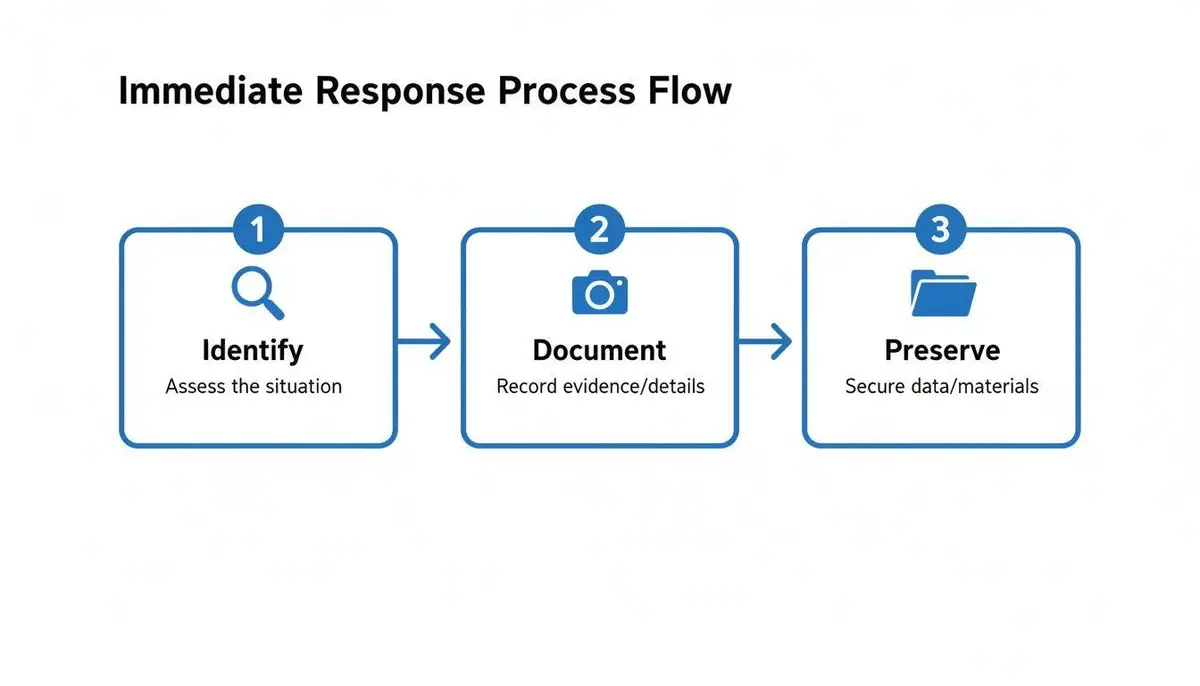
This structured approach ensures you operate from a position of strength, armed with a complete and verifiable record before initiating contact.
The Strategic Imperative of Meticulous Preparation
This is not administrative busywork. Data indicates that nearly 45% of potential customers will disengage from a transaction after encountering negative online content. This elevates content removal to a mission-critical priority for executives and their enterprises. You can review the strategic reasons for content removal to fully grasp the business implications.
The evidence collected in these initial days is not merely for internal records. It is Exhibit A for any correspondence with a webmaster, a platform’s legal department, or a court. A case built on weak documentation is often dismissed before a substantive review of the facts.
Completing this foundational work prepares you for the next phase. With a meticulously prepared file, you are no longer the target of a negative attack. You are an informed principal, prepared to execute a clear strategy, whether that entails direct webmaster contact, a formal Google removal request, or the engagement of legal counsel.
Taking Action: Direct Removal and Search Engine De-Indexing

With your evidentiary file compiled, the objective shifts from defense to a controlled offensive. The goal is unequivocal: remove the damaging content from public view. This requires a surgical focus on two primary outcomes: source removal and de-indexing.
The distinction is critical. Source removal is the complete eradication of the content from the host website. De-indexing renders the content undiscoverable through search engines like Google. The source page persists, but it is invisible to a public search; a direct link, however, remains active. A deeper analysis of these mechanics is available in our guide on understanding URL de-indexing.
First Move: Contacting the Site Administrator
Your initial action should be direct contact with the website administrator. This is not an emotional appeal. It is a formal, fact-based takedown notice articulating the legal or policy-based grounds for removal.
Your communication must be professional and precise, devoid of emotion. It must:
- Identify the exact URL(s) where the content is located.
- State the grounds for removal, referencing specific policy violations, privacy breaches, or defamatory claims.
- Attach the previously gathered evidence.
This initial outreach establishes a documented record of your attempt at a reasonable resolution. While a non-confrontational tone is often effective, the message must be firm. You are not requesting a favor; you are demanding compliance with their own terms of service or applicable law.
A well-crafted notice signals your preparedness to escalate. It informs the administrator that this is not an ordinary complaint but the first step in a formal process, compelling them to treat the matter with appropriate gravity.
Should they fail to respond or refuse cooperation, this documented attempt becomes critical leverage for subsequent actions, whether that is escalation to Google or legal counsel.
Selecting the Appropriate Removal Strategy
Not all negative content is equivalent, and your approach must be tailored to the specific problem. The correct strategy is contingent on the content type and its hosting location. This table outlines the most common scenarios.
| Content Type | Primary Removal Path | Success Probability | Typical Timeline |
|---|---|---|---|
| Copyright Infringement (Images/Text) | DMCA Takedown Notice to Host/Google | High | 1-14 Days |
| Private Information (PII) | Google’s “Results About You” Tool / Site Admin | High | 1-7 Days |
| Defamatory Blog Post/Article | Legal Counsel / Court Order | Medium | 3-12 Months |
| Negative Business Review | Platform Reporting (e.g., Yelp, Google) / Legal | Low to Medium | 2-6 Weeks |
| Forum/Social Media Harassment | Platform Reporting Tools / Direct Admin Contact | Medium | 1-10 Days |
A copyright claim is a more rapid and straightforward process than removing a defamatory article, which frequently necessitates legal intervention. Use this framework to establish realistic expectations and allocate resources effectively.
Leveraging Google’s Removal Tools
When a website owner is non-compliant, the next recourse is Google itself. Google provides tools for content removal, but success is contingent on fitting your request into one of their specific, narrowly defined categories.
Google is most responsive to requests concerning personally identifiable information (PII). This category includes highly sensitive data such as:
- Bank account or credit card numbers
- Social Security or other government identification numbers
- Confidential medical records
- Images of signatures or private contact details (address, phone number)
Requests involving PII are prioritized. When utilizing Google’s “Results About You” tool, be meticulous. Provide the exact URLs and articulate precisely how the content violates their PII policies.
Search engines do not adjudicate truth. They will not remove a negative review based solely on a claim of unfairness. However, their policies are not static. Between early 2025 and mid-2026, Google’s systems automatically removed reviews from over 60,000 business profiles in a major enforcement of its policies, demonstrating the dynamic nature of the environment.
Ultimately, compelling a search engine to act requires a case anchored to a clear violation of a specific policy, substantiated by the evidence you have already collected.
Legal Recourse: Defamation and Copyright Claims

When direct outreach to a site owner fails, the strategy shifts from administrative requests to formal legal demands. This escalation does not automatically entail protracted litigation. It involves the use of specific legal instruments to compel a response, particularly when your rights have been violated.
The most direct legal tool is often a copyright claim. If another party has used your intellectual property without authorization (a corporate logo, a professional headshot, or proprietary text) you possess a powerful and efficient means of recourse.
The DMCA as a Takedown Instrument
The Digital Millennium Copyright Act (DMCA) is a highly effective federal law that enables the issuance of a formal takedown notice for copyright infringement.
Crucially, this notice is not sent to the website operator but to their hosting provider or Internet Service Provider (ISP).
Under the DMCA’s “safe harbor” provisions, hosting companies are shielded from liability for their users’ copyright violations, provided they act expeditiously to remove infringing content upon receiving a valid notice. This creates a powerful incentive for them to comply, often without involving the site owner.
A valid DMCA notice must include:
- A precise description of the copyrighted work.
- The exact URL of the infringing content.
- Your name, address, and contact information.
- A sworn statement, under penalty of perjury, that you are the copyright owner or are authorized to act on their behalf.
For clear instances of content theft, the DMCA process is frequently the most rapid path to source removal.
Contesting Online Defamation
The legal landscape becomes more complex when addressing false and damaging statements. This is the domain of online defamation, which encompasses both libel (written falsehoods) and slander (spoken falsehoods, such as in a video).
A successful defamation claim requires proof that a false statement of fact (not opinion) was published, that it caused harm to your reputation, and that the publisher acted with negligence or malicious intent.
The primary obstacle is Section 230 of the Communications Decency Act. This federal law generally immunizes platforms like Google and review sites from liability for user-generated content. Consequently, legal action must target the individual who posted the content, not the platform. If the poster is anonymous, a “John Doe” lawsuit may be required to subpoena the platform for their identity.
In most defamation actions, the objective is not monetary damages. The primary goal is a court order declaring the content defamatory. This legal instrument can then be submitted to Google and other search engines, which will typically de-index the URL, effectively removing it from search results.
This is a strategic legal maneuver. To understand the associated costs and considerations, review our analysis of online defamation of character lawsuits for executives.
Cease and Desist vs. Court Order: A Strategic Choice
The legal response must be proportional to the threat. The initial step is often a cease and desist letter from legal counsel. This is not merely a strongly worded email; it is a formal legal warning that puts the adverse party on notice of their violations and signals your intent to litigate if they fail to comply. The gravity of a letter from a law firm is often sufficient to compel action.
If the content is hosted on a major news outlet or is part of a sophisticated smear campaign, a cease and desist letter may be ignored. In these high-stakes scenarios, pursuing a court order is the definitive action. While a more resource-intensive process, it is the ultimate tool for forcing the removal of intransigent, high-impact negative content. The decision is a cost-benefit analysis, weighing the reputational damage against the required investment of time and capital.
Suppressing Unremovable Content with Strategic SEO
When damaging content cannot be legally or practically deleted, such as lawful reporting or protected opinion, the strategy must shift. If removal is not an option, the objective becomes suppression. This involves taking deliberate control of the first page of search results for your name or brand.
Suppression is a methodical campaign to create, publish, and promote high-authority digital assets that outrank the negative content. The mission is to construct a digital firewall of controlled media, displacing the damaging material to the second or third page of search results, where it becomes effectively invisible to 95% of searchers.
Constructing a Digital Firewall
An effective suppression campaign is founded on authoritative content that Google’s algorithm is predisposed to rank highly. This is a sustained effort to build assets that fortify your credibility and dominate the primary search positions associated with your name.
The most effective assets include:
- Optimized Executive Profiles: Creation and enhancement of profiles on high-authority platforms such as LinkedIn, professional association websites, and niche industry directories.
- High-Value Publications: Authoring articles or opinion pieces for respected industry journals or news outlets lends third-party credibility.
- Corporate News and Press Releases: Distributing official announcements through reputable newswires creates a consistent flow of positive, factual content.
- Personal or Corporate Websites: An SEO-optimized website serves as the central, controlled hub for your professional narrative.
This is a strategic process of acquiring digital real estate. Each positive, high-ranking asset is another property you control on the first page of search results, systematically displacing negative content. A more detailed examination is available in our strategic guide to suppressing negative search results for executives.
Executing a Sustained Campaign
A common error is to assume that publishing a few positive articles is sufficient. Without a sophisticated promotion strategy involving backlinking and social media amplification, new assets will fail to gain the authority required to rank.
A significant consideration is authenticity. Over 2025-2026, Google enhanced its ability to detect sentiment manipulation, using AI to identify profiles with unnaturally perfect feedback. An exclusively positive digital footprint is now a potential liability; therefore, a content strategy must be nuanced. You can discover more insights about Google’s evolving policies on search data.
Suppression is not a quick fix; it is a long-term investment in your digital authority. A successful campaign requires a minimum of six to twelve months of consistent effort to achieve and maintain dominance over the first page of search results for a given name or brand.
This proactive approach shifts the dynamic from reactive defense to active narrative control. By commanding the top search positions, you are not merely burying a negative result. You are defining what the world sees first.
When to Engage Professional Counsel
Recognizing the moment to transition from a self-directed effort to specialist engagement is a critical strategic decision. While many basic reputation issues can be self-managed, certain situations demand a higher level of expertise. Attempting to manage a high-stakes conflict without specialist support can backfire, wasting time and exacerbating the damage.
This is not an admission of failure but a calculated business decision. When confronting an organized adversary, a major media outlet, or an anonymous campaign, the rules of engagement change. You require a specialized playbook to counter their advantages.
Red Lines Demanding Immediate Escalation
Certain threats fall entirely outside the scope of a self-managed campaign. Encountering any of the following is an immediate signal to cease independent action and escalate to specialists.
- Coordinated Reputation Attacks: This is not a single negative review but a synchronized campaign involving dozens of fake websites, social profiles, and forum posts disseminating the same falsehoods. This is the work of a well-resourced, organized adversary.
- Content on High-Authority News Sites: A negative story on a platform like The Wall Street Journal, Forbes, or the BBC cannot be addressed with a simple webmaster request. These organizations have legal teams prepared to defend their journalism. Removal requires a sophisticated blend of legal pressure and discreet negotiation.
- Impersonation & Deepfakes: The creation of fake social media accounts, websites, or AI-generated media in your name is an attempt to hijack your identity. This necessitates a rapid, multi-platform response involving direct contact with senior trust and safety teams, not standard reporting forms.
- Data on the Dark Web: The discovery of your personal or corporate information on the dark web is a security crisis, not merely a reputation issue. It indicates a sophisticated data breach requiring specialized intelligence capabilities beyond the scope of a public-facing removal service.
The Strategic Value of a Specialist Firm
Engaging a specialist firm is not about outsourcing tasks you have already attempted. It is about deploying a different class of tools, relationships, and strategies designed for hostile digital environments.
A reputable firm operates with a speed and discretion that is unattainable through self-directed efforts. They have direct lines of communication to administrators at hosting companies, senior personnel at social media platforms, and legal contacts. This access can reduce a months-long conflict to a resolution within days.
The real value of a specialist is their library of proprietary removal strategies, built from years of navigating complex platform policies and legal precedents. They know exactly which arguments work and which get ignored, a crucial edge when every second counts.
Furthermore, a professional team provides a necessary buffer, managing all communications as a dispassionate third party. This allows for calculated, strategic moves, free from the emotional judgment that can compromise outcomes.
Removal is only one part of the equation. The most robust defense is a proactive strategy for Social Reputation Management, designed to build a brand so resilient that negative content fails to gain traction.
Ultimately, the decision to hire an expert is a business calculation, an investment in a decisive response to a threat that could otherwise inflict lasting financial and reputational harm.
Common Questions About Removing Negative Search Results
When confronted with a negative search result, urgent questions arise. For executives and high-net-worth individuals, the stakes demand direct answers, not ambiguous possibilities. The following are the most frequent inquiries from our clients during a crisis.
How Long Does It Take to See Results?
The timeline is dictated entirely by the strategy. A straightforward DMCA takedown for a clear copyright violation can be resolved within 24 to 72 hours, as hosting companies are motivated to avoid legal liability.
Conversely, a defamatory article on an established news site presents a longer path. This process often requires a court order to establish the illegality of the content, a procedure that can take from three to twelve months. Suppression campaigns, which aim to displace negative links with positive ones, are a long-term strategy, typically requiring six to twelve months of sustained effort to produce a significant shift in search rankings.
It is critical to set realistic expectations. Some solutions are rapid, while others are strategic marathons. The complexity of the case, the authority of the hosting website, and the legal requirements are the primary determinants of the timeline.
Is It Possible to Permanently Delete Something from the Internet?
True permanent and total eradication of content from the internet is practically impossible due to caching, archiving, and reposting. However, for all practical purposes, source removal is the functional equivalent of permanent deletion.
When content is removed from the original website, it is permanently gone from that URL. This is the gold standard. Once the source is eliminated, Google’s crawlers will eventually register its absence, and it will disappear from search results. This is a superior outcome to simple de-indexing, where the page still exists and is accessible via a direct link.
What Is the Difference Between Temporary and Permanent Removal from Google?
Google’s terminology can be a source of confusion. A “temporary removal” via Google Search Console blocks a URL from search results for approximately six months. It is a tactical, short-term measure to remove damaging content from view while a permanent solution is being executed.
A permanent removal from Google is the final objective. This is achieved in one of three ways:
- The content is deleted at the source, and Google’s crawlers update their index to reflect the change.
- A court order declaring the content illegal (e.g., defamatory) is obtained and submitted directly to Google.
- The content violates one of Google’s specific policies on highly sensitive personal information.
Understanding this distinction is crucial. A temporary block is a stopgap, not a solution. The strategic goal must always be a permanent removal, either by compelling the source website to delete the content or by using a legal order to force Google’s compliance.
Can I Handle This Myself or Do I Need a Professional?
For low-complexity issues, flagging a fraudulent review or using Google’s “Results About You” tool for a home address, a self-directed approach may suffice. However, once direct, polite requests are ignored or when facing a sophisticated attack, self-management can become counterproductive.
A specialist is engaged when the situation demands speed, discretion, and access to non-public channels. A professional firm is not merely sending emails; we are leveraging established relationships with platform administrators, hosting providers, and legal teams to bypass standard procedures and engage in direct negotiation. This level of precision and authority is non-negotiable when your reputation and financial interests are at risk.
When facing a complex or high-stakes reputation attack, self-directed efforts are often insufficient. ContentRemoval.com provides the specialized expertise and proprietary processes required to remove damaging content swiftly and permanently. We act with the discretion and urgency that executives, family offices, and legal professionals demand.
If you are dealing with a critical online reputation issue, schedule a confidential assessment with our specialists today.
Frequently asked questions
What evidence do I need before asking a website to remove a negative search result?
Full-page, timestamped screenshots that show the URL in the address bar, ideally captured with a third-party tool that verifies the date and time. Record every URL where the content appears, including social shares and archive copies, before you contact anyone, because an alerted publisher may edit or delete the page and weaken your record.
Can I sue Google to remove a defamatory search result?
Not usefully. Section 230 of the Communications Decency Act shields Google and review platforms from liability for user content, so the claim must be brought against the person who posted it, using a John Doe suit if they are anonymous. The aim is a court order declaring the content defamatory, which Google will typically act on to de-index the URL.
Is a temporary removal in Google Search Console enough to fix a bad result?
No. A temporary removal blocks the URL from results for about six months and is a stopgap while a permanent route is pursued. Permanent removal comes from deletion at the source, a court order submitted to Google, or a match with Google’s policies on sensitive personal information.