
Removing negative content from Google works in a set order: direct negotiation with the publisher for source removal, then Google’s own removal forms for content that breaches a policy such as exposed personal data, copyright or non-consensual imagery, then legal action leading to a court order, and finally search suppression for accurate but damaging material that cannot be removed.
Key facts
- A professionally drafted request to the right webmaster can secure source removal, sometimes within 48 hours.
- Google’s DMCA process typically takes 24 to 72 hours; personal information requests take one to three weeks.
- For defamation, Google generally requires a valid court order before it will de-index a page.
- The EU Right to be Forgotten does not apply to google.com results viewed from the United States.
Where ContentRemoval.com comes in. ContentRemoval.com takes on Google removal for executives and companies whose search results are being read by boards, investors and journalists. The first call often comes from a lawyer or agency who has hit the limits of Google’s forms and needs someone to negotiate with the publisher directly. A free 15-minute Exposure Scan maps each URL to its realistic route, and the report is yours to keep. Get a Free, Confidential Exposure Scan or read how our search result removal work is done.
Discovering damaging online content about yourself or your enterprise triggers an immediate and understandable crisis. The impulse is to react quickly, but uncoordinated action often complicates the problem. A successful resolution requires a methodical, legally informed strategy. Each scenario is unique; a generic approach is insufficient.
The initial analysis is the most critical phase. It dictates every subsequent action, from direct publisher negotiation to initiating legal proceedings. Correctly assessing the situation from the outset ensures every step is calculated for maximum efficacy and protects your reputation.
Removal vs. Suppression: Defining the Strategic Objectives
A clear understanding of the two primary outcomes is essential: source removal and de-indexing.
Source removal is the definitive solution. The content is permanently deleted from the host website, rendering it inaccessible. This is the optimal and most secure result.
De-indexing removes the content from Google’s search results. The webpage still exists, but Google’s crawlers are instructed to exclude it. While a direct link would still function, the content becomes effectively invisible to public searches for your name.
When source removal is not viable (for instance, with a factually accurate but damaging article from a major news outlet) the strategy shifts to search suppression. This is a sophisticated SEO countermeasure. It involves creating and promoting a portfolio of positive digital assets to dominate the first page of search results, thereby demoting the negative content to subsequent pages where it receives minimal visibility.
This decision framework illustrates the strategic pathways available after a thorough content analysis.
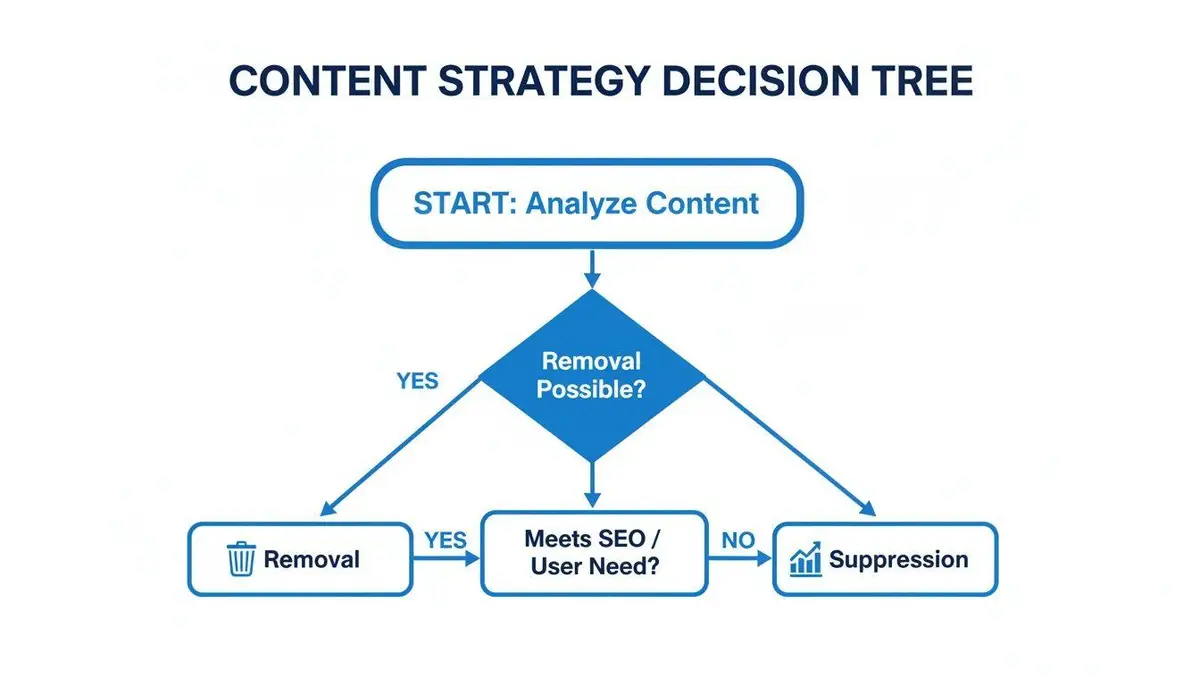
As shown, every effective campaign begins with a dispassionate analysis that determines whether direct removal or suppression is the appropriate course.
Conducting a Reputational Triage
Before initiating any contact, a rigorous triage is necessary. This is a clinical assessment of the reputational threat. It is also imperative to understand what to do after a data breach, as such events are frequent precursors to online reputational crises.
The critical assessment points are:
- Content Classification: Is it a news report, a defamatory blog post, a negative review, or a public record? Each category is governed by distinct legal and practical standards.
- Publisher Jurisdiction: A publisher’s location is a determinative factor. A U.S.-based entity operates under robust First Amendment protections. A European publisher, by contrast, may be subject to GDPR’s “Right to be Forgotten.” The applicable legal framework is theirs, not yours.
- Authorial Intent: Was the publication motivated by malice, a matter of public record, or ignorance of the potential harm? This context dictates whether the initial approach should be a diplomatic request or a formal legal notice.
Only after this analysis can one select the appropriate instruments and tactics to remove online content and begin the process of reputational recovery.
Mastering Direct Webmaster Negotiation

Before engaging counsel or navigating Google’s intricate forms, the most efficient first step is often direct communication with the website’s operator.
A professionally crafted request can secure source removal, sometimes within 48 hours. This is not an emotional appeal but a strategic negotiation that leverages an understanding of the publisher’s operational concerns and potential liabilities.
The process depends entirely on identifying the correct individual. This requires more than using a generic “contact us” form; it involves investigative work to locate a person with the authority to execute a content deletion.
Failure to conduct this preliminary research is a common error that distinguishes an actionable request from one that is summarily ignored.
Locating the Decision Maker
Identifying the right contact is a methodical process, not a matter of chance.
Begin with a WHOIS lookup for the domain. While many owners utilize privacy shields, the registrar or hosting provider is often visible and can serve as an initial lead. Concurrently, examine the website for “About Us,” “Team,” or “Legal” sections, which frequently identify editors, executives, or legal counsel.
For corporate entities, state business registration databases and LinkedIn are invaluable. Cross-reference names and titles to map the organizational structure. The objective is to target the appropriate party, whether it is the editor-in-chief, general counsel, or head of IT.
A generic request is a critical error. Communication must be tailored. A request sent to an independent blogger is framed differently than a formal notice to the legal department of a global media corporation.
Crafting a Compelling Removal Request
With a contact identified, the request must be drafted. The tone should be firm and legally informed, yet devoid of hostility. An aggressive approach invites a defensive reaction, precluding a swift and discreet resolution.
The message must construct a logical argument for removal. Successful requests are typically predicated on one of three core principles.
- Factual Inaccuracy: Clearly identify the erroneous information. If documentary evidence exists, such as court records confirming dismissal of charges or official documents correcting a false claim, provide it. This enables the publisher to easily verify the error and justify a correction or removal.
- Violation of Terms of Service: Most websites have policies prohibiting harassment, hate speech, or the publication of private data. Review these terms and cite them directly. Referencing the publisher’s own rules demonstrates due diligence and frames the content as a pre-existing compliance issue for them to address.
- Potential Legal Exposure: It is possible to signal potential legal liability without making an overt threat. If the content constitutes defamation or copyright infringement, state this professionally. The implicit message is that removal is a far more efficient and cost-effective course of action than defending a formal legal challenge.
Direct negotiation is often the most expedient method for achieving permanent content removal from Google. When executed correctly, this foundational step can conserve significant time and resources.
Playing by Google’s Rules: Using Official Removal Tools

When direct negotiation fails, the strategy pivots. If a publisher is unresponsive, anonymous, or hostile, further attempts at persuasion are futile. The focus shifts to a direct appeal to Google.
This process is not a debate over fairness; it is a meticulous presentation of evidence demonstrating how specific content violates Google’s established policies. Precision and comprehensive documentation are paramount. Understanding the criteria Google’s reviewers use is essential for a successful outcome.
This approach does not delete the content at its source. It de-indexes it from Google’s search results. Given Google’s dominance as a discovery tool, this effectively renders the content invisible to the public, which constitutes a significant victory.
Your Guide to Google’s Removal Forms
Google’s removal ecosystem can be labyrinthine. Each category of harmful content corresponds to a specific form and a distinct set of success criteria. This matrix serves as a quick-reference guide to select the appropriate tool.
Google Removal Request Triage Matrix
This table specifies which Google tool to use based on content type, the necessary burden of proof, and the expected processing time.
| Content Type | Primary Google Tool | Key Requirement for Success | Typical Processing Time |
|---|---|---|---|
| Personal Info (PII) | Results about you tool | Proof of direct harm (doxxing, fraud risk) | 1-3 weeks |
| Defamation (Libel/Slander) | Third-Party Legal Form | A valid court order | 2-4 weeks (after order) |
| Copyright Infringement | DMCA Dashboard | Proof of original ownership | 24-72 hours |
| Non-Consensual Explicit Imagery (NCII) | NCII Removal Form | Proof of lack of consent | 24-48 hours (high priority) |
| Impersonation | Impersonation Form | Proof of identity | 1-2 weeks |
Submitting to the incorrect form is a frequent error that results in automatic rejection. To avoid delays, always begin with the tool that most precisely aligns with the situation.
Removing Exposed Personal Information
For public figures and high-profile individuals, the exposure of personal information is not a mere inconvenience. It is a direct threat. Google maintains specific policies to address this, permitting requests for the removal of search results that disseminate personally identifiable information (PII) without consent.
This policy applies to content that creates a tangible risk of identity theft, financial fraud, or physical harm. A successful request must demonstrate that the information falls within one of Google’s protected categories:
- Confidential identification numbers, such as a Social Security number.
- Bank account or credit card numbers.
- Images of handwritten signatures or identity documents.
- Confidential, private medical records.
- Personal contact information (doxxing), including home address, private phone number, or email.
The initial step is to utilize Google’s ‘Results about you’ tool. The submission must be exact. Identify the specific URLs and articulate precisely which policy has been violated. A vague claim of privacy invasion will be rejected.
How the ‘Results About You’ Tool Works
Google has progressively refined its policies, expanding the definition of removable PII. The ‘Results about you’ tool now serves as a centralized dashboard for submitting and tracking these sensitive requests, providing a necessary layer of transparency.
Policy updates, such as those announced for Safer Internet Day in February 2026, have enhanced these tools. It is now possible to request the removal of search results containing images of driver’s licenses, passports, and other sensitive documents. For non-consensual explicit images, a batch processing feature has been introduced, streamlining the reporting of multiple instances. Further details are available in Google’s privacy policy updates.
A submission does not guarantee removal. Google consistently balances individual privacy against the public’s right to information. If an address is cited in a public court record reported by a news organization, Google will almost certainly decline the removal request.
Tackling Copyright and Explicit Content
Beyond personal data, Google provides robust removal mechanisms for two other critical categories: copyright violations and non-consensual explicit imagery (NCII).
For copyright infringement, the Digital Millennium Copyright Act (DMCA) takedown notice is the primary legal instrument. If original work (photographs, articles, or proprietary code) has been published without authorization, a DMCA notice compels Google to de-index the infringing URL. This process is highly effective but demands accuracy; filing a fraudulent DMCA claim carries legal penalties.
For NCII, colloquially known as “revenge porn,” Google maintains a zero-tolerance policy. An expedited removal process exists for explicit images or videos published without the subject’s consent. These requests receive priority due to the severe and immediate nature of the harm. A successful NCII request requires clear proof that the content is explicit and that consent for its distribution was never granted. Google acts swiftly on well-documented claims.
Taking Legal Action to Force a Removal
When direct negotiation and platform policies fail to yield a resolution, legal action becomes the necessary escalation. This is not a preliminary step but the deployment of significant resources when all other avenues have been exhausted.
The objective is not to issue empty threats but to construct an irrefutable legal case that compels compliance from publishers and search engines. The ultimate goal is a court order, a legally binding instrument that declares the content unlawful.
Winning a Court Order for Defamation
A defamation lawsuit is the most direct legal pathway to compel de-indexing. By proving in court that a statement is false, has caused demonstrable harm, and was published with negligence or malice, a judge can issue an order for its removal. Submission of this order to Google’s legal department almost invariably results in the removal of the specified URLs from search results.
The evidentiary standard for proving defamation is exceptionally high. This is particularly true for public figures, who must often prove “actual malice”: that the publisher knew the information was false or acted with reckless disregard for the truth.
The legal process generally involves these stages:
- Case Assessment: Counsel analyzes the content to confirm it is a provably false statement of fact, not protected opinion or an inconvenient truth.
- Filing Suit: This action formally initiates litigation against the publisher.
- Litigation & Discovery: This protracted phase involves evidence gathering, depositions, and building the legal argument.
- Securing a Judgment: The final step is obtaining the court order that explicitly identifies the content as defamatory and mandates its removal.
A court order is a legal command, not a request. When presented with a valid order, Google’s obligation shifts from a policy review to a legal requirement to comply. This is what gives the instrument its power.
This is a meticulous, costly, and often lengthy process, complicated by anonymous publishers or foreign jurisdictions. However, for verifiably false and damaging attacks, a lawsuit is often the only definitive remedy. For procedural details, you can learn more about how to submit a Google legal request and the required documentation.
Using Copyright Law to Your Advantage
Defamation is not the sole legal recourse. The Digital Millennium Copyright Act (DMCA) can serve as a potent and often faster alternative. While typically associated with intellectual property like music or photographs, the DMCA has strategic applications in reputation management.
If the offending webpage contains intellectual property owned by you or your entity (such as a company logo, a commissioned professional headshot, or text copied from your website) a DMCA takedown notice can be filed.
This legal notice creates liability for copyright infringement on the part of hosting companies and search engines. To mitigate their own legal risk, they frequently remove the content swiftly. When a host removes a page due to a DMCA notice, Google consequently de-indexes the URL.
The key is to identify a legitimate copyright violation. For instance, a defamatory website might illegally use a CEO’s official corporate photograph. That image becomes the legal basis for demanding the removal of the entire page, even if the accompanying text does not meet the legal standard for defamation.
Overcoming Jurisdiction and Enforcement Hurdles
Legal action is inherently complex, and international cases introduce significant challenges. A publisher in a foreign jurisdiction does not operate under U.S. law. Enforcing a U.S. court order against a foreign entity can be an arduous undertaking.
This is where specialized expertise in global internet law is non-negotiable. A successful strategy depends on selecting the appropriate legal venue and approach to secure an enforceable order that Google will recognize and act upon. While legal action is a final resort, it is a necessary investment when the reputational damage is severe.
Fighting Back With Search Engine Suppression

In some cases, source removal is not an option. A historical news article or a public court record, for example, is often protected and permanent. When faced with an immovable object, the objective must change from removal to rendering the content irrelevant.
This is the function of search engine suppression. It is a proactive strategy to bury negative search results by outranking them with positive, authoritative content that you control.
The strategy is direct: populate the first page of Google search results with favorable assets, pushing negative content to the second page and beyond. Given that the second page of Google captures less than 10% of all clicks, any demoted link becomes effectively invisible. This is not about deception; it is about constructing a powerful and authentic online presence that accurately reflects your current reality.
Building Your Digital Fortress
An effective suppression campaign requires more than a single website or social media profile. It necessitates the creation and management of a diverse portfolio of digital properties that Google’s algorithm recognizes as credible and relevant to your name.
This portfolio is your first line of reputational defense. It is a network of platforms where you dictate the narrative. Each digital asset must be meticulously optimized to compete directly with the negative URL for search ranking.
The most effective assets for this purpose typically include:
- A personal or professional website: This serves as the central hub of your online identity, which you own and control.
- Executive biographies: Profiles on corporate websites, non-profit boards, and other professional organizations carry significant authority and rank well.
- Key social media profiles: A well-curated LinkedIn profile is essential. Depending on the industry, an active presence on platforms like X (formerly Twitter) provides crucial ranking signals.
- Positive press and thought leadership: Features in interviews, published articles on reputable third-party sites, and speaking engagements create powerful endorsements that are highly valued by Google.
Creating Content That Ranks
The mere existence of these profiles is insufficient. They must be populated with high-quality, authoritative content. To outrank a negative article, you must produce superior content. This involves understanding how to write SEO-friendly blog posts that showcase expertise and provide genuine value.
Content creation must be followed by strategic promotion. The most critical element of this is link building: securing inbound links from other respected websites to your positive assets. Within Google’s algorithm, these backlinks function as votes of confidence, signaling that your content is trustworthy and deserves a high ranking. This requires a sophisticated understanding of SEO, from keyword research to technical site optimization.
Suppression is not a single action but a sustained campaign. It requires a continuous output of high-value content and proactive SEO to maintain the desired search results. It is an ongoing investment in controlling your public narrative.
Ultimately, search suppression is about reclaiming control of the narrative on the first page of Google. When removal is not feasible, building a dominant, positive online presence is the most powerful strategic move. While the mechanics are detailed in our strategic guide to search visibility, executing a full-scale suppression campaign is a complex, long-term project best managed by specialists.
Common Questions We Get from Our Clients
When your reputation is at stake, you require direct, unambiguous answers. Having managed digital crises for years, I find these questions arise consistently. This is what you need to know.
How Long Does This Actually Take?
There is no universal timeline; any firm that provides one is not being forthright. The duration is entirely dependent on the required strategy.
In an ideal scenario, a cooperative webmaster responds to our outreach, and the content is removed within 24 to 72 hours. This outcome, however, depends on their willingness to comply.
If we are addressing a specific violation of Google’s policies, such as non-consensual explicit imagery or doxxing, the process through their official reporting channels typically takes several days to a few weeks for review and action.
Legal action is the most protracted path. Securing a court order for defamation is measured in months. Conversely, when removal is not possible, a search suppression campaign begins to yield tangible results in approximately three to six months, but it requires ongoing management to maintain its effectiveness.
What About the “Right to Be Forgotten”?
Clients frequently inquire about invoking the “Right to Be Forgotten” in the United States. The short answer is that it does not apply.
This right is a legal principle established under the EU’s GDPR. It is effective within the EU and the UK, allowing individuals to petition search engines to delist links containing outdated or irrelevant information. The U.S. legal framework, however, prioritizes the First Amendment’s protection of free speech.
Consequently, while a successful request in Europe will remove a link from google.co.uk or google.fr, it will remain visible on google.com for users searching from the United States.
For our U.S. clients, the “Right to Be Forgotten” is not a viable strategy. Our approach must be grounded in U.S. law and policy: direct publisher negotiation, specific Google policy violations such as copyright or impersonation, or U.S.-based litigation.
Can We Get an Article Taken Down from a Big News Site?
Compelling a major news organization to retract a story is nearly impossible. Institutions like The New York Times or The Wall Street Journal have reputations founded on archival integrity. They are protected by journalistic shield laws and will not delete a factually accurate story, regardless of its negative impact.
They will only entertain a correction or removal if presented with irrefutable proof of a significant factual error or a severe breach of journalistic ethics. This is an exceedingly high standard to meet.
Therefore, the strategy must pivot. If the source is immutable, the objective shifts from removal to suppression. We execute an aggressive search engine suppression campaign designed to displace the negative article from the first page of Google’s results. This is achieved by creating and promoting a network of positive, high-authority content that outranks the offending piece.
What’s the Difference: De-Indexing vs. Source Removal?
Understanding the distinction between these two outcomes is critical.
- Source Removal: This is the ideal resolution. The content is permanently deleted from the host website. The URL becomes inactive, the page is expunged, and it is no longer accessible. This is always our primary objective.
- De-indexing: This is our secondary objective. The webpage remains live on the original website, but we have successfully petitioned Google to remove it from its search index. While the content is no longer discoverable via search, it can still be accessed and shared via a direct link.
We always pursue full source removal first, as it offers a permanent and complete solution. De-indexing and suppression are powerful secondary strategies deployed when the source content cannot be altered.
Navigating the complexities of online content removal requires a steady, experienced hand. At ContentRemoval.com, we specialize in taking decisive, discreet action for individuals and companies who can’t afford to let a digital crisis dictate their future. If you’re facing one now, reach out for a confidential assessment.
Frequently asked questions
Which Google form do I use to remove personal information from search results?
Use Google’s Results about you tool. It covers Social Security and other ID numbers, bank and card numbers, images of signatures and identity documents, private medical records and personal contact details published without consent. Name the specific URLs and the exact policy breached, because a vague privacy complaint is rejected.
Does Google remove defamatory content without a court order?
Almost never. Google does not judge whether a statement is true, so a defamation claim needs a court order declaring the content unlawful, which is then submitted through Google’s legal form. Public figures face the higher actual malice standard, which makes these cases lengthy and expensive.
What is the difference between de-indexing and source removal?
Source removal deletes the page from the host website so the URL no longer works, which is the permanent outcome. De-indexing leaves the page live but removes it from Google’s results, so it is invisible to searchers but still reachable by direct link. Source removal is pursued first, with de-indexing and suppression as fallbacks.