
Removing Google search results is one choice: de-indexing, which hides the result in search, or source removal, which changes the underlying page. If you control the page, delete it or add noindex and use the Removals tool as a bridge. If not, use Google’s Results about you workflow, a DMCA notice or a legal request, and approach the publisher.
Key facts
- Google’s own guidance says permanent removal requires changing or deleting the page, a noindex directive or a legal request.
- The Search Console Removals tool hides an owned URL temporarily, typically for about six months.
- Results about you handles personal contact details and lets users request a refresh after a page changes.
- A sloppy request to a hostile publisher can trigger copycat reposts or a higher removal demand.
Where ContentRemoval.com comes in. ContentRemoval.com runs search result removal as a coordinated campaign for executives, investors and family offices, deciding for each URL whether the route is de-indexing, source removal, platform enforcement or legal escalation, and tracking mirrors and reposts alongside. Contact usually comes from the individual, their general counsel or their chief of staff ahead of a financing, board appointment or transaction. A free, confidential 15-minute Exposure Scan maps what is removable and by which route, and the report is yours to keep. Get a Free, Confidential Exposure Scan or read how our search result removal work is done.
A damaging Google result rarely arrives at a convenient moment. It appears before a financing round, during litigation, ahead of a board appointment, or when your family office starts due diligence on a new relationship. You search your name or company, see the result, and your first instinct is simple: get it off Google.
That instinct is understandable. It’s also where smart people waste time.
If you want to know how to remove Google search results, you need to stop thinking like a consumer clicking a help article and start thinking like an operator running a containment and removal campaign. The central question isn’t whether a result is bad. The central question is what kind of removal is available, what will stick, and what will trigger a worse outcome if handled clumsily.
De-Indexing vs Source Removal The Core Strategic Decision
It’s common to confuse two separate objectives. De-indexing removes visibility in Google Search. Source removal removes or changes the underlying content where it lives. Those are not interchangeable outcomes.
Google’s own documentation makes the strategic reality plain. Some tools only hide pages temporarily. Permanent removal generally requires changing or deleting the underlying page, using a noindex directive, or submitting a legal request. If the source page remains live, the result can return after recrawl, which is why source removal is the durable play. Google says that directly in its guidance on removing content from Google.
What de-indexing actually buys you
De-indexing is speed. It can reduce immediate visibility, calm a short-term crisis, and create breathing room while a permanent remedy is executed elsewhere.
It is not eradication.
If a third-party publisher keeps the page live, Google may surface it again later. If another site republishes the same material, your earlier success may have little value. This is why executives who fixate on the search result alone often end up in an endless loop of chasing symptoms.
Practical rule: If the content still exists and remains reachable, assume the problem is paused, not solved.
That distinction matters even more with records, legal matters, and identity-related content. For example, when a client asks whether an old criminal matter can be made less visible, I often redirect the first conversation away from search mechanics and toward the underlying record itself. In some cases, understanding Texas record sealing options is more valuable than any short-term Google request because the source status determines what can be removed later.
What source removal demands
Source removal is harder because it forces you to deal with the actor that controls the content. That may be your internal web team, a platform trust and safety unit, a hostile publisher, or counsel for the site operator. It usually requires a factual basis, a policy basis, or a legal basis.
That’s the battlefield. Everything else is just tool selection.
If you need a tighter breakdown of the distinction, this strategic guide to de-indexing is useful because it frames removal as an operational choice, not a magic button. My advice is blunt: pursue de-indexing when you need immediate suppression, but build every serious strategy around removing or changing the source.
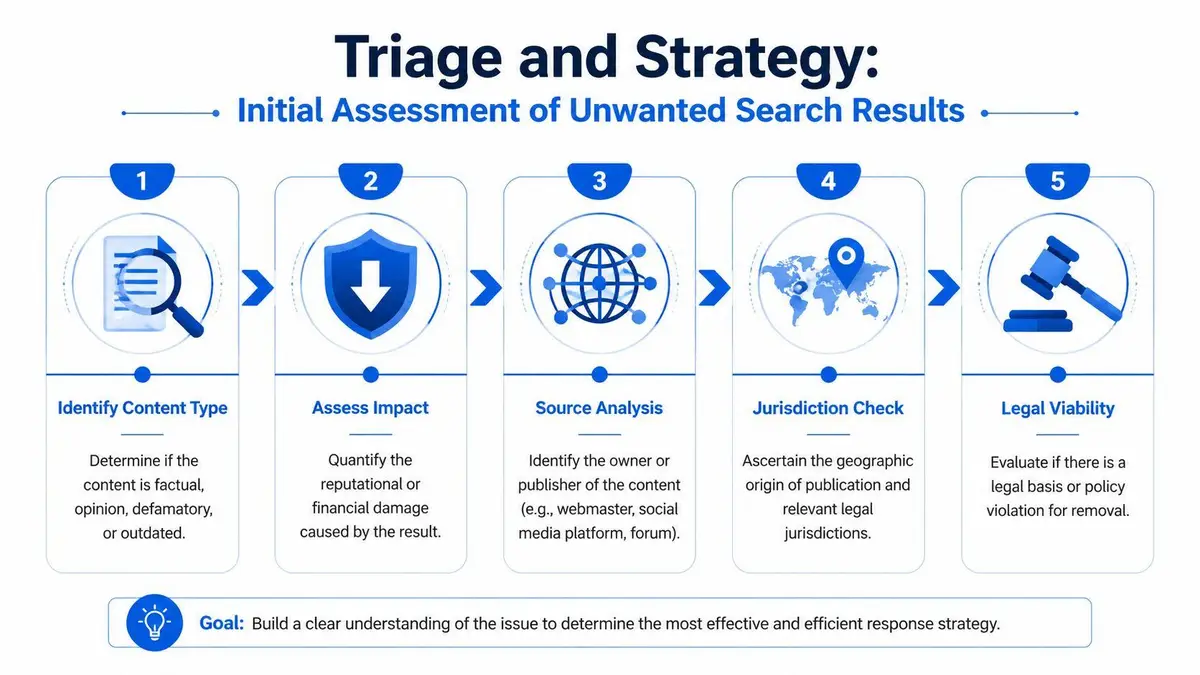
Triage and Strategy Initial Assessment of the Unwanted Result
Before you file anything, diagnose the target. Executives lose advantage when they act first and analyze later. Your first task is to classify the result by control, content type, and removal basis.
The first question is ownership
Ask one question immediately: Do you control the asset where the content is published?
If the answer is yes, your path is technical and administrative. You can alter the page, remove the file, add search directives, and use Google’s own webmaster tools to accelerate visibility changes.
If the answer is no, your path changes completely. You’re now dealing with publisher discretion, platform policy, legal process, or Google’s own removal criteria. Different evidence. Different timing. Different risk.
The second question is what kind of content you’re facing
Not every bad result should be treated as a legal problem. Some are factual but stale. Some are false. Some are opinion. Some expose private information. Some violate platform rules even if they don’t meet the legal standard for defamation.
Use this simple decision frame:
- Factual but damaging: Think old executive disputes, dated articles, prior employment conflicts, or lawful but embarrassing records. These often require source negotiation, legal analysis of the underlying record, or long-term suppression if removal isn’t available.
- False or defamatory: These require documentation, a careful evidentiary file, and usually lawyer-led escalation if you want a durable outcome.
- Private information: Home address, phone number, or similar personal data may fit a Google privacy workflow or platform privacy complaint.
- Policy-violating content: Impersonation, harassment, stolen media, or prohibited disclosures often sit in a platform enforcement lane rather than a court lane.
Don’t ask, “Can I complain?” Ask, “Who has the authority to remove this, and what standard do they apply?”
The third question is whether action will worsen the problem
A sloppy takedown request can alert a hostile publisher, invite copycat reposts, or trigger public escalation. That risk increases when the site profits from controversy or records disputes.
A proper triage review should include:
- Publisher profile: Is this a mainstream publication, a records broker, a forum, a gossip site, or an anonymous operator?
- Jurisdiction: Where is the publisher based, and what law will govern your recourse?
- Replication risk: Has the content already spread to mirrors, aggregators, or social accounts?
- Proof file: Do you have screenshots, URLs, dates, authorship records, and preserved source code where needed?
Discerning clients gain an edge. They don’t rush into forms. They decide whether the problem is technical, legal, reputational, or adversarial, then choose the tool that matches the terrain.
Direct Action on Assets You Control
If the unwanted result sits on a site or property you control, stop overcomplicating it. This is the cleanest scenario you’ll get. Act fast and act correctly.
Delete or change the source first
If the content should disappear entirely, remove the page or file from the website itself. Don’t just pull it from navigation or archive views while leaving the URL live. The objective is to make the content unavailable at the source.
If the page must remain online for operational reasons, then change what’s on the page and decide whether search engines should continue indexing it. At this stage, many in-house teams make a basic mistake. They hide a page from users but leave it indexable, or they block crawling in a way that interferes with proper search removal. The result is a lingering or stale listing.
A strong internal process usually involves legal, communications, and the web team reviewing the same URL list so nobody removes one layer while leaving another untouched.
Use noindex when the page must stay live
Sometimes you need the page for users, auditors, customers, or internal links, but you don’t want it in search. In that case, use a noindex directive. That tells search engines not to keep the page in results once they process the instruction.
Use this with discipline. Don’t apply it blindly to material that still has business value in search, and don’t assume implementation alone solves the immediate optics problem. Search removal may take time, which is why operators pair source changes with a faster interim measure.
Use Google Search Console as a bridge
For controlled assets, Google Search Console’s Removals tool is the fastest way to reduce exposure while permanent fixes are being completed. Google describes it as a quick and temporary hide, and FIU notes that removals typically last about six months in its guide to removing webpages from Google Search.
That six-month window matters. It gives you operational cover while you delete the page, replace it, or add noindex properly.
Here’s the right order:
- First, fix the source: Delete the page, revise the content, or apply noindex based on the actual objective.
- Then, submit the temporary hide: Use Search Console so the result drops faster while Google catches up with the permanent source change.
- Finally, verify the outcome: Search for the exact URL and the brand-query variants that originally exposed it.
Temporary hiding is a tactical screen. The source fix is the actual mission.
Treat internal removals as governance, not just SEO
For executives, unwanted results on owned assets often expose a deeper governance problem. A forgotten press release, an outdated staff page, a leaked PDF in a file directory, or an old microsite usually means nobody controls publication lifecycle across departments.
That’s why I tell clients to pair removal with internal policy. The same discipline used in ensuring data compliance for businesses applies here. If your organization doesn’t know what it has published, where files live, and who can unpublish them, you’ll keep rediscovering the same risk under a different URL.
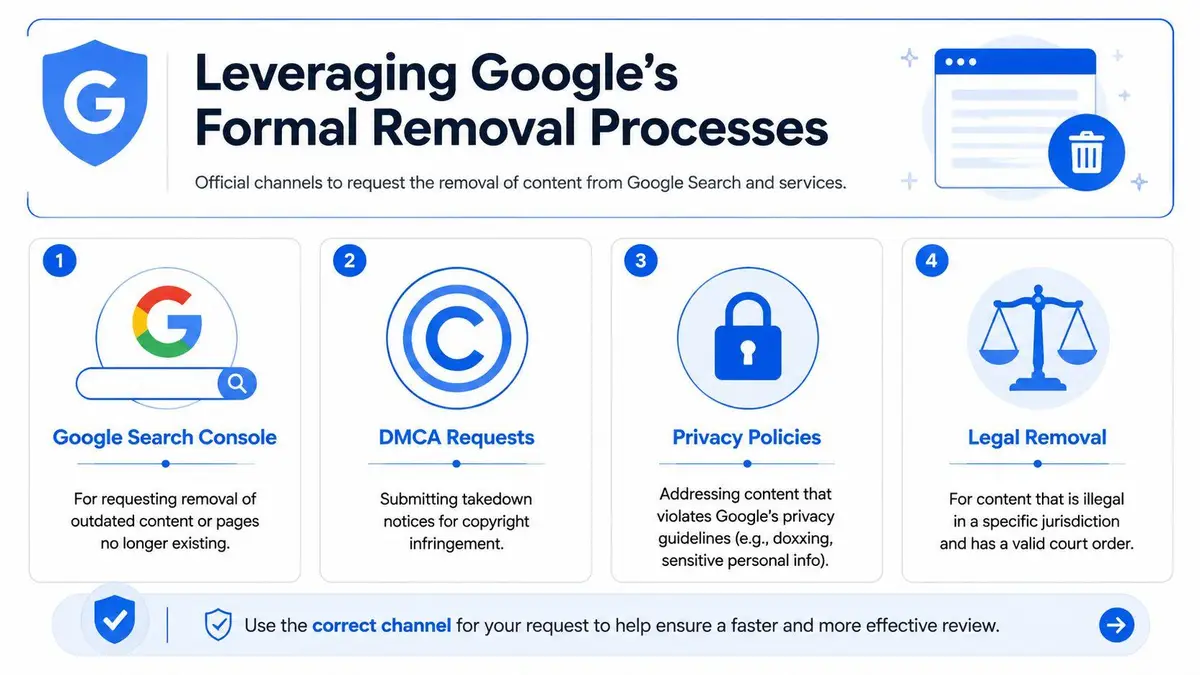
Leveraging Google’s Formal Removal Processes
When the content sits on a third-party site, your recourse may begin with Google rather than the publisher. Not because Google can erase the internet, but because it has formal workflows for certain categories of search-result removal. Used correctly, these are structured processes with defined entry points and trackable outcomes.
Results About You for personal information
Google has formalized Results about you as a user-facing workflow for requesting removal of search results that display personal information such as a phone number or address. Google’s help materials say you can start the process from the dedicated page or directly from a search result’s three-dot menu, and request statuses can be tracked through your Google Account as in progress, approved, denied, or undone. The same documentation also notes that users receive email notifications tied to their account, which makes this a structured removal process rather than an informal complaint route, as described in Google’s Results about you help page.
That matters for high-net-worth clients because personal exposure often isn’t limited to one result. It can involve people-search sites, cached snippets, copied contact data, or surfaced address information tied to a family residence.
Here’s the practical threshold. If the result reveals personal contact data, use this workflow immediately. Don’t wait for a broader strategy memo.
Google also redesigned this workflow to make it more operationally useful. In its product announcement, Google said the updated version can scan for results containing information like a phone number or address, lets users submit requests in fewer clicks from the three-dot menu, and allows refresh requests when a page has already been changed or removed so Search can recrawl and update the result, as outlined in Google’s post on the new design for Results about you.
A concise walkthrough can help if you’re escalating beyond self-service. This guide on how to submit a Google legal request is useful when the issue moves from privacy workflow into a formal legal channel.
Use the right lane for the right problem
Google’s formal processes work best when the content clearly fits a policy category. They work badly when users try to force a reputational complaint into a privacy form.
Use this decision table:
| Content in search result | Best initial lane | What you need |
|---|---|---|
| Personal contact details | Results About You | The exact search result and the exposed information |
| Stale result after page changes | Refresh or update request | Evidence the page was changed or removed |
| Illegal content subject to legal process | Legal removal request | The relevant legal documents or basis |
| Copyright issue | DMCA path | Proof of ownership and infringement details |
Here’s the video version if you want to understand how Google frames these channels operationally.
What these workflows can’t do
They won’t rescue weak facts. They won’t remove an accurate article just because it’s inconvenient. They won’t substitute for publisher action when the source remains lawful and live.
That’s why executives should treat Google’s formal tools as policy instruments, not reputation therapy. They’re excellent when the facts fit. They’re useless when they don’t.
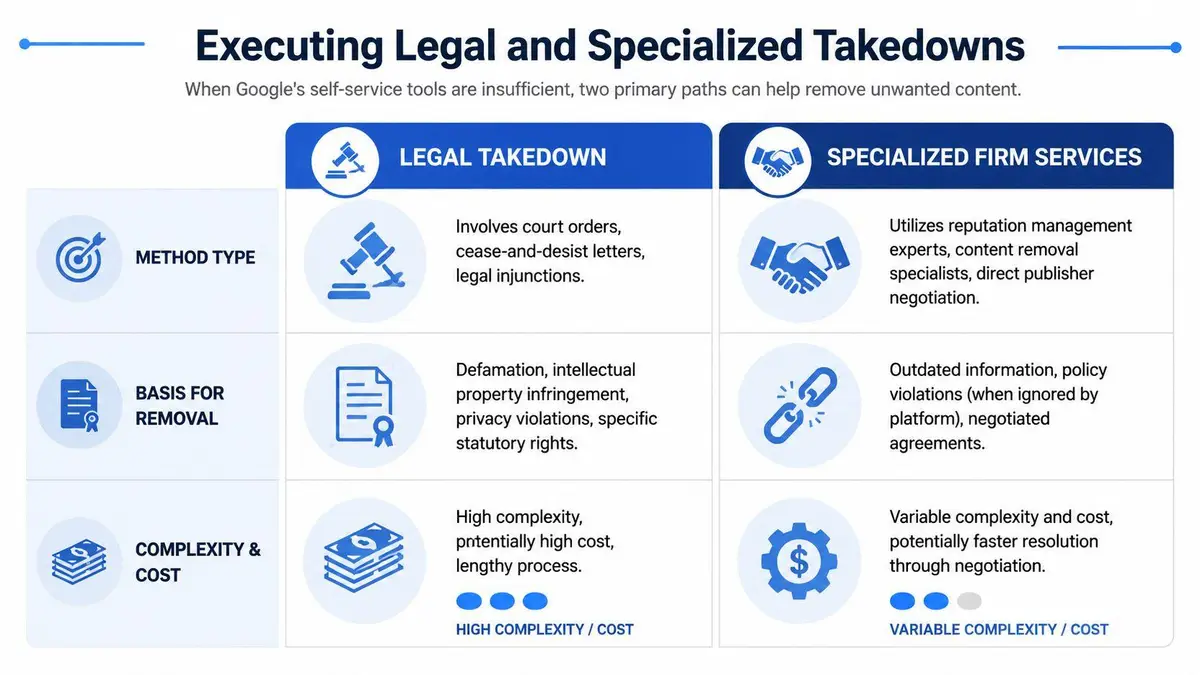
Executing Legal and Specialized Takedowns
When self-service requests fail, the posture changes. You stop asking for courtesy and start asserting rights. That means legal precision, preserved evidence, and a strategy built for enforcement rather than persuasion.
DMCA for copied protected material
The DMCA takedown is one of the most effective removal tools when the target content uses your copyrighted text, photos, videos, reports, or other original material without permission. It works because the issue isn’t reputation. It’s unauthorized use.
This route rewards specificity. You need to identify the protected work, the infringing material, and the relevant URLs with accuracy. Vague outrage gets ignored. Detailed comparison gets action.
If your issue involves copied executive bios, leaked investor materials, proprietary images, or reposted authored content, this is often the first serious legal lever to pull. For process detail, see this guide on how to write and file a DMCA takedown notice.
Defamation needs proof, not emotion
Defamation is where clients often overestimate their position. Being harmed isn’t enough. Being angry isn’t enough. You need a defensible showing that the content is false, harmful, and actionable under the governing law.
That usually means outside counsel, preserved records, and in many matters, a court order before search de-indexing becomes realistic. If the statement is opinion, substantially true, or embedded in protected reporting, your probability changes immediately.
This is why I advise against improvised direct contact with the publisher in a defamation case. A bad first letter can educate the other side, harden their position, and destroy quiet resolution options.
Build the evidentiary file before you build the argument.
Specialized removals sit between law and negotiation
Not every case fits a clean statute. Some involve mugshot sites, abusive forums, impersonation pages, old records, or coordinated reposting. Those often require a mixed approach that combines policy arguments, technical tracing, publisher outreach, and legal escalation in reserve.
That’s where firms operating in this space become relevant. Some matters are solved less by filing forms and more by sequencing pressure correctly. A records broker may respond to one kind of notice. A forum moderator may react only after a hosting issue is raised. A search problem may require identifying all indexed duplicates before any request is sent.
Search data matters here, too. If you’re tracking persistence, duplication, and visibility shifts during an active takedown campaign, tools that help teams understand GSC data for AI search can be useful operationally, especially when you need to confirm whether the issue is shrinking, resurfacing, or mutating into new query patterns.
Why and When to Engage a Professional Removal Firm
DIY removal has a narrow success band. It works when the content fits a clean policy, the publisher is cooperative, or you control the source. Outside those lanes, amateurs usually create delay, noise, or retaliation.

The point where self-help stops working
If the publisher is hostile, anonymous, offshore, extortionate, or strategically provocative, your personal outreach often makes things worse. It confirms that the content hit its target. It may trigger more posts, mirrored copies, or a higher asking price for removal.
Professional intervention becomes necessary when any of these conditions are present:
- The issue is spreading: One URL has become multiple URLs, reposts, snippets, or derivative discussions.
- The target is sensitive: Family addresses, executive personal data, leaked media, accusations tied to active disputes, or content touching minors.
- Jurisdictions are messy: The server, publisher, claimant, and search platform all sit in different legal environments.
- The matter requires discretion: You can’t have internal staff, PR agencies, or junior counsel experimenting in public.
Why specialist handling changes the outcome
A removal firm isn’t just filling out forms faster. The value is in diagnosis, sequencing, and containment. Good operators know when to go to the publisher first, when to use Google first, when to preserve silence, and when to escalate through legal channels without creating a public fight.
In practical terms, that means coordinating evidence capture, policy analysis, rights assertions, and search monitoring as one operation. It also means dealing with secondary effects. Reuploads, copies, snippets, cached remnants, and search query associations can keep a crisis alive after the original page is addressed.
For clients facing severe exposure, one option in that category is ContentRemoval.com, which handles de-indexing and source-removal workflows across search engines, websites, and social platforms. The relevant point isn’t branding. It’s that some problems require a team built for removal itself, not a PR team trying to outpublish the damage.
You hire specialists when failure has a cost. Search removal is no different.
The clients who should skip the trial-and-error phase
If you’re a public executive, founder, investor, family office principal, or counsel handling a reputational emergency, don’t spend the first week testing generic advice. That week is when screenshots spread, records get copied, and search associations harden.
The right time to bring in a specialist is early when speed, privacy, and durability matter. Especially if the issue involves false allegations, personal exposure, leaks, dark-web references, extortionate webmasters, or a board-level event on the horizon.
The market is full of people selling optimism. Serious clients need something else. A removal strategy that distinguishes between what can be hidden, what can be erased, what can be compelled, and what must be managed behind the scenes until the permanent fix lands.
If an unwanted result is affecting your name, company, or family, ContentRemoval.com can assess whether the right path is de-indexing, source removal, platform enforcement, or legal escalation. The useful first step is a confidential review of the exact URLs, the publisher profile, and the available grounds for removal so you know what can be done quickly, what will hold, and what requires a more forceful campaign.
Frequently asked questions
Can Google remove a search result if the website will not?
In defined categories, yes. Google’s formal processes cover personal contact details through Results about you, copied material through a DMCA notice, and content subject to legal process through a legal removal request. They will not remove an accurate article that is merely inconvenient, and the page stays live at the source.
How do I remove a page from Google if it is on my own website?
Fix the source first: delete the page, revise it, or add a noindex directive if it must stay live. Then submit a temporary hide through Search Console’s Removals tool so the result drops faster, and verify by searching the exact URL and the brand queries that exposed it.
Should I contact the website owner myself to get a result removed?
Only after triage. A direct approach to a hostile, anonymous or extortionate publisher can confirm the content hit its target, invite mirrored copies, or raise the price of removal. Preserve evidence, assess the publisher, jurisdiction and replication risk, and route defamation matters through counsel rather than an improvised letter.