
You cannot remove a Google review from your business just because it is negative. Google removes reviews that violate its policies: spam and fake content, off-topic material, harassment, fabricated engagement, impersonation or conflict of interest. Flag it under the closest category, escalate to Google Business Support with evidence, and use the Reviews Management Tool to appeal a denial.
Key facts
- Report from the Business Profile via the three-dot menu, or from Search and Maps, choosing the closest policy violation.
- The Reviews Management Tool allows appeals for up to 10 reviews at a time.
- Newer reviews are easier to action than stale ones, and misclassifying the violation is a common failure.
- A strong report cites no matching customer record and a service you do not offer, not unfairness.
Where ContentRemoval.com comes in. ContentRemoval.com handles the reviews that survive a flag and an appeal, particularly polished fakes, coordinated attacks and reviews that name a physician, lawyer or executive personally, running evidence-led escalation and legal requests as one process. Practice managers, owners and in-house counsel usually make contact once Google Business Support replies have gone generic. A free, confidential 15-minute Exposure Scan maps which reviews are removable and by which route, and the report is yours to keep. Get a Free, Confidential Exposure Scan or read how our review removal work is done.
A damaging Google review usually lands at the worst possible moment. A prospect is doing diligence. A board member is searching the company. A journalist is checking background. Or a competitor has decided to get aggressive. You open your Business Profile, see the review, and the immediate question is simple: how to remove google reviews from my business.
The first answer is blunt. You can’t remove a review just because it’s negative.
The second answer matters more. You can remove some reviews, but only if you approach the problem the way Google does, with policy categories, evidence, escalation discipline, and, in serious cases, legal pressure. Most business owners fail because they argue fairness. Google reviews don’t come down because they’re unfair. They come down because they violate rules, or because a stronger legal mechanism forces action.
Understanding Google’s Removal Thresholds
Google doesn’t let businesses directly delete legitimate negative reviews. Removal is generally limited to content that violates policy, including hate speech, targeted attacks on individuals, profanity, spam, off-topic content, or misleading and fake engagement, as outlined in this guide to Google review removal workflows.
That distinction controls everything. If the review describes a real customer experience, even harshly, your odds of removal are low. If the review is fake, retaliatory, impersonating someone else, or aimed at a staff member rather than the business experience, you may have a removal path.
What Google will usually consider
Start by sorting the review into one of two buckets.
| Review type | Practical outcome |
|---|---|
| Legitimate negative feedback | Usually stays live |
| Policy-violating content | Can be flagged and potentially removed |
The removable bucket usually includes these categories:
- Spam and fake content. Generic attacks, promotional junk, bot-like language, copied phrasing across multiple listings, or reviews from accounts that don’t look authentic.
- Off-topic content. The reviewer is talking about politics, a different business, a separate location, or an issue unrelated to an actual customer experience.
- Harassment and hate speech. Direct abuse, slurs, targeted attacks, or threats aimed at owners, employees, or protected groups.
- Misleading or fabricated engagement. The reviewer appears never to have interacted with the business at all.
- Impersonation or conflict issues. The account pretends to be someone else, or the review appears tied to a competitor, employee, or another conflicted party.
What usually fails
Most removal attempts collapse because the business describes the review as false, damaging, or unfair without tying it to a specific policy category.
Practical rule: Don’t ask Google to judge whether the reviewer was mean. Ask Google to judge whether the content violates a listed rule.
That sounds small. It isn’t. It changes the entire framing of the case. “This review hurts us” is a weak complaint. “This review is off-topic because it describes services we do not offer and names a transaction that never occurred” is the beginning of a usable argument.
The edge cases that require discipline
Some reviews sit in the gray area. They may be fake, but not obviously fake. They may be retaliatory, but written in careful language. They may attack a physician, partner, or executive personally rather than the business. Those are harder, not hopeless.
Your job is to assess the review the way an adjudicator would. Strip out emotion. Identify the strongest policy hook. Then build the file around that hook.
If you want a more detailed breakdown of the categories and their practical meaning, review Google’s removal policy explained for reputation cases.
Executing the Initial Removal Request
The first report is not a casual click. It is the first formal record in a dispute process.
Handle it that way.
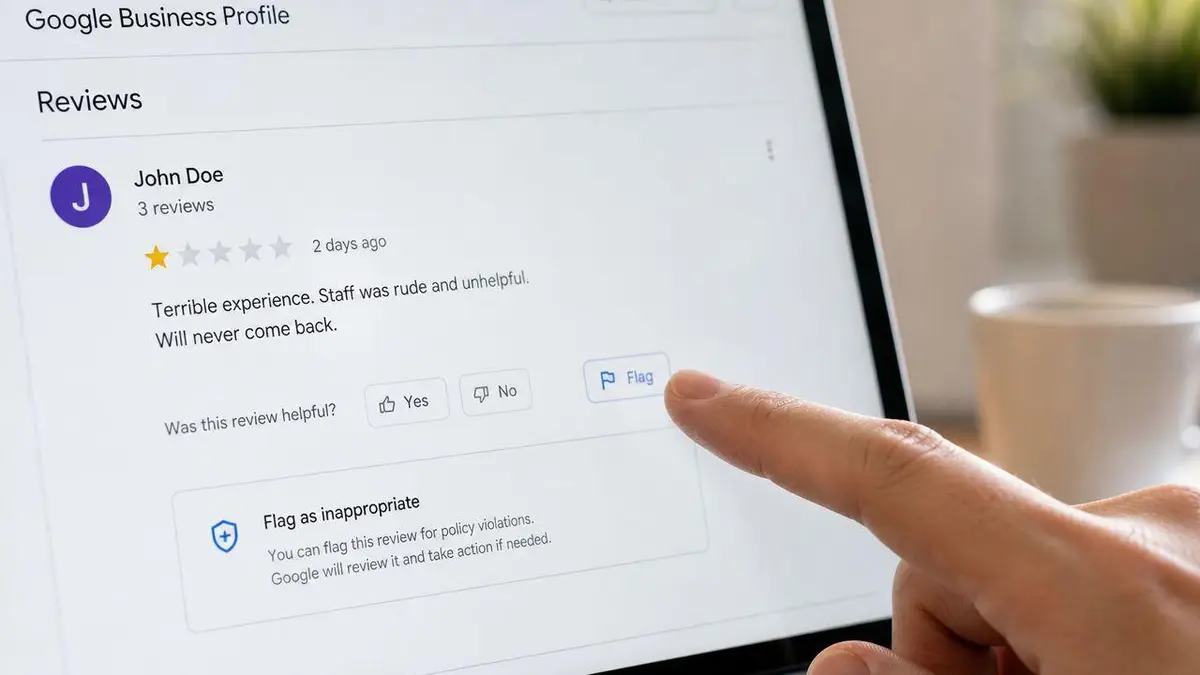
For a business-owned takedown, the operational workflow is straightforward: log into the Google Business Profile, open the specific review, click the three-dot menu, choose Report review or Flag as inappropriate, and select the closest policy violation. If that doesn’t work, the next escalation step is Google Business Support with evidence such as screenshots, timestamps, customer records, or proof the reviewer never interacted with the business, as described in this operational removal guide.
Use the correct reporting surface
Google gives you more than one path, and each one matters.
In Google Search, you can open the Business Profile, click See reviews, select the review, hit the exclamation mark, choose the violation reason, and submit. In Google Maps, you can use the three-dot menu on the review and report it there. Google also provides a review-management tool for formal requests and status tracking.
The mechanics are simple. The decision quality comes from the violation category you choose.
Pick the category that best fits the evidence
Don’t overstate. Don’t stack every accusation into one report. A tight classification works better than an emotional one.
Use this approach:
- If the reviewer was never a customer, classify around fake content, spam, or misleading engagement.
- If the review names the wrong service or location, classify it as off-topic.
- If the review attacks an individual, use the category closest to harassment, targeted attack, or hate content.
- If the account looks fabricated, look closely at patterns that align with understanding spam accounts, then report based on the most defensible fit.
A weak report says, “This is false and hurting our business.”
A stronger report says, “We have no record of this customer, the review references a service we do not provide, and the account profile shows behavior consistent with spam or fabricated engagement.”
Keep the report concise. Google doesn’t need your frustration. Google needs a clean policy match.
Treat speed as part of strategy
Don’t let a bad review sit while internal teams debate wording. Once you’ve identified a plausible violation, file the report promptly. Delay weakens momentum and complicates later escalation because the review begins to look settled rather than contested.
For clients under active reputational pressure, I usually recommend a same-day first action, even if the larger evidence file is still being built.
If you want to see the user-side process in motion before handing it off internally, this walkthrough is useful:
Assembling a Professional-Grade Evidence Package
When the review isn’t a blatant profanity-laced fake, the flag itself won’t carry the case. The evidence will.
That’s where most online advice falls apart. It tells you to report the review, then stops. In real disputes, especially where the reviewer is careful, the outcome depends on whether you can prove the mismatch between the review and reality.
Practitioner guidance in this review removal process analysis says speed and evidentiary quality materially affect outcomes. Newer reviews are easier to action than stale ones, misclassifying the violation is a common failure point, and removals can take days or weeks, which means follow-up and stronger documentation are standard when the first report fails.
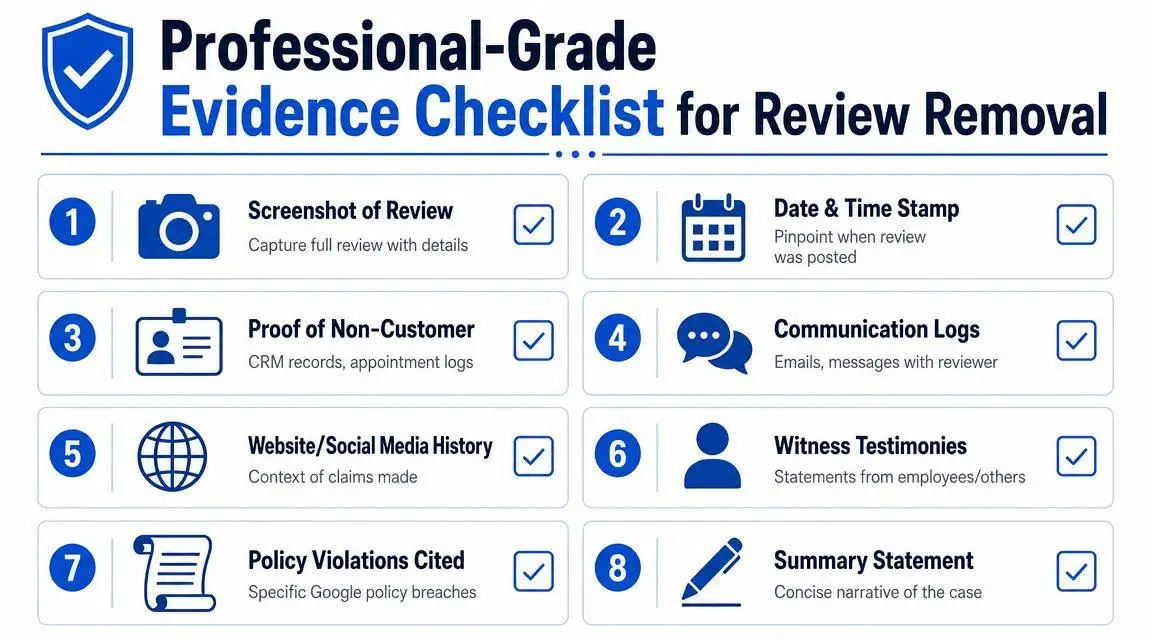
What belongs in the file
A proper evidence package should read like a short case brief, not a complaint email.
Include:
- A full screenshot of the review with the date, star rating, reviewer name, and visible profile details.
- A screenshot of the reviewer profile if it suggests a pattern, alias use, suspicious activity, or irrelevance.
- Your internal records showing no matching customer relationship. That may be CRM data, appointment logs, invoices, reservation records, intake forms, or service history.
- A timeline showing when the review appeared and what internal events may explain it. Former employee dispute, competitor conflict, litigation threat, failed vendor relationship, media event.
- A policy citation sheet that identifies the exact Google category you’re relying on.
- A short summary statement explaining why the review violates policy, in plain factual language.
What makes evidence persuasive
Google support is far more likely to engage with concrete contradictions than with generalized denials.
Compare the two:
| Weak submission | Strong submission |
|---|---|
| “This reviewer is lying.” | “We searched booking, CRM, billing, and support records and found no customer interaction matching the reviewer name, dates, or allegations.” |
| “This review is fake.” | “The review references a treatment, product, or location we do not offer, making it off-topic and non-authentic.” |
| “Please remove this immediately.” | “We request review under the cited policy category and attach supporting records showing lack of customer relationship.” |
Evidence wins because it narrows discretion. The less interpretation Google has to do, the better your odds.
Use a civil-litigation mindset
You’re not litigating inside Google, but the discipline is similar. You need a factual theory, supporting records, and a coherent burden of proof approach. For readers dealing with a parallel legal strategy, this short explanation of proving a civil case in Ontario is a useful reference point for how evidence, not outrage, carries a claim.
That mindset also helps you avoid one of the biggest strategic mistakes: trying to prove everything. You don’t need to prove the reviewer’s entire motive. You need to prove enough to support the specific policy violation you’ve selected.
Preserve everything before the review changes
Screenshots aren’t optional. Reviews get edited. Accounts disappear. Google may remove adjacent content in batches. If you think there’s any chance the matter escalates into a legal dispute, preserve the original version immediately.
I also advise clients to keep public responses short while evidence is being assembled. Don’t reveal your theory in a long reply. Don’t accuse the reviewer publicly unless you’re certain and prepared to defend that statement.
Navigating the Escalation and Appeals Process
If the first flag fails, most businesses stop. That’s a mistake.
Google’s own help documentation confirms that businesses can only flag reviews they believe violate policy, and the Reviews Management Tool allows appeals for up to 10 reviews at a time, which makes the process formal but limited rather than automatic, as explained in Google’s review appeal workflow.
The practical implication is simple. A denied flag is not the end. It is a signal that your first submission didn’t give Google enough, or didn’t frame the issue well enough.
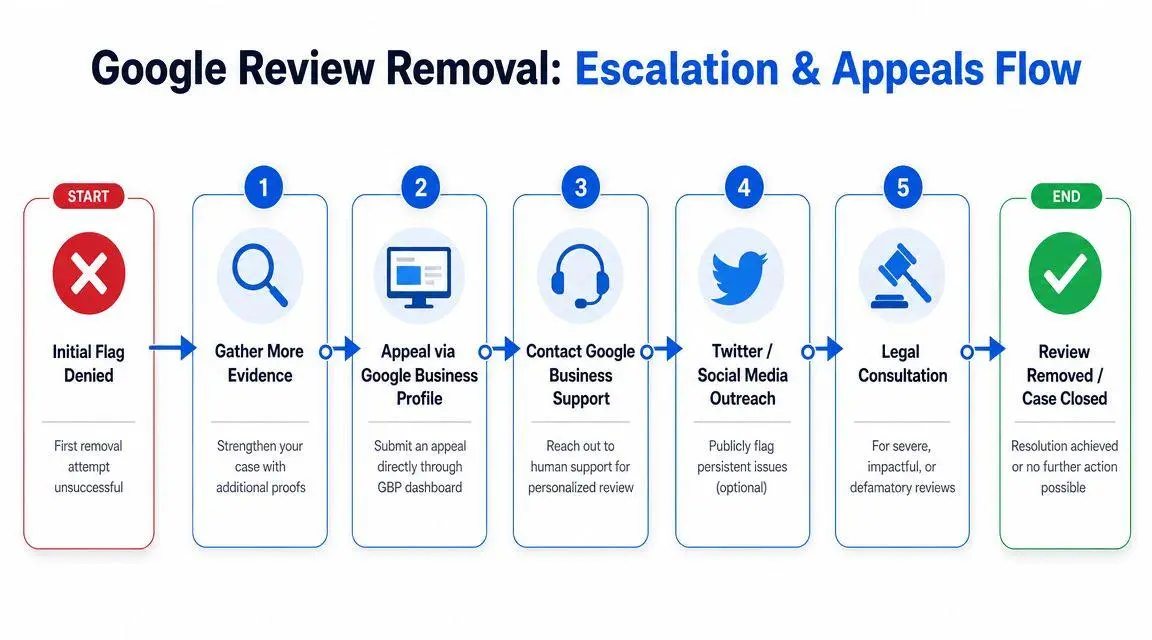
What a proper appeal looks like
A good appeal does not repeat the original complaint with more emotion. It corrects the weaknesses in the first attempt.
That usually means one of three things:
- You chose the wrong policy category and need to reframe around the category best supported by your records.
- You lacked evidence and now have screenshots, timestamps, transaction logs, or proof of non-customer status.
- You failed to explain the mismatch clearly and need a tighter narrative.
A useful appeal packet is short. It identifies the review, cites the policy issue, summarizes the evidence, and attaches only the documents that matter.
Engage support like counsel, not like a frustrated owner
When you contact Google Business Support, write as if a case manager will skim the message in seconds.
Use this order:
- Identify the review precisely.
- State the policy violation in one sentence.
- Summarize the factual proof.
- Reference attached documentation.
- Request review of the prior denial.
Don’t bury the lead. Don’t write a dramatic chronology. Don’t lecture Google about business harm unless that harm ties directly to urgency or impersonation risk.
A support agent can work with facts, dates, and records. They can’t do much with indignation.
Know when the process is stalling
Google removals aren’t instant. If the review survives the first report, waiting through a review period and following up with stronger documentation is normal. But there is a point where the internal process becomes a time sink.
These are the signals that you may need a different path:
- The review is clearly coordinated with others
- The account pattern suggests organized fraud
- The review targets an executive, clinician, or other named individual
- The allegations are factually false in a way that creates legal exposure
- Support responses remain generic after you’ve supplied clear evidence
At that point, you should evaluate whether a formal legal request is more efficient than another routine appeal. A guide on submitting a Google legal request then becomes relevant, because policy-based review moderation and legal notice operate on different tracks.
The overlooked issue in fake review cases
The hardest cases are not the vulgar ones. They’re the polished fake reviews written to look plausible. Those require proof of no customer relationship, pattern recognition, and a disciplined escalation record.
That’s why specialized review removal work often looks less like customer service and more like case management.
When to Deploy Legal and Professional Services
There is a point where Google’s internal reporting process stops being the main tool. High-value businesses need to recognize that line early.
If the review is merely harsh, keep the fight inside Google’s moderation framework. If the review is factually false, reputationally damaging, and identifiable as a statement of fact rather than opinion, legal analysis becomes relevant. Defamation issues don’t disappear because they appear inside a review platform.
The trigger points for legal escalation
Not every bad review justifies counsel. Some absolutely do.
You should move quickly toward legal review when the post does any of the following:
- Accuses the business or its principals of criminal, fraudulent, or unethical conduct without factual basis.
- Names a doctor, lawyer, executive, or employee personally and makes false allegations that can damage professional standing.
- Appears as part of a coordinated attack, especially if multiple reviews or profiles are involved.
- Uses impersonation or identity misuse, including posting as a customer who doesn’t exist or borrowing someone else’s identity.
- Crosses onto other platforms such as maps, social, forums, or press outreach.
In those scenarios, waiting for repeated in-product reports can be strategically weak. You may need preservation steps, platform legal notices, and jurisdiction-specific advice on defamation, injurious falsehood, impersonation, or unlawful interference.
What legal pressure actually changes
Google policy review asks, “Does this violate our rules?”
A legal demand asks a different question. It asks whether the content is unlawful, and whether Google has been put on notice in a form that triggers a different internal process.
That distinction matters. Some content survives ordinary moderation because it doesn’t obviously fit a front-end policy bucket. The same content may become vulnerable once framed as defamation, impersonation, or another recognized legal claim supported by evidence.
When a reputation firm is the better first move
Legal counsel isn’t always the first call. Sometimes the immediate need is operational, not judicial. You need evidence preservation, platform routing, account pattern analysis, escalation drafting, and coordination across support and legal tracks.
That’s where specialized services can be efficient. For example, ContentRemoval.com handles fake review and harmful profile removal matters as one option among legal counsel and internal brand teams, particularly where the issue involves platform takedowns, evidence-led escalation, and parallel monitoring rather than a single cease-and-desist letter.
The business reason to escalate early
Executives often lose time trying to be “reasonable” with a system that is designed for volume. That works for ordinary complaints. It doesn’t work well for targeted, false, or malicious content aimed at a business under scrutiny.
If the review threatens a financing event, regulated license, key hire, acquisition process, or public profile, the right question isn’t whether you can manage it yourself. The right question is whether delay creates more exposure than the cost of fast escalation.
That’s usually the point where professional help stops being optional.
Fortifying Your Reputation Against Future Attacks
Getting one review removed is a tactical fix. A durable reputation strategy does more.
Google is moderating reviews at enormous scale. In 2025 alone, Google deleted 221 million Business Profile reviews, and a later analysis of 335,520 deleted reviews from November 2023 to January 2026 found that 89.1% of removals targeted 5-star ratings. That same dataset reported 34.7% of deleted reviews disappeared within 10 days of posting, and nearly 30% of removal events were batch deletions, according to this analysis of deleted Google review trends. The takeaway is not just that Google removes bad content. It’s that the review environment is unstable, automated, and heavily filtered.
Build a defensible response protocol
Some reviews won’t come down. When that happens, the public reply matters.
Keep it short. Stay professional. Don’t argue facts in public unless you must. If you suspect the reviewer wasn’t a customer, say you can’t locate a matching record and invite direct contact offline. That signals control to future readers without turning the review page into a dispute theater.
Your audience is not the reviewer. Your audience is the next prospect reading the exchange.
Create a review moat
A business with a steady flow of legitimate, recent customer feedback is harder to damage with a single hostile post. That doesn’t mean gaming the system. It means operationalizing review requests after real, successful interactions and making sure location managers or client teams know when and how to ask.
This also protects against another risk in the current environment. Because Google removes large numbers of reviews, including many positive ones, your reputation profile needs consistent maintenance rather than occasional bursts.
Monitor before the issue spreads
Passive review management is too slow for executives, clinics, firms, and premium brands. You need alerts, escalation rules, and someone who can distinguish ordinary criticism from coordinated abuse.
That’s where reputation monitoring services become practical. Early detection gives you the two things that matter most in review disputes: speed and preserved evidence.
If you’re serious about protecting the business, stop treating each review as an isolated annoyance. Build a standing response system. That is how you reduce both removal risk and reputational volatility over time.
If a false, fake, or defamatory Google review is putting revenue, credibility, or a key transaction at risk, ContentRemoval.com can assess the matter confidentially and map the fastest realistic route, whether that means policy-based removal, evidence-led escalation, or a legal request.
Frequently asked questions
Can I delete a negative review on my Google Business Profile?
No. Google does not let businesses delete legitimate negative feedback. A review can only be removed if it breaks a listed policy such as spam, off-topic content, harassment, fake engagement or impersonation, or if a legal mechanism such as a court order forces action.
What should I do if Google denies my request to remove a review?
Treat the denial as a sign the first submission was weak. Reframe around the policy category your records best support, add evidence such as CRM or booking searches showing no customer relationship, and write a short appeal that identifies the review, states the violation in one sentence and references the attached proof.
When should I involve a lawyer over a Google review?
When the review accuses the business or its principals of criminal, fraudulent or unethical conduct without basis, names an individual with false allegations, forms part of a coordinated attack, uses impersonation, or spreads to other platforms. At that point a legal request runs on a different track from policy moderation.