
To dispute a Google review, first decide whether it is a genuine customer opinion, which deserves a calm public reply, or a fake, conflicted or policy-violating post, which should be flagged through Google Business Profile under the single most accurate policy category with a short factual explanation. Google removes reviews for breaking policy, not for being harsh.
Key facts
- Capture full-page screenshots of the review, rating, profile and date before doing anything else.
- Common removal grounds: no customer trace, conflict of interest, spam, personal information, impersonation.
- Businesses often need many attempts, up to 28 per one cited report, before an illegitimate review comes down.
- Defamation, impersonation, copyright and court orders belong in Google’s legal request channels, not review flagging.
Where ContentRemoval.com comes in. When the first flag is rejected and the review is clearly from a former employee, competitor or litigation opponent, the matter turns on how the evidence packet is built and which channel has authority. ContentRemoval.com handles false review takedowns for businesses and executives: classifying the violation, assembling the dossier, selecting the escalation route and pursuing removal confidentially. Owners and counsel usually make contact. A free 15-minute Exposure Scan maps what is removable, and the report is yours to keep. Get a Free, Confidential Exposure Scan or read how our review removal work is done.
A damaging Google review rarely arrives at a convenient time. It shows up before a board meeting, during a fundraise, in the middle of a hiring push, or just as a journalist starts asking questions. You read it once, then again, then start drafting a reply you shouldn’t post.
That first impulse is usually the wrong one.
If you need to dispute google review content effectively, treat the matter as a reputation incident, not a customer service annoyance. Google does remove policy-violating reviews, but it removes them on its terms, through a system that rewards specificity, evidence, and persistence. Casual flagging fails because most businesses submit emotion where Google expects a policy case.
This is the practical playbook I give to high-pressure clients. Not a generic “click report” checklist. A structured way to decide whether to respond, dispute, escalate, or hand the matter to specialists before more damage accumulates.
Your First 24 Hours After a Damaging Review
The first hour matters because your judgment is impaired. Anger makes executives sloppy. Sloppy responses create screenshots, and screenshots live forever.
Start by freezing the situation. Capture the review exactly as it appears, including the reviewer name, date, star rating, profile details, and any photos. Save full-page screenshots on desktop and mobile. If the review changes later, your original record becomes critical.
Google takes review abuse seriously. In 2020, Google removed 55 million reviews for policy violations, a scale that shows both how significant the problem is and how aggressively the platform moderates when a submission fits policy criteria, according to Google review moderation reporting discussed by Opiniion.
Triage the review before you touch it
You have three possible paths, and only one should be chosen at the start.
- Respond publicly if the review appears to come from a real customer with a real grievance.
- Ignore it temporarily if engagement would amplify a vague, low-visibility complaint.
- Prepare for dispute if the review appears fake, malicious, conflicted, or policy-violating.
Most businesses blur these paths together. That creates avoidable mistakes. A public response can undermine a later dispute if you accidentally validate the reviewer’s relationship to your business. Silence can also be damaging if the review alleges serious misconduct and sits unanswered.
Practical rule: Don’t post a reply until you’ve decided whether the reviewer is a genuine customer, a non-customer, or someone with a conflict of interest.
Make a threat assessment, not a feelings assessment
Ask a narrow set of questions:
- Is the reviewer identifiable: Can you match the name, incident, or timing to any real transaction, booking, inquiry, employee history, or legal dispute?
- Does the text allege facts or express opinion: “I hated the service” is different from accusing you of conduct that can be disproved.
- Is there a wider pattern: Did this appear alongside similar low-star reviews, social media agitation, or a public dispute involving your company?
A review with profanity, impersonation, personal information, promotional links, or obvious competitor language should move quickly toward dispute preparation. A review that is merely harsh but plausible usually belongs in the response track.
Establish internal control immediately
If you have multiple staff members with access to your Google Business Profile, lock down the process. One person handles evidence collection. One person approves any public statement. Nobody else engages the reviewer.
That discipline protects you from contradictory messaging and accidental admissions. It also creates a clean timeline if the dispute later needs escalation.
If the review might be fake, your first job isn’t persuasion. It’s preservation.
Deciding Your Course of Action Respond or Dispute
Not every bad review should be disputed. Some should be answered calmly and used to demonstrate control. Others should never be engaged publicly because the right move is removal.
The distinction is strategic, not emotional.
Reviews that usually deserve a response
A critical review from a real customer can still help you if you handle it well. The public audience isn’t judging whether every client loved you. They’re judging whether you behave like a competent operator under pressure.
A response makes sense when the review is negative but facially legitimate. That includes complaints about delays, billing frustration, unmet expectations, or blunt dissatisfaction. You may disagree with the framing, but if the reviewer appears to be real and the content doesn’t violate policy, your energy is better spent on visible professionalism than a weak removal attempt.
Use a short format. Acknowledge the concern. Avoid defensiveness. Invite offline resolution. Don’t litigate facts in public.
Reviews that should move toward dispute
Some reviews aren’t criticism. They’re sabotage dressed as feedback.
These are the common indicators:
- No customer trace exists: You can’t find a matching transaction, inquiry, patient file, reservation, or engagement.
- The reviewer has a conflict: Former employees, competitors, hostile ex-partners, or litigation opponents often post as if they were ordinary customers.
- The content is policy-shaped abuse: Spam, offensive language, personal information, promotional links, impersonation, or fabricated allegations framed as first-hand experience.
- The timing is suspicious: The review appears during a public conflict, after a termination, after a demand letter, or during a coordinated pile-on.
If you’re managing a local brand where reviews affect discoverability, it helps to understand how review signals intersect with visibility. Constructo Marketing’s remodeler’s guide to Google reviews for SEO is useful context because it explains why even one illegitimate review can become a search and conversion problem, not just a vanity issue.
A simple executive decision test
Use this framework:
| Review profile | Best initial move | Why |
|---|---|---|
| Real customer, negative opinion | Respond | Public professionalism creates trust |
| Anonymous, unverifiable, specific accusation | Dispute | High removal potential if evidence disproves relationship |
| Former employee or competitor suspicion | Dispute | Conflict-of-interest issues require documented challenge |
| Vague one-star with no text | Monitor first, then decide | Engagement can give the review more visibility |
| Reviewer names a fixable service issue | Respond | Resolution may neutralize damage faster than removal attempts |
A bad review is not automatically a removable review. Misclassify it, and you lose time, credibility, and leverage.
The mistake I see most often is executives trying to dispute a legitimate opinion because it feels unfair. Google doesn’t remove reviews for being harsh. It removes them for violating policy. If your case depends on “that’s not what happened,” you likely need a response strategy, not a dispute strategy.
How to Flag a Review for Removal
The first formal submission is where most businesses waste their chance. They click “Report review,” select a vague reason, write an emotional complaint, and hope someone inside Google will infer the rest.
That isn’t how this works.
Treat flagging as a formal claim
Within Google Business Profile, locate the review, use the review reporting function, and choose the single most accurate policy category. That choice matters. If the problem is conflict of interest, don’t file it as generic harassment. If the issue is impersonation, don’t bury it under “off-topic.”
Your short explanation should do three things only:
- identify the precise policy problem
- state the factual basis for that conclusion
- reference any evidence you already hold
Good language is narrow. “Reviewer is not found in our client records for the relevant period and appears to be a former employee posting as a customer.” Bad language is theatrical. “This disgusting liar is trying to destroy our business.”
Choose the strongest violation, not every possible violation
Businesses often over-plead. They throw five theories at Google because they assume volume helps. It usually does the opposite.
If your best evidence shows the reviewer never had a customer relationship, build around that. If the review includes personal information or offensive language, use that. If it looks like competitor sabotage, frame it as a conflict issue and prepare supporting records.
For a more detailed understanding of how Google classifies removable material, review Google’s removal policy framework. It helps clarify why certain complaints fail even when the review is damaging.
Expect resistance and build for repetition
Executives often underestimate this process. Businesses frequently need up to 28 attempts to remove a single illegitimate negative review, according to industry reporting summarized by Reviews to the Top. That isn’t because every case is weak. It’s because many submissions are filtered, misunderstood, or insufficiently documented on the first pass.
So file cleanly. Then prepare to refine and refile if needed.
The first rejection usually means your evidence wasn’t framed well enough for the reviewer who saw it. It doesn’t always mean the review belongs there.
A practical walkthrough can help if your team needs to see the interface and mechanics before submitting:
What to avoid in the first submission
- Don’t argue the entire history: Google reviewers aren’t adjudicating your full dispute.
- Don’t upload a rant: Long emotional narratives dilute the policy point.
- Don’t concede a customer relationship accidentally: If uncertain, avoid language that confirms the reviewer was served.
- Don’t stop documenting after filing: Keep screenshots, timestamps, and copies of every support interaction.
A proper dispute google review strategy starts with precision. Flagging is not the end of the process. It’s the opening brief.
Assembling an Undeniable Case for Takedown
When the initial report fails, the posture has to change. You are no longer “asking Google to help.” You are building a file that makes inaction harder to justify.
That requires evidence, structure, and discipline.
Build a dossier, not a complaint
Most failed disputes suffer from one defect. The business asserts bad faith but cannot prove it in a format Google can evaluate. That’s especially true with competitor sabotage and retaliatory reviews.
BrightLocal highlights a serious gap here: existing guidance does not explain how to systematically document competitor sabotage or retaliatory reviews, including the use of court records, employment verification, IP analysis, and timeline correlation to support conflict-of-interest claims. That omission matters because those are often the exact reviews that do the most reputational damage.
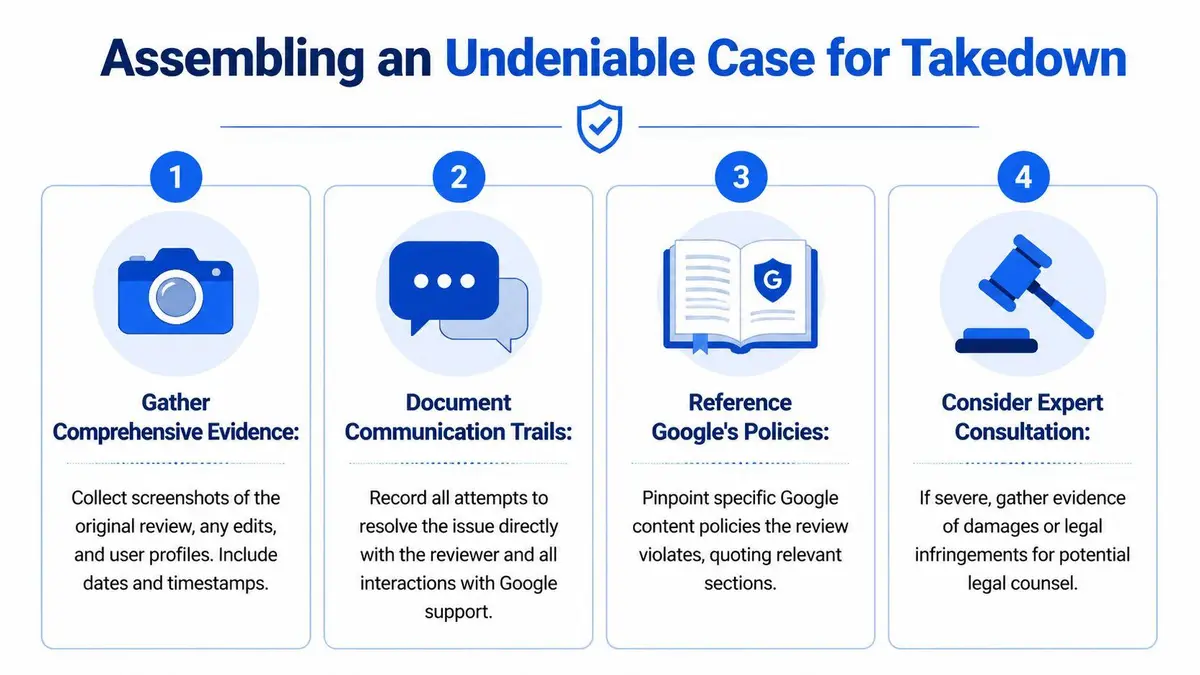
Your file should be organized like a legal appendix. Every claim you make should map to a document, screenshot, record, or timeline entry.
What your evidence packet should contain
| Evidence Type | Description & Purpose |
|---|---|
| Review capture | Full screenshots of the review, star rating, profile, date, edits, and any attached media |
| Reviewer profile record | Screenshots of other review activity that may suggest spam, conflict, or impersonation |
| CRM or booking search | Internal records showing no matching customer, booking, invoice, or account |
| Employment verification | HR or payroll records if you suspect a former employee posed as a customer |
| Litigation or dispute records | Court filings, demand letters, or documented disputes if the reviewer is a hostile opposing party |
| Timeline correlation | A dated sequence connecting the review to termination, conflict, media attention, or coordinated attacks |
| Attack pattern screenshots | Evidence of review-bombing, social posts encouraging negative reviews, or clustered suspicious activity |
| Google support history | Copies of prior reports, case numbers, responses, and rejected appeals |
How to frame nuanced violations
The hardest cases are not the obvious spam reviews. The hard cases are polished lies.
A former executive leaves the business and posts as a “customer.” A competitor uses a personal Gmail account and writes a plausible review. An opposing litigant inserts allegations into a review because they know Google won’t resolve a factual dispute unless you present more than denial.
Your framing should be forensic.
- Start with the policy category.
- Identify the reviewer’s actual relationship to the business.
- Attach documents proving that relationship.
- Show why the review presents that relationship falsely.
- Tie the timing to a specific event if retaliation is involved.
Evidence standard: If an independent reviewer looked only at your file, they should be able to understand the violation without needing your verbal explanation.
What strengthens credibility with Google
Short claims backed by hard records work better than expansive accusations.
For example, “No customer with this name, alias, or complaint appears in our records” is useful if you attach the underlying search documentation. “This is definitely our competitor” is weak unless you pair it with corroborating material such as business affiliations, past interactions, overlapping names, or conflict records.
If the review contains an allegation of criminal behavior, fraud, abuse, or professional misconduct, preserve everything immediately and prepare for dual-track action: platform escalation and legal review. Once a statement crosses from opinion into factual accusation, the reputational stakes rise sharply.
Escalating a Failed Dispute and Legal Options
A denied flag is not a final judgment. It usually means the first channel didn’t resolve the issue. That is all.
The larger problem is structural. Public-facing guidance often makes the process look linear and manageable, yet those same guides admit there is no guarantee of removal and that cases may take weeks with no response at all, as noted in this discussion of inaccurate Google reviews and dispute delays. If you’re an executive with an active reputation threat, that isn’t a workable endpoint.
Move from basic support to structured escalation
Once the initial dispute stalls, your next submission should not be a duplicate complaint. It should be a refined escalation package built around your dossier.
That means:
- referencing the prior report history
- restating the violation in tighter terms
- attaching clearer supporting evidence
- removing weak arguments that distract from the strongest one
If the issue implicates defamation, impersonation, copyright, privacy, or a court-backed order, standard review reporting may be the wrong channel entirely. In those situations, legal request pathways become relevant. The process and threshold are different, and the quality of drafting matters. This guide on how to submit a Google legal request is a useful starting point if your matter has moved beyond ordinary profile moderation.
Know when the issue is no longer a review dispute
A hostile review can become part of a broader legal conflict. If the same party is publishing false claims elsewhere, contacting vendors, sending threats, or interfering with business relationships, the review is only one artifact of a larger campaign.
That’s where legal pattern recognition matters. Even outside the review context, business conflicts with major tech platforms can become procedurally complex very quickly. For broader context on how these disputes can evolve, Miles Hansford’s piece on understanding tech contract disputes for businesses is a useful reminder that platform-related conflicts are often governed by process, bargaining power, and documentation, not common sense.
Legal routes that may justify direct action
Some review matters warrant immediate legal assessment rather than more casual support tickets.
| Scenario | Why legal review matters |
|---|---|
| Defamatory factual accusation | False statements of fact can trigger formal takedown or litigation analysis |
| Impersonation or identity misuse | The issue may affect both platform policy and legal rights |
| Copyrighted images or text in the review | Legal removal channels may be stronger than standard moderation |
| Court order or settlement breach | The review may violate an existing legal obligation |
| Coordinated harassment tied to a dispute | Escalation may require preserving evidence beyond Google |
At escalation stage, the question isn’t “how do I report this again?” It’s “which channel has authority over this exact harm?”
That distinction saves time. It also prevents you from spending weeks in the wrong queue.
Knowing When to Bring in Specialists
At a certain point, this stops being a task and becomes a drain on executive attention. That threshold arrives faster than most clients expect.
If you’ve already filed, been rejected, rewritten the submission, gathered internal records, and still have the review live on your profile, you’re no longer dealing with a simple moderation issue. You’re managing a specialized takedown problem with reputational exposure.
The signals are usually obvious
Bring in specialists when one or more of these conditions exist:
- Your first appeal failed: That usually means the issue now turns on evidence quality and framing.
- The reviewer appears experienced: Competitors, former insiders, and hostile litigants rarely leave easy-to-remove content.
- The attack is ongoing: One review often becomes several, or spreads to other platforms.
- The allegations are serious: Claims involving fraud, criminality, abuse, or professional misconduct need a tighter response structure.
- Your time is more expensive than the process: Senior operators should not spend days inside support loops if the matter threatens revenue, investor confidence, or hiring.
The decision is not emotional. It is operational.
Professional intervention is often the rational move
Most high-profile clients don’t need another tutorial. They need a team that can assess the review, classify the violation, build the evidence packet, select the right escalation route, and keep the matter confidential.
If that’s where you are, review the strategic approach to online review removal services for executives. It lays out how specialist review removal work differs from generic customer support efforts and why an executive-level response is often the more efficient path.
One practical option is ContentRemoval.com, which handles false review takedowns as part of broader reputation protection work for executives, brands, and public figures. The point of using a specialist isn’t symbolism. It’s to shift the matter to people who know how to document, escalate, and pursue removal without wasting your internal time.
The right moment to hire help is before the review becomes the accepted version of events.
A dispute google review matter should not sit unresolved because your team is busy, frustrated, or unsure which channel comes next. Delay favors the reviewer. Strategy favors the party with the better file and the tighter process.
If a false or malicious Google review is threatening your business, profile, or deal flow, ContentRemoval.com can assess the matter confidentially and outline a direct removal strategy based on the review type, evidence available, and escalation options.
Frequently asked questions
Can I get a Google review removed if it is fake?
Yes, if you can show a policy violation such as no customer relationship, a conflict of interest, spam, impersonation or personal information. Report it through Google Business Profile under the one most accurate category, state the factual basis in two or three sentences and keep evidence ready. Emotional narratives and multiple overlapping theories weaken the submission.
What evidence do I need to dispute a Google review?
The article recommends a dossier: full review captures, the reviewer’s other activity, CRM or booking searches showing no matching customer, HR records if a former employee is suspected, litigation or dispute records, a dated timeline linking the review to a termination or conflict, screenshots of any coordinated attack, and copies of all prior Google support interactions.
What should I do if Google refuses to remove a review?
Treat the denial as a failed first channel, not a final ruling. Refile with a tighter escalation package that references the prior case, restates the strongest single violation and attaches clearer evidence. If the review involves defamation, impersonation, copyright or a court order, move to Google’s legal request pathway and consider legal review.