
Removing an arrest record from the internet is a two-front campaign. First, the official record must be legally neutralized through expungement or sealing by the court. Second, that court order is used to compel mugshot sites, data brokers and background check companies to delete the record, negotiate with news archives, and prompt Google to refresh its results.
Key facts
- Expungement destroys the record; sealing hides it from public view while some agencies retain access.
- The court order must reach every agency holding the record, including police, county court and state repository.
- Never pay a mugshot site’s unpublishing fee; the record often reappears on a related site.
- News outlets are protected by the First Amendment, so removal is negotiated: anonymization, noindex or an editor’s note.
Where ContentRemoval.com comes in. ContentRemoval.com handles the online phase once the court has ruled, serving the order on mugshot networks, data aggregators and background check firms, negotiating with newsrooms, and filing the Google legal and outdated content requests that finish the job. Criminal defense attorneys and the client’s own counsel usually make contact once expungement is granted. A free, confidential 15-minute Exposure Scan maps every copy and which are removable, and the report is yours to keep. Get a Free, Confidential Exposure Scan or read how our mugshot removal work is done.
Removing an arrest record from the internet is a two-front battle. First, the official court record must be legally neutralized through sealing or expungement. Only then can you begin the second, equally crucial phase: systematically compelling every website and search engine displaying it to remove the information. This is not a single action, but a campaign requiring legal precision, direct takedown demands, and technical search engine requests.
The Digital Life of an Arrest Record

The moment an arrest occurs, regardless of whether charges are ultimately filed, a public record is born. That entry in a police blotter or court filing initiates a data-dissemination process that is nearly impossible to stop without strategic intervention. This digital ghost can haunt you for decades, silently undermining your reputation and career prospects.
This information is not confined to official government databases. It is scraped, copied, and sold across a vast, interconnected network of websites and data companies.
The Ecosystem of Arrest Data
The journey from a courthouse file to a top Google result is shockingly swift and almost entirely automated. It is a pipeline fueled by businesses that profit from public information, often stripped of critical context like a dismissal or acquittal. For any professional, particularly an executive, understanding these entities is the first step toward reclaiming your name.
The main actors in this data economy are:
- Mugshot Websites: These are the most brazen operators. They aggregate arrest photos and data, then demand hundreds or even thousands of dollars for removal, a practice tantamount to digital extortion.
- Data Brokers and Background Check Companies: These massive firms build detailed profiles on millions of individuals. They sell reports to landlords, employers, and financial institutions, where an old arrest, even one that led to no charges, becomes a permanent liability.
- Local News Archives: Media outlets frequently publish police blotters and arrest reports as part of daily news coverage. These articles are indexed by Google and can dominate search results for years, long after the legal matter is resolved.
The fundamental problem is digital permanence. The legal system has a process for resolution; a case can be acquitted or charges dropped. The internet has no equivalent mechanism. It does not update itself or recognize a final, favorable outcome.
For high-net-worth individuals and executives, the stakes are magnified. An old arrest record can silently terminate a business deal, a board appointment, or a major investment. The opportunity simply vanishes; you will likely never know the cause. The other party performs a cursory search, sees the record, and moves on without discussion. This is why a passive approach is untenable.
Why Your Arrest Record Lingers Online
This information persists due to both technology and policy. When search engine algorithms detect an arrest record posted on multiple sites, they often misinterpret that as a signal of importance, elevating it in search rankings. Concurrently, news publishers often invoke First Amendment rights, refusing to remove or update articles about an arrest, even when presented with proof of a favorable legal outcome.
The problem is amplified by the sheer volume of shared data. For example, recent research reveals a significant increase in ICE detaining individuals with no criminal convictions, demonstrating how even administrative actions can create a harmful and lasting digital trail.
This interconnected data web means a piecemeal approach, such as paying a single mugshot site, is destined to fail. The original data remains available, feeding dozens of other sites. A comprehensive digital footprint cleanup is the only effective strategy. To successfully remove an arrest record from the internet, you must engage on all fronts simultaneously: the legal record, the publishers, and the search engines.
Step One: Legally Neutralize the Record
Before attempting to scrub an arrest record from the internet, you must address the source. That source is not a website or a Google search result; it is the official document in a courthouse or police department file.
Countless individuals waste time and capital attacking digital copies first. It is a losing battle. You cannot win a war against online information if the official public record still exists to legitimize it.
The only way to initiate the process is with a court order. The two primary instruments for this are expungement and sealing. These terms are often used interchangeably, but they are legally distinct.
Expungement vs. Sealing: A Critical Distinction
An expungement is the gold standard. It is a court order that effectively destroys the record, compelling agencies to act as if the arrest never occurred. For all practical purposes, the event is erased from your official history.
A sealing order is also powerful, though less absolute. It does not destroy the record but conceals it from public view. While certain government bodies like law enforcement and professional licensing boards may retain access, it vanishes from the databases that feed commercial background checks and online data brokers.
Eligibility for expungement or sealing is dictated entirely by state law. A minor, non-violent offense that was dismissed might be easily expunged in one state, whereas a neighboring state might only permit sealing after a lengthy waiting period.
The court order obtained through expungement or sealing is your silver bullet. It is not a polite request for websites to remove your information. It is a legal mandate that provides the leverage to force their compliance.
Obtaining the Crucial Court Order
Securing an order for expungement or sealing is a formal legal process that demands precision. It begins with filing a petition in the court where the original charge was filed. This document presents the facts of your case and makes the legal argument for why you qualify for relief under your state’s specific statutes.
This is a stage where errors are costly. A single mistake (a mistyped case number, an incorrect charge, or a missed filing deadline) can result in the petition being dismissed. You would be forced to start over, losing months in the process. This is precisely why a DIY approach is so perilous. For a state-specific breakdown of the required detail, this guide on how to get a record expunged in Texas illustrates the necessary complexity.
Once a judge approves the petition, the court issues an order. That order is then distributed to all relevant state and local agencies, instructing them to update their files. This is the document you will use to prove to Google, news outlets, and mugshot sites that the information they are publishing is legally obsolete.
Navigating Complexities and Common Traps
The legal framework for records is a patchwork that changes dramatically by state. Furthermore, not all damaging records are strictly criminal. Administrative actions can also create a public digital footprint with significant reputational consequences.
For instance, the research on ICE enforcement dynamics on colorado.edu highlights how non-criminal, administrative actions can generate public records that are just as harmful online as criminal ones.
The most common pitfalls we observe are:
- Incomplete Notification: The court order must be sent to every single agency holding the record. This includes the arresting police department, the county court, and the state’s central criminal repository. Missing one allows the data to leak back onto the internet.
- Assuming Eligibility: You cannot assume you qualify. Eligibility is based on strict criteria. A thorough legal analysis upfront prevents wasting months on a petition that is doomed from the start.
- Premature Filing: Most states have mandatory waiting periods that must be honored before you can file. Filing a petition too early guarantees denial.
Securing this legal order is the non-negotiable first step. Without it, you are merely asking websites for a favor they have no incentive to grant. With it, you possess the authority to demand action and begin erasing your digital past.
Executing Publisher and Platform Takedowns
With an expungement or sealing order from the court, the real work begins. You have won the legal battle, but you must now take that victory online. The court order is not just a piece of paper; it is your most powerful weapon for compelling websites to remove your old arrest record.
This next phase is a targeted campaign against three distinct adversaries: predatory mugshot websites, legacy news reports from local media, and the sprawling networks of commercial data brokers. Each operates differently and requires a tailored approach. Your goal is to make the digital world reflect the legal reality your court order has established.
This entire process hinges on first obtaining that legal order. The legal work (petitioning the court, securing the order, and enforcing it) is the foundation for all subsequent action.
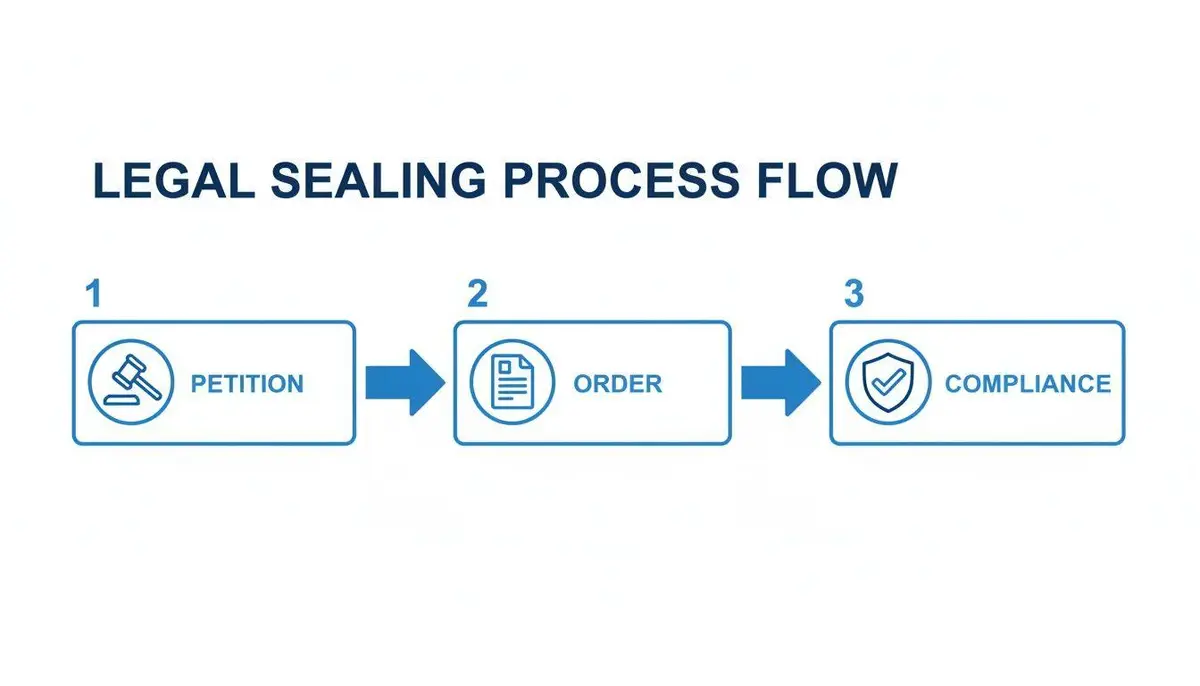
As illustrated, the court order is the critical step that transforms a polite request into a legal demand.
There are several methods for tackling online arrest records. Understanding these approaches is key to setting realistic expectations.
Arrest Record Removal Approaches
| Removal Method | Primary Target | Key Requirement | Typical Success Rate |
|---|---|---|---|
| Legal Order Takedown | Mugshot sites, data brokers | Court-issued expungement or sealing order | High |
| Negotiated Takedown | News media archives, blogs | A compelling ethical or fairness argument | Moderate |
| Terms of Service Violation | Any platform | Proving the content violates platform rules | Low to Moderate |
| Search Engine De-indexing | Google, Bing search results | Successful removal from the source website | High (once source is removed) |
The table confirms that a court order is by far the most effective tool, especially against the most common offenders. For other situations, such as news articles, success depends more on negotiation and diplomacy.
Dismantling the Mugshot Site Racket
Mugshot websites are the bottom-feeders of the internet. Their business model is extortion. They scrape public data, post it for maximum embarrassment, and then charge an “unpublishing fee” for removal.
Never pay these fees. Doing so flags you as a willing target, and your record will often reappear on another site within their network weeks later.
The correct strategy is to confront them with your expungement or sealing order. Send it directly to the site’s operator or, if they are unidentifiable, their web hosting provider. These sites exist in a legal gray area, and a formal demand backed by a court order is a liability they typically wish to avoid.
Your communication must be brief, professional, and direct. It should include:
- The exact URL of the page containing your record.
- A clean, high-resolution copy of the court order.
- A firm statement that continued publication of the expunged record is unlawful and factually inaccurate.
This strategy bypasses their payment demands and reframes the issue around their legal obligation. A surprising number will comply simply to avoid further complications.
Negotiating with News Media Archives
News articles present a more complex challenge due to First Amendment press protections. A news outlet is not legally required to remove a story that was factually accurate at the time of publication, even if the case was later expunged. Initiating contact with legal threats is almost always counterproductive.
When dealing with a news outlet, approach it as a negotiation, not a demand. The most effective angle is an appeal to their journalistic ethics and sense of public fairness, not their legal obligations.
When contacting an editor, be diplomatic. Your strongest argument is that the outdated article is now misleading the public. If you can identify any factual inaccuracies in the original story, even minor ones, that becomes your primary point of leverage.
If full removal is not an option, propose a compromise like redaction or anonymization. Request that they remove your name and other identifying details from the article. This allows them to preserve their archive while breaking the article’s connection to your identity. It is a win-win that many editors will consider.
Compelling Compliance from Data Brokers
Background check companies and other data brokers are the most widespread distributors of arrest information. The good news is they are often more responsive to legal orders than news outlets or mugshot sites because their business models depend on maintaining a reputation for accuracy and compliance.
The process here is highly formal. You must identify the specific data broker publishing your record and utilize their official dispute process. This almost always involves submitting your court order through an online form or sending it via certified mail.
This is where meticulous organization is critical. Maintain a detailed spreadsheet of every site contacted, the date of contact, the method used, and their response. If you do not receive a response, follow up relentlessly every 7-10 business days until you secure confirmation that the record has been removed. This persistent, methodical follow-up is what separates a partially successful cleanup from a truly clean slate.
De-Indexing Your Record from Google Search

Compelling a website to delete your arrest record is a significant victory, but it is incomplete. The digital ghost of that record can persist in Google’s search results for weeks or even months due to a process called caching.
This is a critical distinction: removing content from the source website is not the same as removing it from a search engine. You must address both.
Google’s crawlers constantly take snapshots of web pages to build a massive, stored library, allowing for nearly instant search results. When the original page with your record is deleted, Google’s stored snapshot, the cache, can still appear in search results. To anyone searching your name, the record appears to be live, even though the link now leads to a dead page.
Forcing Google to Update Its Index
To truly erase the record, you must prompt Google to recognize that its information is outdated. This is not a favor; it is a report of a factual error in their index.
The most direct method is Google’s “Remove Outdated Content” tool, which is designed for this exact scenario.
The process requires precision but is straightforward:
- First, copy the URL of the offending search result directly from Google.
- Next, paste that URL into the tool and initiate the request.
- The tool will then ask you to provide proof that the content is gone by showing a snippet of the old, cached text and asking you to confirm it is no longer on the live page.
Neglecting this technical step can undermine all the effort invested in removing the source content. Our strategic guide offers a full breakdown of URL de-indexing and its impact on your search visibility.
A successful takedown is only complete when the record disappears from search engines. Until then, from a reputational standpoint, the damage persists. The “Remove Outdated Content” tool is your method for closing this final, critical gap.
Submitting Formal Legal Requests to Google
What if a website refuses to cooperate, even after you have secured a court order to expunge or seal your record? In these more complex situations, you must escalate by submitting a formal legal request directly to Google.
This path is for cases where the content is not merely embarrassing. It is now legally inaccurate because a court has declared it so.
Google has a specific legal troubleshooter form for these circumstances. When you complete it, you are not just asking for a removal; you are making a legal argument that the content violates local law by displaying an expunged or sealed record.
To maximize your submission’s chance of success, it must be flawless. Be prepared to provide:
- The specific URLs where the infringing content appears.
- A clean, clear copy of the court order for the expungement or sealing.
- A direct explanation of how the content on those URLs violates the law, citing your court order as evidence.
Google’s legal team reviews these requests carefully. If they agree that the content is unlawful based on your documentation, they will de-index the page from search results in that jurisdiction.
Monitor the status of your request. A “Denied” status usually indicates a mistake in your submission, while “Pending” means it is in the review queue. Stay on top of it and be prepared to follow up until you receive the “Removed” confirmation. That is the moment the arrest record is finally gone.
You can attempt to handle a simple, one-off arrest record removal yourself. But this requires a cold, hard look at the risks. The DIY approach is only viable in a perfect-world scenario involving a single, cooperative publisher where the record has not spread. For any professional with a reputation to protect, banking on a best-case scenario is not just optimistic; it is a dangerous gamble.
Once an old arrest record appears on multiple sites, the problem becomes exponentially more complex. You are no longer dealing with one website but a web of interconnected data brokers, news archives, and mugshot sites, each with its own takedown policy and willingness, or unwillingness, to comply. At that point, engaging professionals is not a luxury; it is a strategic necessity.
The Point of Escalation
Knowing when to transition from a DIY project to professional intervention is crucial. The decision comes down to clear triggers indicating the problem has grown beyond what one person can effectively manage. If you encounter any of these roadblocks, it is time to engage a specialist.
Escalation is warranted if:
- Widespread Content: The record appears on more than two or three websites, especially a mix of mugshot databases and old news articles.
- Unresponsive Publishers: You have sent a valid expungement order to a website, but they have either refused to comply or ignored you for over 30 days.
- High-Profile Coverage: The arrest was reported by a major local or national news outlet, not just a small-town police blotter.
- A Complicated Legal History: The case itself is messy, involving multiple charges, different jurisdictions, or a nuanced outcome that is difficult to convey in a simple takedown request.
If you face any of these, the probability of succeeding on your own drops dramatically. The time and energy expended, plus the risk of a critical error, are not worth it.
The greatest mistake is underestimating your adversary. Predatory publishers and indifferent platform administrators do not respond to polite emails. They respond to precise, relentless pressure applied through channels they cannot afford to ignore.
The Strategic Advantages of a Specialized Firm
Hiring a firm that specializes in how to remove an arrest record from the internet is about more than outsourcing the work. It is about deploying a team with the resources, experience, and relationships that are inaccessible to an individual. That is what delivers results quickly and discreetly.
A professional firm brings critical assets to the engagement. We have spent years cultivating back-channel relationships with administrators at major publishing houses and tech platforms. These contacts facilitate conversations and resolutions that a cold email from a stranger can never achieve.
Beyond relationships, specialists have the infrastructure to execute a campaign on multiple fronts simultaneously. This means dispatching legal notices, technical de-indexing requests, and direct negotiations all at once, while meticulously tracking every action and response. Managing that process alone, especially while maintaining a career, is nearly impossible.
For executives whose careers and reputations are on the line, the cost of failure is immeasurable. A botched removal attempt can cause publishers to dig in their heels, drawing more attention to the very information you seek to remove. In these high-stakes situations, the certainty and discretion of a professional internet removal service are paramount. While technology like an AI legal assistant can help organize documents before a consultation, it cannot replace specialized expertise.
Ultimately, the decision to hire experts is a cost-benefit analysis. Is the potential damage to your career, your company, and your personal life worth the risk of a DIY attempt? For our clients, the answer is a clear “no.” Professional intervention is the only reliable path to a clean digital slate.
Frequently Asked Questions About Arrest Record Removal
When confronting an arrest record online, you have urgent questions that demand clear, experienced answers. For the executives, professionals, and high-net-worth individuals we serve, there is no room for guesswork. Here are direct answers to the questions we handle daily.
How Long Does Arrest Record Removal Take?
A precise timeline is impossible to guarantee, as it depends entirely on the specifics of your case. The process can range from a few weeks to several months.
In a best-case scenario, a single mugshot site and a clean expungement order, we can often achieve results in 30 to 60 days.
However, if the record has proliferated across dozens of data broker sites or a news outlet is resistant, the process can easily extend to six months or longer. Delays typically arise from waiting on publisher responses and the subsequent lag before search engines like Google de-index the page. It is a multi-front campaign, and while we apply pressure simultaneously on all fronts, patience is essential.
What If My Case Was Not Dismissed or Expunged?
If you were convicted and your record is not eligible for sealing or expungement, your options for complete removal are limited. News outlets, in particular, are protected by the First Amendment when publishing factually accurate information about a conviction. Mugshot sites are also far less likely to cooperate without a court order.
When removal is not feasible, we pivot to a strategy of suppression. This is not about deleting the past; it is about controlling the present narrative. We build a portfolio of positive, professional content (such as a personal website, new executive bios, and professional profiles) and use advanced SEO to push these assets to the top of your search results. The old arrest record is buried deep on page two or three, where it is rarely seen.
Suppression is not a consolation prize. It is a specific, powerful strategy for reclaiming control of your online narrative when removal is not an option. It ensures that your professional success, not a past mistake, defines your digital first impression.
Will an Expunged Record Appear on a Background Check?
Legally, an expunged record should not appear on a standard employment or housing background check. The purpose of an expungement is to legally erase the arrest, compelling state and local agencies to remove it from their public records.
The problem is the gap between legal reality and internet data practices. Many background check companies scrape data but do not always update their databases promptly. An old record can linger long after being legally expunged. This is why we do not stop at the court order. We proactively serve the expungement documents to major data aggregators like LexisNexis to ensure their records are scrubbed clean. These “ghost records” must be actively neutralized before they can cause future problems.
Can I Force a News Outlet to Remove an Article About My Arrest?
In short, no. You generally cannot force a news organization to take down a factually accurate article, even if the record has been expunged. The First Amendment provides them with very strong protections, and courts almost never order the press to remove content.
Achieving removal of a news article is a matter of negotiation and diplomacy, not legal threats. Sending a demand letter is the quickest route to a firm refusal. A superior approach is to appeal directly to the editor’s sense of fairness and journalistic ethics. We construct an argument that keeping an article online about a charge that was dismissed and expunged is actively misleading and causes real, ongoing harm.
If full removal is rejected, we pursue alternative solutions:
- Anonymization: We can request the removal of your name and other identifying details from the story.
- De-indexing: We can persuade them to add a “noindex” tag to the article’s code, which instructs Google and other search engines not to include it in search results.
- An Update: We can request that they add a prominent editor’s note explaining that the charges were dismissed and the record expunged.
Any of these outcomes can resolve the issue. Reaching them requires a professional, nuanced approach that understands newsroom operations and priorities.
When your reputation is on the line, you require a swift, discreet, and permanent resolution. At ContentRemoval.com, we provide the strategic expertise that high-profile individuals and their legal teams rely on. Start the process with a confidential assessment of your situation at ContentRemoval.com.