
Removing a picture from Google takes two actions: deleting the image from the website that hosts it, and asking Google to de-index it under a specific policy. Google does not host images, so source removal is the only permanent fix. Google’s removal routes cover non-consensual intimate imagery, exposed personal data, copyright under the DMCA, and sites that charge for removal.
Key facts
- Run reverse image searches on Google Images, TinEye and PimEyes to find every copy before requesting removal.
- Google’s removal pathways: NCII, personally identifiable information, DMCA copyright, and exploitative removal sites.
- Google’s Results about you tool now covers identifiers such as driver’s licenses, passports and Social Security numbers.
- If a webmaster refuses, file an abuse complaint with the hosting provider and domain registrar found via WHOIS.
Where ContentRemoval.com comes in. ContentRemoval.com runs image takedowns across every copy of a photo, from the original host to the forums and scraper sites that reposted it, then clears the search results and monitors for re-uploads. The person pictured, their assistant or their lawyer usually makes contact after a reverse image search shows more copies than expected. A free, confidential 15-minute Exposure Scan maps each copy and whether it is removable, and the report is yours to keep. Get a Free, Confidential Exposure Scan or read how our search result removal work is done.
To remove a picture from Google search results, you have two distinct courses of action: compel its deletion from the source website or petition Google for its de-indexing based on specific policy violations. The only permanent solution is source removal. When an image is eliminated from the host server, Google’s index eventually reflects its absence. A direct request to Google only suppresses the image from search results; it remains live and accessible on the original website.
Why Removing an Image from Google Requires a Strategic Approach

The discovery of a compromising or private image online is not a technical inconvenience; it is a direct threat to your professional and personal standing. The immediate impulse is to react, but unstructured, frantic communication with website administrators and Google is ineffective and can exacerbate the situation by drawing further attention to the content.
A fundamental miscalculation is assuming Google “hosts” the image. It does not. Google functions as an index, a catalog of content that exists on third-party web servers. Its crawlers perpetually scan the internet, indexing content to make it discoverable. This mechanism is why a single damaging image can become a persistent liability.
Therefore, a successful removal campaign must address two separate objectives:
- Source Removal: This is the primary objective: the complete deletion of the image file from the hosting server, whether it be a blog, social media platform, or news outlet. This is the definitive resolution.
- De-indexing: This is a secondary, suppressive measure where you request Google to hide the image from its search results. If successful, the image is concealed from search but remains accessible to anyone with a direct link.
Attempting to “remove a picture off Google” without a coherent strategy is destined for failure. A request to Google concerning an image that does not violate its specific policies will be denied. Similarly, a demand sent to a website owner without a valid legal or procedural basis will be ignored or, worse, may provoke retaliation.
The Dynamics of Digital Discoverability
The urgency of this matter is magnified by the velocity at which content propagates online. An image published on an obscure website can be indexed and rank for your name within hours. For individuals with a public profile, this risk is amplified exponentially.
Consider how search interest fluctuates. Between June 2022 and June 2023, Google searches for public figures like footballer Neymar increased by 110%. This volatility demonstrates how any image associated with a trending name can be swept into a wave of intense, unpredictable public scrutiny, facilitating the rapid dissemination of harmful or non-consensual content.
A successful removal campaign is not a single action but a calculated legal and technical process. It requires identifying the source, establishing the strongest legal or policy-based argument, executing precise communication, and preparing for escalation.
Building a Defensible Strategy
An effective strategy begins with a precise diagnosis of the situation. You must identify the image owner, the website operator, and the exact legal or procedural leverage you possess. A defensible approach often starts with an analysis of intellectual property rights to determine if a copyright claim is viable. This analysis dictates whether the initial step is a professional request, a formal DMCA takedown notice, or the initiation of legal proceedings.
Without this strategic framework, you are merely reacting to events. With it, you reclaim control and execute a deliberate plan to neutralize the threat and restore your reputation.
Securing Image Takedown at the Source

Before engaging Google, you must secure the deletion of the image from its host website. This is the foundational principle of content removal. Requesting Google to de-index a live image is an inadequate, temporary measure. So long as the image file exists on the original server, it can be re-indexed or disseminated via direct links, ensuring the problem remains unresolved.
Your initial action is to map every online location of the image. This requires more than a simple name search. A comprehensive reverse image search using tools like Google Images, TinEye, and PimEyes is necessary to locate every duplicate. This process will yield a precise inventory of every website, forum, and social profile hosting the picture. Each URL represents a distinct challenge, as the protocol for removing a photo from a personal blog differs significantly from that for a major news publisher or a global social media platform.
Making First Contact
With your list of URLs, the next step is to identify the correct point of contact: a webmaster, administrator, or editor. This information is typically found on a site’s “Contact Us” or “About” page. If these avenues are fruitless, a WHOIS lookup may reveal the registrant’s contact details, though privacy services frequently obscure this data.
The construction of your request is critical. An initial communication must be professional, precise, and devoid of emotion. An inflammatory demand will be disregarded. The objective is not to engage in a dispute but to provide the site owner with a clear, justifiable reason to comply.
A competent takedown request must include:
- Identification: Your identity and the exact URL where the image is published.
- Justification: A concise explanation of the legal or policy basis for your removal request.
- Action Required: A specific request for the permanent deletion of the image file from their server.
Tailoring Your Takedown Strategy
The justification for removal is the core of your request and must be tailored to the specific context. If you own the copyright to the photograph, it is a matter of intellectual property infringement. If it is an intimate image posted without consent, it is a severe privacy violation and a breach of the platform’s terms of service.
For instance, platforms like Facebook and Instagram have structured reporting systems for harassment, non-consensual imagery, and intellectual property claims. In contrast, a news organization will be more responsive to arguments grounded in journalistic ethics or potential defamation.
The objective is not to win an argument but to secure the removal of the image. Frame your request to make deletion the most logical and least resistant path for the webmaster. Referencing their own terms of service or privacy policy can be highly effective.
If the image exposes personal information, citing relevant data privacy and compliance laws adds significant weight. If you own the copyright, a formal DMCA takedown notice is a powerful legal instrument that compels most US-based entities to remove the content to avoid liability. Understanding how to write and file a DMCA takedown notice is a critical component of this work.
Ultimately, successful source removal depends on methodical execution: precise location of all copies, strategic communication, and the intelligent application of the correct legal or ethical argument for each specific circumstance.
Using Google’s Official Removal Tools Effectively
Once source removal has been attempted, successfully or not, the focus shifts to Google. Petitioning Google to remove an image is not a casual request but a formal process that requires precision and specific evidence. Google does not remove content arbitrarily, but it provides defined channels for content that violates its established policies.
Our experience shows that success hinges on selecting the correct channel and constructing an irrefutable case. Filing an improper request wastes critical time. Your objective is to align your situation so perfectly with one of Google’s policies that a reviewer’s only logical conclusion is to approve the removal.
Choosing the Right Weapon: Google’s Removal Policies
Google’s policies are specialized instruments. You cannot file a privacy complaint for a copyright issue and expect a result. Each removal pathway is designed for a specific violation, and the evidentiary requirements differ completely.
The primary pathways for high-stakes image removal include:
- Non-Consensual Explicit Imagery (NCII): For any explicit photo or video created or shared without your consent. Google prioritizes these cases, making this one of the most effective grounds for removal.
- Personally Identifiable Information (PII): If a search result exposes sensitive data such as bank account details, medical records, or an image of a government ID, Google will remove it to mitigate the risk of financial fraud or identity theft.
- Copyright Infringement (DMCA): If you are the copyright holder of the image, you can file a Digital Millennium Copyright Act (DMCA) notice. This is a formal legal request for the removal of infringing content.
- Content on Sites with Exploitative Removal Practices: This policy targets websites that publish personal information and then demand payment for its removal, such as mugshot sites.
Selecting the incorrect pathway guarantees denial. An accurate diagnosis of the violation is imperative from the outset.
The “Results About You” Tool and Major NCII Updates
Google has advanced user control through its “Results about you” dashboard. This serves as a centralized hub for managing and tracking removal requests, particularly for PII and NCII violations.
A critical recent development is Google’s handling of non-consensual explicit images. The February 2026 removal tool represents a significant enhancement, enabling streamlined reporting of multiple explicit images directly from search results. This procedural improvement, announced on Safer Internet Day, is a major advance over previous one-by-one reporting methods. The analysis on PPC Land details these changes.
Your submission to Google must be a clear, concise argument based on its specific policies, not a general plea. You must provide the exact URL of the image and the search result page where it appears, and then articulate precisely why it meets the criteria for removal. Ambiguity will ensure your request is denied.
Before submitting, assemble all necessary documentation: screenshots, URLs, and a straightforward explanation of the harm. For more complex situations, such as defamation that does not fit neatly into these categories, our guide on how to submit a Google legal request details the more formal legal process.
Google Image Removal Request Pathways
This table delineates the primary removal options, their applicable scenarios, and the required evidentiary standards.
| Removal Type | Applicable Scenarios | Primary Evidence Required | Typical Processing Time |
|---|---|---|---|
| NCII | Intimate images or videos shared without consent. | URL of the image and search result; confirmation of identity. | High Priority: 24-72 hours |
| PII Violation | Exposure of financial, medical, or official ID info. | Proof of the data’s sensitivity and the specific URLs. | Days to weeks |
| DMCA Takedown | Unauthorized use of an image you own the copyright for. | Proof of copyright ownership; URL of infringing material. | Days to weeks |
| Defamation | An image used in a defamatory context (requires a court order). | A copy of the court order declaring the content unlawful. | Weeks to months |
Selecting the correct pathway is the most critical step. Each represents a distinct legal or policy-driven process, and understanding which applies to your situation is essential for a rapid and successful outcome. Petitioning Google is akin to filing a legal motion; it demands precision, evidence, and a firm grasp of the rules. When executed correctly, these tools are highly effective for regaining control of your online reputation.
Advanced Escalation for Non-Compliant Websites
When a webmaster refuses to cooperate or remains silent, it is time to escalate. This phase is not about sending more insistent emails; it is about applying leverage through third parties. Every website relies on a domain registrar and a hosting provider to remain online. These service providers operate under strict terms of service that prohibit illegal content and harassment, and these terms are your new point of leverage.
Locating the Hosting Provider and Domain Registrar
Your first action is to identify these providers. A WHOIS lookup tool will typically reveal the registrar and, in some cases, the hosting company. You are looking for an “abuse” contact email or a formal complaint portal.
When you contact them, you are not forwarding your original request; you are filing a formal abuse complaint. Your communication must be framed as a report of a terms-of-service violation. Be specific, referencing the exact terms the content violates.
Your complaint can be based on violations such as:
- Copyright Infringement: If you hold the copyright, the hosting provider has a legal obligation under the DMCA to remove the infringing content.
- Harassment or Abuse: Most providers have explicit policies against using their services for harassment or defamation.
- Illegal Content: This applies to non-consensual explicit imagery (NCII) or other content deemed illegal in their jurisdiction.
By reporting the violation directly to the host, you force them to act. Ignoring a valid complaint, particularly a formal DMCA notice, exposes the hosting company to significant legal risk. They are far more likely to take action against their customer than to become embroiled in a legal dispute.
The Power of a Legal Notice
If the host or registrar fails to act, legal intervention is the next step. A cease and desist letter drafted by legal counsel is fundamentally different from an email. It signals your seriousness and elevates the matter from a personal request to a formal legal dispute.
A letter from a law firm is a demand, not a request. It signals that informal negotiations have concluded and that litigation is the imminent next step. This compels the website owner and their service providers to treat the situation with the gravity it requires.
This single document is often sufficient to resolve the impasse. It specifies the laws being violated, the damages incurred, and a firm deadline for compliance before further legal action is initiated. The threat of litigation and associated costs is typically enough to compel immediate removal of the image.
This flowchart helps visualize the decision-making process for your specific circumstances.
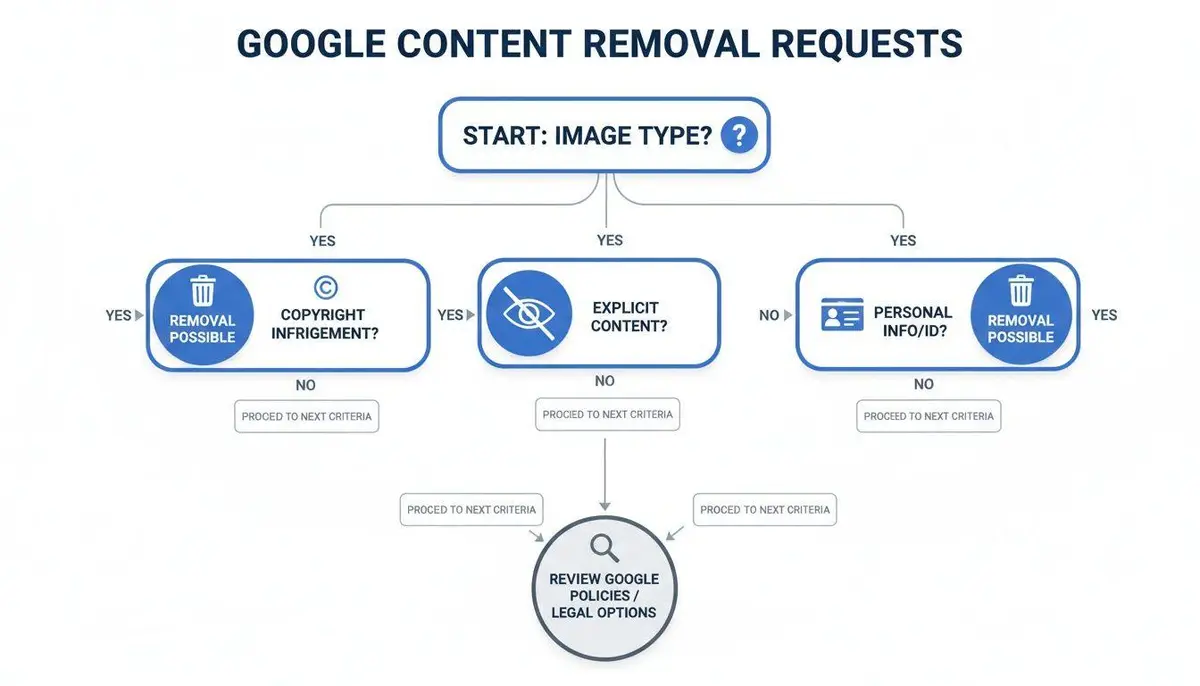
The basis for removal (copyright, explicit material, or data privacy) is the primary determinant of your strategy.
Unmasking Anonymous Attackers
In cases where the poster is anonymous, as is common on certain forums and gossip sites, the legal system can be used to compel identification.
A DMCA subpoena is a particularly effective instrument. If the image infringes on your copyright, your attorney can issue a subpoena directly to the website host, social media platform, or Internet Service Provider (ISP), legally obligating them to disclose the identity and contact information of the anonymous poster.
For non-copyright matters such as defamation, a “John Doe” lawsuit serves a similar function. A suit is filed against an unnamed defendant (“John Doe”), after which the court can grant permission to subpoena service providers to reveal the user’s identity. Once identified, the individual can be named in the lawsuit and pursued for damages. This action creates immense pressure and is often the decisive maneuver when all other methods to remove a picture off Google have failed.
Long-Term Monitoring and Reputation Defense

Securing the removal of a damaging image is a critical victory, but it is rarely the final chapter. The internet has a tendency to resurrect content previously thought to be eliminated. A one-time takedown is a single battle; a sustained defense strategy is required to win the war for your reputation.
Once an image has been published, copies can persist on obscure servers or be maliciously re-uploaded. Without active monitoring, you are left in a state of perpetual reactivity, an inefficient and stressful way to manage your digital presence. The strategic imperative is to transition from a reactive to a proactive posture.
Establishing Proactive Monitoring
The foundational layer of defense is automated monitoring that goes well beyond a simple Google Alert. A functional system must be capable of tracking the unique digital signature of the image itself.
From our professional experience, a robust monitoring protocol integrates several key techniques:
- Automated Reverse Image Searches: These services act as a digital patrol, continuously scanning the web for the target image and issuing immediate alerts upon detecting a new copy.
- Keyword and Contextual Tracking: Monitoring must extend beyond your name to include related phrases, event names, or any keywords associated with the image. This broadens the net, catching re-uploads even when the accompanying text is altered.
- AI-Powered Image Recognition: This is an advanced capability. Specialized software uses image recognition to identify visually similar matches, even if the original has been cropped, filtered, or otherwise modified. It is an essential tool for staying ahead of determined adversaries.
This level of comprehensive oversight constitutes true reputation monitoring. It transforms crisis management from frantic damage control into methodical threat detection, ensuring that a re-uploaded image is identified and neutralized within hours, not weeks after it has inflicted new damage.
Notably, Google continues to expand its privacy controls. As of February 2026, the ‘Results about you’ tool now addresses personal identifiers used in identity theft, such as driver’s licenses, passports, and Social Security numbers. This policy update acknowledges the serious risk of search engines inadvertently facilitating data exposure. You can review these updates to Google’s image removal policies on IndiaHerald.com.
Building a Digital Fortress
Monitoring is your shield; a proactive content strategy is your sword. The most effective long-term defense against a negative image is to systematically suppress it with a dominant portfolio of positive, authoritative content that you control.
The objective is to dominate the first several pages of search results for your name. An individual conducting a search should encounter your professional website, LinkedIn profile, positive media coverage, and other assets that reinforce your desired narrative, not an old, unwanted photograph.
A successful takedown makes an image disappear. A successful reputation defense strategy makes it irrelevant. By controlling your search results, you ensure that even if the image resurfaces on an obscure corner of the web, it will never again achieve the visibility required to cause harm.
We refer to this as building a “digital fortress.” It is a deliberate, ongoing campaign to create and promote a network of owned media assets. Through this effort, you are not merely cleaning up a problem; you are fortifying your online identity against future threats. The question evolves from “how to remove a picture off Google” to “how do I build an online presence so strong that a single image is rendered powerless?” That is how you secure permanent control.
Frequently Asked Questions About Image Removal
In the process of reclaiming your online image, numerous questions arise. The process can be opaque and frustrating, but clear, expert answers provide necessary direction. Based on extensive experience, we have compiled the most frequent client inquiries to provide direct, authoritative insight.
How Long Does It Take to Remove a Picture from Google?
There is no standard timeline. The duration depends entirely on the location of the image and the compliance of the parties involved. Source removal can take hours if a webmaster is cooperative, but it can extend to weeks or months if the site owner is unresponsive, necessitating escalation to hosting providers and legal channels.
Once the image is deleted from the source website, you must wait for Google’s crawlers to re-index the page and register the change. This can take anywhere from a few days to several weeks. While you can expedite this process using Google’s Remove Outdated Content tool, the final timing is subject to Google’s indexing schedule.
Can I Permanently Delete a Picture from the Internet?
True, permanent deletion, where no copy exists anywhere, is a practical impossibility. Once digital content is published, it can be copied and stored on countless private servers and personal devices beyond your control.
The strategic objective is not total digital erasure, but rendering the image so difficult to find that it is effectively neutralized as a threat to your reputation.
This is achieved through a comprehensive removal campaign. The process involves securing takedowns from all public websites, de-indexing from all major search engines, and implementing continuous monitoring. This monitoring is critical for identifying and removing any re-uploads as they appear. This defensive posture is the closest one can get to permanent removal.
What if the Website Owner Refuses to Remove My Picture?
A refusal or lack of response from a site owner is a common occurrence. It simply signals the need to escalate your strategy. Voluntary compliance is the preferred first step, but its failure opens other powerful avenues.
The next action is to bypass the site owner by filing a formal abuse complaint with the website’s hosting provider and domain registrar. These service providers have terms that prohibit harmful content and are often more responsive than the site owner due to their own legal liability.
If the host fails to act, legal channels are the next recourse. A cease and desist letter from an attorney signals imminent legal action and often compels compliance. In cases of copyright infringement, a formal DMCA takedown notice is a potent legal tool for forcing removal.
Does Removing an Image from Google Also Remove It from the Website?
No. This is the most critical distinction to understand. De-indexing an image from Google only removes it from search results. The image itself remains live on the original website. Anyone with the direct URL can still access, view, share, and re-publish it.
This is precisely why source removal is always the primary objective. A Google-only removal is a temporary and incomplete solution that leaves you vulnerable. The image can and will resurface until it is deleted from the source server.
When your reputation is at stake, you require more than advice; you need decisive action. At ContentRemoval.com, we execute complex takedown campaigns with the speed and confidentiality that high-stakes situations demand. If you are prepared to remove damaging content and secure your digital footprint, contact us for a confidential assessment.