
Monitoring brand mentions for risk means treating it as a control function rather than marketing. Write a monitoring doctrine covering brand names, misspellings, executive names, products and hostile phrases. Build a stack with baseline, broad and advanced layers including AI search checks. Then triage each mention by severity, route it to legal, security or communications, and report on speed.
Key facts
- Monitor legal names, misspellings, executive and family names, product names, hashtags and competitor terms.
- Check how the brand appears in ChatGPT, Perplexity, Gemini and AI Overviews for presence, accuracy and contamination.
- A three-level severity scale routes Code Red items to legal, security and an executive owner immediately.
- One cited threshold routes real-time alerts for sources over 10,000 followers or posts over 1,000 engagements.
Where ContentRemoval.com comes in. ContentRemoval.com works with brands and their executives once monitoring has found something that needs more than a reply: a fabricated article, an impersonation account, a false review cluster or a claim now repeated in AI search answers. General counsel, the communications lead or the company’s agency usually makes contact. A free, confidential 15-minute Exposure Scan maps what is removable across search, web and social, and the report is yours to keep. Get a Free, Confidential Exposure Scan or read how our content removal work is done.
At some point, every high-profile organization has the same unpleasant moment. A board member forwards a screenshot. A client asks for comment on a post you haven’t seen. A journalist calls after a false claim has already spread across platforms you don’t actively watch. By the time the issue reaches the executive suite, the damage isn’t hypothetical. It’s already in circulation.
That is why brand mention monitoring can’t sit inside a generic marketing dashboard. If you’re exposed to litigation risk, impersonation risk, activist pressure, leaked materials, hostile competitors, or executive targeting, monitoring is part of your control environment. It belongs beside legal review, security reporting, and crisis escalation.
Most articles about how to monitor brand mentions treat the subject as audience engagement. That framing is too shallow for anyone operating under scrutiny. You are not trying to “join the conversation.” You are trying to identify harmful narratives early, verify them quickly, and decide who acts before the issue hardens into search results, review patterns, AI-generated summaries, or evidentiary records.
Beyond Marketing The Executive Mandate for Monitoring
If someone publishes a false allegation about your company at 6:30 a.m., your risk isn’t limited to the original post. The primary exposure comes from replication. Review sites echo it. A forum thread reframes it. A short-form video turns it into a simplified accusation. By noon, your own staff may be reading a distorted version of events.
That’s why I advise clients to stop using the phrase “social listening” as their primary frame. It suggests passive observation. What you need is active digital surveillance of reputational risk.
The threats that actually matter
A serious monitoring program is built around specific threat classes:
- Defamation and false narratives: Untrue claims about conduct, finances, ethics, or safety can move from obscure posts into mainstream visibility very quickly.
- Impersonation and executive spoofing: Fake profiles, false endorsements, and cloned identities create legal exposure and trust erosion.
- Intellectual property abuse: Unauthorized use of brand assets, logos, product images, or proprietary materials often appears first in scattered, low-visibility channels.
- Disinformation campaigns: Coordinated or semi-coordinated attacks rarely announce themselves as such. They begin as fragments.
Consumer behavior is one reason this matters so much operationally. 78% of consumers say online reviews influence purchasing decisions, and 80% have purchased products directly after seeing them in social media content, according to industry figures summarized by Marketers Media. Mentions are not background noise. They are a live signal of reputation, demand, and risk.
You don’t monitor because you want more data. You monitor because you want less surprise.
Why this belongs with legal and security
Marketing teams often track mentions after a campaign launch. High-stakes clients need the opposite sequence. Monitoring must exist before any event, transaction, personnel move, lawsuit, fundraising round, or public controversy. It should inform counsel, security, executive communications, and in some cases family office staff.
There’s also a governance issue. If mention monitoring is delegated too far down the organization, the team reviewing alerts may not know what deserves escalation. A junior coordinator can identify a spike. They often can’t judge whether a post creates regulatory, defamatory, or extortion exposure.
A more defensible executive framework is outlined in this strategic discussion of monitoring costs for executives. The central point is correct. Monitoring should be evaluated as a control function, not a discretionary media expense.
The operating principle
A disciplined monitoring program does three things well. It detects fast, classifies correctly, and routes decisively.
Miss any one of those and the system fails. Detection without classification creates panic. Classification without routing creates delay. Routing without prior doctrine creates contradictory responses that make the issue worse.
Architecting Your Monitoring Doctrine
Most monitoring systems fail before the first alert arrives. They fail in the design phase because nobody defines what the organization is trying to detect. The result is predictable. Too many keywords, too much noise, no response map, and no distinction between irritation and real threat.
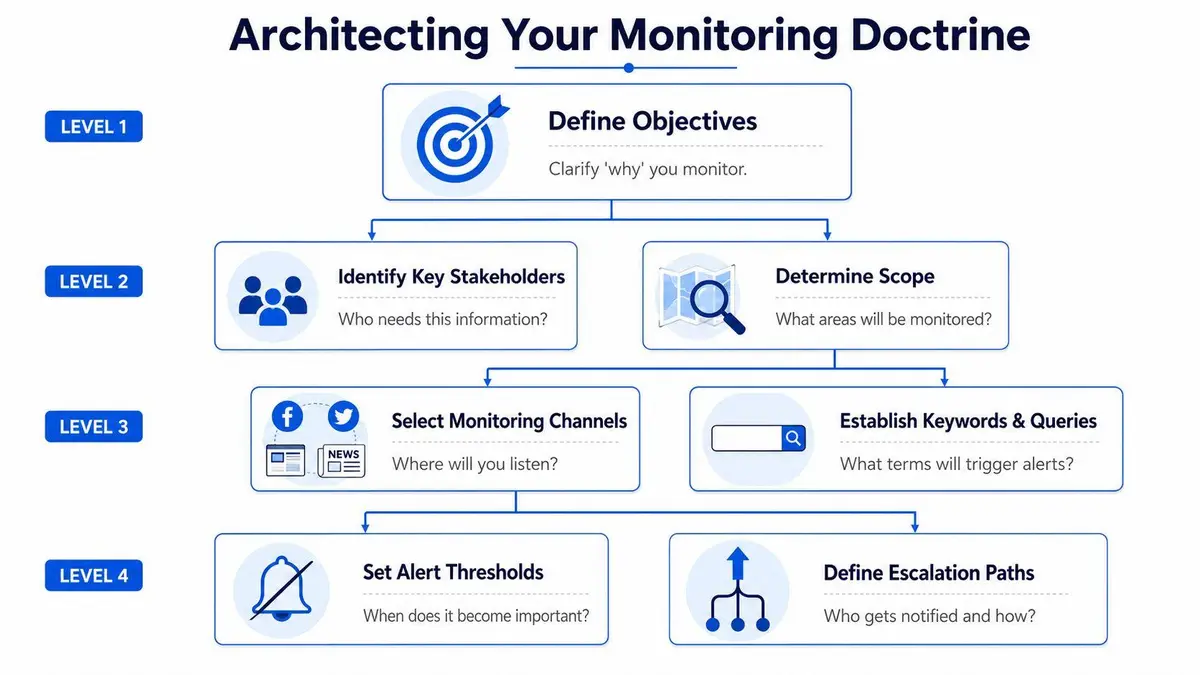
You need a monitoring doctrine. That means a written, defensible set of rules governing what you watch, where you watch it, who owns the output, and what happens when a mention crosses a threshold.
Start with monitored assets, not vanity keywords
A modern monitoring strategy requires cross-channel listening that includes not just brand names but also misspellings, product names, executive names, campaign hashtags, and competitors, because that’s what allows teams to detect reputation shifts early and separate routine chatter from high-risk issues, as outlined in Qualtrics’ guidance on brand monitoring.
That principle is correct, but most organizations still apply it too narrowly. They monitor the company name and flagship product, then assume they have coverage. They don’t.
Your doctrine should include, at minimum, the following categories:
- Primary identifiers: Legal entity names, trading names, brand names, abbreviations, and common misspellings.
- Executive exposure terms: CEO, founder, chair, spokesperson, and other visible individuals. For some clients, family members and close affiliates also need protection.
- Commercial assets: Product lines, service names, trademarks, slogans, campaign hashtags, and branded visuals.
- Hostile or adjacent narrative terms: Competitor names, disputed claims, recurring accusations, and phrases commonly paired with your brand in negative discussions.
Build queries like an investigator
Keyword lists are too blunt on their own. You need structured searches that distinguish useful signals from obvious clutter. That means boolean logic, exclusions, source filtering, and regional segmentation.
A simple example makes the point:
| Query element | Purpose |
|---|---|
| Brand name plus common misspellings | Captures obvious direct references |
| Executive name plus allegation terms | Surfaces higher-risk personal exposure |
| Product name plus defect or scam language | Isolates potential legal and customer harm |
| Brand name minus jobs, careers, investor PDF, unrelated geography | Removes recurring false positives |
A proper doctrine also specifies channel coverage. High-risk clients usually need visibility across social platforms, news coverage, review sites, forums, short-form video, and search-facing web content. If your operation spans several jurisdictions, language and regional filters are essential from the start.
Practical rule: If a search query returns too many mentions for a human to review intelligently, the query is badly designed.
Decide what matters before the first incident
Most organizations wait until a crisis to decide whether a mention is serious. That’s backwards. Your doctrine should state, in writing, what counts as a security issue, what counts as a legal issue, and what remains operational chatter.
Use explicit categories. For example:
- Reputational volatility such as sudden negative narrative concentration around a product or executive.
- Rights abuse such as counterfeit use, unauthorized distribution, or misuse of protected content.
- Identity threats such as impersonation, fabricated endorsements, or fake accounts.
- Litigation-sensitive content such as allegations, leaked documents, or claims that may require preservation and counsel review.
Without that architecture, “how to monitor brand mentions” becomes a software exercise. With it, monitoring becomes a controlled intelligence process.
Configuring the Intelligence Stack
A high-profile mention rarely arrives in a neat, searchable format. It shows up first as a clipped video, a forum screenshot, a review quote copied into an AI answer, or a false allegation repeated across low-grade sites that suddenly rank for your name. If your stack is built for marketing visibility, you will see fragments. If it is built for risk control, you will see the chain.
Technology only helps after the doctrine is clear. The stack should be configured as an intelligence system with defined coverage, source priority, and investigative depth. I recommend three layers: baseline detection, broad listening, and advanced investigative coverage.

Baseline, broad, and advanced coverage
The baseline layer catches obvious web mentions and indexing changes. Google Alerts still has value as a free backstop for basic detection, but it is not command infrastructure. It will miss context, produce false positives, and give you little control over priority.
The broad listening layer should cover news, major social platforms, review sites, forums, short-form video, and search-facing web content. It also needs practical controls: language filters, geography filters, source-type segmentation, and exclusion logic that removes junk before it reaches a human reviewer. Without those controls, the stack becomes an alert generator instead of an early-warning system.
The advanced layer handles the formats and behaviors that create real exposure. That includes logo detection in images and video, monitoring of screenshots and reposts, source mapping across affiliated domains, and tagging that distinguishes criticism from impersonation, allegations, rights abuse, or litigation-sensitive claims. Text-only coverage leaves blind spots that skilled attackers use on purpose.
The AI search blind spot
Many organizations still ignore AI search results. That is now a serious failure in monitoring design.
You need scheduled checks for how your brand appears in ChatGPT, Perplexity, Gemini, and AI Overviews for the prompts a client, investor, journalist, regulator, or opposing counsel would use. AI systems condense scattered public material into a single answer with unwarranted confidence. A false review cluster, an old article, or a forum thread copied across scraped sites can become the dominant narrative in that answer.
Monitor four things:
- Presence: whether your brand appears for relevant prompts
- Accuracy: whether the answer is materially correct
- Contamination: whether false claims, hostile framing, or outdated allegations are being repeated
- Displacement: whether another company, affiliate, or hostile source is taking your place in high-intent results
For a broader framework that connects monitoring with enforcement and exposure control, review this guide to online brand protection services.
Configuration mistakes that ruin signal quality
Poor signal quality usually comes from over-collection, weak filtering, and no source hierarchy. Teams load every possible keyword into a platform, ingest thousands of low-value mentions, and then assume the software will sort out what matters. It will not.
Set source weighting at the start. A regulator’s website, a major publication, a high-authority review platform, and a disposable forum account do not belong in the same queue. Apply exclusion rules aggressively. Separate visual detection from text detection. Create dedicated monitoring sets for executives, brands, products, legal terms, and impersonation patterns. If a query pulls in recurring noise, rewrite it immediately.
A strong stack is selective and resilient. It surfaces material that can trigger legal exposure, executive risk, platform abuse, or AI-search distortion before those issues harden into a public record.
The Triage and Prioritization Workflow
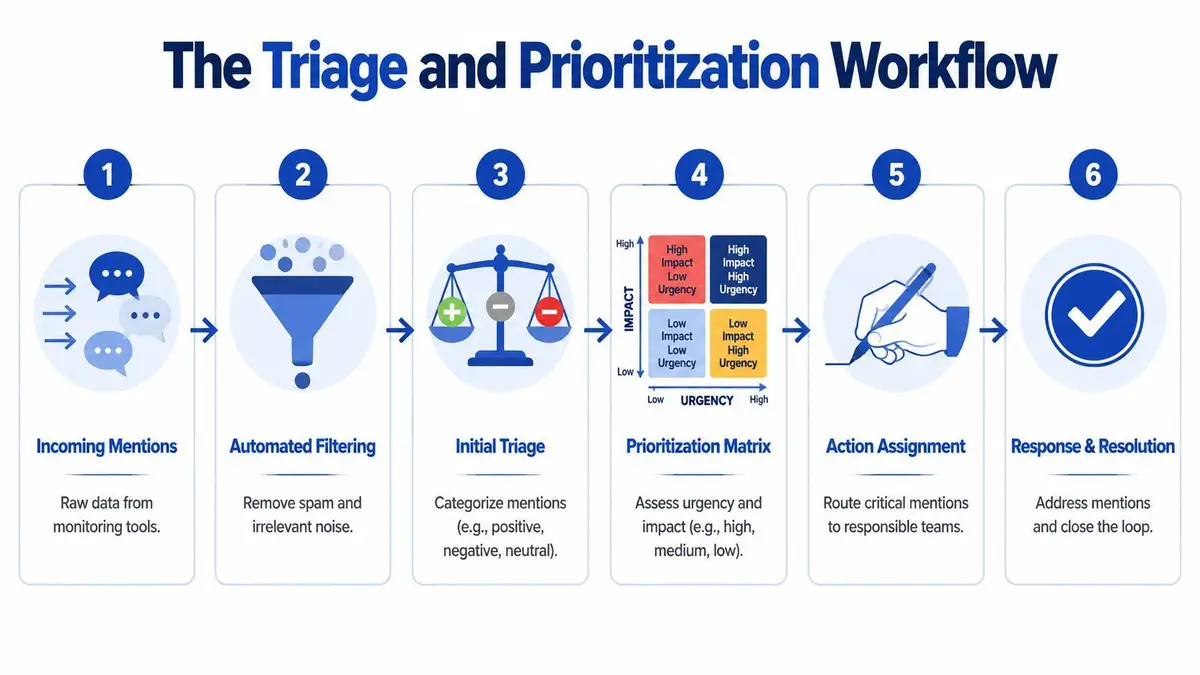
Detection is only useful if the output is processed with discipline. Most organizations don’t have a monitoring problem. They have a triage problem. They receive alerts, glance at them, and postpone judgment until a senior person has time to review them. That delay is where manageable incidents become public crises.
Your workflow needs explicit severity levels, named decision owners, and default actions. If those elements aren’t predetermined, people improvise under pressure.
Use a severity framework that people can apply fast
I recommend a three-level structure because it forces clarity without creating bureaucratic drag.
| Severity level | What it usually includes | Default handling |
|---|---|---|
| Code Red | Defamation, impersonation, leaks, explicit threats, false criminal or financial allegations, high-visibility media pickup | Immediate routing to legal, security, and executive owner |
| Code Amber | Negative coverage with traction, coordinated criticism, influential commentary, major customer accusations, harmful inaccuracies | Same-day review with designated response lead |
| Code Green | Routine mentions, low-impact complaints, generic praise, isolated chatter with no spread | Digest review and no immediate escalation unless pattern changes |
This framework matters because attention is finite. Not every negative mention deserves intervention. Some deserve preservation, analysis, and silence. Others demand immediate action before they multiply.
A practical benchmark from Semrush’s brand mention workflow guidance is to route high-priority alerts in real time while using digests for lower-priority mentions, with a useful threshold at sources with over 10,000 followers or posts with over 1,000 engagements. That is a solid operational rule because it prioritizes mentions with higher likelihood of spread.
Filter first, then escalate
Automated filtering should remove spam, obvious irrelevance, duplicated reposts, and low-value bot traffic before a human sees the alert. Human review should then answer four questions in order:
- Is the mention authentic? Fake screenshots, parody posts, and manipulated clips waste time if not verified quickly.
- Is it spreading? Velocity often matters more than raw negativity.
- Does it create legal, security, or commercial exposure? Some hostile content is merely unpleasant. Some is actionable.
- Who owns first response? Counsel, communications, security, customer operations, or no one.
Later in the workflow, this short video gives a useful practical lens on handling monitoring output:
Don’t confuse reaction with control
The fastest response isn’t always the best response. Public replies can validate fringe content and increase its reach. For serious incidents, the first move is often internal: preserve evidence, identify source authority, confirm jurisdiction, map replication points, and decide whether the issue is removable, suppressible, or merely monitorable.
A mention becomes dangerous when it reaches the wrong audience with the wrong framing at the wrong time.
That is why your triage process should record not just sentiment, but risk type. A negative product review is not the same as an impersonation account. A hostile op-ed is not the same as a false criminal allegation on a regional forum. Treating all negatives alike is amateur work.
Escalation Protocols and Content Remediation
Once a mention is classified as serious, monitoring stops being an observational function. It becomes a command function. At this point, many internal teams freeze. They know something is wrong, but they haven’t agreed in advance on who makes the call, what evidence must be collected, or which remedy fits the facts.
That uncertainty costs time, and time usually favors the publisher.
Build the chain of command before the incident
Every high-severity mention should map to a response owner and a legal or executive checkpoint. The point isn’t hierarchy for its own sake. The point is to prevent drift.
A workable escalation matrix usually looks like this:
- Legal-sensitive content: Routed to internal or outside counsel for defamation analysis, platform complaint review, preservation decisions, and jurisdictional assessment.
- Security-related content: Routed to security or trust teams when there’s impersonation, doxxing, extortion, account compromise, or credible threat language.
- Media-sensitive content: Routed to executive communications only after legal and factual review, not before.
- Rights enforcement matters: Routed to trademark, copyright, or platform enforcement specialists for takedown action where applicable.
If you don’t define that chain beforehand, teams tend to over-consult and under-act. The issue then sits in Slack threads while copies continue to spread.
Match the remedy to the content type
Not all harmful mentions should be handled the same way. A false review may require platform challenge and pattern documentation. An infringing video may require rights-based removal. A fabricated article may call for legal notice, publisher negotiation, search suppression strategy, or all three.
The key is selecting the remedy based on source, jurisdiction, platform rules, and evidentiary strength. Knee-jerk public rebuttals often produce the worst outcome because they create a second, more visible record of the allegation.
For executives dealing with this intersection of detection and enforcement, this guide to content removal and reputation risk addresses the response logic clearly.
Counsel’s view should come early: the first question is not “What should we say?” but “What can be removed, challenged, preserved, or escalated without enlarging the record?”
Multi-language and regional issues require separate rules
A significant challenge in global monitoring is separating crisis spikes from sustained narrative shifts across different languages and jurisdictions, rather than collecting more data, as emphasized in Prowly’s discussion of brand mentions. That distinction matters because a transient local flare-up should not trigger the same response as a cross-market narrative taking hold over time.
Regional monitoring therefore needs more than translation. It needs local interpretation. A phrase that reads neutral in one market may imply fraud in another. A local review platform may carry more commercial weight than a major global network. A legal remedy available in one jurisdiction may be ineffective or counterproductive elsewhere.
For that reason, escalation protocols should specify when local counsel, regional communications leads, or specialist investigators must be brought in. “Global dashboard, local response” sounds neat, but it fails unless the local layer possesses actual authority.
Measuring and Reporting for Strategic Oversight
At 6:30 a.m., a board member forwards an AI-generated answer that repeats a false allegation about your company as if it were settled fact. By 7:00 a.m., legal wants to know how long it has been circulating, who saw it, whether it migrated into search or media coverage, and what you did when it first appeared. Your reporting function should answer those questions immediately.
A serious monitoring program reports to leadership as an oversight and control system. The standard is simple. Can the organization show early detection, correct classification, disciplined escalation, and a defensible response record across search, social, review platforms, news, and AI search outputs?
That requires reporting built around three things: control performance, narrative persistence, and escalation quality.
What belongs on the executive dashboard
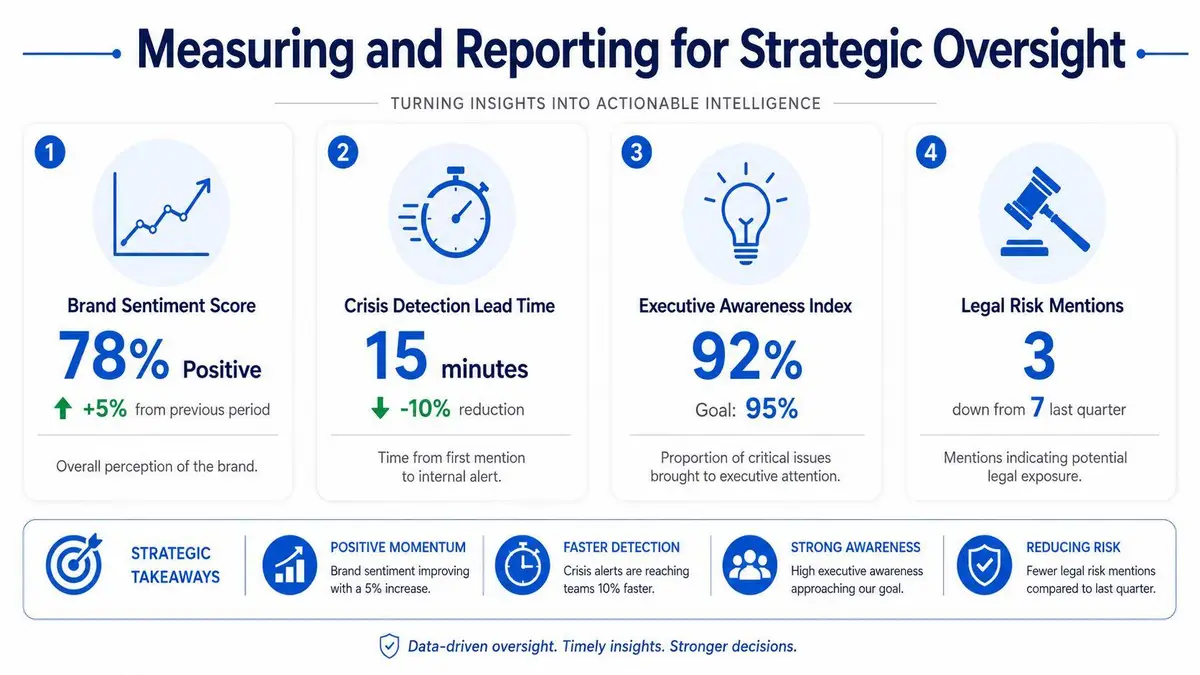
An executive dashboard should stay compact and answer a small set of operational risk questions.
- Detection speed: How quickly did high-risk mentions reach the right internal owners?
- Decision speed: How quickly did the organization move from alert to legal, communications, security, or executive review?
- Exposure concentration: Which risk categories are recurring, such as impersonation, false reviews, executive allegations, harassment, doxxing, IP abuse, or claims repeated by AI systems?
- Narrative persistence: Did the issue fade, or did it spread across channels, geographies, and AI search summaries?
- Control reliability: Which escalations were handled within protocol, and where did delays, confusion, or ownership gaps appear?
Include AI search monitoring in this view. If a false claim appears in generated answers, summaries, or chat interfaces, treat it as a distribution layer, not a novelty. Leadership needs to know whether a harmful mention stayed isolated on one URL or began influencing what investors, journalists, customers, counterparties, or employees see when they ask AI tools about the company.
Report trends that affect exposure
Boards, general counsel, and principals do not need a pile of screenshots. They need a concise account of what changed, why it matters, and whether the organization remained in control.
Use a three-part reporting model:
- Executive brief: What emerged this period, what crossed escalation thresholds, and what remains unresolved.
- Pattern review: Which narratives strengthened, weakened, or moved from one environment to another, including search results, reviews, social posts, publisher coverage, and AI-generated answers.
- Action record: What was removed, challenged, preserved, referred to counsel, escalated to platforms, or left alone by deliberate decision.
This format does two jobs at once. It keeps senior stakeholders out of operational clutter, and it creates a record that can withstand scrutiny after a serious incident.
Weekly review usually gives leadership a clearer read than daily noise. The goal is to identify sustained narrative movement and control failure, not react to every fluctuation.
The standard for useful measurement
Measure the monitoring function against outcomes that matter to counsel and senior leadership:
- Did the team identify the issue early enough to limit spread?
- Did the item reach the correct decision-maker without delay?
- Did the escalation path match the risk category and jurisdiction?
- Did the response reduce visibility, remove content, preserve evidence, or contain amplification?
- Did the same failure mode appear more than once?
If your reporting cannot answer those questions, it is not strategic oversight. It is activity logging.
The final test is blunt. If the same allegation, leak, impersonation attempt, or AI-generated falsehood appears again tomorrow, can leadership trust the system to catch it early, route it correctly, and produce a defensible record of action?
If not, fix the reporting before the next incident.
If you need a confidential assessment of your current exposure, ContentRemoval.com helps executives, brands, and public figures monitor high-risk mentions, assess escalation options, and remove harmful content across search, web, and social environments with discretion. The right time to build that capability is before the next incident forces the issue.
Frequently asked questions
Is Google Alerts enough to monitor brand mentions?
It has value as a free backstop for basic web detection, but the article treats it as a baseline layer only. It misses context, produces false positives and offers no priority control, so high-risk organizations add broad listening across social, news, reviews, forums and video, plus visual detection and AI search checks.
Which brand mentions should be escalated to legal?
Defamation, impersonation, leaks, explicit threats, and false criminal or financial allegations belong in the top severity tier and go to counsel, security and an executive owner immediately. Negative coverage with traction or coordinated criticism gets same-day review, while routine mentions sit in a digest.
How do I monitor what AI tools say about my company?
Schedule checks in ChatGPT, Perplexity, Gemini and Google AI Overviews using the prompts a client, investor, journalist or regulator would type. Track whether the brand appears, whether the answer is accurate, whether false or outdated claims are being repeated, and whether a competitor or hostile source has displaced you.