
Brand protection monitoring is a governance function that detects impersonation, counterfeits, lookalike domains, fake apps and stolen brand assets across web, marketplaces, social media, app stores and the dark web, then converts each alert into verified evidence and a channel-specific takedown. Its value is measured by mean time to detection, time to takedown and takedown success ratio, not alert volume.
Key facts
- The brand protection tools market is projected to grow from USD 3.40 billion in 2025 to USD 7.96 billion.
- Phishing domains often live less than 24 hours, so next-day discovery through customer complaints is already too late.
- Social impersonation usually resolves faster under platform impersonation and fraud policies than through trademark argument.
- Triage should confirm the asset is live, the harm it causes, the evidence available and which channel controls removal.
Where ContentRemoval.com comes in. ContentRemoval.com handles the remediation half of brand protection: taking down executive impersonation accounts, cloned pages, scam listings built from stolen imagery and the search results that keep them visible, with recurrence monitoring afterward. Security leads, legal teams and communications heads usually bring the firm in once their monitoring vendor has produced alerts but no removals. A free 15-minute Exposure Scan maps what is removable, and the report is yours to keep. Get a Free, Confidential Exposure Scan or read how our content removal work is done.
A familiar pattern plays out in boardrooms more often than most executives admit. A fake social profile appears on a Friday evening using your CEO’s name and photograph. By Saturday morning it is soliciting investors, customers, or job applicants. Your team spots it only after confused emails start arriving, and by then the impostor has already harvested trust that took years to build.
That is the subject of brand protection monitoring. It is not a software category to be parked with marketing, and it is not a trademark watch service with a modern label. It is a control function for preserving enterprise value when criminals, counterfeiters, impersonators, and opportunists use your name faster than your internal teams can react.
Many companies already buy monitoring tools. Far fewer have built a response process that can verify a threat, preserve evidence, choose the right legal theory, approach the right platform or registrar, and keep pressure on the issue until removal is confirmed. That gap is where reputational damage becomes operational damage. Detection without remediation creates dashboards, not protection.
If you carry responsibility for revenue, governance, investor confidence, or customer trust, a passive posture is indefensible. The market has already moved. The broader market for brand protection tools is projected to grow from USD 3.40 billion in 2025 to USD 7.96 billion by 2035, a projected 8.8% CAGR, according to Future Market Insights on the brand protection tools market. Spending has expanded because the problem has expanded. The practical remit now covers web, marketplaces, social media, app stores, and the dark web.
Introduction The Mandate for Active Digital Defense
Your brand is an asset on the balance sheet in everything but accounting treatment. When an attacker impersonates your executives, clones your website, or sells counterfeit goods under your marks, the immediate issue isn’t abstract reputational harm. It is misdirected payments, corrupted customer relationships, legal exposure, and avoidable strain on internal teams.
Senior leadership often underestimates the pace of these events. The old model assumed abuse would surface through complaints, legal notices, or routine sweeps. That model is obsolete. Modern abuse campaigns move across channels in parallel, and they do so with very little friction.
Governance, not housekeeping
Treat brand protection monitoring as a governance function. It sits alongside fraud prevention, incident response, and executive protection because the consequences are the same. Someone abuses trust that belongs to your organization, then your organization pays to unwind the damage.
Practical rule: If a fake asset can reach your customers before your team can verify and escalate it, you do not have a monitoring problem alone. You have a control failure.
That’s why response speed matters more than tool volume. Mature programs measure mean time to detection and time to takedown because those metrics reflect whether your organization can interrupt a threat before it matures into a customer incident. Vendors and practitioners now treat these as core performance indicators rather than legal afterthoughts, as noted in the earlier market discussion.
The executive test
Ask a hard question. If a fraudulent domain, counterfeit marketplace listing, or executive impersonation account appears tonight, who owns the next three hours?
If the answer involves multiple inboxes, unclear authority, or a debate over whether legal, security, communications, or marketing should lead, then your current setup is not protection. It is escalation theater. Effective brand protection monitoring only works when detection, evidence, legal analysis, and enforcement operate as one business process.
The Modern Threat Landscape for Brands
A fake support account appears on social media at 8:10 a.m. By 9:00, customers have shared card details in direct messages, your contact center is overloaded, and Legal is still deciding whether the account qualifies as impersonation, fraud, or trademark misuse. That sequence is the primary problem. Brand abuse now moves faster than internal decision-making at many companies.
The threat surface is broader than trademark infringement or counterfeit goods. Attackers go where trust already drives clicks, payments, and disclosure. They use search results, social accounts, app stores, marketplaces, messaging channels, and cloned sites because each one gives them direct access to your customers under your name.
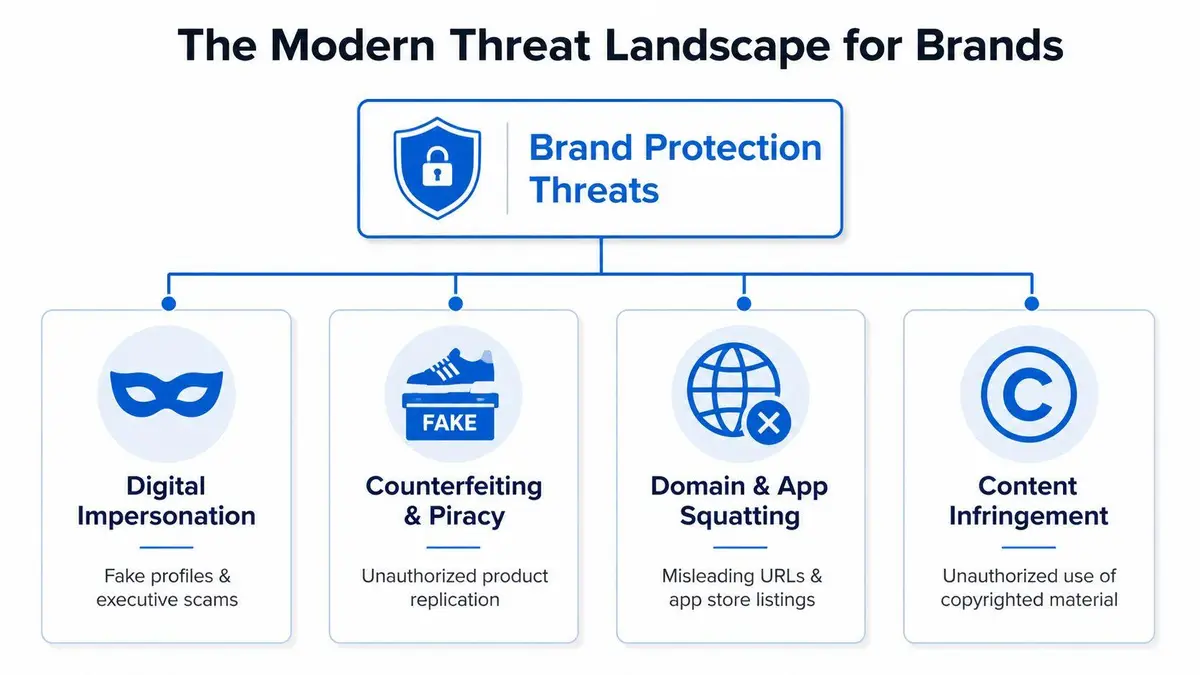
Impersonation is usually the fastest route to customer harm
A fake executive profile, spoofed recruiting page, or cloned support account can cause immediate damage because people act on familiar branding before they verify source authenticity. The asset does not need to be elaborate. It only needs to look plausible long enough to trigger a payment, a credential submission, or a public reaction.
The operational challenge is clear. Impersonation cases demand triage in hours, not days. If your teams detect a fake account quickly but cannot gather evidence, assign ownership, and trigger platform or legal action without delay, monitoring has done only half the job.
Counterfeiting and unauthorized sales break channel control
Counterfeit listings and unauthorized sellers do more than infringe intellectual property. They weaken pricing discipline, create product safety exposure, distort marketplace data, and train buyers to distrust legitimate channels. Once that confusion sets in, every enforcement action becomes more expensive.
Executives should treat this as a control issue, not a catalog-cleanup exercise.
The strategic risk is fragmentation. One seller may violate distribution policy. Another may offer counterfeit stock. A third may copy product images and bundle them into a scam listing. Automated monitoring can detect these assets at scale. It cannot decide, on its own, which cases require marketplace enforcement, contractual action, customs support, or trademark escalation. That judgment is where mature programs separate signal from legal noise.
Domain and app squatting create the infrastructure for larger attacks
Lookalike domains, deceptive landing pages, and fake apps are often the foundation for phishing, payment diversion, credential theft, and malware delivery. Their purpose is not visibility alone. Their purpose is conversion.
A single fraudulent domain can support email spoofing, fake checkout flows, paid search abuse, and social promotion at the same time. That is why isolated review is a mistake. Security, legal, and brand teams need to assess the full abuse chain tied to the asset, then remove the parts that sustain the threat.
The right test is simple. Would a tired customer on a phone trust it for ten seconds? If yes, treat it as an active risk.
Content theft gives bad actors credible raw material
Unauthorized use of logos, product images, videos, and marketing copy often looks minor until those assets appear inside fake storefronts, scam ads, or impersonation pages. Stolen content gives fraudulent assets enough legitimacy to pass a casual check. That is usually all an attacker needs.
The response should match the abuse type. Some cases belong in a copyright process. Others are stronger as impersonation, consumer protection, or deceptive conduct claims. The important point is operational. If your teams classify every misuse as generic infringement, they will choose slower remedies and lose time that matters.
Closed channels shift the warning window earlier
Public exposure is often the middle of the story, not the start. Scam kits, leaked credentials, fake documents, and planned impersonation campaigns often circulate in closed groups or underground forums before any customer sees the public-facing asset. By the time a fake domain or account is reported, preparation may already be complete.
This changes the executive requirement. You need early visibility, but you also need a response model that can act on incomplete signals without creating legal overreach. Fast detection matters. Defensible escalation matters more.
| Threat category | Typical business consequence | Executive concern |
|---|---|---|
| Impersonation | Fraud, misinformation, customer confusion | Trust, liability, response speed |
| Counterfeiting | Revenue diversion, unsafe products, channel conflict | Margin, safety, channel control |
| Domain and app abuse | Credential theft, scam payments, fake support | Customer harm, cross-channel fraud |
| Content infringement | Scaled deception using your own assets | Loss of control, slower enforcement |
Core Technologies in Brand Protection Monitoring
The technology matters, but not for the reasons vendors usually emphasize. Executives don’t need a lesson in detection jargon. They need to understand what capabilities separate a useful monitoring system from an alert factory.
The baseline requirement is breadth. Effective brand protection monitoring is a multi-channel detection pipeline that scans domains, websites, social platforms, marketplaces, app stores, email infrastructure, and dark-web sources to identify lookalike domains, fake profiles, phishing pages, counterfeit listings, and executive impersonation before they scale into customer-facing fraud, according to Netcraft’s explanation of what brand protection software does.
Wide-net collection finds what your teams won’t manually see
Think of modern monitoring as a persistent surveillance grid, not a watchlist. The system has to collect signals from many different environments because attackers don’t stay in one lane. They register domains, spin up pages, create profiles, upload listings, and reuse images across channels.
A serious program won’t rely on exact keyword matching alone. It needs continuous collection that can spot variations, near matches, and assets linked by behavior rather than identical text.
Image and logo recognition close obvious blind spots
Bad actors rarely copy a brand perfectly. They alter colors, crop logos, change spacing, or combine official product images with fake offers. That is why modern platforms combine keyword monitoring, image and logo recognition, and pattern recognition, as Netcraft notes in the source above.
For a non-technical executive, the analogy is simple. Text matching catches someone using your exact name. Image recognition catches someone wearing your uniform with the badges slightly moved.
Monitoring that only sees exact text strings will miss the abuse that actually fools customers.
Pattern recognition matters more than vendor buzzwords
Many providers market artificial intelligence as if the term itself settles the issue. It doesn’t. The useful capability is pattern recognition that spots suspicious relationships across assets. A cluster of fake profiles using similar imagery, repeated page structures across cloned sites, or recurring naming conventions in fraudulent apps tells analysts where to focus.
That is what separates scalable monitoring from random searching. The objective is not to prove that a model is advanced. The objective is to reduce blind spots and route credible threats for verification quickly.
Monitoring must support action, not just visibility
Detection systems earn their value only when they support evidence collection and escalation. Screenshots, links between related assets, timestamps, ownership indicators, and platform context all matter because they become the basis for enforcement.
A practical buying standard is whether the monitoring layer can feed a response workflow. If it cannot, you are paying for awareness without resolution.
For organizations that want broader visibility into online reputation risks alongside brand abuse, services such as reputation monitoring from ContentRemoval.com can sit adjacent to specialist detection platforms. The right mix depends on whether your main risk is phishing infrastructure, impersonation, counterfeit activity, or harmful published content.
The Takedown Lifecycle From Alert to Resolution
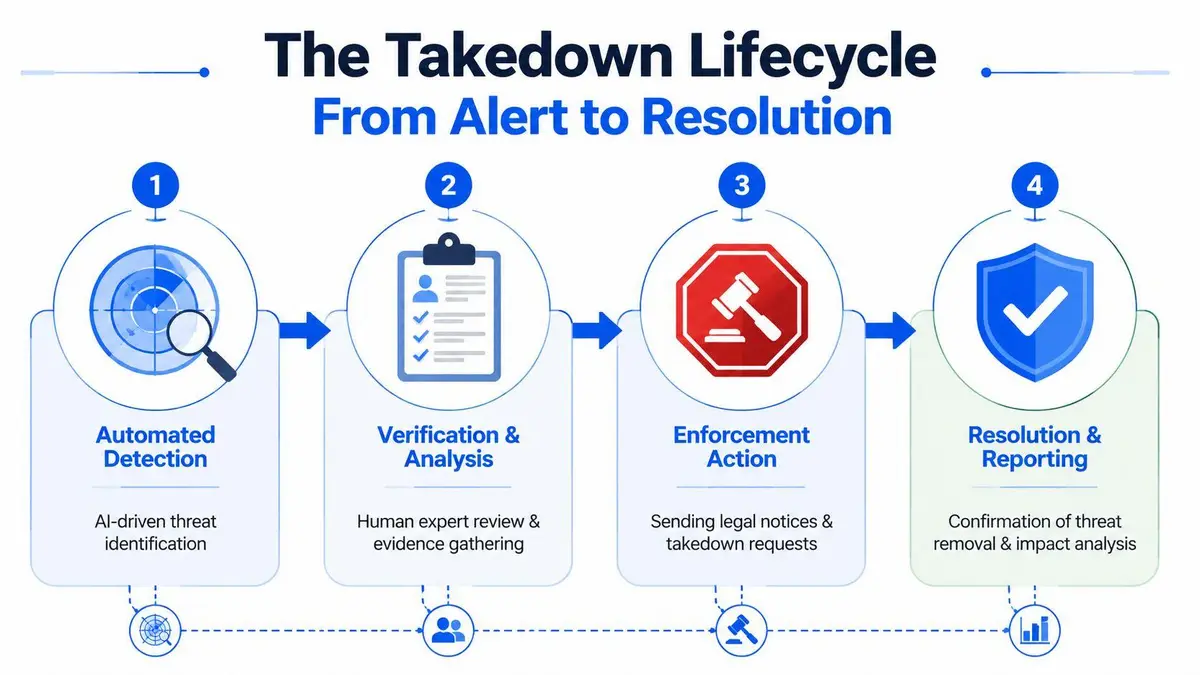
Most failures in brand protection happen after the alert. A system flags a suspicious domain or fake profile. An analyst glances at it. Someone emails legal. The platform form is submitted with weak evidence. Days pass. The asset disappears and reappears elsewhere. Internally, everyone says the threat was “handled.” It wasn’t.
A defensible process looks different.
Detection without triage wastes time
An alert is not a case. It is a lead. Someone has to verify whether the asset is malicious, unauthorized but benign, parody, fair use, legitimate resale, or a duplicate of an existing matter. That sounds obvious, yet many in-house teams skip it under pressure and start filing notices too early.
Poor triage creates two problems. It slows action against real threats, and it undermines credibility with platforms and registrars when your notices overreach.
A disciplined first review should answer four questions:
- Is the asset real and active: Dead links and stale profiles consume time if no one checks them.
- What harm is it causing: Phishing, payment diversion, impersonation, counterfeit selling, or asset misuse each require a different response theory.
- What evidence exists right now: Screenshots, account handles, listing details, captured content, and visible identifiers must be preserved immediately.
- Which channel controls removal: Platform trust and safety, marketplace enforcement, hosting provider, registrar, search engine, or direct legal action.
Legal theory determines the speed of removal
Many automation-first programs break down. They detect correctly but remediate clumsily because they treat every threat as the same type of complaint.
A fake marketplace listing may hinge on trademark rights, copyright in product images, unauthorized seller policy, or consumer deception rules. A cloned website may support a registrar or host escalation if it is clearly fraudulent, while a reused article excerpt may call for a copyright route. Domain disputes can move into UDRP strategy in the right circumstances. Social impersonation often succeeds faster under platform impersonation and fraud policies than through formal trademark argument alone.
The fastest path is rarely the broadest accusation. It is the most precise claim supported by the cleanest evidence.
Human handoffs decide whether you win
The operational model should resemble incident response. Detection identifies the event. Analysts verify it. Legal or specialist remediation teams choose the enforcement path. Stakeholders receive updates based on business impact, not technical noise.
That is why incident discipline matters here. If your team needs a practical framework for escalation ownership, severity, and post-incident review, Tekk.coach incident management tips are a useful reference point. The mechanics differ, but the underlying principle is identical. Clear ownership beats improvised collaboration every time.
A strong workflow usually includes these roles:
| Role | Primary responsibility | Common failure if absent |
|---|---|---|
| Analyst | Verify threat and preserve evidence | False positives, weak records |
| Legal or specialist remediation lead | Select enforcement path | Wrong notice type, avoidable delay |
| Business owner | Set priority based on impact | Low-risk issues consume high attention |
| Reporting lead | Confirm removal and recurrence watch | Threat reappears unnoticed |
Resolution is not the endpoint
A takedown request accepted by a platform is progress, not closure. Someone still has to confirm the content is removed, indexed references are addressed where relevant, and related assets have not migrated to adjacent channels.
The best teams also document what the matter revealed. Was there a recurring seller cluster, a repeated impersonation script, a vulnerable executive profile, or a pattern in how attackers reused your imagery? That post-resolution analysis improves future detection and shortens future cases.
The executive takeaway is blunt. Buying monitoring software solves only the first tenth of the problem. The value sits in the full response lifecycle, because that is where exposure is reduced.
Measuring Performance KPIs for Brand Protection
Executives don’t need more activity reports. They need proof that the organization can reduce exposure in meaningful time. If your reporting centers on raw alert counts, your program is probably under-managed. More alerts can mean broader coverage, but they can just as easily mean worse prioritization.
Speed metrics are operational truth
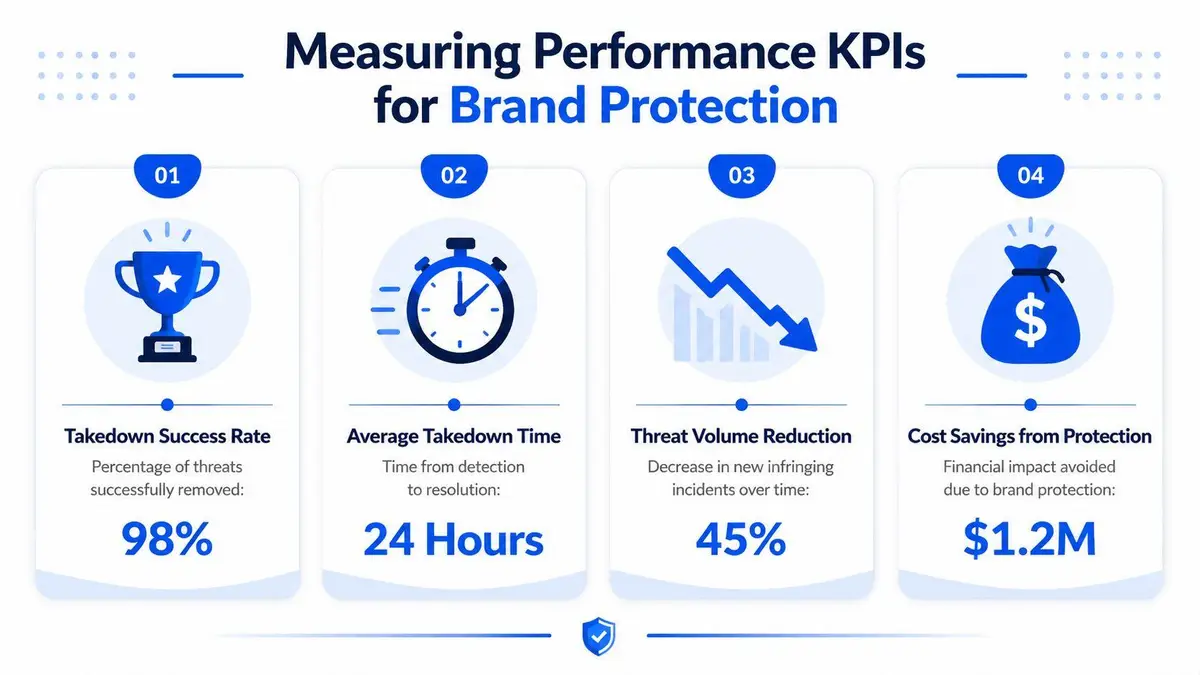
The most useful measures in brand protection monitoring are mean time to detection and time to takedown. They tell you whether your system can find abuse quickly and whether your process can remove it before customers are exposed for too long.
Some malicious assets do not stay live long enough for leisurely review. Recorded Future notes that phishing domains often have a lifespan of less than 24 hours, which is why continuous monitoring is now essential, as explained in Recorded Future’s discussion of real-time intelligence for brand protection.
A short-lived phishing domain creates an unforgiving reality. If your team learns about it through customer complaints on the following day, enforcement timing has already failed.
The right KPI set is narrow and unforgiving
A practical executive dashboard should focus on a small number of performance indicators tied to business impact. Recorded Future also notes that organizations track takedown success ratio, customer complaints, and fraud losses prevented as standard KPIs in this area, in the source above.
Use those metrics with discipline:
- Mean time to detection: Measures how quickly your monitoring and triage processes identify a credible threat.
- Time to takedown: Measures how quickly the organization turns detection into confirmed removal.
- Takedown success ratio: Shows whether your notices are precise, evidence-backed, and sent through the right channels.
- Customer complaints: Indicates whether abuse is still reaching the public despite monitoring.
- Fraud losses prevented: Links the function to avoided harm rather than administrative activity.
Vanity metrics distort decision-making
An executive team should challenge weak reporting. “Threats identified” is not enough. “Notices sent” is not enough. “Platforms contacted” is not enough. Those are throughput measures, not outcome measures.
A monitoring program that cannot show detection speed, takedown speed, and removal effectiveness is describing motion, not control.
For leadership teams under pressure to justify spend, the more useful question is whether brand protection is reducing incident exposure across customer trust, fraud prevention, and reputational stability. If you need a framework for connecting protective activity to business outcomes, this guide on proving ROI on reputation management for executives is a practical companion.
Selecting Your Brand Protection Partner
Most buying mistakes happen because companies evaluate brand protection like software procurement. They compare dashboards, crawler coverage claims, and price. Those factors matter, but they do not determine whether you will get harmful material removed quickly and defensibly.
The partner you need is not just a monitoring vendor. You need an operator that can detect, assess, enforce, and report across jurisdictions and platforms without creating legal mess or internal confusion.
What differentiates a serious provider
Start with remediation competence. Ask how the provider handles impersonation, counterfeit listings, cloned pages, fake apps, and unauthorized content use as distinct problem types. If the answer sounds like one universal takedown engine, keep looking.
Then test evidence quality. A premium provider should preserve the material needed to support the specific enforcement path being used. That includes the context that platforms, registrars, and legal teams need to act. Thin evidence leads to rejected notices and repeated submissions.
A capable partner should also explain its operating model in plain terms:
- Escalation design: Who reviews alerts, who authorizes action, and what happens outside business hours.
- Legal fluency: Whether the team can distinguish platform policy violations from copyright, trademark, privacy, and fraud-based enforcement routes.
- Jurisdictional reach: Whether they can act across the countries and platforms where your exposure exists.
- Reporting discipline: Whether reports show outcomes, recurrence, and business impact instead of just case volume.
Questions worth asking before you sign
Use procurement pressure to force clarity. If a provider cannot answer these questions cleanly, your program will suffer later.
| Question | Why it matters |
|---|---|
| How do you prioritize threats by business impact | You need more than chronological ticket handling |
| What evidence do you preserve before filing notices | Weak evidence weakens every remedy |
| Which removals depend on policy, and which depend on legal rights | The route determines the timeline |
| How do you monitor recurrence after takedown | Repeat abuse is common |
| What does executive reporting include | Leadership needs outcomes, not noise |
Implementation should be narrow before it becomes broad
Don’t start by trying to monitor every possible abuse scenario equally. Define the assets and threat types that create the most serious exposure. For one company, that may be executive impersonation and investor scams. For another, it may be counterfeit marketplace activity or cloned checkout pages.
Then align stakeholders early. Security, legal, communications, trust and safety, and executive protection often touch the same incidents from different angles. If those teams don’t share ownership rules, your provider will end up waiting on internal decisions that should have been settled before launch.
A broader guide to online brand protection services can help frame the service categories, but the central decision remains simple. Choose the partner with the strongest response lifecycle, not the prettiest interface.
Case Studies in Brand Protection and Your Next Steps
The value of brand protection monitoring becomes obvious when you look at how these matters play out.
An executive team at a private company discovers that a fake profile using the founder’s identity is contacting investors with a revised payment instruction. A weak provider would classify that as a social impersonation case and start platform reporting. A capable provider treats it as a live fraud event. The response includes evidence capture, impersonation reporting, related account discovery, domain and email infrastructure review, and direct coordination with the company’s legal and communications leads. The objective is not just removal. It is disruption of the wider scam pattern before more recipients are targeted.
A consumer brand faces a cluster of unauthorized marketplace sellers using stolen product images and modified packaging. The mistake many companies make is to file isolated complaints listing by listing. That approach is slow and expensive. A stronger team maps the network, identifies repeated asset reuse, separates legitimate gray-market questions from outright counterfeit activity, and pushes coordinated enforcement through the relevant platforms. The measurable value isn’t a dashboard full of tickets. It is restored control over where and how the brand appears.
A third example is less visible but just as serious. A family office principal begins seeing fragments of personal data and private imagery reused in scam posts and fake account biographies. The issue is no longer just reputation. It is personal security. The correct response combines continuous monitoring, discreet evidence handling, and targeted removal strategy across social platforms, search visibility, and source locations.
These examples all point to the same conclusion. Monitoring is only valuable when it feeds a legally sound, operationally disciplined response process. If your current setup produces alerts but still leaves executives, customers, or counterparties exposed, it is not mature enough.
The next step should be confidential and concrete. Inventory the names, domains, executive identities, core products, and visual assets that require active defense. Review who owns triage, who approves enforcement, and what happens when incidents emerge outside business hours. Then assess whether your current provider can do more than detect.
If you need a confidential assessment of your current exposure, ContentRemoval.com can evaluate where your brand, executives, or private principals are vulnerable online and outline a response plan focused on detection, evidence preservation, takedown strategy, and ongoing monitoring.
Frequently asked questions
What KPIs should a brand protection program report to the board?
Mean time to detection, time to takedown, takedown success ratio, customer complaints and fraud losses prevented. The article warns that counts of threats identified, notices sent or platforms contacted are throughput measures that describe motion rather than control.
Why do takedown requests for fake accounts or listings get rejected?
Usually because the notice overreaches or the evidence is thin. Filing too early without verifying whether the asset is malicious, parody, fair use or legitimate resale slows real cases and damages credibility with platforms and registrars. The most precise claim with the cleanest evidence moves fastest.
How should a company choose a brand protection partner?
Test remediation competence across impersonation, counterfeits, cloned pages, fake apps and content misuse as distinct problem types. Then ask how evidence is preserved, who reviews alerts outside business hours, which removals rest on policy versus legal rights, and how recurrence is tracked after a takedown.