
Localized digital marketing for executives is a governance exercise with revenue consequences: local search, maps, directories and review platforms are due diligence surfaces, so verification and response must be localized before demand generation. That means tiering markets by opportunity and exposure, locking down canonical listing data and ownership, adapting content natively, and running monitoring, triage, action and recurrence control.
Key facts
- Cited benchmarks report 46 percent of Google searches carry local intent and most nearby searchers visit within a day.
- Markets are tiered as primary growth, secondary or watchlist, each with its own reputation posture and operational standard.
- Lock down Google Business Profile, Apple Maps, data aggregators and directories before running content or ads.
- The defensive layer separates lawful negative reviews from impersonation, outdated listings and defamatory content.
Where ContentRemoval.com comes in. ContentRemoval.com closes the gap between expanding local visibility and controlling what appears beside it, removing impersonation profiles, false reviews, duplicate listings and harmful regional results for executives, clinics, advisory firms and family offices. The marketing director or general counsel usually gets in touch when a branded city query has started surfacing something the campaign is paying to amplify. A free 15-minute Exposure Scan maps what is removable in each market, and the report is yours to keep. Get a Free, Confidential Exposure Scan or read how our content removal work is done.
A campaign launches cleanly in London and Singapore, then starts failing in Miami, Dubai, or a second-tier regional market you didn’t treat as strategically distinct. Search results show outdated business information. A local directory carries the wrong phone number. An impersonation profile appears beside your official listing. A negative article or false review starts ranking for branded local queries just as paid media spend increases. The problem isn’t only wasted budget. It’s that you expanded visibility faster than you expanded control.
That is the core challenge with localized digital marketing for executives, founders, and public figures. Most advice treats localization as a revenue exercise. It isn’t. It is a governance exercise with revenue consequences. If your name, firm, clinic, office, or brand appears in local search, maps, directories, review platforms, and city-specific media, you need a system that captures demand without exposing the business to unmanaged reputational risk.
An advanced local strategy does two jobs at once. It wins high-intent discovery where buyers are ready to act. It also hardens the local search environment so hostile, false, outdated, or misleading assets don’t sit beside your official presence and poison conversion at the moment of decision.
The Dual Imperative of Localized Marketing
Most companies still frame localization too narrowly. They ask how to translate pages, adapt ad copy, or rank in local search. They should be asking a harder question. What happens when localized visibility expands faster than your ability to verify, defend, and correct what local audiences see?
The commercial case is already clear. 84% of businesses see revenue growth from localization, while 58% of people use voice search for “near me” queries, according to localization and local intent benchmarks. The same dataset reports that 46% of all Google searches have local intent, 76% of people who search for something nearby visit a business within 24 hours, and 28% of near-me searches result in a purchase the same day. Those are not branding metrics. They describe immediate, high-intent behavior.
For executives, that creates a dual imperative. First, you need local discoverability in the markets that matter. Second, you need local result quality. If a high-intent searcher sees a false review cluster, an obsolete location page, a copied listing, or a hostile result tied to a city-specific query, your visibility becomes a liability.
Revenue without control is exposure
Local intent is commercially valuable because it sits close to action. That also means any error appears at the worst possible point in the buyer journey. A person searching for a nearby office, a local adviser, or a regional branch is no longer browsing casually. They are evaluating credibility in real time.
Practical rule: Treat every local search result as a due diligence surface, not just a traffic source.
That changes the operating model. Localized digital marketing should not be delegated as a light adaptation layer under a generic global campaign. It needs ownership across search, listings, paid media, reviews, legal escalation, and internal approvals. If that sounds more stringent than standard marketing guidance, it should. High-value names attract a different category of risk.
The first principle of a control-based strategy
Your first principle is simple. Don’t localize demand generation until you’ve localized verification and response. Before you push spend or expand content, establish who owns market-by-market accuracy, who approves regional messaging, who monitors local search results, and who handles takedown or correction requests when bad assets surface.
For teams comparing local and broader organic search priorities, this breakdown on comparing search strategies for Tampa businesses is useful because it clarifies a distinction many executive teams blur. Local SEO is not just narrower SEO. It is a separate visibility layer with its own conversion path, map pack dynamics, and reputation implications.
Strategic Geo-Targeting and Audience Definition
The common mistake is obvious once you see it. Companies choose target markets by volume, income, and channel cost, then realize too late that the market carries unusual reputational friction, cultural sensitivity, or operational complexity. A disciplined geo strategy starts somewhere else. It starts with control.

The sharper way to define audiences is to score markets on two axes at once. One axis is commercial opportunity. The other is exposure. Exposure includes local review volatility, ease of listing abuse, prevalence of unofficial directory replication, cultural sensitivity around claims and imagery, and the likelihood that local searchers will encounter outdated or hostile material before they reach your controlled assets.
Build tiers, not a flat target list
A flat list of “priority markets” produces sloppy execution. Use tiers.
| Market tier | Commercial posture | Reputation posture | Operational standard |
|---|---|---|---|
| Primary growth markets | Aggressive local capture | Active monitoring | Full local landing pages, listings governance, review oversight, legal escalation paths |
| Secondary markets | Selective expansion | Elevated caution | Controlled testing, tighter approvals, slower rollout |
| Watchlist markets | Defensive presence only | High sensitivity | Minimal media, verified listings only, continuous observation |
Many teams mishandle underserved or culturally distinct regions. Guidance on rural and underserved markets increasingly treats location-based marketing as an operating system with one governance model, while raising the unresolved issue of how brands set thresholds for market size, travel radius, and cultural adaptation without creating fragmented or exclusionary campaigns, as discussed in location strategy for rural and underserved markets.
The implication is practical. Don’t assume tighter geo-targeting is always smarter. In sparse markets, a narrow radius can underdeliver. In culturally distinct regions, superficial local references can feel manipulative. In cross-border trade zones, rigid city logic may ignore how people travel and buy.
Questions that should decide market entry
Before you authorize spend, answer these:
- Who travels into this market: Don’t rely on map boundaries alone. Check whether demand is local, regional, commuter-based, or cross-border.
- What local assumptions could backfire: Imagery, family structure, luxury cues, formality, and urgency language often trigger distrust before copy quality becomes the issue.
- How easy is it to corrupt the local presence: Some markets have messier directory ecosystems, more impersonation risk, or weaker moderation on review platforms.
Later in the process, execution details matter. For teams evaluating city-level visibility mechanics, a market-specific example like Salt Lake City SEO services can be useful because it illustrates how local intent is operationalized at the city level rather than abstracted into generic national SEO advice.
A short brief can help internal alignment.
Enter markets only when three conditions are met: there is enough demand to justify local adaptation, enough operational coverage to maintain data accuracy, and enough response capacity to handle local reputational incidents.
That standard keeps expansion disciplined.
A useful visual explainer on regional targeting and market logic appears below.
Establishing a Controlled Local Presence
Most local marketing failures start in infrastructure, not creative. The business launches content and ads before it establishes a single source of truth for addresses, phone numbers, business descriptions, categories, operating hours, and ownership rights across local platforms. Once bad data spreads, it replicates.

A controlled local presence means something very specific. Your organization knows which profiles are official, who has administrative access, which listing data is canonical, and how corrections are propagated when changes occur. If you don’t have that structure, local SEO and local advertising amplify inconsistency.
What has to be locked down first
Start with the assets that shape branded local discovery: Google Business Profile, Apple Maps, core data aggregators, major directories, sector-specific directories, and any review platform that frequently appears for your brand queries. Then secure social profiles with clear naming consistency, because social accounts often rank for local branded searches even when they weren’t intended as location assets.
Use this order of operations:
- Verify ownership
Claim every legitimate profile and document the controlling login, recovery method, and internal owner. Shared inboxes and informal credential handling create obvious security problems. - Define canonical business data
Approve one master record for each location. Include naming rules, phone format, hours, categories, website destination, and permitted description variants. - Suppress duplicates and fakes
Duplicates split signals and confuse customers. Fake listings create direct reputational and commercial harm when users call the wrong number, arrive at the wrong address, or encounter unauthorized content. - Standardize update procedures
Location changes, holiday hours, executive office moves, and service-area changes need a controlled publishing workflow. If one team updates Google and forgets every other platform, the inconsistency becomes public almost immediately.
Accuracy is a reputation issue
Many teams still treat listings as low-level operational admin. That’s a mistake. In a high-trust business, inaccurate local data reads as instability. A wrong suite number, dead phone line, or conflicting operating hour doesn’t just frustrate a customer. It raises doubt about the whole organization.
A concise operational reference on safe online business listings is worth reviewing because listing hygiene and listing security are the same discipline. You’re not just optimizing for maps. You’re reducing the chance that false information or unauthorized edits become visible at scale.
Here is the practical test I use with clients.
- Can a third party alter key local business facts without immediate detection
- Can your team prove which listing version is authoritative
- Can you remove or correct an abusive duplicate quickly
- Can legal, operations, and marketing see the same location inventory
If the answer to any of those is no, your local presence is not under control.
For teams running paid acquisition on top of local listings, this matters even more. Work on local service business ad campaigns can be useful context because ads often perform against the credibility established by your business profiles and local landing pages. If the listing layer is unstable, ad spend won’t solve the underlying trust failure.
Clean local data does two things at once. It improves discovery, and it narrows the attack surface for impersonation, duplicate listings, and customer confusion.
Executing Localized Content and Geo-Targeted Media
Literal translation is the fastest way to look careless. It is also one of the fastest ways to damage trust in a market you’re trying to enter. The familiar pattern is simple. Headquarters approves a campaign. Local teams receive lightly adapted copy. The message is grammatically acceptable, strategically wrong, and culturally tone-deaf.
That is not a language problem. It is an operating problem.
GeoTargetly warns that one-size-fits-all campaigns often feel copied and pasted and can confuse or alienate users, while The Zoe Team reports that 8% to 13% of customers are lost when content isn’t translated, as noted in localized marketing strategy guidance. That number matters, but the reputational lesson matters more. Audiences don’t merely fail to convert when messaging feels imported. They question whether the company understands the market at all.
Replace translation-first workflows
The wrong workflow is familiar. Translate headlines. Swap imagery. Launch city pages. Add radius targeting. Hope local demand responds.
The right workflow is stricter:
- Research local intent before writing: Review how the market searches, what competitors emphasize, and which claims trigger skepticism.
- Create locally native variants: Adapt tone, proof points, testimonials, offer framing, and calls to action. Some markets respond to certainty. Others want discretion.
- Use native-speaker review before launch: Not just proofreading. Ask whether the message feels credible, pushy, vague, imported, or socially off-key.
- Test media placement quality: A local audience strategy fails if your ads appear beside sensational local publishers, low-grade forums, or inflammatory placements.
What to localize beyond words
A common approach is to localize nouns and leave the persuasion logic untouched. That isn’t enough. High-performing localized digital marketing adjusts the implied social context around the offer.
Consider these variables:
| Element | Weak localization | Controlled localization |
|---|---|---|
| Social proof | Generic global testimonials | Local-language proof points and region-specific credibility signals |
| Offer framing | Same CTA everywhere | CTA reflects local buying expectations and sensitivity to urgency |
| Visuals | Stock imagery copied globally | Imagery reflects local norms without caricature |
| Media placements | Broad local reach | Curated local inventory with brand-safety review |
A premium advisory firm, private clinic, law practice, or executive office has to be especially careful here. Over-aggressive ad language can feel predatory in one market and merely assertive in another. Certain luxury cues can signal credibility in one city and excess in another. A headline that works nationally can sound absurd when paired with local news context.
Paid media needs a brand-safety filter
Geo-targeting doesn’t excuse poor placement discipline. If your ads follow users into low-quality local environments, you borrow the tone of those environments. That is often where brand teams lose control.
Use inclusion lists where possible. Exclude known problematic categories. Review search terms for local brand association risk. Separate experimental markets from protected markets so one weak campaign doesn’t contaminate another. Above all, keep local landing pages under strict version control. Rogue edits at the page level often create more reputational damage than the ad itself.
If local content needs explanation from headquarters after launch, it wasn’t ready to launch.
The Defensive Layer for Reputation Protection
The missing discipline in most localized digital marketing programs is obvious once a problem surfaces. Teams know how to win map visibility, local rankings, and city-targeted clicks. They don’t know how to respond when local search results start exposing defamation, impersonation, obsolete assets, false reviews, or leaked material attached to a region-specific query.
That gap is no longer acceptable. Localized search is a reputational surface.
A more developed view of the field recognizes that most coverage explains how to win “near me” searches but rarely addresses how to suppress harmful or obsolete regional results. That gap, and the need to balance discoverability with takedown, suppression, and continuous monitoring, is highlighted in reputation-aware local presence management.
What the defensive layer looks like
This is not public relations. It is procedural control. You need a repeatable system that identifies local threats early, classifies them correctly, and routes them to the right remedy.
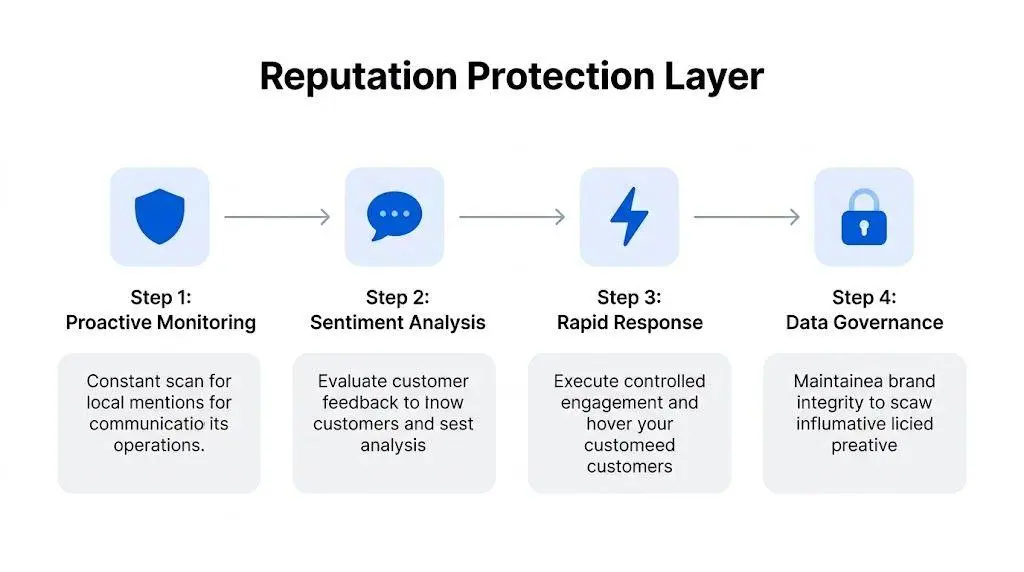
The framework usually has four functions:
- Monitoring
Track branded local queries, executive-name-plus-city queries, map surfaces, review platforms, regional news mentions, social impersonation, and image/video leakage tied to local search terms. - Triage
Separate inconveniences from actual threats. A negative but lawful review is different from impersonation. An outdated listing is different from defamatory content. A leaked asset requires a different clock speed than a directory inconsistency. - Action
Determine whether the remedy is correction, platform report, legal notice, de-indexing request, source-level removal, suppression strategy, or evidence preservation for counsel. - Recurrence control
Monitor for reposts, duplicate uploads, copied reviews, or resurfacing through secondary domains and local aggregators.
Treat local incidents as operational events
Executives often make a category mistake here. They see a bad local result and treat it as a communications issue. In practice, local reputational incidents behave more like security incidents. They require logging, classification, ownership, response timing, evidence capture, and resolution tracking.
A robust reputation monitoring system should support that workflow by identifying adverse local mentions and search variations before they harden into entrenched result sets. The point is not to watch more dashboards. It is to shorten the time between detection and containment.
Here is the distinction that matters:
- Marketing asks whether a market is visible
- Reputation control asks what appears beside that visibility
- Executive governance asks who acts when that answer becomes unacceptable
The most common blind spots
The riskiest local issues are often the least glamorous:
- City-specific duplicate listings that outrank the official location
- False reviews attached to the wrong branch or executive
- Impersonation accounts using local office names
- Obsolete articles or cached pages tied to prior disputes, moves, or personnel changes
- Leaked photos or videos that begin ranking through local query variants
A clean local presence is not the absence of criticism. It is the presence of verified, controlled, defensible information in the places where buyers and journalists actually look.
If you run localized digital marketing without this defensive layer, you are paying to accelerate discovery in an environment you haven’t secured.
Measuring Performance and Ensuring Compliance
Most dashboards fail because they measure only commercial outcomes. They track clicks, conversions, and spend efficiency, then ignore the reputational variables that determine whether those outcomes are durable. For executive-facing localization, that is incomplete.
A practical localized workflow should operate as a measurement and iteration system. ActiveCampaign recommends regional dashboards that track engagement, conversions, unsubscribe rates, and sentiment, while also warning that brands lose trust and conversion when they “translate before they localise,” as discussed in regional dashboard design for localized marketing. That insight should shape governance, not just reporting.

Use a dual-purpose dashboard
A serious executive dashboard for localized digital marketing should combine market performance with risk indicators. If those sit in separate systems, the organization will optimize one while neglecting the other.
A workable model looks like this:
| Category | What to track | Why it matters |
|---|---|---|
| Commercial performance | Engagement, conversions, unsubscribe rates, sentiment | Shows whether localized messaging is earning trust |
| Search presence quality | Listing accuracy, ranking integrity, review consistency | Reveals whether discoverability rests on stable information |
| Incident response | Detection time, escalation status, resolution status | Shows whether local reputational threats are being contained |
| Governance | Approval compliance, access control, data update completion | Prevents local assets from drifting out of policy |
This approach changes decision-making. A market with strong lead flow but repeated listing abuse, recurring false reviews, or slow incident response is not a healthy market. It is a market producing fragile returns.
Compliance is not a footnote
The legal side of localization gets underestimated because teams often think about privacy law only when collecting lead data. That’s too narrow. Compliance affects claim language, review solicitation, data retention, regional tracking, and how quickly you can investigate or remove harmful content across jurisdictions.
Executives operating across borders need a clear ruleset for:
- What local teams may publish without legal review
- How user data is collected, stored, and routed
- Which reputation incidents require outside counsel
- How takedown efforts differ by jurisdiction
- What evidence must be preserved before action
A strategic legal primer such as navigating online content removal laws for executives is useful in this context because local marketing and local content disputes increasingly collide. If your market entry plan doesn’t account for legal variation, your response times will lag when speed matters most.
Review cadence and accountability
The review cycle should be short enough to catch drift before it becomes public damage. The most disciplined teams use regional reviews that combine quantitative signals with direct feedback from local sales or support staff, because metrics alone rarely explain why trust is rising or falling.
Use a simple accountability model:
- Marketing owns demand and message fit
- Operations owns listing accuracy and platform access
- Legal or specialist advisers own escalation pathways
- Executive leadership owns threshold decisions for sensitive markets
That division prevents the usual chaos where everyone sees the issue and no one has authority to act.
Localized digital marketing works best when it is run like controlled expansion, not content adaptation. That means measured rollout, verified local assets, native review, monitored search surfaces, and fast response when a market starts producing reputational risk. Anything less is not localization. It is exposure disguised as growth.
If your local visibility is expanding faster than your ability to control search results, listings, reviews, and harmful regional content, ContentRemoval.com can help you close that gap discreetly. The firm advises executives, high-profile individuals, family offices, and brands on removing damaging material, addressing impersonation and false reviews, and building a defensible reputation protection process around search and local discovery. Start with a confidential assessment and get a clear action plan.
Frequently asked questions
Why is localized marketing a reputation risk for executives?
Because local intent sits close to action: someone searching for a nearby office or adviser is evaluating credibility in real time, and any false review cluster, outdated listing, copied profile or hostile result appears at the worst point in the decision. Expanding visibility faster than you can verify and correct local results turns that visibility into a liability.
What should be locked down before launching local ads or content?
Ownership of every legitimate profile on Google Business Profile, Apple Maps, core data aggregators, major and sector directories and relevant review platforms, with the controlling login and internal owner documented. Then a canonical master record per location, suppression of duplicates and fakes, and a standard update procedure so changes propagate everywhere.
How should a company handle a false review or impersonation account tied to one city?
Treat it as an operational incident rather than a communications issue: log it, classify whether it is a lawful negative review, an outdated listing, impersonation or defamation, then route it to correction, a platform report, a legal notice, a de-indexing request or source removal as appropriate, and monitor for reposts through local aggregators.