
Filing a defamation lawsuit starts with a pre-filing assessment: choose the forum that gives the strongest position, check the filing deadline, and build a documented damages model. Preserve time-stamped captures and native files, prove falsity with records, and gather evidence of fault. Then decide whether a demand letter, platform takedown or complaint comes first, since litigation is rarely fastest.
Key facts
- State filing deadlines for defamation commonly fall within a one to three year range.
- Plaintiffs must prove a false statement, publication, fault and harm; public figures face actual malice.
- Preserve captures with URL, date, account name, context and native source files, not bare screenshots.
- Strong settlements include removal obligations, retraction, non-disparagement and enforcement deadlines.
Where ContentRemoval.com comes in. ContentRemoval.com runs the containment track that a lawsuit cannot: platform takedowns, de-indexing, removal of scraped copies and monitoring for reposts, coordinated with the client’s litigation counsel so the evidence file serves both lanes. Contact usually comes from the lawyer, the general counsel or the executive’s chief of staff in the first days after publication. A free, confidential 15-minute Exposure Scan maps what is removable now, and the report is yours to keep. Get a Free, Confidential Exposure Scan or read how our defamation removal work is done.
Someone has published a false statement about you or your company. It’s ranking in search, spreading on social platforms, getting forwarded in private chats, and forcing awkward conversations with investors, customers, employers, or family. Your first instinct is usually the same: sue immediately.
That instinct is understandable. It’s also often poorly timed.
If you want to know how to file defamation lawsuit claims in a way that protects your interests, you need to separate anger from strategy. A defamation case is not just a moral complaint. It’s a precision exercise involving venue, evidence, timing, strategic advantage, and post-filing discipline, and if the content is online, the legal case and the reputation response cannot be treated as separate tracks. They must be coordinated from day one.
The Pre-Filing Strategic Assessment
A false statement can start costing you money before your lawyer files a single page. Search results harden. Customers hesitate. Employees start asking questions. The pre-filing assessment decides whether you should sue now, pressure for removal first, or do both in a coordinated sequence.

Pick the forum that helps your case
Before anyone drafts a complaint, answer three questions: Where can we file, how fast is the deadline approaching, and what damages can we prove with documents? Get any one of those wrong and you weaken your position at the start.
Court selection is not an administrative detail. It shapes the law, the defenses, the motion practice, and the cost of getting to an outcome. As BDB Law explains in its guide to filing a defamation lawsuit, states often impose short filing deadlines, commonly within a one-to-three-year range, and state rules differ on defamation, privacy claims, damages, and pre-suit requirements.
Online publication makes this analysis harder and more important. The speaker may be in one state, the platform may operate elsewhere, and the economic hit may land where you live, work, or run the business. Filing in the first court that appears available is sloppy. File where the facts and law give you the strongest position.
A disciplined forum analysis usually turns on these facts:
- Where the statement appeared: The site, platform, or account activity can affect jurisdiction and procedure.
- Where the defendant is based: Personal jurisdiction fights can derail a case early.
- Where the injury landed: Lost clients, damaged investor relations, employment fallout, or licensing problems in a specific state can support a better filing choice.
Practical rule: Ask, “Which court gives this case the best advantage and the fewest avoidable defenses?”
Treat the clock as an active threat
Delay is expensive.
Defamation claims often expire faster than clients expect, and online attacks keep spreading while people wait for things to calm down. They usually do not. They get indexed, copied, reposted, and quoted out of context.
That does not mean you race to the courthouse blindly. It means you run two tracks at once. Preserve evidence, assess venue, prepare claims, and start immediate containment. If the post, review, article, or video can be removed or suppressed faster than a lawsuit can move, pursue that result now. This strategic guide for online defamation victims is a useful starting point for that response plan.
A lawsuit is one tool. It is rarely the only one, and it is almost never the fastest.
Put a number on the harm early
Clients often describe the injury in emotional terms. Courts want proof tied to money, business disruption, or concrete reputational fallout.
Build a working damages model before filing. If you cannot explain what the statement cost you, in what time period, and through what business or personal consequences, your claim is not ready. Use records, dates, witness names, and a clean chronology. For document review and issue organization, a tool like the PDF AI legal assistant can help your team sort source material faster.
Start with a simple internal chart:
| Damage category | What to gather |
|---|---|
| Lost business | Canceled contracts, dropped deals, client emails, revenue interruption records |
| Career harm | Recruiter correspondence, lost speaking opportunities, licensing issues, employment consequences |
| Reputational injury | Investor concerns, board communications, customer complaints, referral drop-offs |
| Corrective costs | Legal spend, security spend, crisis management, monitoring and removal efforts |
Keep the goal clear. You are not filing a lawsuit to express outrage. You are building pressure, containing spread, creating settlement strength, and positioning for a result that repairs the actual damage.
Building an Unassailable Case File
A client calls on Monday. A false accusation is live on a news site, screenshots are spreading on LinkedIn, and a key customer has gone silent. If you start with anger, you lose time. Start with proof.

Build the file for pressure, not just pleading
A strong defamation file does two jobs at once. It supports a complaint, and it gives you ammunition for faster off-ramps such as takedown requests, publisher outreach, search de-indexing arguments, and settlement pressure. If your evidence only works in court two years from now, it is incomplete.
The file should answer five questions fast. What exactly was said? Why is it false? Who saw it? What did the speaker know? What did it cost you?
One widely cited guide from Best Lawyers on suing for defamation makes the core point clearly: plaintiffs must prove a false statement, publication, fault, and harm, and defamation cases often fail because that proof is weak. Organize your record around those elements from day one.
Prove the statement, the context, and the falsity
Pull the exact words. Do not paraphrase. Save the headline, post text, caption, comment, transcript, audio, and surrounding thread. Context matters because defendants often retreat into half-quote defenses, opinion arguments, or claims that the audience understood the statement differently.
Then prove falsity with documents that travel well. Contracts, emails, board minutes, accounting records, prior published corrections, sworn statements, source materials, and third-party records carry more weight than a client’s summary of events.
For online attacks, pair preservation with removal strategy. The same evidentiary package that supports a complaint often supports a faster website takedown strategy for slander and false online statements. Build it once. Use it in both lanes.
Preserve evidence like the defendant will edit or delete tonight
That assumption is usually right.
Capture the material in a form that shows authenticity and timing. A screenshot with no URL, no timestamp, and no surrounding context is weak. A preserved page with the URL, date, account name, visible engagement, and source code or native file is much harder to attack.
A strong file usually includes:
- Time-stamped captures showing the URL, account name, date, and full context
- Native source material such as HTML files, PDFs, audio files, video downloads, and transcripts
- Spread evidence including reposts, quote-posts, mirrored pages, search results, newsletters, and messaging app forwards
- Version history showing edits, deletions, headline changes, or stealth revisions
- A clean chronology that tracks publication, republication, discovery, notice, and resulting business fallout
- Witness evidence from customers, coworkers, investors, recruiters, or counterparties who saw the statement and changed their conduct
If the record is large, get it organized immediately. A PDF AI legal assistant can help sort source materials, compare versions, and surface contradictions without wasting lawyer hours on manual review.
Fault decides whether a hard case becomes a winning case
Many plaintiffs focus only on falsity. Good defense counsel focuses on fault because that is where weak claims break.
For private figures, the fight may center on carelessness, sloppy verification, or failure to check obvious facts. For executives, founders, public-facing professionals, and anyone likely to be treated as a public figure, expect a tougher battle over actual malice. That means evidence showing the defendant knew the statement was false, had obvious reasons to doubt it, ignored contradictory facts, or republished after receiving a clear correction.
Look for internal inconsistencies and pre-publication warnings. Prior drafts, interview recordings, reporter notes, editorial emails, legal review comments, text messages, and ignored correction requests can matter more than the post itself.
The strongest case file does not just preserve the defamatory statement. It captures the documents that prove falsity, spread, fault, and commercial damage in one organized record.
This brief video forces the right question. Can you prove the legal elements with admissible evidence?
A disciplined file changes the defendant’s risk calculation early. That is the point.
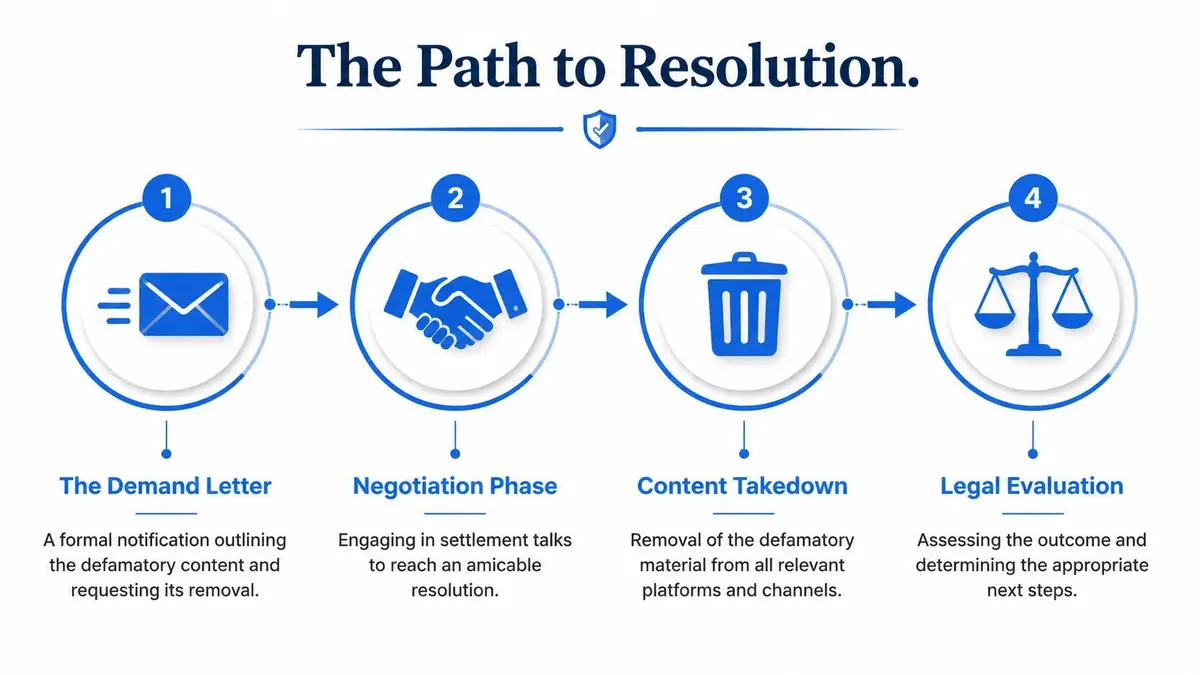
The Demand Letter and Takedown Gambit
A lawsuit is powerful, but it is rarely fast. If the false content is actively ranking, spreading, or getting republished, your first move should be driven by speed and containment, not litigation theater.
Don’t send a demand letter by reflex
Lawyers love cease-and-desist letters because they are familiar, formal, and visible. Clients love them because they feel like action. Both instincts can be wrong.
For online defamation, litigation timelines are often too slow. AllLaw’s discussion of starting a defamation lawsuit notes that demand letters can lead to a “quicker, less expensive resolution,” but also highlights a larger strategic gap: too much guidance ignores pre-litigation removal strategies such as platform reporting and de-indexing that can resolve matters in days rather than the months or years litigation can consume.
That’s the issue. A demand letter is not automatically the first step. It is one tool. Sometimes it provides an advantage. Sometimes it warns the defendant, invites republication, or locks everyone into a slower and more public fight.
Match the tool to the target
A publisher, ex-employee, anonymous troll, competitor, and gossip account require different treatment. The right move depends on who posted the content, where it lives, and what you need the outcome to be.
| Situation | Best first move | Reason |
|---|---|---|
| Mistaken publisher with some legal sophistication | Demand letter | Retraction or correction may be achievable without filing |
| Anonymous or evasive actor | Takedown and preservation work | Speed matters more than argument |
| Viral platform post causing immediate damage | Platform reporting and de-indexing | Containment first, lawsuit later if needed |
| Defendant likely to destroy evidence | Quiet preservation plus rapid legal planning | Don’t tip your hand too early |
If you need practical context on fast removal options, this resource on how to get a website taken down for slander is worth reviewing alongside legal advice.
The sequence matters more than the formality
A well-timed demand letter can work. A badly timed one can do real damage. If the platform has a realistic pathway for reporting abusive, impersonating, or policy-violating content, start there while evidence is preserved. If search visibility is the pressure point, de-indexing strategy may be more valuable in the first days than a beautifully written threat letter.
Use a demand letter when you need to establish notice, create a record of continued publication after correction, or give a rational defendant an off-ramp. Skip it when silence, speed, or stealth will produce a better outcome.
Decision test: If your main objective is immediate removal, pick the mechanism most likely to remove the content fastest. If your main objective is damages or precedent, build toward filing with notice and evidence discipline.
The expensive mistake is treating every defamation matter as if it starts the same way. It doesn’t.
Navigating the Mechanics of a Lawsuit
Once you decide to file, the case becomes less emotional and more procedural. That’s good. Procedure creates an advantage for disciplined plaintiffs and opportunities for sloppy defendants. But it also creates traps for plaintiffs who thought filing itself was the victory.
Draft the complaint like you expect a motion to dismiss
The complaint is not a rant with numbered paragraphs. It is the document that frames the case, narrows the issues, and signals whether you understand defamation law at a practical level.
A strong complaint identifies the exact statement, where it appeared, when it appeared, why it was false, who saw it, what level of fault applies, and how the harm manifested. Vague allegations invite early attack. Precision forces the defense to engage your facts instead of caricaturing your claim.
The first audience for your complaint is not the public. It’s the judge deciding whether the case survives.
Service and defendant response
After filing, the defendant must be served properly. That sounds routine until it isn’t. Defendants evade service, hide behind shell entities, move, deny authorship, or appear through counsel solely to attack jurisdiction and sufficiency.
Expect one of three early responses:
- A motion to dismiss: The defense argues that the complaint fails as a matter of law.
- An answer with defenses: The defendant denies key allegations and asserts truth, opinion, privilege, or other defenses.
- Settlement probing: The filing itself may create enough pressure to open resolution talks.
Your lawyer should prepare for all three before the complaint is filed, not after.
Discovery is where the real case often appears
Discovery is the phase where each side obtains information from the other. In defamation matters, that can include communications about the statement, source materials, editorial drafts, internal messages, financial records, audience metrics, and documents showing harm.
Many clients finally realize the strategic value of pre-filing discipline. If your file is clean, discovery strengthens your position. If your file was assembled casually, discovery exposes the gaps.
A useful way to think about the mechanics is this:
| Litigation stage | What it really means for you |
|---|---|
| Complaint | Your theory becomes public and testable |
| Service | The defendant is formally forced to respond |
| Motion practice | The court decides whether your claim is legally viable |
| Discovery | Both sides lose privacy and gain information |
| Settlement conferences | Risk gets priced in real time |
| Trial preparation | Cost, exposure, and pressure escalate |
File only when you’re ready to live with the consequences of discovery. In defamation cases, your reputation is not the only subject under examination. Your records, communications, and conduct may become part of the fight.
Keep your objective visible
Many plaintiffs get pulled into process and lose sight of purpose. The question is not whether litigation feels active. The question is whether litigation is moving you toward a business result, a personal vindication, a retraction, a recovery, or a durable cleanup of the public record.
That discipline matters because every stage forces choices. Do you amend the complaint or appeal? Do you push harder in discovery or narrow the dispute? Do you spend more to chase a public judgment, or accept a confidential settlement with removal and non-disparagement terms?
Clients who treat litigation as a control system do better than clients who treat it as catharsis.
Defining Victory Settlement, Trial, and Reputation Recovery
A defendant offers to pay, remove the post, sign a non-disparagement clause, and walk away without admitting fault. At the same time, the false statement still ranks in search, copied versions remain live, and a trial date is six months out. That is the decision point that matters. You are not choosing between pride and weakness. You are choosing the result that repairs the damage fastest and holds up longest.
Define victory before emotion takes over. In defamation matters, clients who wait until late-stage settlement talks to decide what they want usually overpay for vindication or undersell a strong position. Set the target early: removal, retraction, damages, deterrence, privacy, or public exoneration. Then force every settlement discussion and trial decision to answer one question. Does this outcome fix the actual problem?
Settlement should be judged by what it changes
A strong settlement often outperforms a courtroom win because it can deliver relief faster and with more control. Money matters, but strategic plaintiffs focus just as hard on terms that change the public record and reduce the chance of repeat harm.
The right settlement package usually includes several of these terms:
- Removal obligations: Delete the original content, remove reposts under the defendant’s control, and send formal requests to third-party platforms.
- Retraction or correction: Put accurate facts in writing and make the correction visible enough to matter.
- Non-disparagement: Stop the next round before it starts.
- Defined cooperation: Require passwords, account access, sworn statements, or platform communications needed to complete takedowns.
- Enforcement teeth: Include deadlines, liquidated consequences where enforceable, and clear remedies for breach.
- Confidentiality terms that fit the objective: Privacy can protect you, but secrecy can also dilute the value of vindication.
A weak settlement closes the case file. A strong settlement changes search results, reduces republication risk, and gives you enforceable remedies if the defendant starts again.
Trial is a tool, not a badge of honor
Trial has one advantage settlement often cannot match. It can produce a public finding that the statement was false and actionable. That matters when your board, investors, licensing body, counterparties, or family need a formal judgment rather than a private compromise.
It also carries obvious costs. Legal fees rise. Attention rises. Public filings rise. A trial win can still leave damaging headlines, indexed pleadings, and repeated allegations visible long after judgment.
Use trial when the business case is clear. Use it when the defendant will not agree to meaningful removal terms, when deterrence matters, or when only a public judgment will restore your position. Do not use it to satisfy anger.
A judgment without cleanup is an incomplete win
Too many lawyers stop at liability. That is a process win, not a finished result.
If the false statement remains searchable, copied pages stay online, or summary sites keep recycling the allegation, the reputational injury continues. You need a parallel plan for removal, de-indexing, monitoring, and suppression where removal is not available. This guide to removing defamation from the internet for executives explains how to connect court pressure, platform requests, and post-resolution cleanup into one strategy.
Search is usually the longest tail of harm. The original post may disappear while commentary pages, scraped copies, and negative snippets continue to rank. That is why experienced counsel coordinates legal relief with reputation work instead of treating them as separate tracks. For broader context on persistent visibility issues, review these strategies for negative search results.
Courts resolve claims. They do not clear the internet for you.
What victory usually looks like
For founders, executives, public figures, and family office principals, a successful outcome usually combines legal pressure with reputation repair. The mix changes by case, but the framework is consistent.
| Outcome | Why it matters |
|---|---|
| Content removal or de-indexing | Cuts immediate visibility and limits ongoing spread |
| Retraction, correction, or clarifying statement | Repairs the factual record |
| Enforceable settlement or judgment | Creates consequences for repetition |
| Monitoring and repeat-response protocol | Catches reposts, aliases, and mirror pages quickly |
| Search result rehabilitation | Brings public visibility closer to the truth |
That is the point many plaintiffs miss when they first ask how to file defamation lawsuit claims. Filing is one instrument. Use it to get pressure, evidence, an advantage in settlement, and cooperation for cleanup. Use it badly, and you hand the falsehood a larger audience.
When to press harder and when to close
Press harder when the defendant is cornered, the evidence is clean, and the additional spend is likely to produce better removal terms, better money, or a judgment with real practical value. Close the case when the available package fixes the harm, locks in enforcement, and avoids keeping the allegation alive for another year.
Different clients need different endpoints. Some need damages. Some need a signed correction. Some need the first page of search cleaned up and monitored so the issue does not return.
The right final question is simple. Has the result materially repaired the damage and reduced the chance it happens again? If yes, you have won.
If false online statements are damaging your name, your company, or your family, ContentRemoval.com can help you move faster than litigation alone. Their team handles confidential assessments, coordinated takedown strategy, de-indexing, monitoring, and reputation protection for high-profile clients who need decisive action, not generic advice.
Frequently asked questions
How long do I have to file a defamation lawsuit?
It depends on the state, but deadlines are often short, commonly within a one to three year range, and some states add pre-suit notice requirements. Online publication complicates the analysis because the speaker, the platform and the harm may sit in different jurisdictions.
Is a cease and desist letter the first step in a defamation case?
Not automatically. A demand letter suits a mistaken publisher who may retract, but it can warn an anonymous or evasive actor and invite republication. For a viral post causing immediate damage, platform reporting and de-indexing usually come first, with a letter used when you need to establish notice.
What evidence do I need to prove defamation online?
The exact words in context with time-stamped captures showing URL, account and date, native files such as HTML, audio or video, evidence of spread through reposts and search results, version history, a chronology, and witnesses whose conduct changed. Records proving falsity and any ignored correction requests support the fault element.