
Erasing a digital footprint means strategic reduction, not disappearance. Start with a threat model of what exists: old profiles, public records, data broker listings, forum comments, breach leaks and photo tags. Lock down the accounts you keep, delete rather than deactivate the rest, then pursue de-indexing and source removal for third-party content using GDPR, CCPA, DMCA or defamation routes.
Key facts
- Deactivation keeps your data on the platform; deletion is permanent after a 14 to 30 day grace period.
- De-indexing hides content from search results; source removal deletes it from the website itself.
- Article 17 of the GDPR, the right to be forgotten, can compel erasure of personal data.
- Quick wins often land in 30 to 90 days; hostile content needing court orders can take 6 to 18 months.
Where ContentRemoval.com comes in. ContentRemoval.com takes on the targeted end of this work, the defamatory post, the mugshot site, the leaked document or the hostile publisher that an automated opt-out subscription cannot touch, and pairs each removal with monitoring so it does not return. The individual, their family office or their security adviser usually makes the first approach. A free, confidential 15-minute Exposure Scan maps what is removable and in what order, and the report is yours to keep. Get a Free, Confidential Exposure Scan or read how our content removal work is done.
Erasing your digital footprint requires grasping its scope and, more critically, the specific liabilities it creates. This is not a superficial clean-up of social media accounts. It is a strategic operation to dismantle a vast, interconnected web of personal data scattered across the internet, data that poses an active threat to high-profile individuals.
This guide is a playbook for systematically reducing your online exposure and shielding yourself from the personal, financial, and reputational risks inherent in a public profile.
Understanding Your Digital Footprint and Its Inherent Risks

Your digital footprint is the complete, ever-growing trail of every action you have taken online. It is far more than your social media profiles; it is a complex mosaic of data that paints a detailed picture of your public and private life. For executives and public figures, this picture becomes an active threat surface.
This data trail originates from two sources: information you have actively shared and data collected without your direct action. Controlling both is fundamental to regaining control.
Your active digital footprint comprises the data you consciously create. It includes every social media post, blog comment, forum contribution, and public review you have authored. Every email you dispatch and every online form you complete adds to this dossier.
Your passive digital footprint is the result of invisible data collection. It is comprised of websites logging your IP address, location, and browsing habits. It includes social media platforms constructing “shadow profiles” from your contacts’ data and data brokers scraping public records to compile and sell your information.
The Compounding Nature of Digital Risk
For an individual with a significant profile, these scattered pieces of information are systematically aggregated. Automated systems, and more alarmingly, malicious actors, constantly piece them together, building comprehensive dossiers that can be weaponized. A single data breach from a dormant, forgotten forum can expose a reused password, granting an adversary access to your entire digital infrastructure.
The scale of this exposure is significant. Over 2.3 billion accounts are compromised annually. In 2023, 85% of the 3,214 tracked data breaches exposed sensitive personal information, the very fuel that powers an exploitable digital footprint.
Your digital footprint is not a mere record of your past; it is a blueprint for future attacks. Each data point (an old address, a forgotten username, a tagged photo) is a potential key for an adversary seeking to exploit your reputation, finances, or privacy.
Effectively erasing your footprint demands a methodical, surgical approach. The goal is not total erasure, but the strategic identification and removal of liabilities. This requires pinpointing the highest-risk data and leveraging the correct technical and legal channels for its removal. Understanding the technical permanence of data removal through concepts like what is data sanitization is critical, particularly for the physical devices you discard.
A Forensic Threat Model
A scattered approach (deleting a few accounts, tightening privacy settings) is ineffective. A professional strategy begins with a forensic analysis of your unique exposure, mapping each data point to the primary risk it poses.
Consider the components of your footprint and the specific dangers they present.
Digital Footprint Threat Matrix
| Data Component | Primary Risk Vector | Consequence Example |
|---|---|---|
| Old Social Media Profiles | Impersonation, Reputational Damage | An ill-advised post from an old account is resurfaced during a critical career move. |
| Public Records (Address, etc.) | Doxing, Physical Threats | A hostile actor discovers your home address from a public database and harasses your family. |
| Data Broker Profiles | Phishing, Scams, Identity Theft | A scammer acquires your data profile to craft a highly convincing and personalized phishing attack. |
| Forum & Blog Comments | Out-of-Context Weaponization | A comment made years prior is taken out of context to damage your professional standing. |
| Data Breach Leaks | Credential Stuffing, Account Takeover | A password from a 2015 breach is used to compromise your current email or financial accounts. |
| Third-Party Photo Tags | Privacy Invasion, Misrepresentation | A tagged photo from a private event reveals your location, associations, or activities. |
This threat modeling enables a targeted campaign that neutralizes the most critical vulnerabilities first, ensuring resources are deployed for maximum impact. This assessment is the necessary precursor to dismantling your digital footprint.
Your First Move: The Immediate Technical Lockdown
The initial action to regain control is a swift, aggressive lockdown of your entire online presence. This is not a matter of adjusting a few privacy settings; it is a full-scale purge designed to immediately halt the outflow of new data and seal existing vulnerabilities.
This process shrinks the attack surface. We begin by identifying and eliminating every dormant, forgotten, and active account that is no longer essential. Each represents a potential liability, a repository of personal information awaiting a breach. The scope of these accounts is often surprising, ranging from old Myspace profiles to single-use photo editing app subscriptions.
Deactivate vs. Delete: A Critical Distinction
Platforms intentionally obscure the difference between deactivating and deleting an account. Their business model favors deactivation, as it retains your data on their servers for potential reactivation.
Deactivation is a temporary measure. Your profile becomes publicly invisible, but all associated data (photos, messages, contact lists) remains on the company’s servers. It is a reversible action and therefore insufficient for our purposes.
Deletion is a permanent directive. By requesting deletion, you instruct the company to permanently remove your data. This is the only acceptable option for accounts being abandoned.
A deactivated account is a sleeping liability. A deleted account is a neutralized threat. Always pursue deletion; deactivation provides a false sense of security while your information remains vulnerable.
Executing the Deletion Process
This operation requires investigative work. The first task is to compile a master list of every account linked to you. A systematic review of old email inboxes, searching for terms like “welcome to,” “confirm your account,” or “password reset,” is an effective starting point. Your browser’s saved passwords and any password managers are also crucial data sources.
With your list compiled, the methodical work of deletion begins. You must log in to each service and locate the “delete account” function, which is often buried deep within settings under obscure headings like “Account Information” or “Privacy & Security.”
Expect resistance. Companies employ “dark patterns”, confusing layouts and manipulative messaging (“Are you sure? Your friends will miss you!”), to discourage deletion. Persevere through all confirmation screens until you receive a final message confirming the deletion process has commenced. It is advisable to screenshot this final confirmation and record the date. Most platforms enforce a 14-30 day grace period before data is permanently purged; do not log in during this time.
Fortifying Core Accounts
Concurrently with the deletion process, you must secure the accounts you retain. These are your primary digital assets: your main email, financial portals, and key professional profiles. Their security is non-negotiable.
Implement these measures immediately for all core accounts:
- Unique, Strong Passwords: Each account must have its own unique password. Password reuse is the primary vector through which a minor breach at one company escalates into a catastrophic personal compromise. Employ a trusted password manager like 1Password or Bitwarden to generate and store these credentials.
- Multi-Factor Authentication (MFA): Enable MFA on every service that offers it. Prioritize authenticator apps like Google Authenticator or Authy over SMS-based codes, which are susceptible to interception. MFA is the most effective defense against unauthorized access, even if your password is stolen.
This initial lockdown is the foundation for all subsequent actions. It stops the data bleed and secures your perimeter, creating a stable base from which to address the more complex challenge of removing content you do not directly control.
Tackling Content and Data Broker Removals
Once you have secured the accounts you control, the primary offensive begins. This phase shifts from defense to targeting information you do not own, a campaign against search engine results, third-party sites, and the opaque data broker industry.
Success here requires understanding the critical distinction between de-indexing and source removal. De-indexing merely hides content from search results; source removal eliminates it entirely. The former is a temporary measure; the latter is the only definitive solution for serious threats.
Removing Content from Search Results
The first battle is often with Google. When adverse information appears in search results, the immediate objective is de-indexing. This action severs the link between a search for your name and the harmful content, rendering it effectively invisible to the public.
However, de-indexing does not delete the content from the original website. The article, post, or public record remains live. Anyone with a direct link can still view, share, and weaponize it. This is an unacceptable liability. True security is only achieved by compelling the website owner to remove the content at its source. We detail these strategies in our guide on how to remove yourself from Google.
A negative news article can be de-indexed from Google’s results for your name, yet the article itself can still be circulated internally at a firm or located by a determined adversary. Source removal is the only method to ensure its permanent elimination.
The flowchart below outlines the foundational steps of auditing and securing your accounts, the necessary prelude to confronting external content.
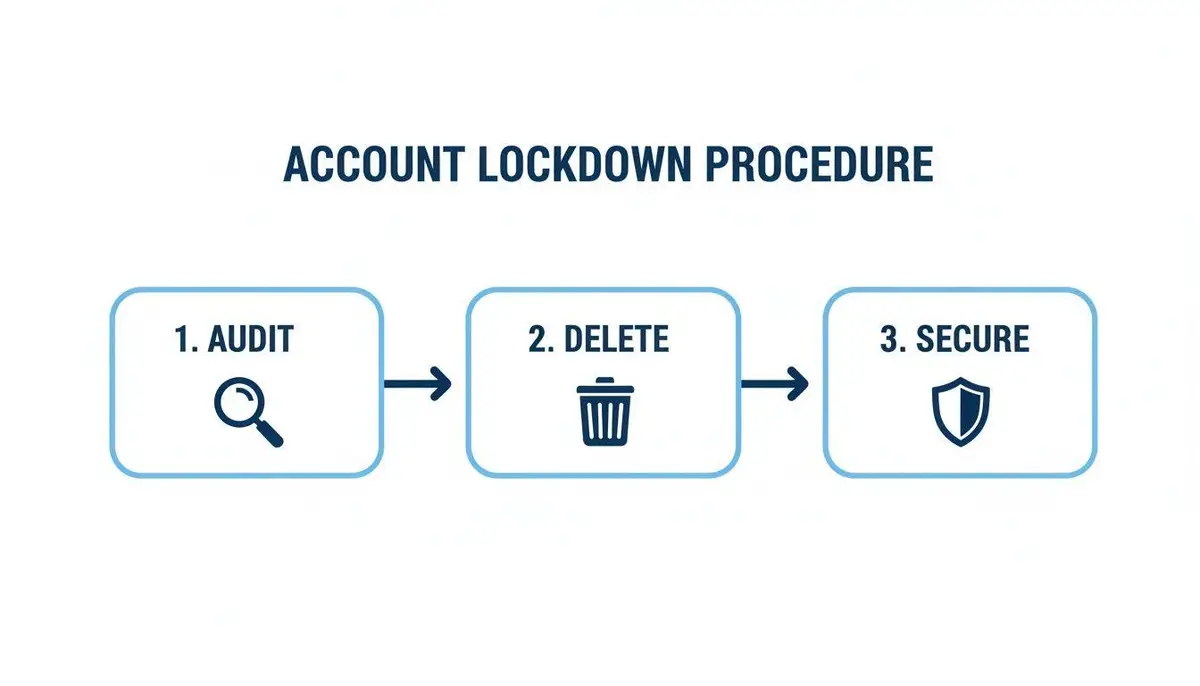
By auditing, deleting, and securing your accounts first, you stop the active dissemination of your personal data before confronting the entities that already possess it.
Confronting the Data Broker Industry
More insidious than a single negative article are the thousands of data points about you collected and sold by data brokers. These entities operate in the digital background, scraping and trading your personal information without your knowledge or consent. Their profiles often contain everything from your address history and phone numbers to information on your relatives and property records.
Attempting to opt-out from these sites individually is a futile endeavor. There are hundreds of such brokers, and their removal processes are deliberately convoluted and time-consuming. Even if you succeed in removing a profile, it often reappears months later when the broker acquires a new data set containing your information.
Manually opting out of data brokers is an exercise in futility. It is a temporary fix for a systemic problem, akin to bailing out a sinking ship with a teacup. The data almost always returns.
Despite growing privacy concerns, the public remains largely unaware of this industry. A study on Security.org found that only 6% of American adults have ever used a data removal service. More revealing is that only 42% are even aware such services exist, leaving the vast majority exposed.
Automated Services vs. Professional Operations
For basic privacy hygiene, automated subscription services like DeleteMe or Kanary have a function. They operate as a dragnet, broadcasting mass opt-out requests to a predefined list of data brokers. They are a reasonable first line of defense.
However, these automated tools are inadequate for high-stakes situations. They cannot:
- Remove defamatory news articles or blog posts.
- Address sensitive public records like court filings.
- Handle complex cases of impersonation or intellectual property theft.
- Compel removal from non-compliant or hostile websites.
This is where a professional firm becomes non-negotiable. While automated services are a shotgun blast, a specialized operation is a sniper. We do not rely on standard lists; we conduct deep forensic analysis to uncover your data not only on common broker sites but also on obscure forums, dark web markets, and international databases.
When facing a false accusation in an online publication or a mugshot on a predatory site, a standard opt-out request is useless. These cases demand direct negotiation, legal pressure, and proprietary methodologies that no automated tool can execute. The objective is not merely to suppress the information but to achieve complete source removal and then implement continuous monitoring to ensure it never resurfaces. This is the difference between basic privacy and active reputation defense.
When Simple Requests Fail: Advanced Legal and Specialized Takedown Tactics
When polite emails and online forms are ignored, the strategy must escalate. When platforms or publishers refuse your requests, it is time to shift from asking to compelling action through legal force.
This is no longer about requesting link removal. It is about strategically leveraging specific laws to force compliance from website owners, hosting companies, and other uncooperative platforms. Mastery of these legal instruments is often the deciding factor in a successful removal campaign, particularly when your reputation is at stake.
Leveraging the Law: GDPR, CCPA, and Your Rights
The internet may seem lawless, but the data flowing through it is governed by powerful regulations. Laws like Europe’s General Data Protection Regulation (GDPR) and the California Consumer Privacy Act (CCPA/CPRA) have granted individuals unprecedented authority over their personal information.
These are not suggestions; they are enforceable statutes with severe financial penalties for non-compliance. Their impact is significant. While 60% of internet users report having a “regrettable digital footprint,” the GDPR has driven a 30% increase in data deletion compliance, and in California, the CCPA has prompted over 500,000 deletion requests since 2020. Recent research on digital footprints and privacy attitudes further illuminates how these laws are reshaping privacy norms.
Consider the text of Article 17 of the GDPR, known as the ‘Right to be Forgotten.’ This is one of the most potent tools in our arsenal.
This article grants individuals the legal right to demand the erasure of their personal data when it is no longer necessary for its original purpose. A precisely worded GDPR notice citing this article can compel a European company, or any company serving European residents, to remove content they would otherwise ignore.
Fighting Back with Copyright and Defamation Claims
Beyond data privacy laws, other legal instruments are highly effective for content removal. The Digital Millennium Copyright Act (DMCA) is the primary tool when your intellectual property, such as a personal photograph or corporate document, is published without permission.
A DMCA takedown notice is not a request; it is a formal legal notice asserting your ownership. Upon receiving a valid DMCA notice, a hosting provider has a legal obligation to promptly remove the infringing content or risk facing liability themselves.
When your reputation is under attack, legal action is not the last resort. It is the primary offensive tool. A formal legal notice from a specialist firm transforms your complaint from a dismissible request into an urgent legal problem that demands resolution.
Defamation law provides another avenue, though it can be more complex. If a party has published false statements of fact that are demonstrably harming your reputation, you have grounds for a legal claim. This process typically begins with a forceful cease and desist letter that identifies the defamatory content, proves its falsity, and demands its immediate removal under threat of a lawsuit. Our guide on navigating legal content removal provides a closer examination of this process.
Tackling Worst-Case Scenarios: Mugshots, Revenge Content, and the Dark Web
Certain malicious content requires a distinct playbook. This includes predatory mugshot websites, extortion-style “revenge” content, and sensitive information leaked onto the dark web.
- Mugshot and Arrest Record Websites: These businesses profit from public humiliation by scraping public records and optimizing them to rank for name searches. Simple requests for removal are almost universally ignored. Eliminating this content requires aggressive legal pressure and sophisticated negotiation strategies developed through experience with this predatory industry.
- Dark Web Content: If your information (credentials, financial data, or personal threats) appears on a dark web forum, it is beyond the reach of standard legal notices. Addressing this requires specialized intelligence operations, including infiltrating these hidden networks, tracing the source of the leak, and working with experts to neutralize the threat.
These are high-stakes situations where professional intervention is non-negotiable. Attempting to navigate these hostile environments independently can backfire, often making you a more prominent target. A specialized firm brings the necessary combination of legal leverage, established processes, and discretion to achieve a definitive resolution.
Establishing Proactive Defense and Long-Term Reputation Management

Content removal is a significant victory, but it is a temporary one. The most common error is to view the task as complete. It is merely the beginning of a new defensive posture. Without an immediate transition to a proactive, long-term strategy, you will find yourself fighting the same battles repeatedly.
For any public-facing individual, the internet is not a neutral space; it is an environment of constant, automated threats from data scrapers, aggregators, and malicious actors. An automated offense must be countered with an automated defense. This requires moving from reactive clean-up to proactive narrative control, building a digital presence designed to anticipate and neutralize threats before they gain momentum.
Implementing Real-Time Monitoring Systems
You cannot fight an adversary you cannot see. Following any major content removal campaign, the implementation of a professional-grade monitoring system is essential. Basic tools like Google Alerts are insufficient; they barely scratch the surface and typically provide alerts long after the damage is done.
A professional-grade system powered by sophisticated AI is required to scan the entire web in real time. This includes comprehensive coverage of:
- Surface Web: Monitoring news sites, blogs, forums, and all social media platforms for mentions of your name or affiliated entities.
- Deep Web: Scrutinizing public records databases, court filings, and other sources missed by standard search engines.
- Dark Web: Searching clandestine forums and marketplaces for leaked credentials or personal data that could signal an impending attack.
This level of coverage provides the early warning necessary for rapid response. When adverse content appears, a plan must be in place to analyze and neutralize it within hours, not days. The first 24 hours are critical. This is the window to remove content before it is indexed by Google or goes viral. Any delay allows it to proliferate, making removal exponentially more difficult. Our guide on professional reputation monitoring offers a deeper analysis of the technology and strategies behind this constant vigilance.
Adopting Strict Digital Hygiene
Technology is only one component of the solution. Your personal online habits are the most critical element of long-term reputation management. For high-profile individuals, the era of casual online engagement is over. Every click, comment, and share must be deliberate, guided by a strict protocol designed to minimize risk.
Your daily digital habits are the foundation of your long-term defense. A single moment of carelessness online can undo months of intensive removal work. Discipline is your most effective shield.
It is time to adopt what we term “executive-level digital hygiene.” This is not paranoia; it is the application of professional risk management principles to your digital life.
Key habits to internalize include:
- Compartmentalize Your Digital Life: Use separate email addresses, usernames, and even different web browsers for your professional, personal, and financial activities. A breach in one silo should not compromise the others.
- Practice Zero-Trust Data Sharing: Before providing any personal information online, critically assess why it is required, how it will be secured, and the consequences of a breach. If a service demands excessive data, find an alternative.
- Assume Everything is Public: Post, comment, and message with the understanding that anything you write could be screenshotted and published. This forces a level of self-discipline that prevents the creation of new liabilities.
By combining powerful monitoring systems with disciplined personal habits, you transition from a reactive to a proactive posture. You assume a position of command and control, ensuring that once your digital footprint is reduced, it remains that way.
Your Questions About Erasing a Digital Footprint, Answered
Attempting to erase your digital footprint inevitably raises complex questions at the intersection of technology, law, and strategy. We field calls daily from individuals under pressure who require clear, direct answers about what is genuinely achievable. Here is what you must understand.
Can My Digital Footprint Ever Be Completely Erased?
Complete invisibility on the internet is not a realistic objective. The process is better understood as strategic reduction rather than total erasure.
The primary goal is to remove the most visible, damaging, and easily discoverable information about you. We work to bury adverse content so deeply that it is inaccessible to casual observers, journalists, or business rivals. A successful campaign dismantles low-hanging fruit (public social media profiles, data broker listings) and surgically removes high-risk content like defamatory articles or personal data leaks.
The result is that you become a hard target. Your footprint is minimized to the point where it offers no valuable intelligence to an adversary.
How Long Does It Take to See Results?
Results are not immediate. The timeline is dictated by the complexity of the content being targeted. It is best to conceptualize the process in phases.
The First 30-90 Days
This phase targets quick wins, assets under your direct control. Within this initial window, you can expect data broker profiles to begin disappearing and old forum or social media accounts to be successfully deleted. This constitutes the foundational cleanup.
The Next 2-6 Months
The focus now shifts to third-party content. This involves removing items like outdated news articles or minor negative mentions from websites. This often requires direct outreach and straightforward legal requests, with removals typically occurring within this timeframe.
The Long Haul: 6-18+ Months
For deeply embedded, hostile content (such as a defamatory post on a vindictive blog, a major news story, or any matter requiring a court order) the process is significantly longer. These situations demand formal legal action and persistent follow-up, often taking more than a year to fully resolve.
Consider footprint removal a strategic operation, not an instantaneous fix. While some results are rapid, resolving serious reputational threats requires patience and a sustained, professional effort.
Is a Subscription Service or a Professional Firm Better?
This is not a matter of one being universally superior; it depends on the nature of your problem. They serve entirely different functions.
An automated subscription service is a tool for basic digital hygiene. It casts a wide net, sending hundreds of automated opt-out requests to common data brokers. This is effective for reducing background noise and mitigating marketing-related targeting.
However, against a specific, targeted threat (a false review, a slanderous blog post, a leaked document) these services are powerless. They possess no legal authority or strategic expertise to compel the removal of a single piece of damaging content. To effectively manage your reputation, you must learn how to protect personal information online in a targeted manner, which is beyond the capabilities of automated tools.
A professional firm, conversely, provides a surgical approach. We do not use a dragnet; we use a scalpel. Each action is precisely tailored to the specific content, the platform hosting it, and the governing legal jurisdiction. This is the only viable method for handling high-stakes situations where your career, security, or reputation is on the line.
When facing targeted online attacks, a standard approach is insufficient. At ContentRemoval.com, we employ specialized legal and technical strategies to permanently remove damaging content that automated services cannot address. If you require a definitive and discreet solution, contact us for a confidential assessment. ContentRemoval.com
Frequently asked questions
Can I completely erase my digital footprint?
No. The realistic goal is strategic reduction: removing the most visible and damaging information so a casual observer, journalist or rival finds nothing useful. Low-hanging items like social profiles and data broker listings come off first, while high-risk content such as defamatory articles or leaks is removed through legal and technical channels.
Are data removal subscriptions like DeleteMe worth it?
They serve a purpose for basic hygiene by sending bulk opt-out requests to common data brokers. They cannot remove defamatory news articles, court records, impersonation profiles or content on hostile websites, and broker data often returns when a new data set is acquired.
What legal tools force a website to remove my personal data?
The GDPR’s Article 17 right to erasure and the California CCPA give individuals enforceable rights over personal data. The DMCA compels a host to remove copyrighted photos or documents published without permission, and defamation law supports a cease and desist where false statements of fact are causing harm.