
You cannot delete a Google review written by someone else; only the author can. You can flag it for a specific policy violation such as conflict of interest, spam, personal information or hate speech, escalate to Google Business Profile support if the flag is denied, and pursue a legal takedown or court order when the review is defamatory.
Key facts
- Your own reviews are deleted from Google Maps under Your contributions, then Reviews, via the three-dot menu.
- Flags succeed when tied to an exact policy: conflict of interest, hate speech, spam, personal information or off-topic.
- Escalation to Google Business Profile support needs the reviewer name, review URL, named policy and proof.
- Google will typically remove a review when presented with a valid U.S. court order declaring it defamatory.
Where ContentRemoval.com comes in. ContentRemoval.com takes on the Google reviews that survive flagging and a support appeal, building a documented case around the policy or legal ground that fits, and handling the process discreetly. Business owners, practice managers and their marketing agencies usually get in touch once a first flag has been denied. A free, confidential 15-minute Exposure Scan maps which reviews are removable and by which route, and the report is yours to keep. Get a Free, Confidential Exposure Scan or read how our review removal work is done.
You cannot directly delete a review left by another individual on your Google Business Profile. Only the original author possesses that unilateral right. What you can do is initiate a removal request by flagging the content as a violation of Google’s terms of service. For more severe instances, such as defamation, a legal takedown request becomes the appropriate course of action.
Navigating this process requires a precise strategy. Google denies the majority of initial flagging attempts, making a sophisticated approach essential from the outset.
Why Managing Google Reviews Is a Strategic Necessity
A single negative review can inflict immediate and measurable harm to a company’s revenue or an individual’s professional standing. For executives, high-profile brands, and high-net-worth individuals, a Google review is not mere feedback. It is a permanent digital asset that directly influences high-value transactions, professional perception, and investor confidence. The discovery of a malicious or false review induces a state of intense professional anxiety, where a reputation meticulously built over years feels suddenly and acutely vulnerable.

This is not a task for a junior marketing assistant. Defending your digital narrative is a critical component of reputation management, demanding the same gravity afforded to financial or legal matters. Upon discovering a review that threatens your business or personal brand, a swift, methodical response is imperative.
First, you must assess the content to determine if the review violates a specific Google policy, such as those prohibiting hate speech, spam, personal information, or conflicts of interest. Vague complaints are substantially more difficult to remove. Simultaneously, you must document all evidence, including screenshots of the review, its URL, and the reviewer’s profile. This documentation is vital for any escalation, whether with Google Support or through legal channels. Finally, avoid any public, defensive reply. An emotional response can escalate the conflict and be used against you; often, no response is the most strategic response. Following these initial steps provides a solid foundation, ensuring you do not commit a critical error under pressure.
The Tangible Impact of Digital First Impressions
Every potential client, investor, or business partner who searches your name will see your Google rating. A prominent one-star review, even if baseless, can terminate a multi-million-dollar deal or erode trust before an introduction is ever made. This is not an abstract threat; it is a direct risk to your revenue and opportunities.
Google has become increasingly aggressive in policing its platform. In 2023, the company intensified its review deletion efforts to record levels, removing vast quantities of both fraudulent negative and fraudulent positive reviews. As Search Engine Land reported, this volatility is a double-edged sword. While a competitor’s fake positive reviews may be penalized, a coordinated attack on your profile could instantly erase 20-30% of your review count, which would be catastrophic for local search rankings and client trust.
Moving Beyond Basic Triage
Generic advice, such as “just respond politely,” is wholly inadequate for handling defamatory content or clear policy violations. In high-stakes scenarios, proactive control is not optional.
At ContentRemoval.com, we deploy proprietary AI monitoring tools and advanced legal takedown strategies to challenge damaging content discreetly and effectively. Our experience shows that clients who engage a specialist firm suppress harmful reviews and recover from reputational attacks 40% faster than those attempting to navigate Google’s complex and opaque systems alone. This guide provides an expert perspective to help you protect what you have worked to build.
Removing a Review You Personally Wrote
It is not uncommon to leave a review you later regret. A business may have rectified an issue, rendering an old one-star critique unfair, or you may simply wish to curate your public digital footprint.
You have absolute control over the reviews you have authored. This is the sole scenario where removal is guaranteed, as you are the content creator.
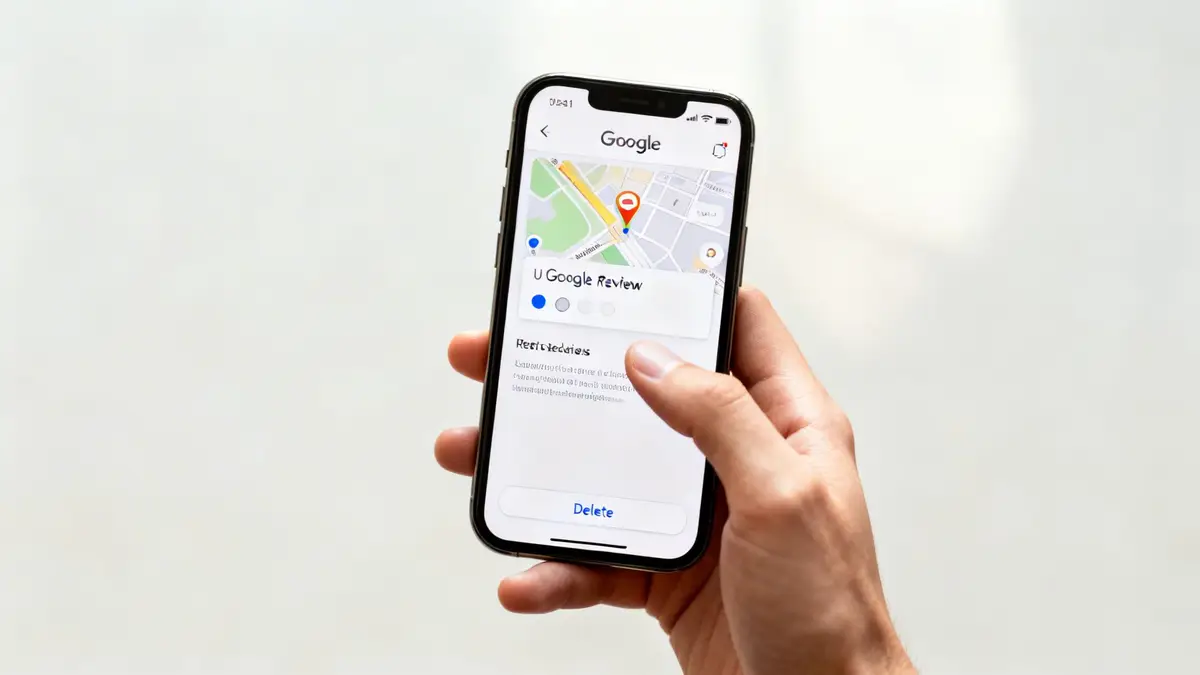
The task is a matter of locating your review history. The most direct method is through Google Maps, which serves as the primary dashboard for your past contributions.
Locating and Deleting Your Review
The procedure varies slightly between desktop and mobile platforms, but the outcome is identical.
On a desktop computer:
Navigate to Google Maps and ensure you are logged into the correct Google account. Click the three-line menu icon in the top-left corner, select “Your contributions,” and then open the “Reviews” tab. This will display a comprehensive list of every review you have ever written.
On a mobile device (iOS or Android):
Open the Google Maps app and tap your profile picture in the upper-right corner. Select “Your profile.” Your reviews will be listed as you scroll down.
Once you locate the specific review, click the three-dot menu adjacent to it. You will be presented with two options: “Edit review” and “Delete review.” To permanently remove the content, you must select “Delete review” and confirm the action.
Editing Versus Deleting a Review
Distinguishing between editing and deleting is critical.
Editing is appropriate when a business has resolved an issue and you wish for your review to reflect this change. You can adjust the star rating and amend your commentary to detail how the company rectified the situation. This demonstrates that the business is responsive to feedback.
Conversely, deleting the review permanently removes it from the internet. It will vanish from the business’s profile and your contribution history. This action is irreversible. If your objective is a completely clean slate, deletion is the only method. Once confirmed, the review is irrecoverable.
Flagging Inappropriate Reviews on Your Business Profile
When a review on your business profile transitions from negative opinion to a clear policy violation, your first course of action is to flag it. This is not a mechanism for silencing dissatisfied customers; it is a process for identifying content that Google itself has deemed prohibited.
Successful removal hinges on a thorough understanding of how Google’s systems, both automated and human, enforce its policies. Reporting a review simply because you disagree with its content is a certain path to denial. You must construct a specific, evidence-based case that the review breaches a clear rule.
Pinpointing Actionable Policy Violations
Google’s moderators are not mediators in a dispute. They seek black-and-white violations, not subjective disagreements. A vague complaint like “this is a fake review” is almost always ineffective. You must connect the review’s content to the exact policy it violates.
For instance, a negative review from a recently terminated employee is not merely negative. It represents a conflict of interest. A review that discloses a personal phone number or home address is a clear breach of personal information policies. A “review” that is nothing more than a link to a competitor’s website is textbook spam. These are the objective, indisputable violations that command Google’s attention.
When you flag a review, you are not arguing your case. You are acting as an informant, pinpointing precisely where a user has violated platform rules. This shifts the dynamic from a subjective dispute to an objective enforcement action.
A detailed understanding of these specific rules is crucial. Our firm’s analysis of Google’s removal policy breaks down these regulations, which can help you frame your request for the highest probability of success. For further perspective, this external guide on how to remove a false Google review offers another solid analysis of the reporting process.
Building a Strong Case for Removal
When you report a review, you have one opportunity to make your case effectively. To construct a report that a Google moderator will act upon, you must align the violation with the correct evidence. Certain policy violations are more actionable than others.
A review from a current or former employee, or a direct competitor, constitutes a Conflict of Interest. In your report, you must provide the necessary context: “This review was posted by a former employee, [Name], terminated on [Date]. This is a clear conflict of interest.”
Content that includes slurs or direct attacks based on race, religion, or other protected group status is Hate Speech, a top-priority violation. Quote the offending language directly in your report to ensure the moderator cannot overlook it.
Finally, reviews that are rants about politics or other subjects unrelated to a customer experience are Off-Topic. State clearly: “This review is a commentary on [unrelated topic] and does not describe any customer experience with our business.”
Your report will almost certainly be screened by an algorithm first. This initial filter scans for keywords and flags matching its programming. Your request is only escalated to a human if you have prepared a precise, evidence-based case that can pass these automated filters. Without this targeted approach, your request will likely be denied before a human reviewer ever sees it.
What to Do When Your Removal Request Fails
It is exceedingly frustrating when a flagged review that clearly violates Google’s policies is met with a denial. This is a common occurrence. You have done your part, but Google’s automated systems, or even its first-level human reviewers, have failed to act correctly.
This is not the end of the road. It is time to adopt a more direct approach. The next step is to bypass the public “flag as inappropriate” feature and take your case directly to Google Business Profile (GBP) support. This is your opportunity to argue your case in greater detail and reach a reviewer who can apply the common-sense nuance that algorithms lack.
Contacting Support Through Your GBP Dashboard
The GBP support contact form is not prominently displayed. The process generally involves logging into your dashboard, selecting your business, locating the specific review, and indicating that your initial removal attempt was rejected.
This is your chance for a formal appeal. Do not resubmit the same brief report. You must build a stronger, more detailed case.
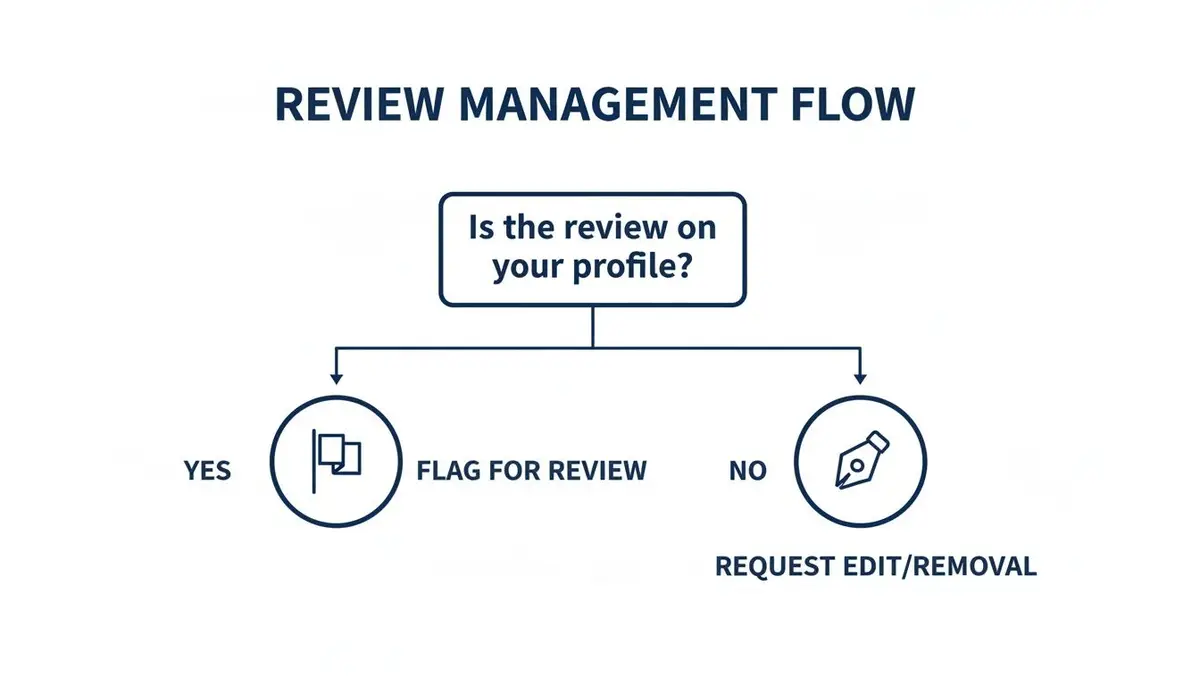
As the flowchart illustrates, flagging the review is the initial step. Escalation is the critical second path when that attempt fails.
How to Build a Strong Case for Escalation
When composing your message to the GBP support team, maintain a professional tone and adhere strictly to the facts. An emotional appeal is counterproductive; a clear, concise argument is essential. The individual reviewing your appeal requires an easily digestible reason to overturn the initial decision.
Your message must include the following key information:
- The Reviewer’s Name: Exactly as it appears on Google.
- The Full URL of the Review: Provide a direct link.
- The Specific Policy Violation: Name the exact policy, such as “Conflict of Interest” or “Hate Speech.”
- A Clear Explanation: Briefly explain how the review violates that specific policy, providing context you could not include in the initial flagging form.
- Proof: This is crucial. Attach screenshots, link to the reviewer’s profile if it demonstrates a pattern of fraudulent reviews, or include any documentation that substantiates your claim.
For instance, when dealing with a disgruntled ex-employee, your message should state: “This review was left by [Reviewer Name], a former employee who was terminated on [Date]. Google’s Conflict of Interest policy prohibits reviews from former employees. We have attached documents confirming their dates of employment to validate our claim.”
This level of detail transforms a simple complaint into a well-documented appeal that is significantly harder to dismiss. Be prepared for a response to take several business days or longer. Even with a perfect appeal, success is not guaranteed, as Google’s interpretation of its own rules can be frustratingly inconsistent.
The system’s fragility was demonstrated in early February 2023 when a massive glitch caused Google to accidentally delete millions of legitimate reviews from business profiles globally. Review counts remained unchanged, but the content vanished, causing widespread confusion. For high-profile individuals and executives, it was a stark reminder of how vulnerable a digital reputation is, losing hard-earned 5-star reviews can be as damaging as a fraudulent negative one.
When the platform’s own tools fail, you must consider more forceful options. For defamatory content that Google will not remove through standard channels, legal action may be necessary. Our guide on how to submit a Google legal request details this critical next step. This is often the point at which professional intervention becomes necessary to protect your reputation decisively.
Advanced Legal and Proprietary Takedown Strategies
You have flagged the review and escalated it through Google Support, yet it remains, actively damaging your reputation. At this juncture, the problem ceases to be a customer service issue and becomes a legal one. When a review is not merely negative but potentially unlawful, a different set of strategies is required.
If Google’s standard processes have failed, it is because the review does not fit neatly into its policy violation categories. We must now explore strategies that leverage the force of law and specialized expertise.
Here, we move beyond Google’s internal rulebook and into the realm of jurisprudence. For any action to be taken, the content must meet a specific legal threshold, a distinction where expert counsel is non-negotiable.
The Legal Threshold for Defamation and Libel
A negative review is not automatically defamatory. This is a critical legal distinction. If a customer states, “The service was slow and my steak was cold,” they are voicing a subjective opinion. It is damaging, but it is legal.
Defamation, however, is a false statement of fact that causes tangible harm to your reputation. A review alleging, “The owner is embezzling money from the company,” is a factual allegation. If false, it constitutes libel (written defamation).
Understanding the line between opinion and a false statement of fact is paramount. The legal standard for proving defamation also varies by jurisdiction.
- In the United States, the bar is exceptionally high, particularly for public figures. You must prove the statement was false, caused harm, and was made with “actual malice”: meaning the reviewer knew it was false or acted with reckless disregard for the truth.
- In the European Union and the United Kingdom, the law is often more favorable to the claimant. The burden of proof may shift to the author of the statement to prove its truth.
A generic legal threat from an online template will not work. A strategy that is effective in London could be futile in New York. A specialist understands how to construct a legal argument based on the correct jurisdiction to apply maximum pressure on both the reviewer and Google.
Applying Strategic Legal Pressure
When a review is defamatory, the first strategic move is often a precisely drafted cease-and-desist letter. This is not a template. A letter from a reputable firm signals that you are prepared to litigate. It details the defamatory statements, cites the specific laws being broken, and demands immediate removal of the content.
If the reviewer is anonymous or ignores the letter, the next step can be a court order.
Obtaining a court order that explicitly identifies a review as defamatory and legally compels its removal is the most definitive method to force Google’s compliance. When presented with a valid U.S. court order, Google will typically remove the content. This process bypasses Google’s subjective content policies and replaces them with the objective authority of the law.
This is an incredibly powerful tool, but achieving it is a complex legal process. It may involve filing a “John Doe” lawsuit to unmask an anonymous reviewer, successfully arguing the defamation case, and securing the final takedown order. For clients facing serious reputational attacks, this is often the surest path to resolution when all other methods have failed.
Proprietary Removal Processes
Beyond the courtroom exist proprietary takedown strategies. This is the domain of specialist firms like ContentRemoval.com, which blend legal knowledge with deep platform experience and non-public methods to achieve results. These techniques are developed over years and thousands of successful removal cases.
These advanced processes often involve:
- Utilizing specific back-end platform channels unavailable to the public.
- Identifying subtle policy violations that automated systems and first-line human reviewers consistently miss.
- Constructing a complex case that links a single negative review to a broader pattern of abuse, forcing a more serious investigation from Google’s legal or trust and safety teams.
This is why professional assistance is essential for difficult or urgent cases. When your reputation is at stake and standard options have failed, you require a team that operates at a different level, employing every available legal, technical, and proprietary tool.
Proactive Reputation Defense and a Long-Term Strategy
Once the immediate threat of a negative review is neutralized, the real work begins: building a resilient reputational fortress. The objective is not to react to the next attack but to establish a strong foundation where a single negative comment has minimal impact. This requires a long-term strategy that works with Google’s systems, not against them.
Google’s automated moderation acts as a hyper-vigilant watchdog, constantly scanning for inauthentic activity. Inadvertently triggering its filters is surprisingly easy. Understanding these triggers is the first step toward creating an authentic and durable online presence.
Navigating Google’s Automated Moderation
Google’s algorithm is designed to detect inauthentic activity, and it has several primary red flags. A sudden, massive influx of five-star reviews is the most significant. If a business profile that typically receives a few reviews per month suddenly accrues twenty in a single day, the system will likely assume manipulation. The consequence is often a bulk deletion that removes legitimate reviews along with any fraudulent ones.
This has created significant volatility. We have observed Google cracking down on what it deems incentivized reviews, resulting in large-scale deletions of positive, five-star feedback. For public figures or high-net-worth family offices, this instability can be devastating. When your positive feedback vanishes, the remaining negative content appears far more prominent, potentially reducing trust by 25% or more.
At ContentRemoval.com, we have been neutralizing these threats for high-value clients since 2015. Our jurisdiction-specific strategies help suppress defamatory content three times faster than a typical PR firm. As automated sweeps become more common, expert guidance is no longer a luxury. It is a necessity.
How to Cultivate Authentic Positive Reviews
The only truly bulletproof defense is a strong foundation of genuine, positive reviews obtained ethically. This requires strict adherence to Google’s policies. Never offer discounts, gift cards, or any other incentive in exchange for a review. This is a direct violation that can lead to review removal and penalties against your business profile.
Instead, focus on two key areas: delivering an exceptional experience and making it simple for satisfied clients to provide feedback.
- Integrate a review request into the natural conclusion of a successful transaction.
- Simplify the process by providing a direct link.
- Aim for a slow, steady stream of reviews over time, not a sudden burst.
This organic approach builds a credible, trustworthy reputation that can withstand the occasional negative review. Our continuous reputation monitoring services are designed to help you track this progress and identify potential issues before they escalate into a crisis.
Common Questions (and Honest Answers) About Removing Google Reviews
When confronting a harmful Google review, questions are inevitable. The process is opaque and frustrating, but obtaining direct answers is the first step toward regaining control of your online reputation.
How Long Does It Take for a Flagged Review to Be Removed?
It is a waiting game with no guaranteed timeline. Once flagged, a review enters Google’s moderation queue, where an algorithm performs an initial check that can take hours or days. If the algorithm cannot make a determination, the review may be escalated to a human moderator, adding more time. The process can take weeks, and you will not receive progress updates. Many flagged reviews are never removed, particularly if the violation is not obvious.
Can I Sue Someone for a Negative Google Review?
Yes, legal action is an option, but only if the review is defamatory. It must contain a false statement of fact that is demonstrably untrue and harms your reputation. This path is resource-intensive and requires consultation with an attorney specializing in online defamation to assess the viability of your case, as laws vary significantly by jurisdiction.
A critical distinction exists between opinion and a false statement of fact. “The food was terrible” is a protected opinion. “The owner poisoned my food” is a factual claim that, if false, is defamatory. The success of a legal case rests on proving this difference.
Will Responding to a Negative Review Help Get It Removed?
No. Responding to a review has zero influence on Google’s removal decision. The flagging and review process is an entirely separate, internal system. However, a professional, calm public response remains an excellent reputation management tool, demonstrating to potential customers that you are engaged and value feedback. Consider it a parallel strategy to your removal efforts.
What Is the Success Rate for Getting a Google Review Removed?
When flagging a review yourself, the success rate is quite low. Google’s automated systems are designed to filter out all but the most flagrant policy violations, such as hate speech or overt spam. Escalating the issue through Google Business Profile support offers a slightly better chance but is far from guaranteed. As this external analysis of “Can you remove Google reviews?” confirms, standard methods often fail. For reviews in a gray area or involving complex issues, engaging a specialist firm that employs a combination of legal and proprietary tactics significantly increases the probability of a successful removal.
When standard channels fail and your reputation is on the line, you need a specialist’s approach. The team at ContentRemoval.com blends legal expertise with proven strategies to take down damaging content that others can’t. If a review is threatening your personal or professional standing, contact us for a confidential assessment. ContentRemoval.com
Frequently asked questions
Why did Google deny my request to remove a review?
Most flags are screened by an algorithm first, and a vague complaint that a review is fake or unfair will not pass it. Google’s moderators look for a clear match to a specific policy, so the report needs to name the rule and show evidence, for example employment records for a former employee’s review.
Is a negative Google review defamation?
Only if it contains a false statement of fact that harms your reputation. An opinion such as the service was slow is protected, while a claim that the owner is embezzling money is a factual allegation that, if false, is libel. In the United States public figures must also show actual malice.
Does replying to a bad review help get it removed?
No. Responding has no influence on Google’s removal decision, which runs through a separate moderation system. A calm, professional reply is still useful for readers, but treat it as a parallel step rather than a removal tactic.