
Reputation management for accountants is the practice of auditing, removing, and controlling the online content that prospective clients find when they research a CPA, an accounting firm, or its partners, so that a single hostile review, an old disciplinary mention, or a fabricated complaint does not silently redirect trust-based referrals to a competitor. For accountants and CPA firms, whose entire business model rests on being perceived as careful, ethical, and safe to hand financial records to, this is not brand polish. It is defense of the referral engine itself.
Accounting is arguably the most trust-sensitive professional service a client ever buys. Clients hand over payroll, tax filings, audited statements, and in many cases visibility into their entire financial lives. That means the diligence bar is low in volume but absolute in kind: a prospect rarely reads ten pages of research, but the one search they do run must come back clean. A restaurant survives a two-star outlier; a CPA firm with “fraud” or “IRS problems” visible in its first page of results often never learns how many engagement letters were never requested.
This guide defines the specific threats accountants and CPA firms face online, explains the mechanisms by which those threats convert into lost revenue and lost referrals, and lays out what professional, removal-first reputation management for accountants involves, and why firms that treat it as a marketing task keep losing to firms that treat it as risk management.
What reputation management for accountants covers
Reputation management for accountants and CPA firms covers four surfaces: search results for the firm name and each partner’s name; review platforms where clients and non-clients rate the firm; complaint sites and forums where disputes are aired; and, increasingly, the AI-generated summaries prospects see when they ask an assistant whether a firm is trustworthy. A removal-first program addresses these surfaces in a specific order (take down or de-index what can be removed, challenge what violates platform policy, then suppress the residue with authoritative content) because content that is removed cannot resurface in an algorithm shuffle, while content that is merely buried can.
This distinguishes real protection from what most accountants are actually sold. The typical “reputation package” pitched to CPA firms is review-generation software plus some blog posts. Review volume helps, but it does nothing about the fabricated one-star review sitting in the firm’s profile, the complaint-board thread ranking for “[firm name] reviews,” or the decade-old state-board coverage that outranks the firm’s own site. Those require removal and de-indexing work, and that is a different profession.
Key takeaway: For CPA firms, generating good reviews and removing damaging content are different disciplines. The first raises your average; only the second addresses the specific item every diligent prospect will read.
Why accountants and CPA firms are targeted
Accountants sit at the intersection of money, deadlines, and stress, a combination that reliably produces online attacks, most of them from predictable sources.
Fee and outcome disputes. Tax season manufactures grievances at industrial scale. A client who owes more than expected, gets audited, or disputes a bill frequently blames the preparer, and takes that blame to Google. These reviews are emotionally compelling and factually one-sided, and the accountant’s confidentiality obligations mean the firm cannot tell its side publicly. IRC §7216 and state confidentiality rules make even a mild public reply to a tax client’s review a genuine compliance hazard, an asymmetry attackers exploit whether they understand it or not.
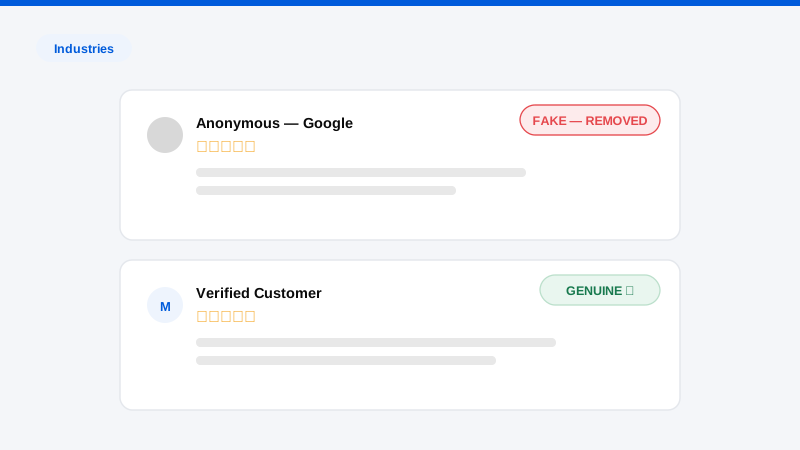
Fake and misdirected reviews. CPA firms accumulate reviews from people who were never clients: an ex-spouse in a divorce where the firm did valuation work, a business partner on the losing end of a forensic engagement, an employee of a client company disgruntled about payroll, or simply reviews meant for a similarly named firm. Non-client reviews violate the policies of every major platform, but platforms rarely remove them without a properly built challenge.
Old disciplinary and regulatory coverage. This is the accounting profession’s signature problem. State board actions, PCAOB matters, IRS-related coverage, and local reporting on decades-old issues persist in search indexes indefinitely, long after the matter was resolved, the penalty served, or the partner involved has retired. Search engines have no statute of limitations. A firm can spend twenty years rebuilding and still watch a 2006 headline sit above its homepage. Prospects reading that result have no way to know, and no incentive to find out, whether it reflects the firm today.
Competitor and bad-actor interference. Accounting is local and search-driven; “CPA near me” and “[city] tax accountant” queries decide real revenue. That creates incentive for review sabotage and for lead-generation sites that scrape firm names into low-quality directories with hostile or erroneous ratings attached.
Partner-name exposure. As with law firms, clients research the individual CPA as much as the firm. A partner’s personal litigation, an old news mention, or a name collision with someone else’s misconduct becomes the firm’s problem the moment a prospect can’t tell the difference.
What’s at stake
The damage mechanism for accountants is quiet, cumulative, and concentrated in the channel firms depend on most: referrals.
The referral short-circuit. Accounting firms grow primarily through referrals: from attorneys, bankers, financial advisors, and satisfied clients. Every referral gets verified: the person receiving the recommendation searches the firm before calling. When that search surfaces a complaint thread or a hostile review cluster, the referral dies silently. The referrer never knows, the firm never knows, and the prospect calls someone else. This is the defining loss pattern for CPA firms: not public controversy, but a steady, invisible tax on the firm’s best channel.
Trust-threshold failure. Legal and accounting services share a property most businesses don’t: prospects aren’t comparing quality on a spectrum, they’re clearing a binary trust threshold. “Is this firm safe to give my financials to, yes or no?” Negative content doesn’t just lower a rating; it flips the binary for some fraction of every month’s prospects, permanently, for as long as it remains visible.
Advisory-relationship stakes. The profession’s economics are shifting from compliance work toward advisory relationships: CFO services, transaction support, wealth-adjacent planning. Those engagements carry higher fees and much deeper diligence. The move upmarket that most firms are attempting raises the reputational bar precisely as it raises the stakes.
Institutional and panel diligence. Lenders, audit committees, private-equity groups, and attorneys placing forensic work run formal diligence on accounting firms. Visible adverse content becomes a line item in someone’s memo, and firms are removed from consideration without ever being told.
Recruiting drag. The accounting talent shortage is well documented across the profession, and candidates research employers the way clients do. Negative Glassdoor narratives and search results push scarce candidates toward competing offers, a second-order cost that compounds the first.
AI answers as the new first impression. Prospects increasingly ask AI assistants to recommend or vet accountants. These systems summarize whatever the index contains, including the complaint thread and the 2006 headline, into an authoritative-sounding answer the firm never sees. Auditing what AI systems say about your firm is now part of basic diligence hygiene.
See what prospects find before they call you.Free confidential Exposure Scan: live results on a 15-minute call, yours to keep either way.
Book Your Free ScanWhat professional protection looks like
A professional program for a CPA firm is built removal-first and runs continuously, because the attack surface renews itself every tax season.
Exposure audit. The work starts with a complete map of what prospects actually find: firm-name and partner-name searches, “[firm] reviews” and “[firm] complaints” queries, local-pack results, review-platform profiles the firm may not know exist, complaint-site entries, forum threads, image results, autocomplete suggestions, and AI-assistant summaries. Most firms discover exposure they had no idea existed: orphaned profiles, scraped directory listings with wrong data, reviews on platforms nobody was watching.
Removal at the source. Each damaging item gets its own strategy. Fake and policy-violating reviews are challenged through platform enforcement with documented evidence of the violation: non-client status, conflicts of interest, prohibited content. Defamatory posts and complaint-site entries are pursued through the removal pathways each platform actually honors. Outdated coverage that misrepresents the firm’s current standing is addressed through de-indexing requests, publisher outreach, and correction or contextualization strategies, approaches that require judgment about which lever fits which publisher, learned only through volume.
Suppression engineered for accounting queries. For content that survives removal efforts, professional suppression builds durable authority around the searches that matter: partner names, “[firm] reviews,” service-plus-city terms. Where a firm’s profile supports it, earned press placement delivers coverage with the domain authority to hold rankings and the credibility to reassure the diligent prospect who reads it.
Standing protection. Because tax season reliably generates new grievances, serious firms operate under continuous monitoring with alerts on firm and partner names, backed by Protection Plans that keep removal capacity on standby. Timing drives outcomes: a fabricated review challenged in its first days, before it gathers engagement and settles into the index, comes down far more reliably than one challenged at extension-deadline crunch six months later.
Key takeaway: CPA firms should time protection to their own calendar. The weeks after April 15 and October 15 are when grievance-driven content appears; a firm with monitoring and standby removal capacity catches those attacks while they are still one review, not a pattern.
Why specialists beat DIY reputation management for accountants
Accountants are systematic professionals, and the instinct to handle this in-house (flag the review, send a firm letter, reply calmly) is strong. It fails for three structural reasons.
First, platform enforcement is a specialist domain. Review platforms and complaint sites run high-volume moderation queues that auto-reject generic disputes. What succeeds is the properly framed challenge: the right policy citation, the right evidence format, the right escalation path when the first pass fails. Specialists run these processes daily across hundreds of matters and know which arguments each platform actually acts on; a firm doing it once learns by burning its best chances on badly framed first attempts, and first attempts matter, because a rejected flag makes the second challenge harder.
Second, the confidentiality trap is real. A public reply that confirms someone was a tax client, or hints at their situation, creates regulatory exposure that dwarfs the review itself. The safe posture is third-party removal work in which the firm never engages the attacker at all.
Third, opportunity cost. Partner hours spent fighting a complaint site are billed at the firm’s realization rate against an unfamiliar problem. Firms that advise clients to hire specialists for specialist problems should take their own advice; a dedicated reputation-management partner resolves in weeks what internal efforts chase for a year.
See what prospects find before they call you.Free confidential Exposure Scan: live results on a 15-minute call, yours to keep either way.
Book Your Free ScanWhy accountants and CPA firms choose Content Removal
Content Removal LLC is built around one competency: getting damaging content removed, de-indexed, or corrected at the source. Accounting firms choose us because that is the competency their problem actually requires, not review-generation software, not a content calendar.
We work the way CPA firms need a vendor to work. Engagements are confidential; we never need client financial information or matter details to do our job. We never respond publicly on a firm’s behalf or engage attackers in ways that could create compliance exposure under confidentiality rules. We are not a law firm and do not provide legal advice; where litigation is the right tool, we work alongside the firm’s counsel and handle the platform-level execution that courts do not reach. We scope honestly, after auditing your exposure, we tell you which items are strong removal candidates, which are long-shot, and which call for suppression instead, because guaranteed outcomes do not exist in this field and firms that promise them should be disqualified on the spot, and we protect both the firm and its partners, because prospects research both. Our case studies show how these engagements run end to end.
Key takeaway: The right partner for a CPA firm is removal-first, confidentiality-disciplined, and candid about odds, the same standards of professional skepticism accountants apply everywhere else.
Frequently asked questions
Can a fake review from someone who was never a client be removed?
Frequently, yes. Every major review platform prohibits reviews from non-customers, and reviews driven by conflicts (opposing parties in disputes where the firm did forensic or valuation work, competitors, misdirected reviews meant for another firm) are among the stronger removal categories. Success turns on documenting the violation the way each platform’s enforcement process requires. No individual item can be guaranteed, but this category resolves favorably more often than most.
What about news coverage of an old disciplinary matter that was resolved years ago?
Old regulatory and disciplinary coverage is harder than review removal but far from hopeless. Depending on the publisher and the specifics, options include de-indexing requests, publisher outreach for updates or corrections, contextualization, and, where removal avenues are exhausted, suppression that moves the coverage off the queries prospects actually run. An honest specialist will assess your specific item before predicting anything; be wary of anyone who quotes odds before seeing it.
Should we reply publicly to a negative review from a tax client?
Treat public replies as high-risk. Confidentiality obligations around tax-return information make even acknowledging someone as a client hazardous, and replies add engagement signals that can strengthen the content’s visibility. The productive path runs through platform enforcement and removal, executed by a third party so the firm never engages directly.
When should a firm invest in this, after an attack, or before?
Both have value, but the economics favor before. Content challenged early, before it accumulates engagement and index authority, is meaningfully easier to remove, and monitoring is what makes early challenge possible. Firms with clean profiles today and a tax season ahead of them are exactly who standing protection is designed for.
The prospects your referral partners send you are searching your firm right now, and whatever they find is deciding whether you ever hear from them. Find out what that is: book a free, confidential Exposure Scan and review your firm’s live results, firm name and partners, on a 15-minute call. The findings are yours to keep either way.