
To find your mugshot online, start with the agency that booked you: the county sheriff, city police, jail roster or state corrections search, using your legal name, county, booking date or case number. Then run exact-match and site: searches, check Google Images and reverse image search, and log every URL. Treat third-party mugshot sites as evidence, not places to pay.
Key facts
- Commercial searches carry a 35% false-positive rate and 28% of arrest records use aliases, so validate every match.
- Florida Statute 901.043 requires removal within 10 business days once dismissal, acquittal, sealing or expungement is documented.
- CCPA Section 1798.105 lets California residents request deletion from covered commercial sites within 45 days.
- Google’s outdated content tool needs both the direct image URL and the hosting page URL.
Where ContentRemoval.com comes in. ContentRemoval.com maps where a booking photo appears across agency portals, mugshot aggregators, mirrors and background-check sites, then runs source removal with the correct statutory or privacy basis, de-indexing from Google web and image results, and monitoring for republication. The individual, a family member or their criminal defense attorney usually makes contact once the case has been dismissed, sealed or expunged. A free 15-minute Exposure Scan maps what is removable and the report is yours to keep. Get a Free, Confidential Exposure Scan or read how our mugshot removal work is done.
You’re probably doing what almost everyone does first. Opening a browser, typing your name, adding “mugshot,” and hoping the result is either clean or manageable.
That instinct is understandable. It’s also sloppy.
If you’re asking How can I find my mugshot online, you’re not dealing with a casual search problem. You’re dealing with a reputation exposure problem. A booking photo can surface in search results, on mugshot aggregators, in background-check ecosystems, and on copied pages you won’t find through a basic Google search. If you search badly, contact the wrong site, or hand over documents too early, you can make the cleanup harder.
The right approach is disciplined. Treat this as the intelligence phase of a removal campaign. First confirm whether the image exists, where it originated, who is republishing it, and what legal grounds you have against each publisher. Then move to eradication.
Adopt a Strategic Mindset Before You Search
Panic creates bad records.
People in this position often make three mistakes in the first hour. They search broadly, click everything, and then start emailing site operators before they understand the publishing chain. That reactive pattern creates confusion, weakens your position, and leaves you with no reliable inventory of what’s present online.
Build a case file, not a browser history
Your first job isn’t to “find the photo.” Your first job is to map the footprint.
Create a working document or spreadsheet with separate columns for the domain, exact page URL, image URL if visible, date found, whether the page is indexed by Google, whether the page appears to be an official government source or a commercial republisher, and what documents might support removal. Keep screenshots. Capture timestamps. Save copies of any visible charges, booking dates, and agency references exactly as displayed.
If you skip this discipline, you’ll lose track of source pages versus copies. That matters later because removing the wrong page first often leaves the original intact.
Practical rule: Don’t contact anyone until you know whether you’re dealing with an agency record, a data broker, a syndicating mugshot site, or a cached search result.
Search privately and search narrowly
Use private browsing. That won’t solve the problem, but it helps you avoid building a noisy trail of personalized searches and repeated clicks. You want clean reconnaissance, not a feedback loop.
Also, don’t start with broad emotional searches like “why is my mugshot everywhere.” Start with controlled queries based on identifiers you already know. Full legal name. Name plus county. Name plus arresting agency. Name plus booking date if known. Case number if you have it. Precision beats volume.
A useful operating rule is simple:
| Search behavior | Result |
|---|---|
| Broad, emotional, repetitive searching | More noise, more false leads |
| Structured, logged, identifier-based searching | Better evidence, faster removal planning |
Define the actual objective
The objective isn’t discovery alone. It’s permanent suppression through source removal, de-indexing, and monitoring for recurrence.
That mindset changes your behavior immediately. You stop thinking like a worried individual and start acting like an investigator preparing a legal and technical takedown file. That is the posture that gets results.
Query Official Law Enforcement Databases First
You need the source record before you touch the copy. Start with the agency that created the booking entry. That is the only place you can confirm whether a mugshot was published, what identifiers are attached to it, and whether later sites are reproducing an active record or an outdated scrape.

Start with the agency that booked you
If you know where the arrest occurred, go straight to that county sheriff, city police department, local jail roster, or state Department of Corrections search page. Use the site’s own terms. “Inmate Search.” “Jail Roster.” “Arrest Search.” “Booking Blotter.”
This step gives you the cleanest evidence and the fewest false positives.
Third-party sites are useful later for scope. They are weak for verification because they copy, delay, truncate, and mislabel records. If your goal is removal, you need the original posting status first. That source record determines whether you are dealing with a live government publication, a stale republication, or a page that should never have remained public at all.
A detailed professional analysis of how mugshot sites actually get and republish records helps explain why this order matters.
Use identifiers that narrow the field fast
Official databases are often clumsy, but they respond to precise inputs. Use the data tied to the booking, not the terms a search engine happens to like.
Priority identifiers include:
- Full legal name used at booking
- Date of birth if the portal accepts it
- Approximate arrest or booking date
- County or city of arrest
- Case number or booking number
- DOC number for correctional records
If you get no result, change the name format and run the search again. Try full middle name, middle initial, suffix, common abbreviations, and alternate spacing. Agency data entry is inconsistent. Your search method cannot be.
Start with geography and agency. Then confirm identity. That sequence cuts error risk and gives you a cleaner record trail.
Confirm existence before you chase the image
Treat this as evidence collection, not casual searching. You do not always need the downloadable photo first. You need proof of publication, the exact URL, the agency name, the booking date, the charge labeling, and whether the page is still public.
That distinction matters in practice. A removal demand to a republishing site requires different support than a petition or request aimed at the original custodian of the record. If you skip this step, you end up arguing from screenshots of copies instead of the source entry itself.
Record four things immediately: whether the page is live, whether a booking photo appears on the page, whether the image can be opened directly, and whether the record includes charge text that has since changed or been dismissed.
For a visual walk-through of how people approach official record searches, this video is useful as orientation before you start logging your findings:
If the public portal comes up empty, escalate with discipline
Do not treat a failed portal search as proof that the mugshot was never published. Agencies remove records from public view, change vendors, break old URLs, and split data across jail, court, and corrections systems.
Your next move is a records request or a direct call to the records division. Ask whether a booking photo was posted publicly, when it was posted, whether it remains accessible, and what office controls the record now. Keep the request narrow and factual. Do not volunteer a removal narrative at this stage.
Public release policies also vary by agency, including publication on social platforms. David G. Moore’s take on police shaming is a useful reminder that dissemination practices can extend beyond a standard inmate lookup page.
That chain of custody matters later. It tells you what was published, who published it, and which party has the strongest legal and practical ability to take it down.
Handle Third-Party Mugshot Aggregators with Caution
You finish checking official records, then your name starts appearing on sites built to turn exposure into revenue. Treat that moment as an intelligence problem, not a customer-service problem. If you contact operators too early, explain too much, or pay on impulse, you hand them information they can use against you.
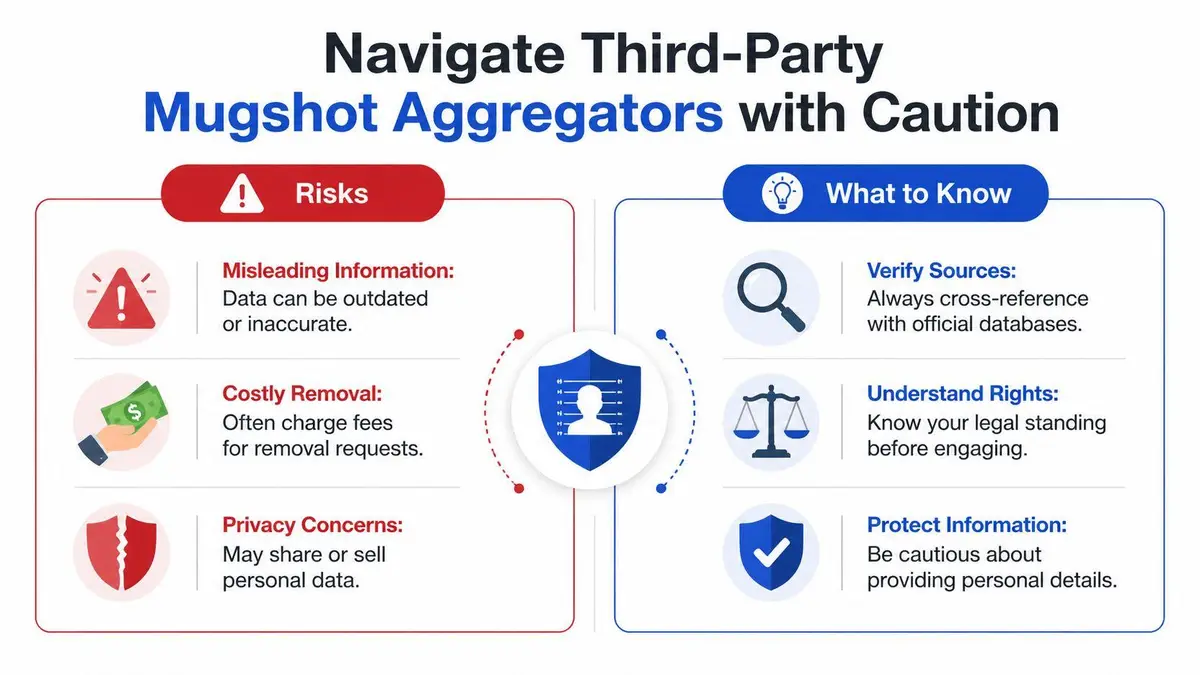
Third-party mugshot sites are rarely passive publishers. They copy public data, republish stale data, cross-post to related domains, and rank pages around name-based searches. The objective is obvious. Put the subject under pressure, then monetize removal, traffic, or both.
Understand the business model before you engage
Start with operator behavior. Ask four questions. Does the page cite an originating agency? Does the site appear to syndicate from other mugshot domains? Does it offer paid removal or route you to a form that collects personal details? Does the same photo appear on affiliated sites with slightly different page templates?
Those details matter because a removal demand sent to the wrong entity wastes time and weakens your position. A rushed payment can be worse. It may remove one page while leaving the image on mirrors, subdomains, scraper copies, archived URLs, and search engine caches. It also tells the operator that the listing has a responsive target.
For a factual breakdown of these publication and monetization patterns, review this professional analysis of how mugshot sites work.
Know the tactical risks
The main risk is misclassification. A page that looks official may be outdated, incomplete, or copied from another source. The county label, charge text, and booking date can create false confidence, especially if the underlying case changed later.
The second risk is network replication. One image can spread across several domains controlled by the same operator or copied by unrelated publishers. If you act against only the page you first found, you solve nothing.
The third risk is premature engagement. Once you write in, upload identification, or explain the case before establishing your legal basis, you reduce a rights issue to a negotiation on the operator’s terms. That is weak strategy.
Public dissemination can also extend beyond traditional mugshot sites. David G. Moore’s take on police shaming shows how arrest imagery can be used for exposure and reputational pressure far beyond a standard records page.
Third-party mugshot sites reward panic. Your job is to document the network, preserve evidence, and avoid signaling urgency before you know who controls the content and what legal pressure points apply.
Use these sites for evidence collection
Inspect them. Do not trust them.
Capture screenshots. Save the full URL. Note the page title, the charge wording, the booking date, the image file path, and any references to the arresting agency or source feed. Record whether the site offers paid removal, requires identity documents, or links to affiliated domains.
Keep your contact footprint minimal until you have a verified map of where the image appears and who controls each page. Do not improvise a narrative. Do not volunteer extra personal data. Do not pay first.
These sites have value, but only as evidence sources inside a larger reputation management operation. Use them to build your file, identify the publishing chain, and prepare for targeted removal action.
Execute Advanced Search and Verification Protocols
A basic name search is not enough. It misses copied pages, indexed image files, alias-based records, and false matches. It also wastes time if your name is common.
Commercial search carries a 35 percent false-positive rate because of name collisions, and 28 percent of arrest records use aliases, which is why secondary validation and reverse-image matching matter, as noted in WikiHow’s mugshot search benchmark summary.

Use search operators like an investigator
Run narrower Google queries instead of repeating your name alone. Useful examples include exact-match searches with quotation marks, plus focused operators such as:
- “Full Name” mugshot
- “Full Name” arrest
- “Full Name” county
- site:domain.com “Full Name”
- site:domain.com booking
- “Full Name” “booking date”
These searches do two things. They isolate pages on specific domains, and they help distinguish your record from people with similar names.
Validate every match before you act
Don’t assume a search hit is yours because the name matches. Compare the page against known identifiers. County. Age range. Booking date. Charges. Agency. If one of those conflicts, flag it as a probable false positive and don’t burn time on it.
Executives and professionals often make a quiet but serious mistake. They delegate the search to an assistant who captures broad screenshots but doesn’t validate identity carefully. That can lead to threatening the wrong publisher about the wrong person’s record. From a legal and reputational standpoint, that is avoidable sloppiness.
A useful validation grid looks like this:
| Identifier | Must match | Notes |
|---|---|---|
| Full name | Usually | Watch for suffixes and middle names |
| County or arresting agency | Ideally | Strong discriminator |
| Booking or arrest date | If known | High value when available |
| Charges | Compare carefully | Similar names often diverge here |
| Photo match | Critical | Use reverse-image methods if uncertain |
Search by image, not just text
If you have any known headshot, profile image, or prior online photo of yourself, use reverse-image tools to find visually similar records and copied image files. This helps uncover alias-based listings and pages that don’t rank for your exact name.
A mugshot problem is often an image-matching problem disguised as a name-search problem.
You should also inspect Google Images separately from standard web results. An indexed image may survive longer than the page you first found, and copied thumbnails can point to additional hosts.
Build a verified inventory
By the end of this phase, you should have a clean list of confirmed items only. Separate them into categories: official record, third-party mugshot site, general data broker, cached search result, and uncertain match.
That verified inventory becomes your action list. Without it, every later removal request is less precise and more expensive.
Assess Your Legal Standing for Mandated Removal
Discovery is only reconnaissance. Removal depends on influence.
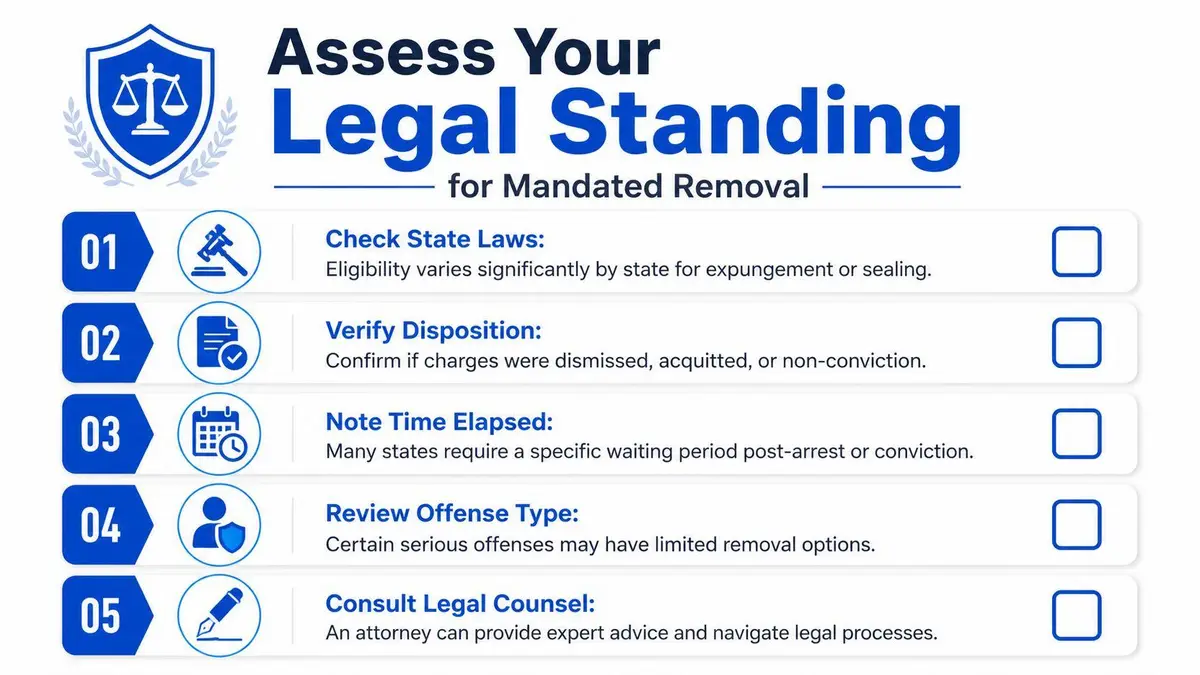
The first legal distinction is simple. A mugshot on an official government portal may still be a lawful public record in that jurisdiction. The same image on a commercial site may be removable under a state statute, a privacy law, or the site’s own obligations once you provide proof of dismissal, acquittal, sealing, or expungement.
Florida gives you a hard deadline
Under Florida Statute 901.043, a website hosting a mugshot must remove the booking photo within 10 business days if you provide documented proof that the charge was dismissed, nolle prossed, you were acquitted, or the record was sealed or expunged. That creates an enforceable compliance window, as explained in this discussion of Florida mugshot removal obligations.
That changes the posture entirely. You’re no longer asking for courtesy removal. You’re asserting a statutory obligation. If the site ignores the request after proper notice, you have a documented refusal.
California creates a separate deletion path
California residents have another route. CCPA Section 1798.105 gives a right to request deletion of personal information, including mugshots, from commercial sites that fall under the law’s coverage. The business must respond within 45 days, with a possible extension to 90 days if it gives formal notice, according to this guide to legal mugshot removal mechanisms.
That matters because not every effective removal route requires an expungement order. Sometimes the right frame is consumer privacy law rather than criminal-record relief.
Match the record type to the remedy
Use this decision logic:
- Official agency posting: Confirm whether the agency still publishes it and whether state law limits release or later display.
- Commercial mugshot site: Evaluate state-specific mugshot laws, privacy rights, and whether the site demands documents it’s legally required to honor.
- Expunged or sealed matter: Obtain the correct verification documents before contacting republishers.
- Background-check style republication: Check whether the publisher is displaying outdated or inaccurate information after the underlying case changed.
For a broader strategic view of what arrest information can surface in screenings, this assessment of whether a mugshot will show up on a background check is a useful companion.
The legal question isn’t “Can I ask for removal?” The legal question is “Who is under an obligation to remove, under what authority, and with which document set?”
Don’t send incomplete paperwork
If your removal claim depends on dismissal, sealing, or expungement, submit the exact supporting record the site or statute requires. In some jurisdictions, that means certified court proof. In others, you may need a verification certificate from the relevant court administration before the demand has force.
Weak paperwork produces predictable outcomes. Delay, denial, or a request for more documents that you should have assembled before first contact.
Determine Your Strategic Next Steps for Eradication
By this point, you should know three things. Where the mugshot originated. Where it has been republished. What legal or procedural recourse applies to each instance.
Now the work becomes operational.
Remove from the source, then remove from search
These are separate jobs. People confuse them constantly.
Source removal means taking the image and page down from the site that hosts it. De-indexing means clearing the search-result visibility that can persist even after the page changes or disappears. If you do only one, the problem often lingers in public view.
For Google, the correct tool is not the generic complaint form. You must use Google’s outdated content removal tool, and you need to provide both the direct image link and the page URL hosting it, as outlined in Security.org’s mugshot de-indexing instructions.
Sequence matters
A clean eradication sequence usually looks like this:
- Lock the evidence with screenshots, URLs, and timestamps.
- Send the strongest removal demand first to the host with the proper legal basis and documents.
- Confirm the page or image changed before filing for de-indexing.
- Submit the Google outdated content request using the correct URLs.
- Monitor for reappearance on copies, mirrors, or search results.
If you reverse that order, you create unnecessary delay. Search engines generally respond to changed or removed source content. They don’t solve the underlying publication problem for you.
Know where self-help stops
You can handle some first-stage discovery on your own. You can sometimes send a straightforward statutory demand on your own. But once the issue involves multiple publishers, offshore hosts, syndication, reuploads, or documents that need precise framing, self-help starts costing more than it saves.
That’s where specialist workflows matter. For example, this protocol for getting your mugshot off Google Images addresses the search-suppression side specifically, which is only one layer of the full problem. A managed campaign may also involve source tracing, legal notice sequencing, host escalation, and recurrence monitoring. ContentRemoval.com is one firm that handles mugshot source removal and de-indexing as part of a broader digital reputation remediation process.
The strategic point is simple. Don’t judge progress by whether one page disappeared. Judge it by whether the image is gone from the source, absent from search, and contained against re-publication.
If your name, business, or family reputation carries real value, treat mugshot removal like litigation support. Precision first. Documentation second. Pressure in the right order. Monitoring afterward.
If you need a confidential assessment of where your mugshot appears, what can be removed, and which demands carry real legal force, ContentRemoval.com can map the exposure and execute a coordinated removal strategy across host sites and search engines. This is the kind of problem that rewards speed, discretion, and exact sequencing.
Frequently asked questions
Should I pay a mugshot website to take my photo down?
Not as a first move. Paying one operator often removes a single page while the image stays on mirrors, affiliated domains, scraper copies and search caches, and it signals that the listing has a responsive target. Establish your legal basis and map the full publishing chain before contacting anyone.
Can I get my mugshot removed if the charges were dropped?
Often, yes. Several states create obligations once you provide proof of dismissal, acquittal, sealing or expungement; Florida, for example, requires removal within 10 business days of proper notice. Submit the exact certified documents the site or statute requires, since incomplete paperwork produces delay or denial.
Why does my mugshot still show up in Google after the page was removed?
Because source removal and de-indexing are separate jobs. Once the page or image has changed or disappeared, submit Google’s outdated content removal request with both the direct image link and the hosting page URL, check Google Images separately from web results, and monitor for copies on other hosts.