
To delete results from Google search, use Google’s removal tools for personal data, explicit imagery, copyright and court orders, pursue source-level removal from the host so Google de-indexes it on the next crawl, and fall back on legal pathways or suppression when the publisher refuses. Google indexes rather than hosts content, so source removal is the most durable route.
Key facts
- Google’s personal information form covers ID numbers, financial credentials, signatures, medical records and doxxing content.
- Search Console’s temporary removal hides a page for 6 months and only works for domains you own.
- Hosts typically act on valid DMCA notices within 24 to 48 hours, and Google de-indexes reported URLs separately.
- Right to be forgotten requests are judged by a balancing test, with public figures facing higher rejection rates.
Where ContentRemoval.com comes in. Google’s tools solve the clean cases. The harder ones involve publishers who will not respond, content spread across many sites, archive copies and results that come back after a crawl. ContentRemoval.com runs those as a single managed case, combining source removal, technical de-indexing, legal demand letters where needed and monitoring. Executives, small business owners and their counsel all make contact. A free 15-minute Exposure Scan maps what is removable, and the report is yours to keep. Get a Free, Confidential Exposure Scan or read how our search result removal work is done.
When your name or brand appears alongside damaging content in Google search results, the urgency to delete results from Google search becomes immediate and critical. Whether facing defamatory articles, privacy violations, outdated information, or reputation-damaging content, understanding the pathways to removal can mean the difference between continued harm and restored reputation. In 2026, Google processes millions of removal requests annually, but success depends on knowing which approach to use, when to use it, and how to navigate the technical and legal complexities involved.
Understanding What Google Can and Cannot Remove
Google operates as an intermediary between users and the vast content ecosystem of the internet. The search engine doesn’t host most content that appears in results-it simply indexes and ranks information published elsewhere. This fundamental distinction shapes every removal strategy.
Content Google Routinely Removes
Google maintains specific categories of information that qualify for removal under standard policies. Personal information including social security numbers, bank account details, credit card numbers, and signature images can be removed through straightforward requests. Explicit content shared without consent falls under dedicated removal protocols, as does content featuring minors in harmful contexts.
Additional removal categories include:
- Doxxing content containing personal contact information intended for harassment
- Copyrighted material when valid DMCA notices are filed
- Court-ordered removals backed by legal mandates
- Duplicate or outdated government records in certain jurisdictions
- Medical records and confidential financial documents
According to Google’s transparency reports, the company evaluates each request against established policies, balancing individual privacy rights with public interest in accessing information.
Content Requiring Alternative Strategies
Not all unwanted content qualifies for direct removal through Google’s standard processes. Negative reviews, critical news articles, public records, and opinion-based content typically fall outside removal eligibility unless they contain specific policy violations.
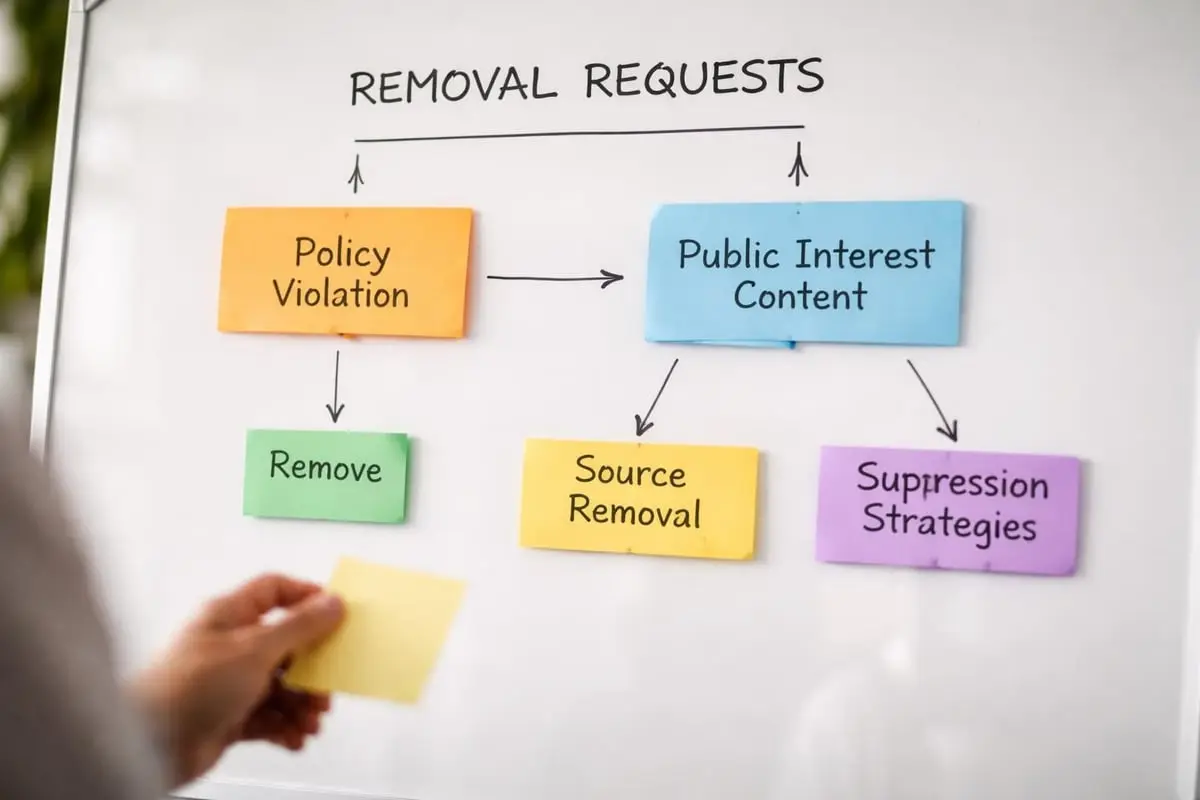
When standard removal paths aren’t available, the focus shifts to source-level takedowns or suppression techniques that push unwanted results lower in rankings. Professional reputation management services specialize in these alternative approaches when direct removal from Google isn’t feasible.
Google’s Official Removal Tools and Processes
Google provides several pathways to delete results from Google search, each designed for specific content types and situations. Understanding which tool applies to your situation determines the efficiency and success rate of your removal effort.
Using Google Search Console for Site Owners
Website owners have the most direct control through Google Search Console. The platform’s Removals tool allows temporary hiding of pages from search results while more permanent solutions are implemented.
| Removal Type | Duration | Best Used For |
|---|---|---|
| Temporary removal | 6 months | Urgent situations requiring immediate de-indexing |
| Outdated content | Permanent (if verified) | Pages already deleted from source website |
| SafeSearch filtering | Ongoing | Adult content on your own domain |
The Removals report in Search Console provides monitoring capabilities, showing the status of all removal requests and allowing site owners to track which URLs have been successfully de-indexed. However, this tool only works for content on domains you own and verify-a significant limitation when dealing with third-party websites.
Personal Information Removal Requests
For individuals seeking to delete results from Google search containing personal data, Google’s dedicated removal request form offers a streamlined process. The 2026 version of this tool has expanded categories compared to previous years.
Eligible personal information categories include:
- Government identification numbers
- Bank account and financial access credentials
- Images of handwritten signatures
- Confidential medical records
- Personal contact information used for doxxing
- Explicit imagery shared without consent
- Content featuring minors
Each request requires specific documentation proving the information belongs to you and appears in search results. Response times typically range from 3 to 14 business days, though complex cases may take longer.
Legal Removal Requests
Content violating laws in specific jurisdictions may qualify for removal through legal requests. Google evaluates these against local regulations while considering broader implications for information access.
Common legal bases for removal include:
- Copyright infringement under DMCA provisions
- Defamation established through court proceedings
- Right to be forgotten claims in applicable jurisdictions
- Court orders mandating specific content removal
- Privacy law violations under GDPR, CCPA, or similar frameworks
The legal removal request process requires substantial documentation and often benefits from legal counsel to ensure proper presentation and maximize success probability.
Source-Level Content Removal Strategies
The most effective way to delete results from Google search often involves removing content at its source. When a page disappears from the internet entirely, Google eventually de-indexes it during subsequent crawls.
Direct Website Contact and Negotiation
Reaching out to website owners or publishers represents the first step in source-level removal. Many sites maintain content policies and removal processes, particularly for user-generated content platforms.
Effective outreach strategies include:
- Identifying the correct content manager or editorial contact
- Clearly stating the specific content requiring removal
- Providing legal or policy-based justification
- Offering documented evidence supporting your claim
- Setting reasonable timeframes for response and action
Response rates vary dramatically by platform type. Social media networks often have standardized reporting mechanisms, while independent blogs or news sites require individualized communication. Professional services specializing in digital footprint cleanup maintain established relationships with major platforms, potentially accelerating removal timelines.
DMCA Takedown Notices
Copyright infringement provides one of the strongest legal bases for content removal. When someone uses your copyrighted material without permission-whether images, text, video, or other creative works-the Digital Millennium Copyright Act establishes a clear removal pathway.
A valid DMCA notice must contain:
- Your contact information as copyright holder
- Identification of the copyrighted work
- Location of the infringing material (specific URLs)
- Good faith statement that use is unauthorized
- Statement of accuracy under penalty of perjury
- Physical or electronic signature
Website hosts receiving valid DMCA notices typically remove content within 24-48 hours to maintain their safe harbor protections. Google separately de-indexes reported URLs, often within hours of receiving properly filed notices. Resources on copyright infringement removal provide templates and guidance for crafting effective notices.

Platform-Specific Reporting Mechanisms
Major platforms maintain dedicated reporting systems for policy violations. Understanding each platform’s specific processes and policies increases removal success rates substantially.
| Platform Type | Primary Removal Paths | Average Response Time |
|---|---|---|
| Social Media | Reporting tools, community guidelines violations | 1-5 days |
| News Sites | Editorial complaints, legal requests | 7-30 days |
| Review Platforms | Fraud reports, terms of service violations | 5-14 days |
| Forums/UGC Sites | Moderator reports, DMCA notices | 2-10 days |
Each platform balances content moderation with free expression differently. Some platforms like removing content from Google through their indexes requires first succeeding with the source platform’s own removal process.
Advanced De-Indexing Techniques
When standard approaches fail to delete results from Google search, advanced techniques targeting the indexing process itself become necessary. These methods require technical expertise and careful execution to avoid unintended consequences.
Robots.txt and Meta Tag Implementation
Website owners can prevent future indexing through technical controls. The robots.txt file instructs search engine crawlers which pages to avoid, while meta tags provide page-level directives.
Key meta tags for removal:
<meta name="robots" content="noindex, nofollow">This tag tells Google not to index the page or follow its links. However, implementation requires access to the website’s code. For content on third-party sites, convincing the owner to implement these tags requires negotiation or legal pressure.
The robots.txt approach works site-wide or for specific directories:
User-agent: Googlebot
Disallow: /private-section/
Changes to robots.txt and meta tags don’t trigger immediate removal. Google must recrawl the pages to detect the changes, which can take days or weeks depending on crawl frequency.
URL Removal Tool Acceleration
Google’s URL Removal tool in Search Console can expedite de-indexing when combined with source removal. After content is deleted from its original location or blocked via robots.txt, submitting the URL through this tool prompts faster processing.
The tool serves several specific functions:
- Temporarily removing pages from search results (6 months)
- Clearing cached versions of pages
- Requesting recrawl of updated content
- Removing entire directories at once
Strategic use involves timing the request immediately after implementing source changes, preventing the weeks-long delay of natural recrawling cycles.
Cache and Snapshot Removal
Even after successful de-indexing, Google’s cached versions and third-party archives like the Wayback Machine may preserve harmful content. Addressing these requires additional steps.
For Google cache removal:
- Ensure the original page returns a 404 or 410 status code
- Submit a removal request through Search Console
- Request cache refresh through the URL inspection tool
- Allow 24-48 hours for cache clearing
Third-party archives present greater challenges. The Internet Archive honors removal requests from content creators but requires verification of ownership and detailed justification. Removing yourself from Google entirely often necessitates addressing these archival sources alongside search engine de-indexing.
Legal Pathways for Persistent Content
Some content resists standard removal approaches, particularly when website owners refuse cooperation or when content enjoys legal protections. In these situations, legal mechanisms provide alternative pathways to delete results from Google search.
Court Orders and Judicial Intervention
Courts can mandate content removal when it violates laws or individual rights. Defamation verdicts, privacy violations, and harassment cases frequently result in removal orders that Google and other platforms must honor.
The judicial process involves:
- Filing a lawsuit against the content publisher
- Presenting evidence of harm and legal violations
- Obtaining a favorable verdict or settlement
- Securing a specific removal order from the judge
- Submitting the order to Google and relevant platforms
According to legal experts on search result removal, certain content categories-including legitimate news coverage, public records, and lawful opinion-typically require court intervention for removal consideration.
International Right to Be Forgotten
The European Union’s General Data Protection Regulation (GDPR) established a “right to erasure” that allows individuals to request removal of personal information from search results under specific circumstances. This right has expanded to similar frameworks in other jurisdictions by 2026.
Qualifying criteria for right to be forgotten requests:
- Information is inaccurate or outdated
- Processing lacks legal basis
- Data subject withdraws consent
- Information causes disproportionate harm
- Collection violated data protection laws
Google evaluates these requests through a balancing test, weighing individual privacy against public interest in accessing information. Success rates vary significantly based on the requester’s public profile and the content’s nature. Public figures and information of legitimate public interest face higher rejection rates.
Defamation Claims and Takedown Demands
False statements causing reputational harm may qualify for removal under defamation law. However, the burden of proof rests with the claimant, who must demonstrate the statement is false, published to third parties, and caused actual damage.
Elements required for defamation-based removal:
- Provably false statement of fact (not opinion)
- Publication to at least one other person
- Fault amounting to at least negligence
- Harm to reputation or presumed harm
- Statement lacks legal privilege or protection
Website owners facing credible defamation claims often remove content to avoid liability. When they refuse, services specializing in content removal can pursue legal demand letters, cease and desist notices, and formal litigation to compel removal. Google typically honors removal requests accompanied by court documents establishing defamatory status.

Suppression as an Alternative to Removal
When direct removal proves impossible, suppression strategies push unwanted results lower in search rankings, reducing their visibility and impact. This approach doesn’t delete results from Google search but minimizes their exposure.
Search Engine Optimization for Positive Content
Creating and optimizing positive content to outrank negative results represents a core suppression strategy. By dominating page one of search results with favorable content, harmful material gets pushed to page two or beyond-where over 95% of users never look.
Effective suppression content types:
- Professional website or personal homepage
- Social media profiles (LinkedIn, Twitter, professional networks)
- Guest articles on reputable publications
- Video content on YouTube and other platforms
- Professional directories and biography pages
- Press releases and news mentions
- Blog content demonstrating expertise
Each piece targets the specific search terms triggering unwanted results. Strategic keyword optimization, authoritative backlinks, and consistent content updates help these properties achieve and maintain top rankings.
Leveraging Owned Properties
Platforms you control directly-personal websites, verified social profiles, YouTube channels-provide the strongest foundation for suppression campaigns. These properties allow unlimited optimization and content updates to maintain relevance.
Optimization priorities for owned properties:
- Exact match domain names for personal or brand searches
- Comprehensive on-page SEO (title tags, headers, schema markup)
- Regular content updates to signal freshness
- Internal linking structures that distribute authority
- Mobile optimization and fast loading speeds
- Authoritative external links pointing to your properties
Google’s algorithms favor authoritative, relevant content. By establishing your owned properties as definitive sources for searches about you or your brand, you naturally push less relevant (including negative) results downward.
Third-Party Authority Building
High-authority third-party platforms provide additional suppression leverage. A profile on Forbes, Harvard Business Review, or LinkedIn carries more weight than most negative content sources.
Strategic third-party suppression involves:
- Securing profiles on industry-leading platforms
- Publishing thought leadership content on reputable sites
- Building Wikipedia presence (if notability criteria are met)
- Earning media coverage in established publications
- Participating in podcasts and interviews that generate indexed content
The combination of owned and third-party content creates a suppression network difficult for negative results to penetrate. Professional reputation management firms often deploy these strategies when removal isn’t feasible, effectively burying harmful content beneath layers of positive material.
Monitoring and Maintaining Search Result Hygiene
Successfully removing or suppressing unwanted content represents only part of the challenge. Ongoing monitoring ensures new harmful content gets addressed quickly and previously removed results don’t resurface.
Automated Monitoring Systems
Modern reputation management relies on automated systems that continuously scan search results, news feeds, and social platforms for mentions of your name or brand.
| Monitoring Type | Coverage | Alert Frequency | Best Use Case |
|---|---|---|---|
| Search Engine Monitoring | Google, Bing, Yahoo results | Real-time to daily | Tracking new indexed content |
| Social Media Monitoring | Major platforms and forums | Real-time | Catching viral content early |
| News Monitoring | Media outlets and blogs | Hourly to daily | Managing PR situations |
| Dark Web Monitoring | Hidden forums and markets | Weekly | Detecting data breaches |
These systems flag new content matching specified criteria, enabling rapid response before harmful material gains traction. Early detection dramatically improves removal success rates, particularly for content violating clear policies.
Response Protocols for New Threats
Establishing clear protocols for addressing newly discovered content ensures consistent, effective responses. Different content types require different approaches and urgency levels.
Tiered response framework:
- Critical threats (explicit content, doxxing, immediate harm): Immediate removal requests through all available channels
- High-priority threats (defamation, major reputation damage): Same-day assessment and removal initiation
- Medium priority (negative reviews, critical content): Weekly review and strategic response planning
- Low priority (minor mentions, neutral content): Monthly assessment and optional action
This framework prevents overreaction to minor issues while ensuring serious threats receive appropriate urgency. Professional monitoring services like reputation monitoring implement these protocols systematically.
Long-Term Reputation Building
The most effective defense against negative search results is a strong foundation of positive content that naturally dominates search results. This requires ongoing effort rather than one-time intervention.
Sustainable reputation strategies include:
- Regular publishing of professional content
- Active social media presence with consistent messaging
- Thought leadership through speaking, writing, and media participation
- Community involvement and positive brand associations
- Proactive PR that generates favorable media coverage
Building this foundation takes time but provides lasting protection against individual negative items gaining prominence. When positive content comprehensively dominates search results, occasional negative mentions struggle to achieve visibility regardless of their presence in Google’s index.
Special Considerations for Different Content Types
Not all unwanted search results respond to the same removal strategies. Content type significantly influences which approaches work best and which legal protections may apply.
News Articles and Media Coverage
Legitimate news coverage enjoys strong legal protections under press freedom principles. However, options exist when coverage contains factual errors, privacy violations, or becomes outdated and irrelevant.
Approaches for news content:
- Request corrections for factual inaccuracies through editorial channels
- Invoke right to be forgotten where applicable for old, non-newsworthy content
- Pursue suppression rather than removal for accurate but unwanted coverage
- Negotiate discretely with publishers for voluntary de-indexing in certain cases
Major publications maintain editorial standards departments that review accuracy complaints. Documented errors often result in corrections or even article removal, particularly when the error is significant and the coverage lacks ongoing newsworthiness.
User-Generated Content and Reviews
Reviews on Google, Yelp, Trustpilot, and similar platforms follow platform-specific policies rather than general search engine guidelines. Removing reviews requires working within each platform’s framework.
Review removal strategies:
- Flag for policy violations (fake reviews, profanity, conflicts of interest)
- Respond professionally to demonstrate good faith
- Generate new positive reviews to dilute negative impact
- Legal action for provably false and defamatory reviews
- Platform escalation through established appeal processes
Platforms heavily protect review content to maintain credibility. According to research on removing Google search results, review removal success rates remain low unless clear policy violations exist. Focus often shifts to response and dilution strategies.
Social Media Posts and Comments
Social media content can be particularly challenging to delete results from Google search because platforms index user content extensively and removal requires working through platform-specific policies.
Each major platform maintains reporting mechanisms for:
- Harassment and bullying
- Hate speech and discrimination
- Privacy violations and doxxing
- Impersonation and fake accounts
- Explicit content and revenge porn
- Intellectual property infringement
Success depends on clearly demonstrating policy violations with supporting evidence. Generic “I don’t like this post” reports rarely succeed, while documented harassment patterns or privacy violations typically receive action.
Images and Videos
Visual content removal follows distinct pathways from text-based content. Google Images and video platforms have dedicated removal processes addressing different concerns.
Image and video removal options:
- Copyright claims through DMCA for unauthorized use of your creative works
- Explicit content removal for non-consensual intimate imagery
- Facial recognition requests under privacy laws in certain jurisdictions
- Platform policy violations for harassment, doxxing, or other abuses
Resources on removing images from Google provide specific guidance for visual content, which often requires different documentation and approaches than text removal.
Working with Professional Removal Services
Complex removal cases often benefit from professional expertise, particularly when standard approaches fail or when speed and discretion are paramount.
When to Engage Professional Help
Several scenarios indicate professional assistance may be necessary to effectively delete results from Google search:
- Multiple removal attempts have failed
- Content appears on numerous sites or platforms
- Legal expertise is needed to craft removal demands
- Time sensitivity requires faster action than DIY approaches
- Content creator refuses cooperation
- Technical de-indexing challenges exceed your capabilities
- Reputation damage threatens career or business outcomes
Professional services bring established relationships with platforms, legal expertise, technical capabilities, and systematic processes that individual efforts often lack. They also provide discretion and arm’s length separation valuable in sensitive situations.
Evaluating Service Providers
The reputation management industry includes both legitimate firms and less scrupulous operators making unrealistic promises. Careful evaluation prevents wasted resources and potential additional harm.
Key evaluation criteria:
- Transparency about capabilities: Honest about what can and cannot be removed
- Case-based approach: Assesses your specific situation rather than offering one-size-fits-all solutions
- Clear pricing structure: Explains costs without hidden fees or ongoing commitments
- Privacy protections: Maintains confidentiality and discretion throughout engagement
- Track record: Provides verifiable case studies and client references
- Legal expertise: Employs or partners with attorneys for complex cases
- Technical capabilities: Demonstrates understanding of search engine mechanics and platform policies
According to analysis of fastest removal methods, professionally managed cases achieve successful outcomes 60-80% faster than self-directed efforts, particularly for complex multi-platform removals.
What Professional Services Deliver
Comprehensive removal services provide end-to-end management of the entire process, from initial assessment through final verification and ongoing monitoring.
Typical service components include:
- Detailed audit of all unwanted search results and their sources
- Strategic removal plan tailored to specific content and circumstances
- Direct outreach to website owners and platform administrators
- Legal demand letters and DMCA notices where applicable
- Technical implementation of de-indexing methods
- Follow-up and escalation when initial approaches fail
- Verification of successful removal or suppression
- Ongoing monitoring to catch new threats or content reappearance
This comprehensive approach addresses not just immediate visible results but underlying sources and potential future occurrences. For high-stakes situations where reputation directly impacts livelihood, professional management often proves worth the investment.
Successfully managing your digital presence requires understanding the multiple pathways to delete results from Google search and knowing when each approach applies to your specific situation. Whether pursuing direct removal through Google’s tools, source-level takedowns, legal intervention, or strategic suppression, the key lies in matching strategy to content type and circumstance. When unwanted content threatens your reputation, Content Removal provides the expertise, discretion, and proven processes to eliminate harmful search results and restore your online reputation through comprehensive, case-managed solutions tailored to your unique situation.
Frequently asked questions
Can I ask Google to remove a search result about me?
Yes, when the content fits a removal category: government ID or financial numbers, signatures, medical records, contact details posted for harassment, explicit images shared without consent, content involving minors, copyright infringement or a court order. Negative reviews, critical news and opinion generally do not qualify, so those need source-level or suppression strategies.
How do I get a page removed from Google if I do not own the website?
Start with the publisher or platform: use their reporting tools, cite the policy or legal violation and provide evidence. If the page comes down, Google drops it on the next crawl, and Google’s outdated content tool can speed that up. If the owner refuses, options include a DMCA notice for copyrighted material, a legal demand letter, a court order or suppression.
How long does it take for a removed page to leave Google?
Personal information requests to Google typically take 3 to 14 business days per the article. After a page is deleted at source, cached versions can linger, so ensure the URL returns a 404 or 410, request cache refresh through the URL inspection tool and allow 24 to 48 hours for clearing. Archives such as the Wayback Machine need separate requests.