
Defamation per quod is a statement that is not defamatory on its face and becomes damaging only when readers supply outside facts. Unlike defamation per se, harm is not presumed: the plaintiff must prove the audience understood the innuendo and show special damages, a specific financial loss tied to the publication. That burden makes litigation slow, so removal comes first.
Key facts
- Per quod claims require extrinsic evidence to prove the statement referred to you and carried a defamatory meaning.
- Illinois courts require a specific pecuniary loss such as a lost contract, commission or salary, explicitly tied to the statement.
- The article cites that only 28 percent of federal per quod claims from 2010 to 2020 produced plaintiff verdicts.
- Illinois, Florida and California treat per quod damages and opinion questions differently, so local analysis is essential.
Where ContentRemoval.com comes in. Coded insinuations are built to survive a generic demand letter and to fall apart as lawsuits. ContentRemoval.com approaches them differently: platform policy enforcement, publisher engagement, search de-indexing and monitoring for re-uploads, without handing the poster a public stage. Executives, family offices and their outside counsel usually make contact. A free 15-minute Exposure Scan maps what is removable, and the report is yours to keep. Get a Free, Confidential Exposure Scan or read how our defamation removal work is done.
The alert usually arrives in the least dramatic form possible. A board member forwards a niche forum post. A private equity contact sends a screenshot with no comment. A spouse notices a search result that wasn’t there last week. The words look mild, even deniable. Yet everyone in your circle who matters understands the implication immediately.
That’s the danger. The attack isn’t obvious enough to trigger instant outrage, but it’s precise enough to poison judgment among investors, counterparties, lenders, or clients who already know the background. By the time you’re asking whether this is actionable, the commercial damage may already be underway.
For executives, founders, and high-net-worth families, defamation per quod is often more threatening than a crude false accusation. It hides in ambiguity. It exploits context, and in many cases, it pushes victims toward litigation that is expensive, public, and strategically weak.
When Seemingly Innocent Words Cause Real Damage
A finance executive takes a late evening call from his general counsel. Someone has posted on an industry message board: “Surprised their new CFO is still handling major deals after his last project’s financing issues.” Read cold, it sounds like gossip. Read by the wrong audience, it suggests incompetence, dishonesty, or worse.
The small group that matters, board members, lenders, co-investors, and competitors, may connect that statement to a confidential failed venture from years earlier. The poster doesn’t need to say “fraud” or “misconduct.” The innuendo does the work.
That is where Defamation Per Quod lives. The statement isn’t plainly defamatory on its face. It becomes defamatory only when readers supply outside facts. For reputation attacks aimed at executives, that structure is common because it gives the speaker plausible deniability while still inflicting reputational harm where it counts.
Why sophisticated attackers prefer implication
Blunt lies are easier to identify and often easier to challenge. A carefully phrased insinuation is harder. It can be dressed up as commentary, concern, or industry chatter.
Practical rule: If a statement only becomes damaging because a select audience knows the surrounding facts, you may be dealing with defamation per quod rather than a straightforward per se claim.
That distinction matters immediately. It affects whether the statement is actionable, what proof you’ll need, and whether filing suit is wise at all. Many executives make the same mistake at this stage. They assume that because the harm feels obvious to them, it will be obvious to a judge. It often won’t.
The real risk is strategic, not academic
Most online legal content stops at vocabulary. That doesn’t help when your lender is hesitating, your search results are deteriorating, and your staff is asking questions. The practical issue is this: an indirect attack can be very real in business terms while still being difficult to turn into a winning lawsuit.
That’s why the first serious question isn’t “Can I sue?” It’s “What outcome do I need, and what path gets me there fastest with the least collateral damage?”
Per Quod vs Per Se The Critical Distinction
Most clients don’t need a lecture on tort law. They need a clean answer on their strategic position. The dividing line between defamation per se and defamation per quod determines whether you’re holding a sharp instrument or a dull one.
Defamation per se is the legal equivalent of a punch to the face. The statement is damaging on its face. Defamation per quod is a whispered rumor in a closed room. It may be just as destructive, but only to people who know what the speaker is hinting at.
According to Chicago Business Law Firm’s explanation of defamation per quod, the legal distinction between defamation per quod and per se hinges on whether extrinsic facts are required to establish defamatory meaning: per quod claims arise when a statement is not defamatory on its face and only becomes actionable through the use of external evidence (inducement) to prove colloquium (the statement refers to the plaintiff) and innuendo (the statement carries a defamatory meaning), whereas per se applies when the statement is damaging on its face under four recognized categories.
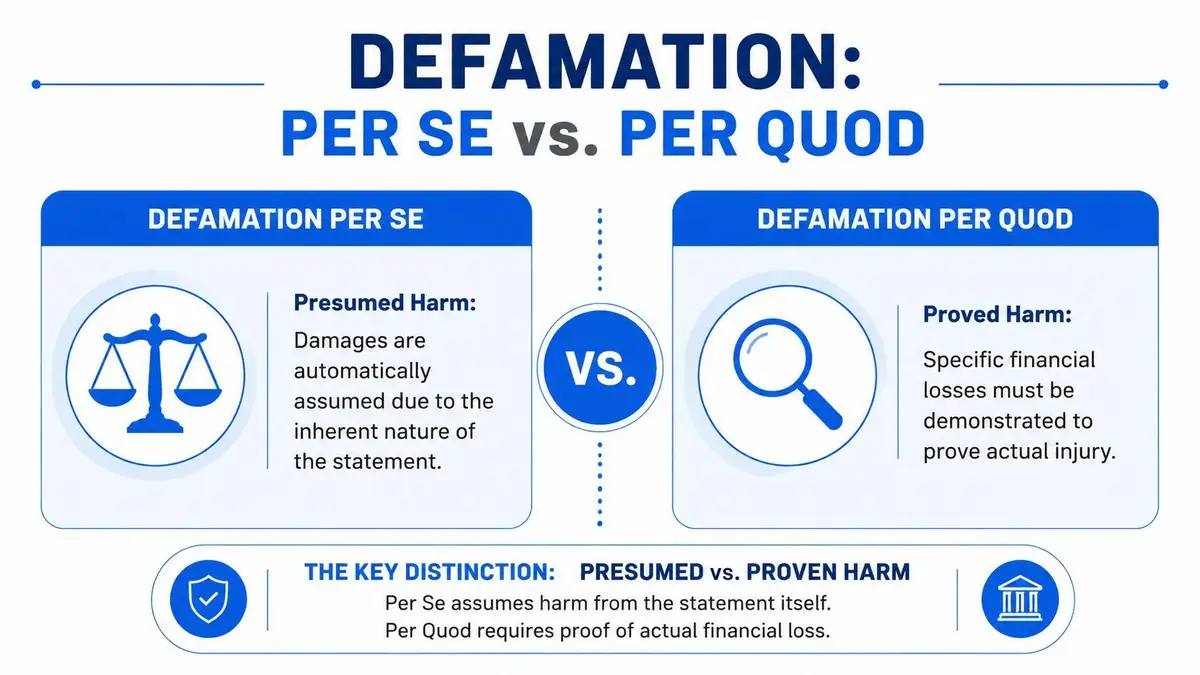
Defamation Per Se vs. Per Quod at a Glance
| Attribute | Defamation Per Se | Defamation Per Quod |
|---|---|---|
| Defamatory meaning | Apparent on its face | Depends on outside context |
| Proof structure | Harm is presumed | Harm must be proved |
| Reader understanding | No special knowledge required | Audience must know extrinsic facts |
| Traditional categories | Crime, loathsome disease, professional incompetence, unchastity | Statements outside those categories or requiring innuendo |
| Litigation posture | Stronger early leverage | Heavier burden on plaintiff |
The table looks simple. The consequences aren’t. If your matter falls into per quod territory, your legal team doesn’t just argue falsity. They must also establish that the audience connected the dots the way you say they did.
Why executives misread the distinction
Executives often hear a statement that attacks their fitness, integrity, or judgment and assume it must qualify as defamation per se. That’s a mistake. In digital disputes, many statements mix direct language with insinuation. Courts can reclassify what looks severe at first glance into a per quod claim if outside facts are needed to make the meaning defamatory.
That shift is brutal for plaintiffs. The legal theory gets narrower just as the proof burden gets heavier. What started as an angry demand letter can become a forensic exercise in reader context, audience knowledge, and actual monetary loss.
If you need a broader grounding in written online defamation before sorting your options, this guide on written defamation and the path to content removal is a useful companion.
A statement can be commercially toxic and still fall into the weaker litigation category.
What this means in practice
Per se claims let plaintiffs rely on the obviousness of the accusation. Per quod claims force plaintiffs to reconstruct the context around the statement and prove that specific readers understood the hidden message. That’s slower, messier, and much easier for defendants to attack.
For a client under time pressure, that difference often decides the strategy before the first filing is drafted.
The High Bar Proving Special Damages
The hardest part of a defamation per quod case isn’t proving that the statement upset you. It’s proving that it cost you money, and proving it with precision.

In Illinois, the rule is direct and unforgiving. As explained in Tressler LLP’s analysis of the special damage requirement, a plaintiff must plead and prove special damages as a matter of law, with no recovery permitted for vague or speculative harm; Illinois courts have consistently held that the plaintiff must identify a specific, quantifiable loss of pecuniary value, such as a lost commission, salary, or contract, and explicitly tie that loss to the defamatory statement.
That single rule defeats many otherwise sympathetic claims. Courts don’t reward generalized stories about reputational injury. They want a straight line from statement to financial consequence.
What courts actually want to see
A serious per quod case usually needs more than screenshots and indignation. It needs documents. Think cancelled invoices, lost deal correspondence, termination notices, rescinded offers, customer communications, bank records, or revenue data that can be linked directly to the publication.
General statements like “our pipeline softened” or “people stopped calling” usually won’t carry the claim. Neither will emotional distress on its own. If your losses can’t be isolated and connected to the defamatory meaning, the lawsuit starts weakening fast.
Here is where many plaintiffs run into a second problem. The statement’s defamatory meaning itself depends on innuendo. So the plaintiff often has to prove two difficult things at once:
- Audience understanding: The relevant readers knew the extrinsic facts and interpreted the statement in the defamatory way alleged.
- Economic causation: Those same readers then changed their conduct in a way that created measurable financial loss.
- Particularized proof: The loss must be identified with specificity rather than described in broad reputational terms.
That is a demanding sequence even when the accusation is false and harmful.
The attrition point is causation
Business relationships change for many reasons. Deals fail. Recruiters hesitate. Investors grow cautious. Competitors spread noise. The defense only needs to create doubt about why the loss occurred.
Historically, the doctrine emerged in English common law, with a formal milestone in 1609 when the Court of King’s Bench recognized that a statement requiring “extrinsic facts” was not actionable without proof of special harm. The principle remained strict in the United States. In 2003, the U.S. Court of Appeals for the Seventh Circuit noted that over 60% of defamation per quod cases rejected by courts involved plaintiffs who failed to provide concrete evidence of economic loss, such as lost contracts or reduced revenue. Modern legal databases further show that in 2024, approximately 45% of defamation lawsuits classified as per quod were dismissed due to inadequate proof of special damages.
Those figures explain why experienced counsel often advise restraint before filing.
A short explainer on litigation risk helps frame the point:
Why many strong factual complaints are weak lawsuits
A client may know exactly who posted the statement and exactly what they intended. That still doesn’t solve the evidence problem. Judges ask whether the loss is quantifiable and whether the publication was a substantial factor in causing it.
“If you can’t prove the money trail, don’t confuse moral certainty with legal strength.”
For public figures and business leaders, the problem can be even sharper. Their commercial environment is noisy. Revenue fluctuates for unrelated reasons. Counterparties rarely put defamatory influence in writing. A lender may go quiet. A recruiter may “pause.” A customer may claim budget pressure.
That’s why a cold-eyed pre-suit assessment matters. Before moving forward, compare the economics of litigation against the realistic prospect of removal, de-indexing, or containment. If you’re evaluating the legal route, this analysis of online defamation lawsuits for executives is worth reviewing.
Jurisdictional Nuances You Cannot Ignore
Defamation law isn’t uniform. It is a patchwork of state rules, local precedent, and judicial temperament. In per quod matters, those differences can change the viability of a claim outright.
Illinois is a good example of why generic advice is useless. The doctrine has deep roots there. Historically, the distinction emerged from English common law and was later codified in U.S. jurisdictions. In 1844, the Illinois Supreme Court affirmed in Anderson v. Vanden Dorpel that vague claims of harm were insufficient and that plaintiffs had to plead specific facts establishing special damages.
Illinois, Florida, and California don’t behave the same way
Illinois has a reputation for insisting on particularity. If the plaintiff cannot identify a specific pecuniary loss and connect it to the publication, the case is vulnerable early.
Florida also treats actual damages seriously in per quod claims, but the practical disputes often turn on whether the statement is fact, mixed opinion, or non-actionable opinion. In commercial conflicts, that line matters because insinuation is often wrapped in commentary.
California adds another layer for public figures and occupation-related harms. The plaintiff may need to satisfy a heightened evidentiary framework around falsity, audience understanding, and causation. That makes casual assumptions about “obvious” reputational injury especially dangerous.
What an executive should do before authorizing a lawsuit
Don’t let outside counsel treat this like a standard template defamation filing. Demand a jurisdiction-specific assessment that answers three questions:
- How will this court classify the statement? If it drifts into per quod, the burden changes immediately.
- What exactly counts as special damages here? The answer is not identical across states.
- What early motions are likely? A strong complaint on paper can still be attacked on meaning, causation, or particularity.
The same statement can look actionable in one state and brittle in another once the court asks how the audience understood it and where the financial loss is.
Local knowledge is not a luxury in this area. It is the difference between having an advantage and an avoidable defeat.
Strategic Response Beyond the Courtroom
A lawsuit is a power tool. It’s also loud, expensive, and often the wrong instrument for a per quod problem.

The numbers support that view. According to a 2022 study by the American Bar Association’s Journal of Tort Law, only 28% of defamation per quod claims filed in U.S. federal courts between 2010 and 2020 resulted in jury verdicts favoring plaintiffs, compared to 62% for per se cases. That disparity matters if your real objective is speed, discretion, and risk containment.
Litigation solves a legal question, not always the reputation problem
Even if you eventually win, the content may remain visible for months or years while the case proceeds. The allegations can become more discoverable through pleadings, hearings, and press coverage. The defendant may be judgment-proof, anonymous, offshore, or eager for a fight. None of that helps if your main concern is stopping counterparties from seeing the material tomorrow morning.
For executives, the practical alternatives are often more effective because they target visibility rather than abstract vindication. A focused response may include:
- Platform enforcement: Use the site’s own terms, impersonation rules, harassment standards, or misinformation policies where they fit the facts.
- Publisher engagement: Some webmasters will remove, edit, or clarify content when approached with the right factual and legal framing.
- Search containment: De-indexing and suppression strategies can reduce the prominence of harmful material when direct deletion isn’t immediately available.
- Monitoring and re-upload control: Harmful posts often reappear in altered forms, across forums, social channels, and low-quality mirrors.
Why indirect attacks require a surgical response
Per quod content is usually crafted to survive simple complaints. It sounds like opinion. It omits explicit accusations. It trades on niche audience knowledge. That means a generic cease-and-desist letter often performs badly. Worse, it can alert the poster that they struck a nerve.
The better approach is usually quieter and more technical. Identify where the content lives, how it ranks, whether the host has relevant policy hooks, who controls publication, and whether the material can be neutralized without giving the attacker a larger stage.
A practical starting point is this guide on removing defamation from the internet for executives, which focuses on outcome rather than courtroom theory.
When litigation still makes sense
Litigation isn’t off the table. It’s the right move when the speaker is identifiable, the falsehood is provable, the financial harm is concrete, and the client wants deterrence or damages as much as removal.
But that is not most per quod matters. Most involve murky facts, coded language, and diffuse harm. In those cases, the winner is usually the party that acts fastest, preserves discretion, and reduces visibility before the story hardens into search history.
Boardroom view: If the content is the problem, prioritize removing or burying the content. Don’t default to a public lawsuit that may amplify it.
Your Action Plan When Facing Indirect Attacks
When a statement damages you through implication rather than direct accusation, resist the instinct to answer publicly. Public rebuttals often educate a wider audience about the very context that makes the statement harmful.
Start by preserving everything. Capture screenshots, URLs, timestamps, user profiles, search results, and any surrounding comments that show how readers interpreted the post. If the statement appears on multiple platforms, map the spread before anyone tips off the poster.
Triage the threat before you choose the weapon
Not every smear deserves a lawsuit. Some deserve immediate removal work. Others require both legal and technical containment. Your first pass should focus on three variables:
- Audience concentration: Is the content circulating where your real stakeholders are, or is it stranded on a low-value site?
- Meaning by implication: Can you show that relevant readers understood the defamatory innuendo?
- Commercial exposure: Do you already have a provable lost contract, compensation event, or business interruption tied to the publication?
If the answer to the last question is weak, a lawsuit may satisfy anger but not strategy.
Choose the advisor based on the outcome you actually want
If your primary objective is damages and deterrence, and you have documentary proof of specific financial loss, use a specialist defamation litigator. If your objective is rapid, discreet neutralization of the online material, use a reputation and content removal team built for platform action, de-indexing, suppression, and monitoring.
That second path is often better aligned with how these attacks work. Indirect smears tend to spread through search, screenshots, AI summaries, and repeated mentions across small sites. A resource like this AI brand mentions guide is useful because it shows how brand references can propagate across automated systems even when the original post looks minor.
The strongest response is usually the one that matches the business objective, not the one that sounds most aggressive. Executives under pressure don’t need symbolic action. They need the threat contained, the audience protected, and the record managed before the insinuation becomes accepted shorthand.
If you’re dealing with coded allegations, reputational innuendo, or search results that are undermining trust, ContentRemoval.com can provide a confidential assessment and a clear action plan. The firm works with executives, public figures, family offices, and legal teams to remove harmful content, de-index damaging results, and contain repeat publication with speed and discretion.
Frequently asked questions
What is the difference between defamation per se and per quod?
Per se statements are damaging on their face, such as accusations of crime or professional incompetence, and harm is presumed. Per quod statements only become defamatory when readers know outside facts, so the plaintiff must prove both that the audience understood the hidden meaning and that a specific financial loss followed.
What are special damages in a defamation per quod case?
A specific, quantifiable loss of pecuniary value such as a lost commission, salary, contract or client, connected directly to the defamatory statement. Vague claims that the pipeline softened or people stopped calling will not carry the claim, and emotional distress alone is not enough.
Should I sue over a post that damages me by implication?
The article suggests litigation only when the speaker is identifiable, the falsehood is provable, the financial harm is concrete and you want deterrence or damages as much as removal. In most per quod matters, the faster path is quiet removal, de-indexing and monitoring, because a public lawsuit can educate a wider audience about the very context that makes the statement harmful.