
Defamation of character is a false statement of fact, communicated to a third party, that injures a person’s reputation. Libel is the written or recorded form, slander the spoken form. A claim requires a false factual statement, publication, fault of negligence or actual malice depending on public status, and demonstrable damage. Opinion that cannot be proven false is protected.
Key facts
- Public figures must prove actual malice under New York Times Co. v. Sullivan, a 1964 unanimous ruling.
- Defamation per se covers false accusations of serious crime, loathsome disease or professional incompetence.
- Roughly 80 percent of countries retain criminal defamation laws, so an aggressive letter abroad can backfire.
- The UK’s Defamation Act 2013 uses a serious harm test rather than the publisher’s intent.
Where ContentRemoval.com comes in. For most executives the harm is on page one of Google, not in a courtroom. ContentRemoval.com removes defamatory content at source through platform and publisher channels, de-indexes what cannot be removed and monitors for resurfacing, while preserving forensic evidence so legal options stay open. The individual, their counsel or their communications adviser usually makes contact. A free 15-minute Exposure Scan maps what is removable, and the report is yours to keep. Get a Free, Confidential Exposure Scan or read how our defamation removal work is done.
For a public figure, an executive, or a high-net-worth individual, a false statement is not merely an insult. It is a direct assault on your reputation, your enterprise’s valuation, and the trust you have meticulously built. Defamation of character is the legal framework that addresses the communication of a false statement that injures that reputation. This guide will dissect the elements of defamation and delineate when decisive action is warranted.
Understanding the Anatomy of a Reputational Attack
When your name or enterprise is subjected to a campaign of falsehoods, the first imperative is to diagnose the nature of the attack. Every leader faces criticism; defamation, however, is a distinct legal injury. It is not defined by vague grievances or negative feedback. It is a false statement of fact, presented as truth, which inflicts tangible harm.
Defamation manifests in two principal forms. The distinction is not merely academic; it dictates the speed at which the falsehood disseminates and informs the strategy required to neutralize it.
The Two Forms of Defamation
Libel is any defamatory statement captured in a fixed, permanent format. This encompasses print and digital media, including articles, blog comments, social media posts, images, and video recordings. For leaders, online libel represents the primary threat vector, where a single false narrative can inflict immediate and widespread damage. A fraudulent report or a malicious tweet can destabilize share prices, deter clients, and even compromise personal security within hours.
Slander refers to defamation in its spoken form. Historically, this meant a false statement delivered in a speech or private conversation. In the current landscape, this includes podcasts, live-streamed videos, and audio-only platforms. While seemingly more transient than a written record, a slanderous comment that is recorded and distributed online becomes as potent and enduring as libel. The distinctions can be complex, as we detail in our comprehensive guide on what constitutes online defamation.
Libel vs Slander: A Strategic Distinction
The following table outlines the key differences between these two forms of defamation. Understanding whether you face libel or slander is the first step in formulating a response, as the nature of the evidence and the potential for exponential damage vary significantly.
| Attribute | Libel (Written/Published) | Slander (Spoken) |
|---|---|---|
| Medium | Text, images, video (e.g., articles, social media, emails) | Spoken words (e.g., speeches, conversations, podcasts, live streams) |
| Permanence | Fixed and durable, allowing for easy republication and dissemination | Ephemeral by nature, unless recorded and distributed |
| Proof of Damage | Damages are often presumed due to the lasting and widespread nature of the publication | Typically requires proof of specific financial or reputational harm, unless the statement constitutes slander per se |
Both forms are profoundly injurious, but the medium of the attack dictates the methodology for gathering evidence and arresting its proliferation.
The Critical Line Between Opinion and Fact
A core challenge in assessing a reputational attack is distinguishing protected opinion from actionable defamation. An opinion is a subjective judgment that cannot be proven true or false. A statement such as, “I find that CEO to be an ineffective leader,” constitutes an opinion, however unwelcome.
A statement of fact, however, is fundamentally different, even when disguised as an opinion. Consider the statement: “In my opinion, that CEO is embezzling corporate funds.” The prefatory phrase “in my opinion” offers no legal shield. The statement asserts a verifiable (and in this case, false) accusation of criminal conduct.
The decisive test is verifiability. Can the core assertion be proven false? If the answer is yes, and it is causing injury to your reputation, it has likely crossed the legal threshold from protected opinion to defamation.
Mastering this distinction is paramount. It enables an accurate assessment of the threat and informs whether the optimal response is a technical content removal, a legal challenge, or a strategic public relations maneuver.
The Four Elements of a Defamation Claim
A feeling of being wronged is insufficient to sustain a defamation claim. The law requires a precise and methodical demonstration of injury. To succeed, you must satisfy four distinct legal elements. Failure to meet even one of these requirements will likely cause the claim to fail. For any executive or public figure confronting a malicious online attack, understanding these elements is the foundation of a sophisticated and strategic response.
Element 1: A False Statement of Fact
The bedrock of any defamation claim is proof that the statement was a false statement of fact. The statement must be presented as factual and, critically, be demonstrably false. Many potential cases fail at this stage, as the law robustly protects expressions of opinion.
For example, a former employee stating, “In my opinion, the CEO is a poor manager,” is expressing a subjective viewpoint. It is not defamatory. However, if they state, “The CEO embezzled funds to finance a personal yacht,” they are making a specific, factual allegation. If that allegation is false, you have satisfied the first element.
Element 2: Publication to a Third Party
The false statement cannot be a private communication between you and the originator. The second element, publication, requires that the statement was communicated to at least one other person.
In the digital sphere, this is typically the most easily satisfied element. A single tweet, a comment on a blog, or a private email forwarded to a colleague all constitute “publication.” The architecture of online platforms ensures that a falsehood can be broadcast to a global audience instantaneously, explaining the rapid escalation of such threats.
The legal definition of ‘publication’ is not limited to mass media. A defamatory falsehood whispered to a single board member or sent in a text message to a business partner is considered published in the eyes of the law.
Because this standard is so low in the online context, the central conflict in a defamation case typically revolves around the other, more demanding elements.
This decision tree provides a visual framework for this initial assessment.
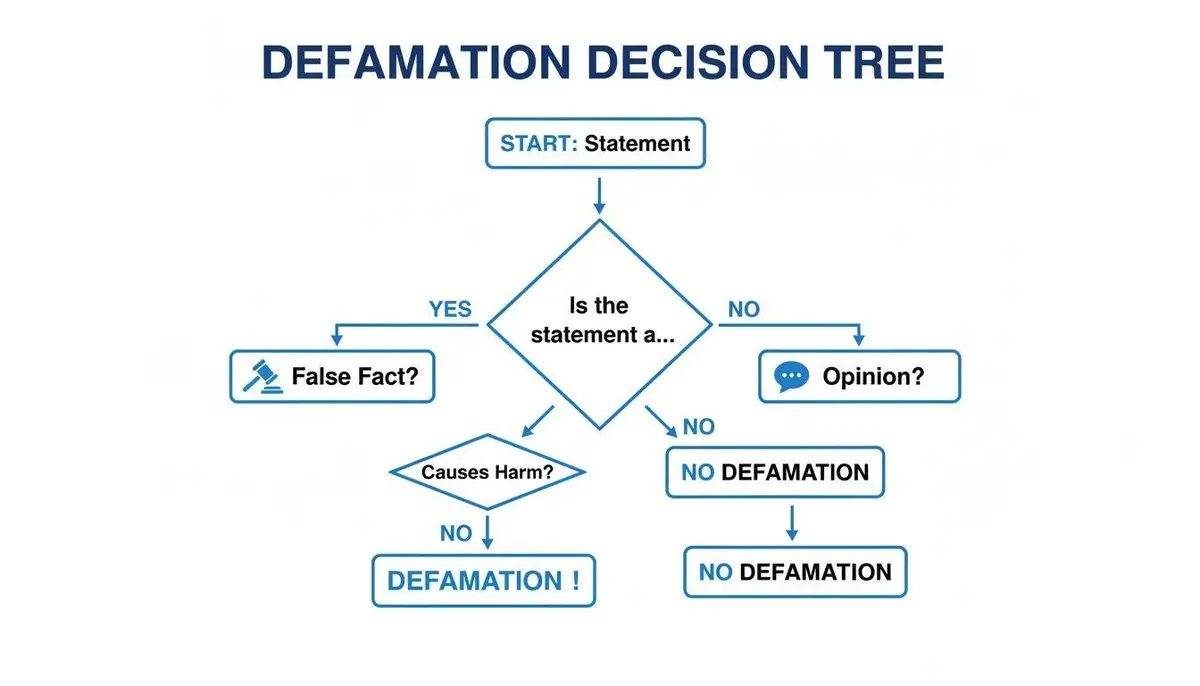
As illustrated, a viable claim only begins to take shape once you have established that the statement is a false assertion of fact, not merely an opinion.
Element 3: The Fault Standard
The third element is fault, which examines the state of mind of the person who published the statement. The standard you must meet depends on your public status.
For a private individual, the standard is negligence. You must only show that the publisher failed to exercise reasonable care in verifying the truth of the statement. For public figures (a category that includes most high-profile executives, celebrities, and prominent brands) the standard is substantially higher.
Public figures must prove actual malice. This is a specific legal term, not a reference to ill will. It requires proof that the publisher either knew the statement was false when they published it or acted with a reckless disregard for the truth. This standard, established in the landmark case New York Times Co. v. Sullivan, is a formidable obstacle because it necessitates probing the publisher’s subjective state of mind.
Element 4: Demonstrable Proof of Damages
Finally, you must demonstrate that the false statement caused you real, quantifiable damages. A court requires tangible evidence of harm.
Certain statements are considered so inherently damaging that harm is presumed (defamation per se). These include false accusations of a serious crime, having a loathsome disease, or professional incompetence. For all other statements, you must produce concrete evidence.
Evidence of damages may include:
- Direct financial losses, such as canceled contracts, a decline in stock value, or termination of employment.
- Quantifiable harm to your reputation with real-world consequences, such as an inability to secure new business or exclusion from your professional community.
- Emotional distress and mental anguish, which, while very real, often require expert testimony from medical professionals to be substantiated in court.
Without clear proof of harm, even a widely published falsehood may not be sufficient to prevail in litigation. All four of these elements must be met to construct a viable case for defamation of character.
Navigating Global Defamation Laws and Jurisdictions

An online attack is not bound by geography. A falsehood posted from one jurisdiction can trigger a full-scale reputational crisis across the globe, plunging the target into a labyrinth of international law.
Mapping this global landscape is not merely a legal exercise; it is the first critical step in combating defamation of character. A strategy that is effective in one country may be futile or even counterproductive in another. The applicable local laws determine whether you can sue, how you can sue, and what you can realistically achieve.
The US vs. UK Divide: A Tale of Two Standards
This divergence is clearly illustrated by comparing the legal frameworks of the United States and the United Kingdom. In the U.S., a public figure faces the high burden of proving “actual malice”, that the publisher knew their statement was false or acted with reckless disregard for the truth. This standard, designed to protect free speech, often leaves executives and brands with limited legal recourse against defamatory attacks.
The UK, by contrast, adopts a different posture. Under the Defamation Act of 2013, the claimant must show that the statement caused or is likely to cause “serious harm” to their reputation. The legal focus shifts from the publisher’s intent to the tangible impact of the defamation. This makes the UK a more favorable jurisdiction for legal action if you can substantiate significant reputational injury.
This legal bifurcation creates a strategic dilemma. A smear campaign originating from a UK-based publisher might be actionable there but legally untouchable in the U.S., even if the primary damage is felt stateside. The choice of jurisdiction is a tactical decision that can determine the outcome of your entire effort.
The Growing Threat of Criminal Defamation
While civil lawsuits for monetary damages are the standard in most Western nations, a more severe threat exists in many parts of the world: criminal defamation. This is not a matter of seeking financial compensation for reputational harm; it involves the state initiating a criminal investigation that can lead to arrest and imprisonment.
The distinction is stark: a civil defamation claim targets financial compensation for reputational harm, managed through private litigation. A criminal defamation charge involves the state prosecuting an individual, with potential penalties including fines and jail time, turning a personal dispute into a matter of public prosecution.
This is not a historical curiosity confined to authoritarian regimes. An estimated 80% of countries, approximately 160 nations, retain criminal defamation laws. As UNESCO research indicates, these statutes are increasingly weaponized to silence dissent and control public discourse, reversing a previous global trend toward decriminalization.
This reality fundamentally alters response protocols. An aggressive cease-and-desist letter, standard practice in the U.S., could be construed as a threat in another country, potentially triggering the publisher to file a criminal complaint against you. Before initiating any action, it is imperative to secure expert counsel who understands the local legal and political climate. Attempting to navigate the international web of defamation of character laws without such guidance is a certain path to escalating a difficult situation into a catastrophic one.
Strategic Lessons From Landmark Defamation Cases
The history of defamation of character litigation offers a rich repository of high-stakes courtroom conflicts. These are not merely academic precedents; they are tactical case studies for anyone whose reputation is under attack today. A close analysis of these battles reveals judicial reasoning, the true cost of public confrontation, and why litigation should almost always be considered a last resort. These cases serve as a powerful reality check, illustrating the difficulty of prevailing, the unpredictability of juries, and the lasting scars of a public fight, even in victory.
The Trial That Forged the “Actual Malice” Standard
The modern playbook for U.S. defamation law was written during the civil rights movement. The pivotal moment was the 1964 Supreme Court case, New York Times Co. v. Sullivan. The case originated from an advertisement in the Times criticizing police conduct in Montgomery, Alabama.
The Court’s decision established the formidable “actual malice” standard. Previously, a public official needed only to prove a statement’s falsity to win. Post-Sullivan, they had to prove the publisher knew the statement was false or acted with a “reckless disregard for the truth.” The unanimous 9-0 ruling overturned a $500,000 judgment against the newspaper, creating a powerful shield for free speech. The Freedom Forum’s collection of famous defamation cases details how this and other key rulings shaped the law.
Modern Battlegrounds and Costly Victories
Today, that same standard is being applied to the digital frontier with staggering consequences. The trial between Johnny Depp and Amber Heard, and the monumental judgments against Alex Jones for his false claims about the Sandy Hook tragedy, demonstrate how the “actual malice” doctrine plays out in the age of viral online content. These cases are a stark reminder of the immense risks when a private dispute becomes a public spectacle.
Even a legal victory can be a pyrrhic one. Oprah Winfrey, for example, was subjected to a grueling trial in Texas over on-air comments about beef safety. She ultimately prevailed, but only after a protracted, expensive, and intensely public legal battle. It was a victory for the First Amendment, but a personally draining ordeal.
These landmark cases converge on a single, hard truth: filing a defamation lawsuit, however justified, means converting a private injury into a public spectacle. The litigation process itself guarantees intense scrutiny that can inflict its own form of lasting damage, long after a verdict is rendered.
This is precisely why so many individuals and organizations now opt for faster, more discreet solutions over protracted court battles. While litigation can offer a path to public vindication, it is a path fraught with peril. A more sophisticated strategy often involves neutralizing the threat quickly and quietly. Our real-world defamation case study provides valuable insights into how this is achieved. The primary lesson from decades of legal warfare is that the most effective move is often the one that keeps you out of the courtroom entirely.
The Modern Toolkit for Reputation Repair Beyond Litigation

While litigation can be a powerful tool, it is often a blunt instrument for resolving online reputational attacks. The legal process is public, protracted, and extraordinarily expensive. For an executive or enterprise watching their reputation and revenue erode in real-time, waiting months or years for a court date is not a viable strategy. A different arsenal is required, one engineered for speed and surgical precision.
This modern toolkit operates outside the courtroom, employing strategies that neutralize defamatory attacks at their source. The objective is not to win a public argument but to make the damaging content disappear. These methods are designed for rapid response, capable of extinguishing a crisis before it gains momentum.
The Power of De-Indexing and Source Removal
The true damage from online defamation of character occurs not on an obscure blog, but on the first page of Google. Search engine visibility is the oxygen that fuels a reputational crisis. The most effective strategy, therefore, is to cut off that oxygen supply through de-indexing.
De-indexing renders a piece of content invisible to search engines. It involves petitioning engines like Google to remove a specific URL from their search results. While the defamatory article may persist on its host website, it becomes practically impossible for the public to find. When your name or company is searched, the attack simply does not appear.
Source removal is a more definitive solution. This involves securing the deletion of the content from the host website itself. This is achieved by working directly with platform administrators (on social media networks, review sites, or forums) to demonstrate that the content violates their terms of service. This approach is often faster and more permanent than obtaining a court order.
A successful de-indexing or removal can make defamatory content vanish from public view in a matter of days, not years. This strategy prioritizes immediate damage control, protecting your reputation while you weigh your legal options.
A Multi-Pronged, Platform-Specific Approach
There is no universal solution for online attacks. Each platform has its own content policies, reporting mechanisms, and enforcement tendencies. A strategy effective on Twitter may fail on a niche industry forum. An effective response requires a bespoke plan for each platform where the defamatory content appears.
This tactical approach involves several key phases:
- Evidence Preservation: Before any other action, we meticulously document all defamatory content. This includes creating forensic-quality screenshots, archiving web pages, and preserving server logs to build a comprehensive evidence file. This preserves the option for future legal action.
- Platform-Specific Takedowns: Our team analyzes the defamatory post against each platform’s specific terms of service. We then frame the removal request to highlight clear violations (such as harassment, copyright infringement, or disclosure of private information) which significantly increases the probability of a swift takedown.
- Continuous Monitoring: Removal is not the final step. We employ sophisticated monitoring tools to ensure the same falsehoods do not resurface on other sites or from different accounts, providing a long-term defensive shield.
The legal landscape is already shifting away from the courtroom. In 2020, the High Court in England and Wales recorded only 152 defamation claims, a sharp decline from 323 the previous year, partly due to stricter “serious harm” requirements. This data underscores how high the bar for litigation has become and why alternative strategies are now essential. It is in this environment that specialized firms excel, offering rapid interventions like de-indexing that can resolve a crisis in under 48 hours. You can review Inforrm’s analysis of UK defamation claims for more on these legal trends.
This modern toolkit rebalances the power dynamic. It enables you to move faster than the speed of social media, quietly dismantling an attack before it can escalate. By combining swift technical removals with diligent evidence preservation, you can neutralize the immediate threat without forfeiting your legal rights. Discover how our specialists remove damaging online content with precision and discretion. A robust public relations strategy is also crucial for recovery; understanding crisis management in PR is essential for protecting and rebuilding your brand.
Frequently Asked Questions About Defamation
When your reputation is under attack, you require clear, strategic answers, immediately. This is not about abstract legal theory; it is about providing the practical insights that executives, public figures, and their legal counsel need when confronting a defamation crisis. These are the urgent questions we address most frequently.
Is It an Attack, or Just Someone’s Opinion?
This is the dispositive question. The distinction between a protected opinion and an illegal false statement is where defamation cases are won and lost. The law affords broad protection to opinions, as subjective beliefs cannot be proven true or false. If a critic deems your latest venture “uninspired,” that is their opinion and it is protected.
However, the inclusion of phrases like “I think” or “in my opinion” does not grant a license to defame. The critical test is whether the statement implies a verifiable falsehood. A post stating, “In my view, the company’s CFO is falsifying financial records,” is not an opinion. It implies a provable and deeply damaging accusation of criminal activity. We analyze the context, the specific language, and how a reasonable person would interpret the statement.
A statement is likely defamatory if a reasonable person would understand it as an assertion of fact. The speaker’s attempt to frame it as an opinion is irrelevant; the underlying implication is what matters.
Can a Bad Online Review Be Considered Libel?
Yes, but with a significant condition: the review must contain a false statement of fact. A vast legal distinction exists between a customer sharing a subjective experience and posting a fabrication. “The hotel room was noisy and the decor felt dated” is a protected opinion based on personal experience.
The situation becomes actionable when the review fabricates a factual claim to inflict harm. For instance, a review asserting, “The restaurant served me spoiled food that resulted in food poisoning,” makes a factual claim. If the restaurant can prove this claim is false and demonstrate a subsequent loss of business, it may have a strong case for libel. The key is to distinguish genuine customer disappointment from a malicious falsehood.
What’s the Difference Between Defamation and Harassment?
While they may feel similar to the target, defamation and harassment are distinct legal concepts. Defamation is exclusively concerned with protecting your reputation from falsehoods. It addresses untrue statements of fact that damage your good name. The remedy is typically civil, such as monetary damages or content removal.
Harassment, conversely, involves a pattern of conduct intended to alarm, distress, or annoy. The statements involved do not need to be false. Harassment can include relentless unwanted contact, credible threats, or stalking. While some jurisdictions have civil harassment statutes, severe cases can escalate to criminal matters, resulting in restraining orders or incarceration. An attack can be both defamatory and harassing, requiring a dual-front response.
Should I Respond Publicly to an Attack?
Engaging an attacker publicly is a high-risk gamble that almost invariably exacerbates the situation. No matter how carefully crafted, a public response lends credibility to the original accusation and amplifies its reach. This is the Streisand Effect in action: the attempt to suppress a story causes it to go viral, permanently embedding it in search engine results.
Furthermore, every word you state publicly becomes evidence that can be manipulated and used against you in subsequent legal proceedings. You are creating a public record that can constrain your future actions. The most prudent first step is always a confidential consultation with legal and reputation experts. A private, strategic response, such as a direct takedown demand or a cease-and-desist letter, is far more effective at neutralizing the problem without initiating a public war.
How Long Do I Have to Sue for Defamation?
This is the statute of limitations, an absolute deadline that cannot be missed. For defamation, the window to file a lawsuit is extremely short, often just one to two years from the date the statement was first published. This time limit varies by jurisdiction, making immediate consultation with legal counsel non-negotiable.
A critical nuance is the “single publication rule,” which most jurisdictions follow. This rule dictates that the clock starts ticking from the moment the content is first published online, not each time it is viewed. If you miss this deadline, your right to sue is permanently extinguished, regardless of the merits of your case.
What About Anonymous Attackers?
Anonymity is not an impenetrable shield. While pursuing an individual hiding behind a pseudonym is more complex, it is far from impossible. A “John Doe” lawsuit can be filed to legally compel internet service providers (ISPs), social media platforms, or web hosts to disclose the poster’s identity.
To secure such a court order, you must convince a judge that you have a legitimate defamation claim. The court will weigh your right to defend your reputation against the poster’s First Amendment right to anonymous speech. If the statement is clearly defamatory, courts will typically grant the subpoena, allowing us to unmask the responsible party and hold them accountable.
Beyond reactive measures, effective reputation management involves proactive defense. Developing a strong personal branding on social media allows you to control your public narrative, build trust, and create a positive firewall against future attacks.
When your reputation is at stake, you cannot afford to wait. The team at ContentRemoval.com specializes in rapid, discreet intervention to remove defamatory content and repair digital damage. We act decisively where traditional methods fail, offering a confidential assessment to build a clear action plan. Contact us to protect what you have built. Learn more at ContentRemoval.com.