
Searching for defamation lawyers near me is only useful once you know the claim is viable: a provably false statement of fact, published to a third party, with fault and measurable harm. Screen candidates for bar admission in the right forum, named defamation results and a clear theory on the first call. Proximity matters less than forum and speed.
Key facts
- In a 312-case dataset, median U.S. plaintiff-side cost was 28,400 dollars and median resolution took 14 months.
- About 71 percent of defamation suits settled before trial, usually within 6 to 10 months of filing.
- Only 23 percent of awarded damages were collected in full within two years of verdict.
- Section 230 generally shields platforms, so complaints usually need to target the original poster.
Where ContentRemoval.com comes in. Counsel is the right tool for damages and formal vindication. When the priority is getting a false post off search and stopping it from spreading, ContentRemoval.com is often the right first call, handling takedown demands, platform reporting, de-indexing and monitoring for reuploads while any lawsuit proceeds on its own timeline. Business owners, their counsel and their agencies all reach out. A free 15-minute Exposure Scan maps what is removable, and the report is yours to keep. Get a Free, Confidential Exposure Scan or read how our defamation removal work is done.
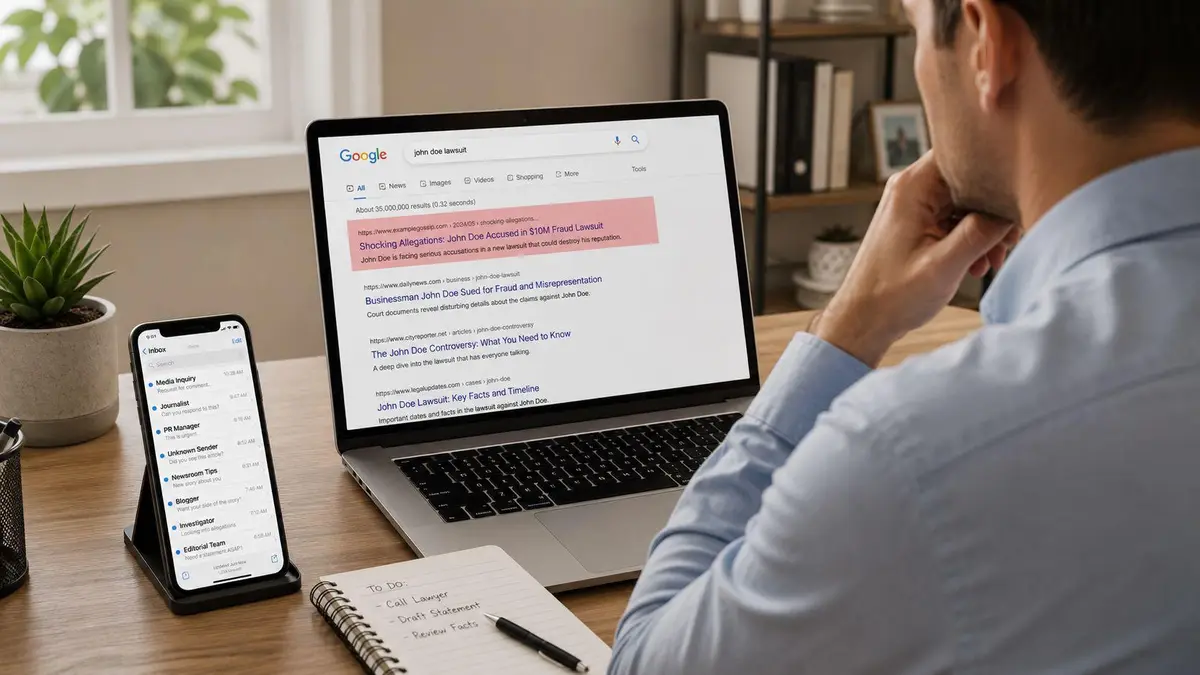
You just saw a false post climb into search results, and now the phones are lighting up. A colleague forwarded the screenshot. A client asked if it’s true. Someone in your circle already opened a quiet internal investigation, and you know that if this sits online long enough, the story starts feeling real.
That’s why “defamation lawyers near me” is only half the search. The other half is faster and harder: does this statement support a claim, or do you need immediate content removal before a lawsuit can even do its job? In defamation matters, the first move often determines whether you preserve the upper hand or spend months chasing damage control after the lie has already spread.
When a Damaging Post Forces a Fast Decision
The worst moment is usually the quiet one. You refresh the page, and the post is still there. Then the emails start, then the screenshots, then the panic from people who never would have seen it if you hadn’t been named in the headline, tagged in the comment thread, or hit with a fake review.
Start with triage, not directory browsing
If the statement is obviously false and already visible to customers, investors, employers, or counterparties, you need a triage mindset. The question is not who is closest to you. The core question is whether the claim is legally actionable, whether the evidence can still be preserved, and whether removal should start before litigation locks the other side into a defensive posture.
That matters because defamation disputes are often expensive and slow. In a 312-case dataset covering the U.S. and England/Wales, the median plaintiff-side cost was $28,400 in U.S. state court and £41,000 in England and Wales, while the median time to resolution was 14 months in U.S. state courts and 19 months in the UK (defamation lawsuit dataset). The same dataset found that about 71% of defamation suits settled before trial, usually within the first 6 to 10 months after filing, and only 23% of awarded damages were collected in full within two years of verdict (defamation lawsuit dataset).
A separate review of defamation litigation also shows why speed matters. Early action is usually about preserving proof, identifying the right forum, and stopping further spread before the story hardens into “truth” by repetition.
Practical rule: if the post is live, searchable, and plainly harming relationships now, preserve it first and search second.
The first 72 hours decide more than many clients anticipate
In the first three days, you need to lock down proof, identify the likely forum, and decide whether local counsel should be handling a claim or whether a removal team should move first. That is not indecision, it is discipline. A rushed complaint filed against the wrong target wastes strength, while a well-documented takedown request or cease-and-desist can sometimes stop the bleeding before a complaint is ever necessary.
The sharp clients do not waste this window arguing about reputation. They use it to save evidence, identify the speaker, and decide whether litigation is the right tool or whether a faster removal path should lead first.
Self-Screening Your Claim Before You Pay for a Consultation
Most bad consultations start because the client hired too early. A lawyer who knows defamation will still ask the same four questions first, because if one fails, the claim usually falls apart before it gets expensive. You can answer those questions yourself before you spend a dime.
The four legal filters that matter
First, the statement has to be a provably false statement of fact. A fake review saying you stole client funds is different from someone saying they “don’t trust” your company. The first can be tested against records and events. The second is often opinion or rhetorical exaggeration.
Second, it has to be published to a third party. If the accusation stayed in your inbox and never reached anyone else, you’re usually not looking at defamation in the classic sense. Third, there has to be fault, which means you need to know who said it and whether they acted negligently or with a higher degree of culpability depending on the forum and plaintiff status. Fourth, the statement has to cause measurable harm or be the kind of claim that law treats as especially damaging.
A practical benchmark is that fewer than 5% of defamation cases reach trial (defamation basics and litigation benchmark). That’s why the early work is evidence preservation and merits screening, not daydreaming about a courtroom win.
Use claim versus defense, not anger versus outrage
If someone posted an anonymous forum accusation of fraud, ask whether the statement can be shown false and whether you can tie it to a real person or account. If a reviewer says your business committed a crime, ask whether the platform-hosted content is the problem or whether the original poster is the target. If a news article misidentifies you, ask whether the publication can be corrected quickly or whether the harm is already embedded in search.
Truth remains the hard stop, and platform immunity can shut down many online claims. Under Section 230(c)(1) of the federal Communications Decency Act, a provider or user of an interactive computer service generally can’t be treated as the publisher or speaker of information provided by another content provider (Section 230 overview). That’s why many online defamation complaints should be aimed at the original poster, not the host.
A strong case starts with a false factual statement, a real audience, and proof that the harm isn’t theoretical.
If your answers are weak on falsity, publication, or damages, you don’t need a courtroom-first strategy. You need removal, correction, or a different remedy.
Where to Actually Search for Defamation Lawyers Near You
Start with sources that have screening value. State bar referral services and Martindale-Hubbell style practice filters are better than a random map search because they at least force you to look at admitted lawyers with some relevance to the subject. If a lawyer can’t even show you the forum they’re admitted in, stop there.
Search in layers, not one blind Google query
Use targeted searches like “defamation attorney [county]” or “[city] libel lawyer” only after you’ve checked bar standing. That takes seconds. Then look at LinkedIn profiles for lawyers who are bar-admitted and have handled reputation cases, media disputes, or related litigation.
Peer referrals still matter. Other lawyers, journalists, and reputation professionals often know who answers the phone, who litigates cleanly, and who knows when not to file. A reputation management firm can also route you to cooperating counsel when the case needs both legal pressure and cleanup work. If you want a more strategic intake model, this executive consultation guide shows how those first calls should be handled.
Know when local counsel matters and when it doesn’t
Local counsel matters when the forum rules, judges, filing procedures, or state standards will shape the case. It matters less when the main problem is online distribution and the practical goal is getting material down fast. In many internet-driven matters, the defendant’s location and the platform’s policy structure are more important than the plaintiff’s ZIP code.
Don’t overvalue star ratings. They’re often marketing, not proof. Instead, confirm whether the attorney is admitted where the dispute belongs, whether they’ve handled actual defamation work, and whether they understand that online harm often needs a coordinated response, not just a complaint.
A fast way to separate signal from noise
A strong local search usually produces two or three names worth real comparison. More than that, and you’re probably collecting polished websites, not useful counsel. Fewer than that, and you’re likely looking in the wrong jurisdiction or the wrong practice bucket.
The Vetting Checklist That Separates Real Specialists from Generalists
Most legal websites sound identical until you ask a hard question. The lawyers who can move a defamation matter will give you specifics fast. The generalists lean on broad reputation language and avoid the parts that expose whether they’ve done this before.
What to demand on the first call
You want recent defamation verdicts or settlements on the record, not vague claims about “protecting reputations.” You want active bar admissions in the relevant forum, not a loose list of cities. You want a lawyer who can explain the applicable standard without warming up the room first.
That standard changes by jurisdiction. In the United States, New York Times Co. v. Sullivan requires actual malice for public officials and public figures, meaning knowledge of falsity or reckless disregard for truth, and Gertz v. Robert Welch, Inc. limits strict liability and certain damages treatment for private plaintiffs without the necessary constitutional showing (California defamation framework). In England and Wales, the threshold is serious harm, and for bodies trading for profit it’s serious financial loss (England and Wales threshold). In Australia, the serious-harm filter is also built into the model provisions, and the non-economic damages cap for 2025 to 2026 is $478,500 (Australian defamation regime).
Bottom line: if a lawyer can’t explain the jurisdictional standard in plain English, keep looking.
Strong signals versus weak signals
| Dimension | Strong Signal | Weak Signal |
|---|---|---|
| Case history | Named defamation verdicts, settlements, or reported matters | Generic “reputation” language with no examples |
| Jurisdiction | Active admission where the dispute belongs | A long list of places with no verification |
| Legal theory | Clear explanation of falsity, publication, fault, damages, and defenses | Evasive talk about “winning your name back” |
| Fees | Direct answer on retainer, hourly work, and scope | Dodging the fee question or making it sound flexible without details |
| First call | A real theory of the case within minutes | A vague promise to “look into it” later |
What you’re looking for in the best candidate
The best lawyer doesn’t flatter you. They narrow the issue. They tell you whether the statement is a claim, whether damages are provable, whether a platform is insulated, and whether the case should start with a demand letter instead of a filing. That kind of honesty saves time and usually saves money too.
If they can’t do that, they’re selling comfort, not strategy.
Building the Evidence Package Your Lawyer Will Ask For
A founder gets hit with a false accusation on a Tuesday morning. By noon, the post has been shared into an industry Slack, and by evening a customer has asked for “clarification.” That’s the moment the evidence file starts, not after someone else has edited the page.
What needs to be preserved immediately
Start with time-stamped screenshots of every URL, every comment thread, and every repost. Capture the full page, not just the offending sentence. Save archived copies through the Wayback Machine and other court-appropriate archival tools, because printouts alone don’t prove what was on the screen when you saw it.
Then gather witness statements from colleagues, clients, or staff who saw the post while it was live. If revenue started slipping after the post spread, save the records showing canceled deals, paused renewals, or lost work. The lawyer needs a factual package, not a story told from memory.
Don’t ignore metadata or prior reputation evidence
Metadata can matter because it helps anchor when content was captured and whether it was altered. If the underlying post changes, deletes, or gets re-uploaded, the details around the file can become as important as the text itself. That’s one reason digital preservation beats casual screen grabbing.
Also save proof that the reputation existed before the attack. Press coverage, customer references, awards, and prior testimonials help show the contrast between the baseline and the harm. That isn’t vanity. It’s part of making damages believable.
For a clean escalation path, pair the archive with a documented reporting workflow like this strategic guide to reporting a defamatory website.
Practical rule: if it can be edited, deleted, or re-uploaded, treat it like evidence, not content.
A simple evidence index to hand counsel
- URL log: every page, post, and repost with the date and time you found it.
- Capture set: screenshots, PDFs, and archived copies.
- Witness list: names and short notes on who saw what.
- Damage file: lost deals, customer complaints, and internal notes.
- Reputation baseline: prior press, references, and positive reviews.
A good lawyer can work with a messy file. A great one prefers a clean index. Hand them both.
Realistic Timelines Costs and Outcomes in a Defamation Matter
A defamation case starts with a hard question: what outcome do you need. If you want money, a public finding, or both, the path is different. If you need the post removed fast and the harm contained before it spreads, litigation is often the slowest route to the result you want.
The numbers are not friendly. In the 312-case dataset, the median plaintiff-side cost was $28,400 in U.S. state court and £41,000 in England and Wales, with a median time to resolution of 14 months in U.S. state courts and 19 months in the UK (defamation lawsuit dataset). About 71% of cases settled before trial, usually within the first 6 to 10 months after filing, which tells you where the pressure point is. Early merits work and settlement posture matter far more than noisy threats.
Collection is the part people underestimate
Winning and collecting are different problems. Only 23% of awarded damages were collected in full within two years of verdict in that dataset (defamation lawsuit dataset). That changes the case strategy immediately. If the defendant has limited assets, is hard to trace, or is likely to appeal, a verdict can look impressive and still fail to solve the business problem in front of you.
The UK adds another hard filter. Under the Defamation Act 2013, a statement is not actionable unless its publication has caused or is likely to cause serious harm to reputation, and the limitation period is one year from publication (England and Wales threshold). Miss that window or fail that threshold, and the case can die before it ever gets traction.
Why jurisdiction changes the economics
Australia uses a serious-harm style filter too, and the local rules for non-economic damages do not map neatly onto what many U.S. clients expect (Australian defamation regime). The practical point is simple. The forum shapes the remedy, the pressure, and the economics, so forum choice has to be made early, not after the damage is already spreading.
The correct call is straightforward. If you want damages and a formal ruling, litigation may be the right tool. If you want the material taken down, de-indexed, and monitored before it keeps circulating, start with a removal strategy like this strategic guide to removing defamation from the internet for executives. A lawyer can still matter, but the fastest fix is often outside court.
When Litigation Is the Wrong Tool and ContentRemoval.com Is the Right One
A lawsuit is a blunt instrument when speed is the objective. If the material is already online, already indexed, and already being forwarded inside a high-value network, a court win can arrive after the reputational harm has already spread. In that situation, a removal-first strategy is the better call.
Compare the tools before you choose the lane
A defamation lawsuit is built to establish liability and recover damages. A cease-and-desist letter is faster, cheaper, and often the first pressure move. A specialist removal engagement is different again, because it can coordinate takedown demands, search de-indexing, platform reporting, and monitoring across jurisdictions instead of leaving you with one letter and a waiting game.
That is why a specialist like ContentRemoval.com can be the right first call when the priority is discretion and speed. It focuses on content removal, de-indexing, and ongoing monitoring, and it typically begins work within 24 to 48 hours according to the publisher’s description of its service model (ContentRemoval.com overview). For a high-stakes client, that coordinated response often matters more than building a long case file before anything moves.
The discipline that keeps the matter from getting worse
Day one, lock down the evidence archive and issue internal litigation holds. Stop direct contact with the defamer. Day two, approve the cease-and-desist or takedown demand and preserve the relevant platform and search-engine records. Day three, line up the communications plan so employees, stakeholders, and media do not improvise.
A specialist removal program can also coordinate legal demand letters, platform policy enforcement, search-engine de-indexing, and monitoring for reuploads. That broader workflow is exactly what most local counsel does not run as a single operating system. Lawyers still matter, but not every reputation problem belongs in court first.
Choose the outcome, not the ego
If you need damages, trial strength, or formal vindication, hire defamation counsel with real litigation depth. If the page has to disappear and stay gone, start with removal, then add litigation only if the target refuses to cooperate. That is the cleanest way to protect a name without feeding the story.
For a direct comparison with the internet-removal approach, review ContentRemoval.com’s strategic guide to removing defamation from the internet. If you need that kind of response now, go to ContentRemoval.com and request a confidential assessment. Their team handles defamatory content removal, de-indexing, and monitoring for reuploads, which is exactly the right starting point when the priority is stopping the spread before it becomes permanent.
Frequently asked questions
How do I know if I have a defamation case worth pursuing?
Run the four filters yourself first: is the statement a provably false fact rather than opinion, did someone other than you see it, can you identify the speaker and show fault, and is the harm measurable or the kind the law treats as especially damaging. If falsity, publication or damages are weak, removal or correction is a better route than court.
How much does it cost to hire a defamation lawyer?
The dataset cited in the article puts the median plaintiff-side cost at 28,400 dollars in U.S. state court and 41,000 pounds in England and Wales, with resolution taking a median of 14 and 19 months respectively. Ask any candidate for a direct answer on retainer, hourly rates and scope on the first call.
What evidence should I gather before contacting a defamation lawyer?
Time-stamped full-page screenshots of every URL, comment and repost, archived copies through the Wayback Machine, witness notes from people who saw the post, records of lost deals or paused renewals, and proof of your reputation before the attack such as press and references. Treat anything that can be edited or deleted as evidence.