
Defamation law in Texas requires proof that a false statement of fact was published to a third party, harmed your reputation and was made with the required fault: negligence for private plaintiffs, actual malice for public figures. Claims must be filed within one year, most plaintiffs must first request a retraction, and the anti-SLAPP statute can end thin cases early.
Key facts
- Texas applies a one-year statute of limitations to libel and slander under Civil Practice and Remedies Code 16.002.
- Section 73.055 requires a timely written request for correction, clarification or retraction before many suits.
- The Texas Citizens Participation Act lets defendants seek early dismissal of claims touching matters of public concern.
- Since the 2013 Defamation Mitigation Act, exemplary damages require actual malice for private and public plaintiffs alike.
Where ContentRemoval.com comes in. Texas counsel handles the retraction demand, the TCPA analysis and the one-year clock. ContentRemoval.com handles what the courtroom cannot do quickly: getting the false post, review or article removed at source, de-indexed from search and monitored for reposts, without a public filing that hands the attacker an audience. The client, their attorney or a chief of staff usually reaches out. A free 15-minute Exposure Scan maps what is removable, and the report is yours to keep. Get a Free, Confidential Exposure Scan or read how our defamation removal work is done.
That instinct can be expensive if you use it badly.
Defamation law Texas is not just about whether a statement is false. It’s about timing, evidence, fault standards, procedural traps, and whether legal pressure will remove the material or amplify it. For executives, founders, physicians, investors, and public figures, the problem isn’t abstract reputational harm. It’s loss of trust, deal friction, board anxiety, hiring drag, and searchable filth that keeps resurfacing.
The right response is coordinated. Preserve evidence fast. Assess whether the statement is actionable. Decide whether a retraction demand creates an advantage or warning. Push for platform and source removal where possible. Litigate only when the facts, timing, and defendant profile justify it. If you approach this as a pure courtroom problem, you’ll often lose the practical war even if you eventually win the legal one.
Responding to a Reputational Attack in Texas
If your name is under attack online, your first mistake would be treating the post itself as the whole problem. It rarely is. The actual threat is distribution. Once a false accusation gets indexed, reposted, screenshotted, and summarized by third parties, the harm stops being a single publication issue and becomes a visibility issue.
Start by assuming two things. First, the content may disappear before your lawyer sees it. Second, it may spread faster than any formal legal process can contain. That means your response has to run on parallel tracks from the start.
Your first moves in the first hours
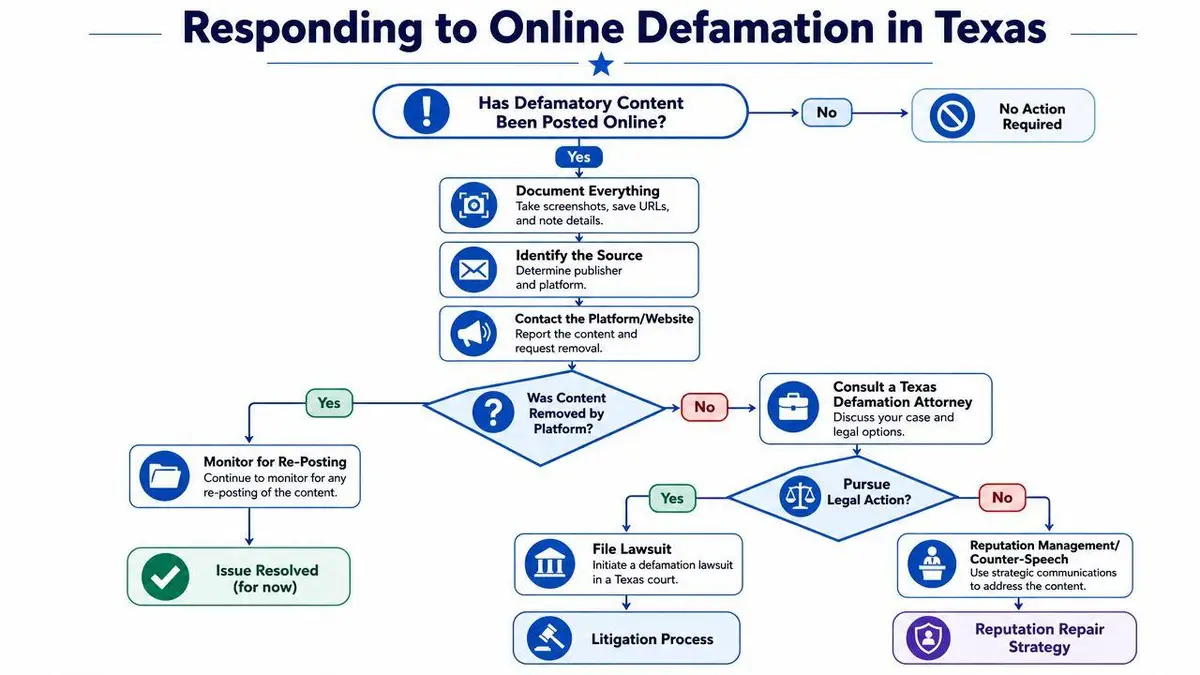
Capture everything. Save screenshots showing the full statement, date, username, URL, search result snippet, and any comments or reposts that add new defamatory meaning. Archive the page. Preserve email alerts, text messages, and internal messages showing business fallout.
Then identify the publisher with precision. Is this a customer review, a fake account, a former employee, a competitor, a forum moderator, or a media outlet? That question controls nearly every strategic decision that follows, including whether a takedown request has any real chance of success.
A practical starting point is this guide on managing online defamation when someone is spreading rumours about you online. Use it to structure the immediate response while counsel analyzes the legal claim.
Immediate priority: preserve proof before you start threatening anyone. Defendants delete. Platforms change pages. Search results shift.
What sophisticated clients get wrong
They wait for certainty. That’s a mistake. In Texas, legal deadlines matter, but so does online persistence. If the statement is false and harming you now, you need a removal strategy and a litigation strategy at the same time.
You also need discipline. Don’t post a defensive thread. Don’t call the attacker publicly a liar unless your facts are nailed down. Don’t let a junior staffer send an emotional cease and desist. Defamation disputes escalate when clients turn a contained smear into a public spectacle.
The right question isn’t “Can I sue?” The right question is “What sequence gets this content out of circulation, preserves my advantage, and avoids giving the attacker a larger audience?”
The Legal Standard for Defamation in Texas
Texas law is narrower than generally believed. Insult isn’t enough. Suspicion isn’t enough. Even damaging speech isn’t enough if it falls on the protected side of the line. A viable claim requires a disciplined legal analysis, not outrage.
What you actually have to prove
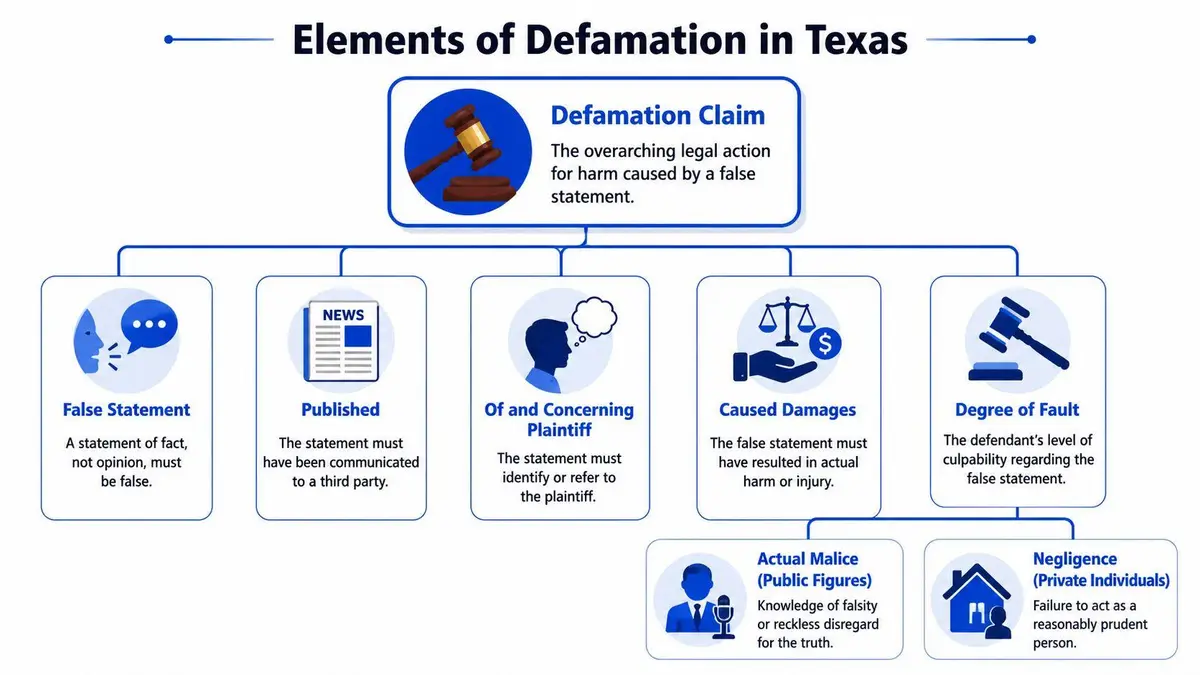
Texas courts require a plaintiff to prove core elements of the claim. As summarized in this Texas defamation elements overview, a defamation plaintiff must prove that a false statement of fact was published to at least one third party, that the statement was defamatory in that it tended to harm the plaintiff’s reputation, and that the defendant acted with the requisite degree of fault. Damages must also be shown unless the statement is defamatory per se, in which case damages may be presumed and proof of economic loss is not required.
That sounds simple until you apply it to real online speech.
A post on X is a publication. A comment on Glassdoor can be a publication. An email sent to one investor can be a publication. Texas doesn’t confine “publication” to newspapers or broadcasters. If a false factual statement reaches a third party, that element may be in play.
The harder fight is often over whether the statement is one of fact. “I think this CEO is a fraud” may be framed as opinion depending on context. “This CEO stole client funds last year” is different. That statement is concrete, falsifiable, and dangerous.
For executives and founders evaluating risk, this breakdown helps sharpen the line between ugly commentary and actionable online falsehoods: what constitutes online defamation for executives and founders.
Why identification matters
The statement must be “of and concerning” you. That doesn’t always require a direct name. If a reasonable audience can connect the accusation to you or your company, that may be enough. In tightly networked industries, vague references can still identify the target with precision.
This becomes critical when a publisher tries to hide behind implication. A post that says “a Houston cosmetic surgeon with a reality TV profile” may not name anyone, but if readers know exactly who is being accused, the identification issue doesn’t disappear.
Later in the section, the video below gives a useful overview of how these elements function in practice.
> **Defamation per se** refers to statements considered so inherently harmful that the law may presume reputational injury. In practice, allegations of criminal conduct or professional incompetence often trigger the most serious exposure because they strike directly at trust, employability, and commercial credibility.A quick legal triage test
Before spending money on letters or filings, ask these questions:
| Question | Why it matters |
|---|---|
| Is the statement provably false? | If you can’t prove falsity, the case weakens fast. |
| Is it factual rather than rhetorical? | Opinion and loose insult are harder to attack. |
| Did a third party receive it? | Without publication, there’s no defamation claim. |
| Would readers understand it refers to you? | Identification is essential. |
| Can you show harm, or is it defamatory per se? | This affects leverage and damages strategy. |
Clients often want to skip this analysis because the content is outrageous. Don’t. Precision here determines whether you have a pressure point or just a grievance.
Public Figures vs Private Individuals The Crucial Distinction
Your status changes the case. Sometimes it changes the case so dramatically that it decides whether filing suit is wise at all.

The burden split that drives strategy
Under Texas law, private plaintiffs and public figures do not carry the same burden on fault. As explained in this discussion of Texas defamation standards, private plaintiffs must prove negligence, meaning the defendant failed to reasonably verify the statement’s accuracy. Public figures or officials must prove actual malice, meaning the defendant knew the statement was false or acted with reckless disregard for its truth.
That difference is not academic. It is the strategic center of the case.
If you’re a private individual, your claim may turn on sloppy verification. Maybe a local site repeated an accusation without checking documents, calling the source, or reviewing obvious contradictions. Negligence can be enough.
If you’re a public figure, that same carelessness may not carry you. You need evidence pointing to knowledge of falsity or reckless disregard. That usually means looking for internal messages, ignored source problems, contradictory documents, or deliberate avoidance of basic facts.
Who counts as a public figure
High-profile clients often underestimate how quickly courts may treat them as public figures, at least for issues connected to their public activity. A politician obviously qualifies. So can a celebrity, major founder, media regular, or someone who injects themselves into a public controversy.
That matters because many reputational attacks target the very subjects that made the person visible in the first place. If your public profile is tied to venture financing, governance, medicine, crypto, philanthropy, or politics, statements about those subjects may trigger the harder standard.
Public visibility creates legal friction. The more the market knows your name, the more likely your case turns on proof of state of mind rather than mere carelessness.
What actual malice means in real litigation
Clients hear “actual malice” and assume it means hatred. It doesn’t. The focus is not personal hostility. The focus is the publisher’s awareness of falsity or reckless disregard for truth.
That shifts the evidence hunt. You’re not just collecting screenshots. You’re looking for signs that the publisher had reasons to doubt the claim and pushed it anyway. Examples include:
- Ignored contradictions: the speaker had documents or messages undermining the accusation.
- Source implosion: the accusation relied on a source with obvious credibility problems.
- No verification at all: the publisher avoided easy checks because the claim was too useful or too sensational.
- Republishing after correction: the speaker kept the accusation live after receiving evidence it was false.
If you’re a public figure, don’t file because the statement is outrageous. File because you can prove the defendant’s state of mind well enough to survive early attack and force meaningful discovery.
Defenses and The Texas Anti-SLAPP Statute (TCPA)
A strong plaintiff-side analysis always starts by trying to kill your own case before the defense does. If you can’t identify the likely defenses early, you’re not ready to send the demand letter, much less file suit.
The classic defenses
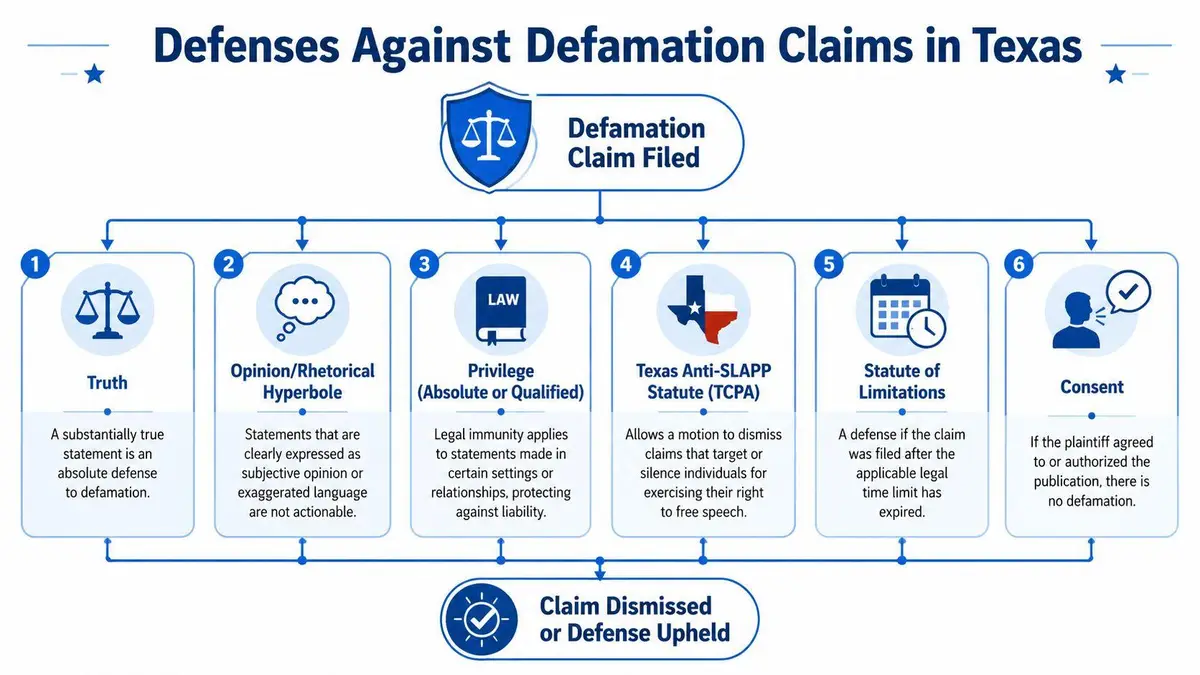
Some defenses are obvious but devastating. Truth ends the case. In practice, substantial truth is what matters, not whether every detail is perfect. If the gist of the statement is true, outrage won’t save the plaintiff.
Opinion is another major barrier. Courts won’t convert every harsh review or ugly comment into a lawsuit. Context matters. Hyperbole, loose rhetoric, and subjective judgment often receive protection.
Privilege also matters in specific settings. Statements made in some legal or official contexts may receive absolute or qualified protection. If the publication sits inside one of those zones, the plaintiff’s advantage diminishes sharply.
A disciplined case review should also test for consent, republication issues, and whether the statement is attributable to the defendant you plan to sue. Online attacks often involve aliases, reposts, mirrored content, or mixed authorship. Misidentifying the responsible party is a fast way to lose credibility.
The procedural weapon that changes everything
The Texas Citizens Participation Act, commonly called the TCPA, is the part many plaintiffs ignore until it hits them. That’s reckless. If your claim targets speech on a matter the defendant frames as public concern, the TCPA can become the central fight before ordinary discovery even gets going.
The defendant may use it to seek early dismissal. That forces the plaintiff to come forward with enough evidence early, before the comfortable, slow build of a conventional case. For some plaintiffs, especially those running on anger rather than proof, that’s where the case breaks.
The risk is not merely delay. A failed approach can turn your offensive move into a financial and public-relations problem. If you file a thin case that looks like an attempt to punish criticism, you hand the defense a narrative they will gladly use.
Strategic warning: in Texas, a weak defamation suit can become leverage for the defendant.
How to assess TCPA exposure before filing
Use a blunt internal checklist:
| Issue | Plaintiff-side implication |
|---|---|
| Speech touches public concern | Expect an aggressive dismissal effort |
| Evidence of falsity is thin | Don’t file yet |
| Fault evidence depends on future discovery only | Early motion risk increases |
| Defendant is media-savvy or politically active | Anti-SLAPP framing becomes more potent |
| Your real goal is removal, not damages | Litigation may be the wrong first move |
The practical lesson for executives
A lot of high-net-worth clients assume filing itself creates pressure. Sometimes it does. Sometimes it does the opposite. Against the right defendant, litigation provides a stage, a fundraising hook, and a free speech narrative.
The right move is usually to pressure-test the defenses before any public filing. Ask whether truth is going to be argued. Ask whether the post reads as fact or commentary. Ask whether the statement sits inside a privileged setting, and ask whether the case can survive an early challenge without relying on wishful discovery.
If the answer to those questions is weak, your best path may be targeted takedowns, back-channel correction efforts, private confrontation supported by evidence, and quiet reputation repair. Court should be a weapon you choose because it fits the facts, not because you’re angry enough to reach for it.
Available Remedies Damages and Filing Deadlines
Winning liability is only half the story. The other half is whether the remedy justifies the fight and whether you can still get into court on time.
Damages are real, but not automatic
Texas defamation cases can involve actual damages, and in some cases damages may be presumed when the statement is defamatory per se. But astute clients often focus on punishment and headlines. They want punitive damages because they believe that’s what will deter the attacker.
Texas makes that harder than many assume.
According to this summary of Texas defamation remedies and the Defamation Mitigation Act, Texas significantly tightened punitive damages in defamation after the 2013 Defamation Mitigation Act. A plaintiff seeking exemplary damages must prove actual malice regardless of whether the plaintiff is a public or private figure. The statute also reiterates the cap on exemplary damages as the greater of twice the amount of economic damages plus noneconomic damages up to $750,000, or $200,000.
That means private-figure status does not save you on punitive damages. If your strategy depends on exemplary exposure, your proof must support actual malice.
What this means in practice
If your main business objective is fast removal, don’t build your entire approach around a punitive damages theory that may never materialize. Use damages analysis to inform your strategic advantage, not fantasy.
Here is the practical divide:
- Actual damages: strongest when you can connect the publication to lost business, damaged contracts, employment harm, or measurable reputational injury.
- Presumed damages: relevant when the accusation falls into territory that is damaging on its face.
- Exemplary damages: available only with proof meeting the actual malice threshold.
Clients often overestimate the value of the last category and underestimate the evidentiary burden attached to it.
The deadline problem most people mishandle
Texas applies a one-year statute of limitations to libel and slander claims under Texas Civil Practice and Remedies Code § 16.002, as discussed in this treatment of libel and slander claims in Texas. That is a short fuse. If you spend months debating messaging strategy while the clock runs, you may preserve your dignity and lose your claim.
Online publication complicates the timing. Search results persist. Third parties aggregate. Old posts reappear through reposting, caching, and republication. Those facts can create factual disputes over triggering dates and where publication occurred. They can also create false confidence. Clients see the content still live and assume time is still open. Sometimes it isn’t.
Delay helps the publisher. It rarely helps the victim.
A deadline-focused action sequence
- Fix the first-publication date early. Don’t guess. Confirm it.
- Map every repost and mirror. Separate original publication from later republication issues.
- Preserve search result evidence. Search visibility often matters as much as source publication.
- Decide quickly whether litigation is on the table. If yes, build backward from the filing deadline, not from your PR calendar.
The legal case and the removal campaign should move together. If you wait to think about one until the other fails, you usually lose time you can’t recover.
Formulating Your Strategic Response to Online Attacks
Legal doctrine matters. Sequence matters more.
The right response to online defamation in Texas is rarely “sue first.” It is usually a coordinated escalation that preserves evidence, satisfies statutory prerequisites, pressures the right intermediaries, and keeps your options open.
Step one is preservation, not outrage
Before anyone sends a letter, capture the full online ecosystem around the attack. Get screenshots of the page itself, the profile, the comments, the share count if visible, and the search results showing indexing. Save timestamps. Identify whether the same text appears on blogs, complaint sites, social platforms, and review pages.
This is not clerical work. It is the foundation of jurisdiction, damages analysis, removal outreach, and any future proof of republication.
Step two is statutory compliance
Texas law creates a procedural trap for the careless plaintiff. Under Texas Civil Practice and Remedies Code § 73.055, many defamation plaintiffs must make a timely and sufficient written request for a correction, clarification, or retraction before maintaining the action. If that notice is mishandled, a claim can be damaged or barred even when the underlying statement is false.
That changes how you communicate. A good retraction demand is not a rant. It identifies the claimant, specifies the statement, explains the defamatory meaning, and preserves optionality. It also forces a strategic decision: do you send it immediately, or do you first gather more intelligence about the publisher and distribution pattern?
Send a retraction demand like a litigator, not like a wounded target. Precision creates leverage. Emotion creates screenshots.
Step three is choosing the correct pressure point
Not every publisher deserves the same treatment. A mainstream publisher, a review site, a rogue blogger, and an anonymous social account require different tactics.
Consider this response matrix:
| Source type | First pressure point | Secondary move |
|---|---|---|
| Social platform account | Platform report and impersonation or policy complaint | Counsel letter if account operator is identifiable |
| Review platform posting | Factual rebuttal and platform challenge | Evidence-backed removal request |
| Anonymous blog | Host, registrar, or site operator review where appropriate | Investigative identification and counsel escalation |
| Media publication | Retraction demand with documentary contradiction | Litigation review if facts support it |
Why a multi-pronged approach works better
Clients under pressure often want one silver bullet. There isn’t one. Court orders take time. Platforms can be inconsistent. Publishers may hide. Search engines don’t always respond to the same arguments as websites.
That’s why the stronger approach combines legal process with practical content removal efforts, reputation monitoring, and a sober decision about whether public response helps or hurts. If the content can be removed or de-indexed without public notice while counsel preserves the litigation threat, you may get a better result with less visibility.
Immediate litigation makes sense in some cases. It is the wrong opening in many others. Filing can trigger more press, invite anti-SLAPP framing, and alert bad actors before you’ve mapped the full spread of the content.
Engaging Professional Counsel and Reputation Services
A serious online attack usually requires two parallel functions. One is legal. The other is operational.
Legal counsel evaluates the claim, drafts retraction demands, handles preservation, identifies procedural risks, and decides whether a lawsuit advances your interests or merely satisfies your anger. A strong defamation lawyer in Texas should think like a strategist, not a form-filer. That means evaluating fault standards, defenses, timing, forum, and whether the defendant is likely to use procedural tools aggressively.
Reputation services solve a different problem. They focus on getting the material out of circulation or out of visibility as fast as possible. That can include source removal efforts, platform escalation, search-engine de-indexing routes where available, ongoing monitoring, and reupload tracking. Those are practical jobs. Traditional litigators often don’t perform them well because litigation and online content operations are not the same discipline.
When to prioritize speed
As noted earlier, the hardest tension in Texas cases is often the one between rapid takedown and the legal deadline. The public problem is immediate. The legal process is not. Add republication by aggregators and recurring resurfacing, and the issue gets more complex fast.
Use legal counsel when you need enforceable remedies, damages analysis, preservation discipline, and a credible path to suit. Use reputation specialists when the business objective is immediate containment, reduced visibility, and quiet cleanup. In many cases, you need both from day one.
For executives weighing that decision, this guide to an internet defamation attorney consultation for executives is a useful framework for choosing the right legal partner.
The real decision point
Don’t ask whether this is a legal matter or a reputation matter. It’s usually both. Ask which path serves the immediate objective.
If the material is spreading, you need speed. If the publisher is entrenched, malicious, and solvent, you may also need legal recourse. If the content is anonymous, mirrored, or cross-platform, operational removal work may matter more in the first week than a complaint sitting in draft.
The clients who manage these events best don’t confuse vindication with outcome. They focus on removing the material, limiting rediscovery, preserving the claim, and choosing a fight they can win.
If false content is damaging your name, company, or family, ContentRemoval.com can help you act fast and discreetly. The firm works with executives, public figures, family offices, and legal teams to remove harmful online material, reduce search visibility, and contain reposting before the damage spreads further. Start with a confidential assessment and get a clear action plan built for speed, privacy, and real-world results.
Frequently asked questions
How long do I have to file a defamation lawsuit in Texas?
One year from publication for libel and slander. Online content complicates timing because reposts, caching and aggregation can create disputes over the trigger date, and a post that is still live does not mean the clock is still open. Fix the first-publication date early and build backward from the deadline.
Do I have to ask for a retraction before suing for defamation in Texas?
In many cases, yes. Section 73.055 of the Civil Practice and Remedies Code requires a timely and sufficient written request for correction, clarification or retraction before maintaining the action. A mishandled notice can damage or bar a claim even when the statement is false, so it should be drafted with precision.
What is the difference between a public figure and a private person in Texas defamation cases?
Private plaintiffs must show negligence, meaning the defendant failed to reasonably verify the statement. Public figures and officials must prove actual malice, meaning the defendant knew the statement was false or acted with reckless disregard for its truth. Courts may treat founders, physicians and media regulars as public figures for matters tied to their public activity.