
A defamation cease and desist letter is a formal pre-litigation demand that a publisher remove false, reputation-damaging statements and stop repeating them. It works when the statements are verifiably false facts, were published to third parties and caused real harm. It should itemize each statement with URLs and evidence, set a deadline, and state the legal action that follows non-compliance.
Key facts
- A viable claim needs a false statement of fact, publication to a third party and demonstrable harm.
- Deadlines of 48 hours for a simple takedown, or 5 to 7 business days for multiple publications, are typical.
- U.S. public figures must show actual malice, while the UK applies a serious harm test.
- Anonymous publishers usually require a John Doe lawsuit and subpoenas to the platform to identify them.
Where ContentRemoval.com comes in. A letter aimed at the publisher is only half the strategy. ContentRemoval.com runs the platform track in parallel, using terms of service violations, legal reporting channels and search de-indexing to get content down when the author ignores the demand, is anonymous or sits overseas. Clients, their attorneys and their agencies all make contact. A free 15-minute Exposure Scan maps what is removable, and the report is yours to keep. Get a Free, Confidential Exposure Scan or read how our defamation removal work is done.
When false, reputation-damaging statements surface online, a defamation cease and desist letter is your opening move. It is a formal, pre-litigation demand instructing the publisher to remove the content and halt further publication. Consider it a calculated first strike to secure a swift resolution, putting the publisher on formal notice that you are prepared to pursue legal action if they fail to comply.
Using a Cease and Desist as a Strategic First Move
For an executive, public figure, or high-net-worth individual facing online defamation, the objective is not a protracted, public court battle. The goal is a swift, quiet, and decisive end to the reputational threat. A professionally drafted cease and desist letter is the optimal tool for this purpose. It is far more than a simple request. It is a potent instrument of legal and psychological pressure.
Sending this letter is the first official step in reasserting control over your reputation. It immediately elevates the dispute from an online grievance to a serious legal matter. This maneuver forces the publisher to confront the real-world risks of a lawsuit, significant financial damages, and public accountability for their statements.
The Power of Professional Authority
A generic letter drafted from an online template is easily dismissed. It signals an empty threat and suggests you are operating without legal counsel, unprepared for a genuine conflict. This perception invites the recipient to escalate their attacks or simply disregard your demand.
Contrast that with a letter issued by a specialized firm like ContentRemoval.com. The entire dynamic shifts. It sends an unmistakable message that you have already invested in expert counsel and are prepared to escalate. The recipient understands they are no longer dealing with an individual, but with professionals who manage these conflicts as a core practice.
A cease and desist from a reputable firm is not a negotiation tactic. It is a formal warning that the next communication will be a court summons. This posture dramatically increases the probability of immediate compliance.
This letter also becomes a critical piece of evidence. It establishes a formal record proving the publisher was officially notified that their statements were false and causing material harm. If they ignore this warning and continue publication, their actions can be framed as malicious, a factor that can substantially increase damages awarded in court.
Averting Costly and Unpredictable Litigation
The legal landscape increasingly favors resolution before a case reaches the courtroom. After the UK Supreme Court established a “serious harm” threshold for defamation, the number of cases filed in the Royal Courts of Justice plummeted by over 50% in a single year. This trend underscores the strategic value of a powerful cease and desist letter, as it can sidestep the immense costs and uncertainties of a trial. You can learn more about how legal precedents shape defamation strategies and their practical outcomes.
Litigation is not only expensive and time-consuming; it is inherently public. Filing a lawsuit risks amplifying the very falsehoods you are attempting to suppress, a reputational disaster known as the Streisand Effect. A cease and desist, by contrast, is handled privately. It maintains pressure squarely on the offender with a single objective: rapid and discreet removal.
By deploying a professionally managed cease and desist strategy, you assert control, prevent further reputational damage, and often achieve your goal without ever entering a courtroom. It is the first move, and frequently, it is the last one you will need to make.
Confirming You Have Grounds for Defamation
Before drafting a cease and desist letter, you must move beyond the initial anger and frustration. Acting on emotion is the quickest way to exacerbate the situation, potentially escalating the conflict or even exposing you to a countersuit.
Your first action is not to fire a warning shot; it is to conduct a dispassionate analysis of whether the statements in question meet the legal standard for defamation. A statement that is negative, hurtful, or unfair is not automatically defamatory. The law applies a specific, multi-part test.
The Three Core Elements of a Defamation Claim
For a statement to be legally actionable as defamatory, you must be able to prove three core elements. If even one is missing, a cease and desist letter is an empty threat.
First, there must be a false statement of fact. This is the cornerstone. A lie presented as truth may be defamatory. An opinion, no matter how vitriolic, is almost always protected speech. For example, “John Doe embezzles from his company” is a factual claim that can be proven or disproven. Conversely, “I think John Doe is a terrible CEO” is an expression of opinion.
Second, the statement must have been published to a third party. This means someone other than you and the author saw or heard it. An online review, a social media post, a blog comment, or a public speech all satisfy this requirement. A private text message sent only to you generally does not.
Third, the statement must have caused you real, demonstrable harm. This refers not to hurt feelings but to tangible damage to your reputation, such as lost clients, termination of employment, ostracism within your community, or other measurable negative outcomes directly resulting from the false statement.
The Fine Line Between Opinion and Defamation
Distinguishing fact from opinion is often the most challenging aspect of this analysis. Courts vigorously protect expressions of opinion, satire, and even hyperbole. The guiding principle is that if a statement cannot be objectively proven true or false, it is likely an opinion.
Consider a real-world scenario. A disgruntled ex-partner writes a blog post claiming you “falsified revenue reports by 30% in Q4.” This is a specific, verifiable allegation. If it is false, you possess strong grounds for a defamation claim.
If, however, they wrote that you are “the most incompetent executive in the industry,” that is almost certainly protected opinion. The statement is subjective, hyperbolic, and cannot be disproven with a spreadsheet. Grasping this distinction is critical before issuing any legal notice. You can explore these complexities further in our guide to defamation.
Before taking any action, ask yourself one simple question: Can I prove this statement is false with hard evidence? If the answer is no, your cease and desist letter rests on unstable ground.
Assembling Your Evidence
Once you are confident the statements satisfy the legal test, you must shift into an investigative role. Meticulously gather and preserve every piece of evidence. This documentation forms the foundation of your entire case, from the initial letter to any subsequent legal proceedings.
Your evidence checklist must include:
- Complete and Dated Screenshots: Do not simply crop the defamatory comment. Capture the entire browser window, ensuring the URL, author’s name or username, the content itself, and the post’s date and time are all clearly visible.
- Archived URLs: Websites and posts can be edited or deleted instantly. Use a web archiving service to create a permanent, time-stamped record of the page as it appeared.
- Proof of Falsity: Assemble the documents that prove the lie. This may include emails, financial records, or sworn statements from witnesses that directly contradict the defamatory claims.
- Evidence of Harm: This is where you document the damage. Collect emails from clients who terminated contracts, records of lost sales, or screenshots of secondary negative commentary that cites the original falsehood.
While collecting this information, remain within legal boundaries. For instance, if the defamation was verbal (slander), you must be aware of the laws in your jurisdiction regarding whether you can legally record a conversation without consent. Properly collected evidence transforms a personal grievance into a serious legal threat that a publisher or platform cannot afford to ignore.
Drafting Your Letter for Maximum Impact

A generic, fill-in-the-blanks letter is a waste of time. It communicates amateurism and invites the recipient to ignore it. Your objective is not merely to request a removal; it is to make it unequivocally clear that this is their final opportunity to comply before the consequences become severe and costly.
A well-crafted defamation cease and desist notice is a strategic weapon. It must land with the authority of a legal filing, conveying that you are serious, well-advised, and fully prepared to litigate the matter to its conclusion. This is about compelling action, not making a complaint.
Key Components of an Effective Cease and Desist Letter
To be effective, your letter must function as a formal legal instrument. This requires the inclusion of specific components that build a robust foundation for a potential lawsuit. Omitting any of these elements weakens your claim and provides the opposing party with an excuse to dismiss your demand.
This table breaks down the essential elements that every powerful cease and desist letter must contain.
| Component | Purpose | Critical Details to Include |
|---|---|---|
| Identification of Parties | Establishes who is making the claim and who is being held responsible. | Your full legal name; the publisher’s full name and contact information. If the publisher is anonymous, address the platform/host to put them on notice. |
| Itemized Defamatory Statements | Removes all ambiguity and proves you have a specific, actionable claim. | Direct quotations of the false statements, exact URLs, publication dates/times, and copies of your evidence (e.g., screenshots, archives). |
| Formal Demand to Cease and Desist | Creates a clear, non-negotiable instruction for the recipient to follow. | Use precise legal language: “You are hereby demanded to cease and desist all defamatory activity and to immediately and permanently remove the specified content.” |
| Statement of Legal Action | This is the core threat that motivates compliance. | A clear statement that you will pursue all available legal remedies, including a lawsuit for damages, if they fail to comply by a specific deadline. |
These elements are the building blocks of a formidable demand. Each one adds a layer of legal gravity, making the letter progressively harder to ignore.
Finding the Right Tone: Firm, Factual, and Final
The tone of the letter is as critical as its content. This is not the forum for anger, emotion, or personal attacks. Such language undermines your credibility and can be used against you in subsequent proceedings.
The most effective letters are cold, factual, and direct. They communicate that legal action is not just a possibility. It is the inevitable outcome if your demands are not met.
Keep your emotions out of it. Focus the recipient’s mind on their own legal and financial risk, not on your feelings. A clinical, professional approach is far more intimidating than an angry rant.
Note the difference in impact:
- Weak: “You are a liar and you’re ruining my reputation! Take this down now or you’ll be sorry!”
- Strong: “Your publication of these verifiably false statements constitutes defamation per se. Should you fail to comply with the demands herein by the specified deadline, we are prepared to file a lawsuit seeking monetary damages and injunctive relief.”
The second example sends a clear message: you understand the law, and you are prepared to enforce your rights. To hone this skill, it is worth reviewing professional tips to get the best outcomes when drafting demand letters before you begin.
Deadlines and Consequences: Making the Threat Real
A demand without a deadline is merely a suggestion. You must include a specific date by which you expect full compliance.
The deadline must be reasonable. For a simple content takedown, 48 hours may be appropriate. For more complex situations involving multiple publications, 5-7 business days is standard. An impossible deadline appears unprofessional, while an overly generous one removes the sense of urgency.
Finally, you must spell out the consequences of non-compliance. This is not about making idle threats; it is about stating your intentions. Mentioning specific legal actions you are prepared to take (such as seeking “compensatory and punitive damages,” “injunctive relief,” and “attorney’s fees”) demonstrates that you understand what is at stake.
By structuring your letter with this level of authority, you dramatically increase the probability of securing content removal without ever entering a courtroom.
Handling Online Platforms and Jurisdictional Issues
Online defamation does not respect borders. A false statement posted in one jurisdiction can inflict damage globally within minutes, reaching clients, partners, and family everywhere. This is the operational reality. A one-size-fits-all cease and desist letter is a dangerously outdated approach.
To achieve rapid removal of defamatory content, you must execute a two-front strategy. You must apply pressure to the individual publisher while simultaneously navigating the internal policies of the platform hosting the content: be it Google, X (formerly Twitter), or a niche review site. This requires a sophisticated approach that balances platform compliance with the complexities of international law.
Navigating Different Legal Standards
Defamation law varies radically by jurisdiction. A legal threat that is potent in the United Kingdom may be dismissed in the United States. Your cease and desist letter must be tailored to the correct legal landscape.
- In the United States, the First Amendment provides robust protection for speech. If you are a public figure, you must typically prove “actual malice”: that the publisher knew the statement was false or acted with a reckless disregard for the truth. Your evidentiary burden is extremely high.
- In the United Kingdom, the Defamation Act of 2013 applies a “serious harm” test. The court is less concerned with the publisher’s intent and more focused on the real-world damage to your reputation. This can make it easier to compel removal, as the argument centers on impact, not the author’s state of mind.
Jurisdictional precision is paramount. Sending a letter based on US law to a publisher in London is an exercise in futility. Your strategy must be surgically precise, targeting the jurisdiction where the publisher resides or where your reputation has suffered the most significant harm.
Targeting the Platform and the Publisher
Sending a cease and desist directly to the defamer is the traditional first step, but it is often the slowest. The publisher may ignore you, operate anonymously, or reside in a country where you have no practical legal recourse. For this reason, you must engage the hosting platform concurrently.
Social media has fundamentally altered this landscape. In the UK, for instance, defamation claims against individual posters now outnumber those against traditional media organizations by more than 3:1. This trend, coupled with a 2025 global survey indicating that 79% of people want platforms to remove defamatory content, makes one thing clear: the platforms are a critical pressure point. You can examine this data in this analysis of rising social media defamation claims.
Platforms like Google, Facebook, and review sites have their own terms of service and legal reporting channels. Using these tools in parallel with your cease and desist can often secure a faster takedown than engaging the original publisher alone.
Consider a false one-star review on Google. It is not only defamatory but also a violation of Google’s own content policies. By submitting a formal legal complaint directly to Google, supported by your evidence, you can often secure the review’s removal without ever interacting with the anonymous reviewer. Our firm has developed a detailed guide on how to submit a Google legal request that explains this specific process.
The Challenge of Anonymity and Foreign Actors
Anonymous attackers and foreign-based publishers present significant challenges. A cease and desist letter is of little use when you do not know the recipient’s identity or when the publisher is outside your country’s legal jurisdiction.
When confronting an anonymous poster, the objective shifts to unmasking the individual. This typically involves:
- Placing the platform on formal notice regarding the defamatory content.
- If the platform fails to cooperate, filing a “John Doe” lawsuit to obtain a court order (a subpoena) compelling the platform to disclose the user’s IP address and account details.
Attempting to sue a party in another country is a procedurally nightmarish, expensive, and often unenforceable endeavor. In these scenarios, the most effective strategy is often to focus on getting the content de-indexed from search engines. This transforms the legal problem into a technical one and is frequently the fastest way to make the defamatory content disappear for the audiences that matter.
When You Need to Escalate and Engage Professionals
Sending a defamation cease and desist letter is a decisive step, but what happens when it is met with silence? Or worse, the attacks intensify? This is not the end of the road; it is a clear signal to escalate your strategy.
An ignored letter indicates the publisher either does not take your threat seriously or is betting you will not follow through. From this point forward, every action must demonstrate your resolve. Your options are to apply greater pressure on the hosting platform or to initiate formal litigation.
From Demands to Strategic Action
The correct next move depends on a practical analysis of time, cost, and the specific nature of the defamatory content.
If the publisher is using your copyrighted photographs or videos alongside false statements, a Digital Millennium Copyright Act (DMCA) takedown notice can be your most effective weapon. This powerful tool often allows you to bypass the defamer entirely and compel the platform to remove the content directly.
If the defamation is purely text-based, your choices are to intensify pressure on the platform or file a lawsuit. Litigation is a significant commitment of both time and capital. With UK business defamation cases sometimes exceeding costs of £250,000, it is clear why many seek alternatives before heading to court. As experts note, there are multiple factors driving a shift away from expensive defamation suits.
This is precisely the gap a specialist firm like ContentRemoval.com is designed to fill. We integrate legal tactics with direct platform engagement and technical solutions to get harmful content de-indexed, often obviating the need for a costly and public court case.
This flowchart illustrates the decision-making process, demonstrating how action can be pursued against both the publisher and the platform simultaneously.
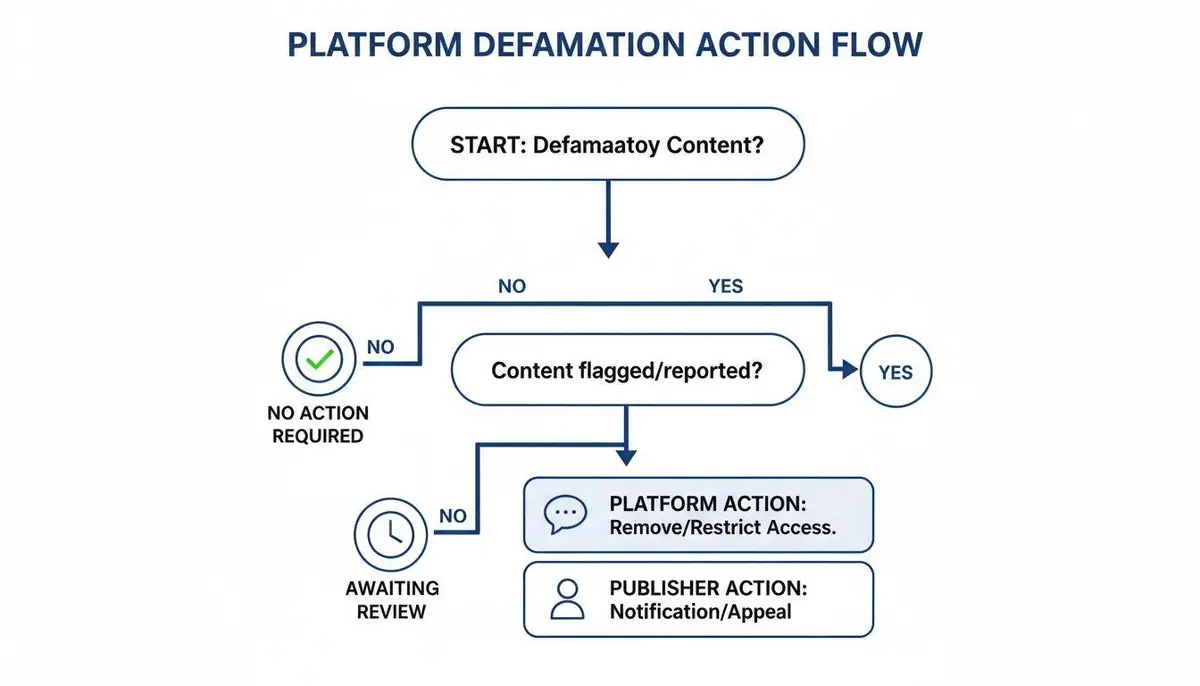
As the diagram shows, attacking the problem from both angles, against the publisher and the platform, is often the key to achieving a swift and comprehensive resolution.
The Value of Specialized Expertise
Managing this escalation phase independently is exceedingly difficult. It is easy to be stonewalled by corporate legal departments or to have your bluff called by a defiant publisher. This is where engaging a professional team becomes a strategic necessity. An expert firm offers three key advantages that cannot be replicated alone.
- Established Platform Relationships: We do not send notices into a void. We have direct lines of communication with the legal and policy teams at major platforms. This access allows us to bypass bureaucratic delays and place your case before decision-makers who can take immediate action.
- Legal and Technical Precision: Our takedown notices and legal complaints are drafted to be legally and technically airtight. We understand the specific rules and legal standards of each platform, ensuring our submissions are built to compel action, not be dismissed on a technicality.
- Speed and Persistence: Our entire operational focus is on rapid, relentless execution. We initiate action within 24-48 hours and pursue every available avenue until the objective is achieved. While you focus on your business, we are 100% dedicated to removing the defamatory content.
Engaging a professional firm is not an admission of defeat. It is a strategic power play. It signals to the opposing party that you are resolute in protecting your reputation and have deployed the expertise to prevail.
When your cease and desist letter is ignored, do not become discouraged. Become strategic. It is time to let professionals who handle these situations daily take the lead. Review our complete content removal services to understand how we can intervene, take control, and secure the resolution you require.
Common Questions About Defamation Letters
The decision to send a defamation letter raises critical questions. It is a high-stakes action, and uncertainty can lead to paralysis. Here, we address the most common concerns we hear from clients.
Can I Send a Defamation Cease and Desist Letter Myself?
Technically, you can. But in any situation where significant financial or reputational damage is at stake, it is a strategic error.
Consider the recipient’s perspective. A letter from you personally is often dismissed as an emotional reaction or an empty threat. It signals that you are likely operating alone, without the resources or legal backing to follow through. It will not be taken seriously.
When the same demand arrives from a specialized firm or an attorney, the dynamic shifts entirely. It provides immediate proof that you have invested in professional counsel and are prepared to escalate. This fact alone dramatically increases the probability of compliance. Furthermore, a self-drafted letter containing emotional language or legal missteps can be used against you.
What if the Defamatory Statement Is Anonymous?
Anonymous attacks require a different strategy. A standard cease and desist letter is ineffective when the publisher’s identity is unknown. The objective here is not just removal; it is to unmask the individual responsible.
This is where a “John Doe” lawsuit is deployed. Instead of suing a named individual, the legal action targets an unknown defendant. This powerful procedural tool allows your counsel to issue subpoenas to website hosts, social media platforms, or internet service providers, legally compelling them to disclose the user data associated with the anonymous post. It is a specialized process that is nearly impossible to navigate without expert legal guidance.
Pursuing anonymous actors is a specialized field. It combines legal discovery with digital forensics to pierce the veil of anonymity and hold offenders accountable.
How Long Does It Take to See Results?
The timeline for a response is contingent on the recipient. An individual who receives a professional demand letter may be intimidated into compliance and remove the content within 24 to 48 hours.
A business, however, will almost certainly refer the letter to its legal counsel. In that scenario, a formal response can be expected within one to two weeks.
If your letter is ignored, the clock resets based on your next action. A platform takedown request might be resolved in a matter of days, but initiating a lawsuit can prolong the process for months, if not years. A key advantage of working with a firm like ours is our ability to attack the problem on multiple fronts simultaneously, which dramatically accelerates the resolution timeline.
Could a Cease and Desist Letter Backfire?
Yes. The risk of the “Streisand Effect”, where an attempt to suppress information only serves to amplify it, is real. This is most likely to occur if your letter asserts weak legal claims or is sent to a journalist or activist who thrives on public conflict.
This is precisely why a professionally drafted letter is non-negotiable. An effective letter is firm but not inflammatory. It is constructed on solid legal ground and delivered discreetly, with the goal of achieving quiet compliance, not provoking a public spectacle. By ensuring the letter is precise and strategically delivered, you minimize the risk of it backfiring.
When a standard cease and desist letter is not the right tool, or is not enough, you need a team that executes complex takedowns with expertise. ContentRemoval.com combines legal strategy with direct platform relationships to protect your reputation with speed and certainty. If you are facing a difficult online defamation issue, contact us for a confidential assessment.
Frequently asked questions
Does a cease and desist letter work for online defamation?
Often, when it is professionally drafted, rests on a verifiable false statement of fact and is delivered discreetly. An individual may comply within 24 to 48 hours, while a business will usually route it to counsel and respond within one to two weeks. It also creates a record that the publisher was on notice, which matters if the matter proceeds to court.
What should a defamation cease and desist letter include?
Identification of both parties, direct quotations of each false statement with exact URLs and dates, a formal demand to remove the content and stop further publication, a specific compliance deadline, and a clear statement of the legal remedies you will pursue. The tone should be cold, factual and free of emotional language.
Can a cease and desist letter make things worse?
Yes. The article warns of the Streisand Effect, where a weak or inflammatory letter, especially one sent to a journalist or activist, amplifies the falsehood instead of removing it. A letter built on solid legal ground and delivered privately reduces that risk. Sending it yourself is usually a strategic error in high-stakes matters.