
Defamation at work is a false statement of fact about you, shared with a third party inside or outside the company, that causes demonstrable harm. Criticism and opinion are not actionable. The right response starts with preserving evidence, identifying who received the statement and whether it has spread online, then choosing between internal correction, takedown work or a legal claim.
Key facts
- A workplace claim needs falsity of a factual statement, publication to a third party, fault and harm.
- Slack, Teams and email all count as publication once a false factual statement reaches another person.
- Employers often rely on intra-corporate privilege, which shields many performance and investigation communications.
- Compelled self-publication, recognized in Berg v. IPEC, applies when a false narrative forces you to repeat it to future employers.
Where ContentRemoval.com comes in. When an internal accusation escapes into Glassdoor, LinkedIn, trade forums or search results, employment counsel and HR are not built to chase copies across platforms. ContentRemoval.com handles the digital track: source removal, de-indexing and monitoring for reposts while your lawyer manages the claim. The executive, their counsel or a chief of staff usually makes contact. A free 15-minute Exposure Scan maps what is removable, and the report is yours to keep. Get a Free, Confidential Exposure Scan or read how our defamation removal work is done.
A false statement at work rarely arrives with the label you want. It shows up as a “concern” copied to the wrong people, a Slack message that suggests you cut corners, or a niche forum post that starts circulating just as a board review, financing round, or lateral move approaches. By the time you learn about it, the issue usually isn’t whether the statement was offensive. The issue is whether other people have already acted on it.
For executives, defamation at work is rarely a pure HR problem. It is a reputation-control problem with legal, commercial, and digital dimensions. A false allegation of policy violation can alter how directors view judgment. A whisper about dishonesty can contaminate an internal investigation. A distorted termination narrative can follow you into future interviews, investor diligence, and search results.
The mistake I see most often is choosing the wrong lane too early. Some clients escalate emotionally inside the company before preserving evidence. Others rush to threaten litigation when the actual exposure is online repetition and search indexing. Others still treat internal defamation as “just politics” until the record hardens in performance files, reference conversations, and digital posts.
The better approach is disciplined. Identify exactly what was said, where it was published, who received it, and what damage pathway matters most. Then decide whether the right move is a contained internal correction, a takedown strategy, or a legal claim designed to change the other side’s incentives. That sequence ensures strategic advantage.
A False Narrative Is Spreading What Is Your Next Move
You find out on a Thursday evening. A trusted colleague forwards an internal message that doesn’t directly call you dishonest, but it doesn’t need to. It says you “misrepresented key facts” on a transaction and “created compliance concerns.” By Friday morning, people who weren’t involved in the matter are discussing whether you can still be trusted with the account.
That’s the moment when many executives make a damaging assumption. They think the first priority is to defend themselves in real time. Usually it isn’t. The first priority is to slow the spread, preserve the record, and work out whether the falsehood lives only inside the company or has already moved outside it.
A rumor inside a team can often be contained if you act before it is repackaged as a formal finding, performance issue, or “reason for separation.” Once that happens, the language acquires institutional weight. Internal listeners begin treating an accusation as fact because it appears in an email chain, a review, or a manager’s summary.
Immediate rule: Don’t start with outrage. Start with evidence, audience, and risk of repetition.
The practical questions are narrower than often assumed. Was the statement factual, or was it framed as opinion? Was it published only inside the company, or did it spill into texts, LinkedIn messages, recruiter calls, or industry forums? Is your real threat a stalled promotion, a lost deal, a damaged exit, or a searchable online record?
A false narrative can be managed. But it has to be handled as a live crisis, not a workplace misunderstanding.
Defining the Line Between Opinion and Defamation
Before you accuse anyone of defaming you, you need a clean diagnosis. Workplace conflict produces a lot of ugly language that isn’t actionable. The law draws a hard line between a false statement of fact and a negative opinion.
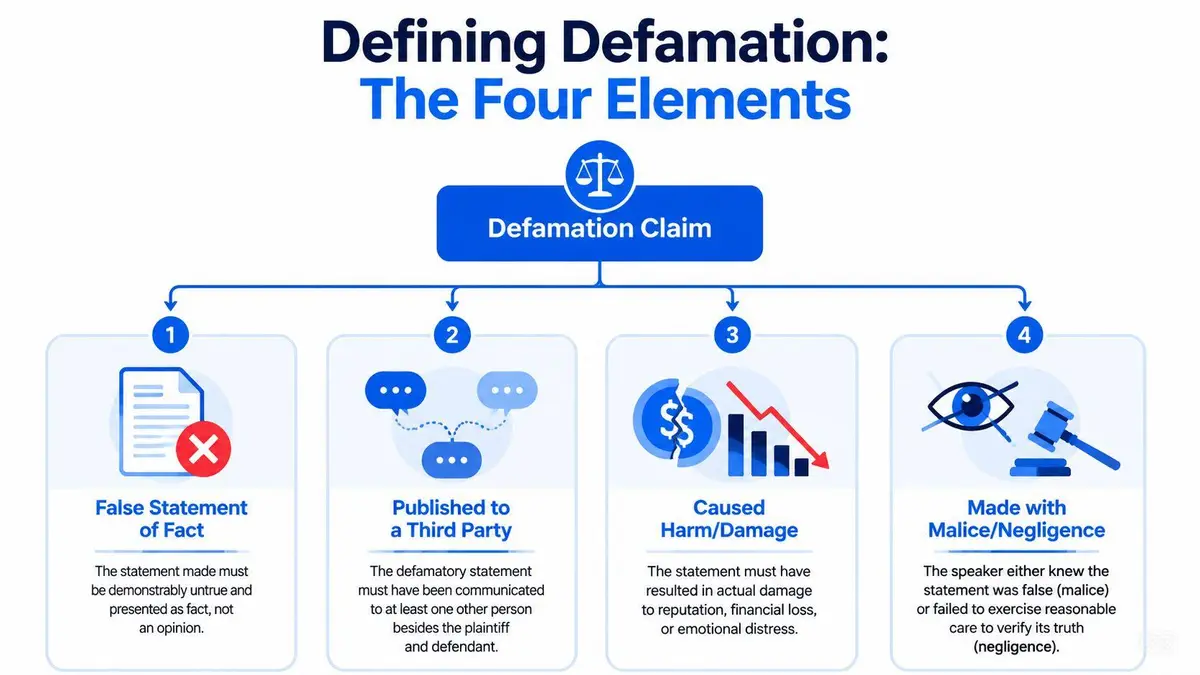
In workplace claims, the plaintiff must prove four elements: falsity of a statement of fact, publication to a third party, fault, and demonstrable harm. The same analysis notes that negligent publication, such as a supervisor emailing unverified misconduct accusations to team members, can satisfy publication and fault in private workplace disputes, and that digital platforms like Slack and Teams are treated like email for this purpose in the workplace context, as discussed in this workplace defamation analysis.
What usually counts as opinion
“Her leadership style is abrasive” is unpleasant, but it is usually opinion. “He isn’t a culture fit” is also usually opinion. Statements like that are subjective, evaluative, and hard to prove true or false in a courtroom.
The same is often true of performance language unless it contains concrete factual assertions. “Weak judgment” may be protected opinion. “Submitted fabricated numbers to close the quarter” is different. That can be tested against records.
What crosses the line
The fastest way to assess a statement is to ask one question. Can objective evidence prove it false?
If the answer is yes, you may be dealing with defamation rather than criticism.
| Statement | Likely treatment |
|---|---|
| “He’s difficult to work with.” | Usually opinion |
| “She violated company policy during the investigation.” | Potentially defamatory fact |
| “His presentation was poor.” | Usually opinion |
| “He falsified expense records.” | Potentially defamatory fact |
Context matters. A remark in a heated meeting may be analyzed differently from a formal review, a disciplinary memo, or an email sent to multiple decision-makers. Internal chat systems also matter because “publication” does not require a newspaper or public website. If a false factual statement reaches another person inside the company, that element may already be in play.
A weak case gets weaker when counsel overstates it. A strong case gets stronger when the statement is identified with precision.
That precision matters strategically. If you challenge a statement that is plainly opinion, you lose credibility with HR, in-house counsel, and later with the court. If you isolate the specific factual allegation and show why it is false, you put pressure where it belongs.
Proving Your Case The Burden of Evidence
A valid legal theory won’t help if the evidence trail is thin. In practice, most workplace defamation matters are won or lost in the first days, when messages are still available, witnesses still remember the sequence, and the plaintiff hasn’t contaminated the record with emotional replies.
Build the record before you debate the merits
If the falsehood appears in email, Slack, Teams, text, or a shared document, preserve it immediately. Capture the full screen, not just the sentence that offends you. You want timestamps, sender identity, recipients, surrounding context, and any attachments or message threads that show how the allegation spread.
The same approach applies to online repetition. If an internal accusation migrates to Glassdoor, LinkedIn, a trade forum, or recruiter chatter, preserve each instance separately. Publication pathways matter. So do edits and deletions.
A practical evidence file usually includes:
- Original statement: Screenshot or export showing the exact words used.
- Distribution trail: Recipient list, forwards, reposts, chat participants, or forum visibility.
- Falsity proof: Policies, calendars, transaction logs, approvals, review history, or witness accounts that contradict the allegation.
- Damage record: Rescinded opportunities, exclusion from meetings, loss of responsibilities, changed reporting lines, or written comments from decision-makers.
When harm is presumed
Some accusations are so serious that the law may presume damages. In major U.S. markets including California and Pennsylvania, defamation per se applies to statements imputing professional disqualification, crime, or business injury. That means a false allegation such as incompetence in one’s profession, policy violation, or criminal conduct can bypass the need to prove actual harm in the ordinary way, as summarized in this workplace defamation factsheet.
That doesn’t eliminate the need for discipline. It changes what your evidence file emphasizes. If the statement fits a per se category, your early work should focus on falsity, publication, and preserving the professional setting in which the statement was made.
Preserve first. Confront second. Deleted messages, edited reviews, and “clarified” HR summaries become much harder to challenge once the original record disappears.
The evidence that executives often overlook
Senior people tend to focus on direct financial loss. That matters, but it isn’t the whole picture. In executive matters, reputational harm often appears indirectly. You are dropped from a sensitive project. A search firm goes quiet. A board member stops returning messages. A counterpart starts asking “process” questions that mirror the allegation.
Write those moments down. Keep them dated. Save the emails. If someone references the allegation obliquely, that still helps show impact and circulation.
What does not work is general indignation. Courts and employers respond to records, chronology, and contradiction. If you can show exactly what was said, exactly why it was false, and exactly who received it, your position becomes far more durable.
Employer and Employee Liability Unpacking the Risks
Once you know what was said, the next question is who should answer for it. That is not always the person who typed the message. In some cases the better target is the employer that adopted, repeated, or institutionalized the statement. In others, the company is difficult to pursue because internal communications are protected.
Why internal claims are hard
Workplace defamation is a difficult area because employers benefit from substantial legal protection. Courts have shielded employers through the intra-corporate privilege doctrine, which protects communications made during management of employees and leaves many workers with limited recourse, as described in this analysis of performance defamation and intra-corporate privilege.
That doctrine explains why so many executives feel certain they were smeared internally yet struggle to convert that certainty into a clean claim. Performance reviews, investigation summaries, and termination discussions often sit inside a zone of qualified privilege. To break that shield, the evidence usually needs to show more than harsh judgment. It needs to show a knowingly false statement or reckless disregard for truth.
The individual versus the institution
A coworker who starts a false rumor may be personally exposed. A manager who repeats an unverified accusation in a wider forum may also create risk. But the strategic question is whether the company merely hosted the statement or effectively adopted it.
Consider the practical differences:
| Target | Strategic upside | Strategic difficulty |
|---|---|---|
| Individual speaker | Clear personal accountability | May have limited assets or deny publication |
| Employer | Greater pressure to resolve and correct record | Privilege defenses are often stronger |
| Both | Broader leverage | More expensive, more complex, more public |
The company’s own risk calculus matters here. HR and general counsel may resist admitting defamation, but they understand governance risk, retaliation allegations, and insurability issues. That’s one reason executives should understand how employment claims are often evaluated through an insurance lens. A concise backgrounder on that framework is this Employment Practices Liability Insurance guide.
Risk management for both sides
If you are the executive claimant, your position strengthens when you can show the company had opportunities to correct the falsehood and chose not to. If you are advising the company, the safer path is disciplined fact-gathering, narrow circulation, and language tied to evidence rather than character judgments.
Online spillover changes the equation again. Once an internal accusation escapes into search results, the legal issue becomes a reputation-containment issue. That is where the analysis in this strategic guide to online defamation of character becomes relevant. Internal privilege may protect a company in one forum while offering no practical help once the allegation is public and indexed.
Your Strategic Response From HR to Litigation
A good response plan is not linear. It is selective. You are choosing the intervention that gives you the best chance of correcting the record without enlarging the audience for the falsehood.

When internal channels are worth using
If the statement is still contained inside the company, an internal approach may be the best first move. But it has to be handled like a record-correction exercise, not a grievance monologue.
A useful internal submission does three things. It identifies the exact statement. It attaches proof of falsity. It asks for a defined remedy, such as correction of a personnel record, withdrawal of a written accusation, or confirmation that the statement will not be repeated in references or interviews.
That kind of request gives HR and legal something operational to act on. It also creates a clean exhibit if the company refuses.
What doesn’t work is broad language about “defaming my reputation” without attaching the actual text and contradiction. Internal teams often default to process. Give them a factual file, not a narrative of outrage.
When counsel should step in
A lawyer letter becomes useful when the falsehood has hardened into a document, spread outside a limited group, or started to affect future employment and commercial relationships. At that point, the issue is not just correction. It is deterrence.
A strong pre-litigation letter is narrow, factual, and targeted to the right audience. It should identify publication, falsity, and the requested remedies. It should also anticipate the obvious defenses, especially opinion and privilege.
Some companies will respond only when they see a credible path to litigation. Others will correct the record with discretion because they want to avoid discovery into how the allegation was created. The decision turns on power dynamics, not emotion.
Litigation is a pressure tool, not a reflex. Use it when the likely benefit exceeds the cost of publicity, delay, and internal entrenchment.
For executives dealing with digital content, there is often a parallel question about synthetic or edited media. If a workplace dispute starts generating manipulated clips, AI voice content, or defamatory training videos, reviewing platform rules can help frame takedown demands. One practical reference point is the LunaBloom enterprise video generation rules, because platform terms often shape what hosts will remove even before a court does.
When litigation is the right move
Litigation makes sense when the accusation is serious, false, documented, and causing ongoing harm that lesser measures won’t stop. It also matters when you need compulsory process to obtain records, identify anonymous speakers, or force preservation.
There is one doctrine executives often overlook when deciding whether to sue. In California and other U.S. jurisdictions, courts recognize compelled self-publication, which can apply when an employer’s false statement forces the employee to repeat the accusation to future employers. In Berg v. IPEC (1981), that theory supported liability where the employee’s own compelled disclosure carried the defamatory implication forward, as explained in this FindLaw discussion of compelled self-publication in workplace references.
That matters if the company’s line is already influencing your next move. If you are being forced to explain a false “for cause” narrative in interviews, your damages are not speculative. They are being manufactured in real time.
For digital-first incidents, legal escalation may also need a separate operational track. Such a track facilitates a structured response to publication, evidence preservation, and platform removal, and this strategic guide for victims of online defamation gives a practical starting point for that parallel work.
The Modern Battlefield AI Defamation and Digital Takedowns
The traditional assumption is that if a statement is defamatory, the legal system will eventually sort it out. That assumption is often wrong once the allegation becomes digital, searchable, and reusable.

A false internal allegation used to live in a review, a memo, or a reference call. Now it can appear in screenshots, copied chat logs, anonymous posts, AI-generated summaries, and synthetic “evidence” that spreads faster than counsel can draft a complaint.
One emerging problem is AI-generated workplace records. A 2026 Deloitte report, cited in this discussion of workplace defamation and AI-generated evaluations, states that 78% of Fortune 500 firms use AI for evaluations, and 23% of employees reported disputed AI outputs as “maliciously inaccurate” leading to terminations. Whether every disputed output becomes actionable is a separate question. The strategic point is that AI can create false factual assertions at scale, and those assertions leave digital trails that can be preserved and tested.
Why speed matters more online
If a defamatory allegation sits on a website, forum, or platform profile, litigation may eventually create bargaining power. But the search result does its work immediately. Recruiters, journalists, investors, and counterparties don’t wait for a judgment.
That is why digital response has become its own discipline. Source removal, de-indexing, account reporting, metadata preservation, and reupload monitoring are all different tasks. They require different evidence packages and different timing.
Here is a useful briefing on how online attacks evolve and why rapid response matters:
What works and what doesn’t
What works is a split-track strategy. Preserve the evidence for legal use while also targeting the publication point and the search pathway. What doesn’t work is assuming a demand letter alone will solve anonymous or viral repetition.
If the falsehood is confined to an internal file, litigation advantage may be enough. If it is online, you also need platform-based and search-based action. In practice, that means treating the legal claim and the digital footprint as related but distinct problems.
Taking Control of the Narrative with Professional Assistance
By the time most executives seek help, the issue is no longer just whether a statement was false. The issue is whether the false version of events has become easier to find, easier to repeat, and harder to dislodge than the truth.
That is why defamation at work has to be handled as information control. Employment counsel can assess privilege, publication, and damages. Internal HR can sometimes correct a file. But neither is built to move quickly across anonymous posts, scraped copies, search results, and platform removals.
There is also a growing overlap between legal review and technical review. Teams evaluating evidence, notice letters, and platform submissions are increasingly using AI-assisted workflows. For legal departments looking at process design, this overview of using AI for contract review is a useful example of how AI tools can support structured legal analysis without replacing judgment.
Where the problem is public and digital, one option is to combine legal strategy with specialist removal work. ContentRemoval.com handles source removal, de-indexing, and ongoing monitoring in matters involving false reviews, defamatory posts, leaked material, and anonymous attacks. For executives trying to protect long-term visibility, this broader online reputation management strategy for 2026 is often the right frame. The point is not to “win the argument” online. It is to reduce discoverability, stop repetition, and restore a usable record.
The falsehood may have started at work. The damage rarely stays there.
If a false workplace narrative is threatening your role, deal flow, or future search results, speak with ContentRemoval.com for a confidential assessment. The right response often combines evidence preservation, takedown strategy, and discreet reputation protection before the allegation hardens into the public record.
Frequently asked questions
Can I sue a coworker for spreading false rumors about me?
Possibly, if the rumor is a false statement of fact rather than opinion, it reached other people, and it caused real harm to your role or prospects. Statements imputing crime, policy violations or professional incompetence may qualify as defamation per se in states like California and Pennsylvania. The individual speaker may be personally exposed, though they may have limited assets or deny publication.
Is a bad performance review defamation?
Usually not. Language like weak judgment or poor culture fit is evaluative opinion and hard to prove false. A review becomes potentially defamatory when it contains a concrete factual assertion that records can disprove, such as claiming you falsified expense reports. Employers also benefit from qualified privilege for internal management communications.
What evidence do I need for a workplace defamation claim?
Preserve the original message with full screen captures showing sender, recipients, timestamps and context. Add the distribution trail, documents that prove the statement false such as approvals or transaction logs, and a dated record of harm like rescinded opportunities or changed reporting lines. Preserve before you confront anyone.