
Dark web monitoring software uses automated crawlers on Tor and I2P to sweep known black markets, hacking forums and paste sites for your executives’ credentials, internal documents and personal data, then alerts you. Its limit is access: the highest-value deals happen in invite-only channels it cannot enter, so an alert is often confirmation of an older breach, not the resolution.
Key facts
- Judge tools on signal-to-noise ratio, data freshness and which sources they reach, not alert volume.
- Private messaging coverage is limited to public Telegram or Discord channels; encrypted invite-only groups stay invisible.
- Remediation has four steps: immediate verification, threat containment, content and data removal, reputation management.
- Top-tier providers can alert within hours of data appearing on a major criminal forum.
Where ContentRemoval.com comes in. ContentRemoval.com is the team a buyer hires when the question moves from detection to resolution: verifying the alert, removing exposed data at source where possible, de-indexing, impersonation handling and protecting the personal and corporate brand from the fallout. Founders, their CISOs and family office managers usually make the approach after a 2 a.m. alert with no next step. A free 15-minute Exposure Scan maps what is exposed and removable, and the report is yours to keep. Get a Free, Confidential Exposure Scan or read how our personal data removal work is done.
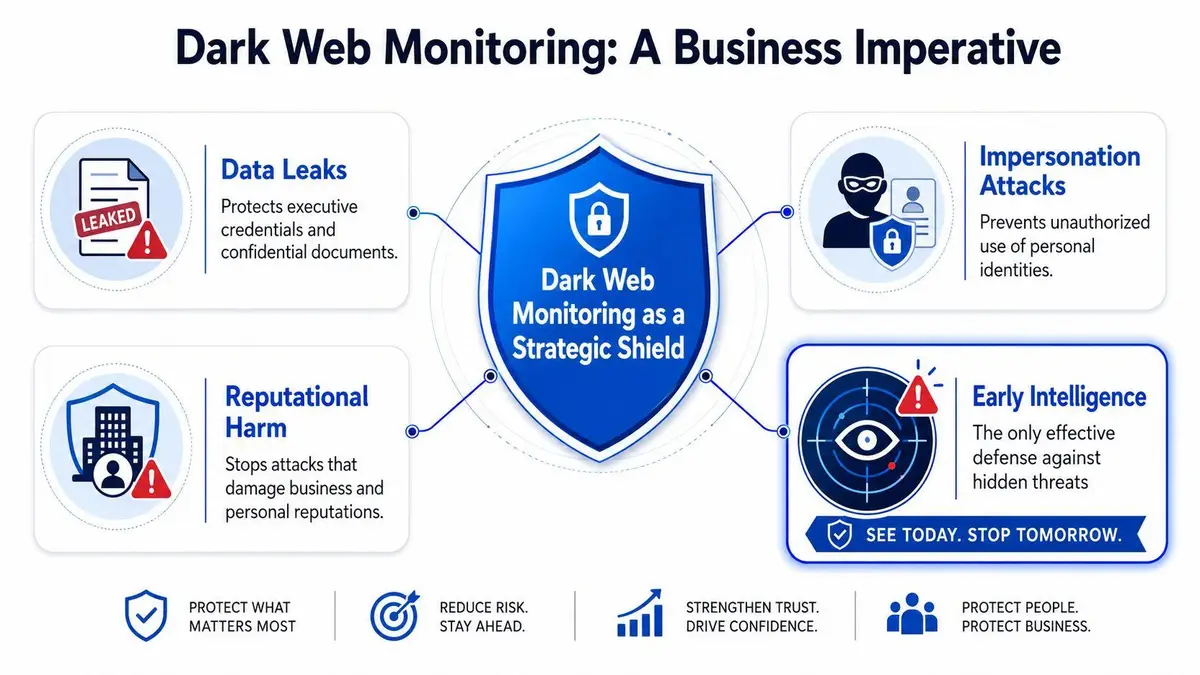
Dark web monitoring software serves as a lookout in the internet’s most dangerous neighborhoods. It is a security tool that continuously scours hidden online marketplaces, shadowy forums, and criminal networks, searching for any sign of your organization’s stolen data. Its function is to provide an early warning when sensitive information (an executive’s password, confidential company documents, or personal family details) appears where it should not. This alert is often the only defense against data leaks turning into impersonation attacks and reputational disasters.
Why Dark Web Monitoring Is a Business Imperative
For executives, founders, and their families, the exposure of private information is not merely an IT issue; it is a direct threat to business operations, personal safety, and professional reputation. The dark web is not a chaotic collection of forums but a thriving, well-organized underground economy where your most valuable assets are packaged, sold, and exploited by criminals.
The risks materialize with alarming speed. A single compromised email account can spiral into a devastating business email compromise (BEC) attack, leading to fraudulent wire transfers or the theft of trade secrets. When personal information leaks (home addresses, family member names, or vacation plans) it creates severe physical security risks.
The Strategic Value of Early Intelligence
The purpose of dark web monitoring software is to shift the security posture from reactive clean-up to proactive defense. Waiting until a data breach makes headlines or until anomalous activity appears in financial accounts means the damage is already underway. Monitoring provides the critical intelligence to act before an attack fully materializes.
An alert from a monitoring service is a signal flare. It confirms a defensive breach and indicates that your assets are now for sale in hostile territory. This creates a crucial, time-sensitive window to change stolen passwords, secure exposed accounts, and engage professional assistance before criminals can monetize the data.
This pre-emptive intelligence is paramount. A proactive security mindset is non-negotiable for understanding and defusing potential threats, a point emphasized in many CTO Input data protection strategies. Ignoring the hidden chatter on the dark web is equivalent to hearing an intruder at your front door and choosing to do nothing.
The ultimate goal is not just finding the leak, but containing the fallout. For leaders whose personal brands are inextricably linked to their companies, any breach can shatter trust with investors, partners, and customers. As detailed in our guide on online brand protection services, monitoring is a key component of a larger defensive strategy. Professional intervention is a necessity for protecting your life’s work.
How Dark Web Monitoring Actually Works
The dark web is a sprawling, chaotic digital underground, a hidden city with no map, where data is the most valuable currency. Standard search engines cannot determine if your company’s secrets or personal information have been exposed there. Navigating this space requires a guide who knows the terrain, which is the essential function of dark web monitoring software.
These tools are not aimless; they are designed for reconnaissance in hostile territory. The software uses automated crawlers built to navigate the anonymous networks where these illicit markets operate, such as Tor and I2P. These crawlers methodically comb through known black markets, private forums, and paste sites where criminals often dump stolen data for quick sale or public exposure.
How the Tools Pinpoint Your Data
Once inside these networks, the software is programmed to find specific pieces of information that prove your assets have been compromised. It hunts for the digital equivalent of a fingerprint.
These tools search for identifiers such as:
- Executive email addresses and login credentials
- Internal documents, source code, or other intellectual property
- Personally identifiable information (PII) of key staff and their families
- Company financial records or sensitive client lists
This is far more sophisticated than a simple keyword search. Modern tools use AI and machine learning to understand context. They can differentiate between a random chatroom mention of your company and a credible offer to sell your CFO’s network credentials. This intelligence is crucial for cutting through the noise and delivering alerts that demand action, preventing a flood of false alarms.
This infographic helps visualize how monitoring acts as a strategic shield against these threats.
This is not a technical chore. It is about turning intelligence into a protective measure against serious business risks.
Navigating a High-Risk Environment
Attempting this work manually is not only impractical but also incredibly risky. The scale is one issue; the Tor network alone sees around 2.5 million daily users, creating a vibrant, always-on marketplace for stolen data. Research from the Prey Project indicates that nearly 57% of the dark web’s content is tied to illegal activities, making it a dangerous environment for any corporate network to access directly.
The function of dark web monitoring software is to automate this hazardous work. It acts as a proxy, providing constant surveillance without exposing your organization to direct risk. The tool watches for threats so you can focus on responding to them.
Automated intelligence is your first line of defense, but it is only one component. The same hidden channels where criminals trade your data are also used by legitimate, though often unethical, data brokers. This creates its own set of privacy challenges, which we cover in our strategic guide to executive privacy and data brokers.
The software provides the alert. What you do next is what truly counts.
Understanding Detection Sources and Inherent Limitations
No magic spyglass for the dark web exists. To derive real value from any dark web monitoring software, one must accept its capabilities and its constraints. An automated alert is a smoke signal. It indicates a fire but does not reveal who started it or the extent of the damage.
Effective monitoring tools constantly scan the usual sources where stolen data is bought and sold openly. This is akin to a patrol officer walking a familiar beat, checking pawn shops and known hangouts for stolen goods.
Where Monitoring Tools Typically Look
These platforms cast a wide net across the more “public” areas of the criminal internet, where they excel at spotting large-scale data dumps and credentials sold as commodities.
Most tools focus on crawling locations such as:
- Known Black Markets: These are the storefronts on networks like Tor where criminals openly list stolen databases, credit card details, and company logins for sale.
- Hacking Forums and Communities: These are the industry conference rooms for cybercriminals, where they trade attack methods, boast about recent breaches, and sell initial access to compromised corporate networks.
- Paste Sites: Services like Pastebin are notorious drop points where attackers often dump huge text files of stolen data for easy, if temporary, access.
By continuously sweeping these locations, the software can flag when your company’s assets, like an executive’s email address or a snippet of source code, suddenly appear. But this is only what is happening on the surface.
To provide a clearer picture, this table breaks down where these tools are looking and what they might be missing.
Dark Web Monitoring Data Sources and Visibility
| Data Source | Typical Coverage | Key Limitation |
|---|---|---|
| Dark Web Marketplaces | Scans for listings of stolen databases, credentials, and PII. | Only sees what’s for sale publicly; the initial, private sale has likely already occurred. |
| Hacking Forums | Monitors posts and discussions for mentions of your company, breached data, or exploits. | Cannot access private sub-forums or encrypted chats where the most valuable intel is shared. |
| Paste Sites | Crawls public pastes for data dumps containing email addresses, passwords, and API keys. | Data is often temporary and may be removed before it’s indexed; lacks context of the breach. |
| Private Messaging Apps | Limited to public channels on platforms like Telegram or Discord. | Completely blind to invite-only groups and end-to-end encrypted messages where deals are made. |
The automated scan is just the first step. The real action often happens out of sight.
The Inherent Blind Spots of Automation
The primary limitation of any automated tool is its inability to access private, exclusive environments. The most valuable, time-sensitive intelligence is almost always traded in closed circles long before it reaches a public forum accessible to a crawler.
A critical mistake is assuming your monitoring software sees everything. The most damaging deals happen in places an automated tool cannot enter, invite-only Telegram channels or private servers where trust is paramount and outsiders are immediately excluded.
These are the venues where a zero-day exploit or a full database of C-suite credentials gets its first, highest-value sale. By the time that same data trickles down to a public market where your software finally spots it, the original buyer has had a significant head start.
An automated alert remains crucial, but it is often confirmation of a breach that is hours, days, or even weeks old. It reveals what happened, but not how or who was first to exploit it. This gap is precisely why human expertise is required to take that initial alert, investigate where software cannot, and contain the threat before significant damage is done.
Evaluating Software With Metrics That Matter
When evaluating dark web monitoring software solutions, it is easy to become distracted by flashy dashboards and slick marketing promises. Experienced professionals understand that the only thing that truly counts is the quality of the intelligence delivered.
To assess a tool’s real value, one must look past the sales pitch and focus on metrics that directly impact security posture and response time.
Separating Real Intelligence From Raw Data
Many platforms attempt to impress with the sheer volume of alerts they generate, creating a false sense of security. In reality, most of this is noise, low-priority findings or false positives that fatigue security teams and obscure real dangers.
This is why the first metric to examine is the signal-to-noise ratio. The best tool is not the one that finds the most “stuff.” It is the one that finds the right stuff, delivering verified, high-risk alerts that require immediate action.
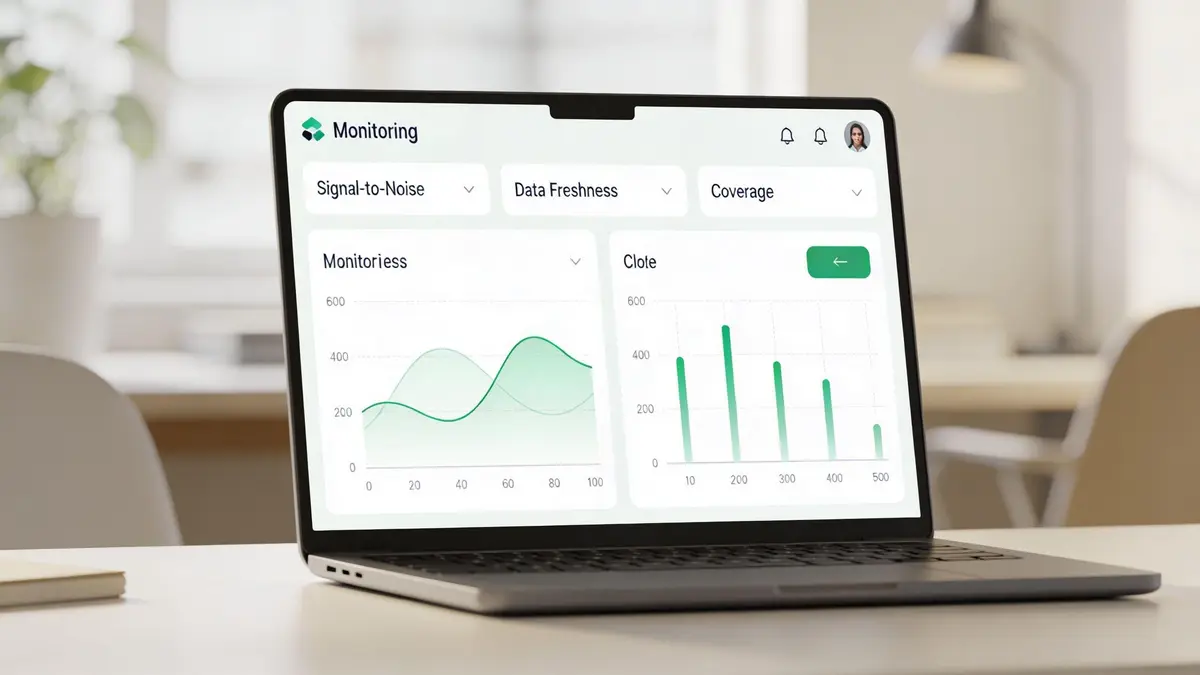
A flood of raw data is not an asset; it is a liability that can paralyze a response team.
The value of a dark web alert decays rapidly. This brings us to the second critical metric: data freshness. This is the time gap between your information appearing on the dark web and your receiving an alert. An alert about a credential leak from three weeks ago is not actionable intelligence; it is a historical record of a breach you may already know about.
Push vendors for specifics. How often do they crawl sources? More importantly, how quickly do they process data from a fresh infostealer log compared to a post on a public forum? A delay of even a few hours can mean the difference between stopping an attack and managing a full-blown incident.
A valuable alert is not just a raw data point. It is a contextualized piece of intelligence that identifies the source of the leak, the specific assets at risk, and the immediate recommended action. Anything less forces your team to conduct the investigation that the software should have handled.
Finally, consider breadth of coverage. This is not a numbers game about how many forums a tool scans. It is about which forums, marketplaces, and private channels it can access. As discussed, many automated tools are blind to the closed, vetted communities where the most damaging data is often sold first.
Real coverage requires access to these hard-to-reach sources, which almost always necessitates human intelligence operators, not just automated web crawlers. Understanding these differences is as vital as having a broader strategy for your overall reputation monitoring to protect your complete digital footprint.
Turning an Automated Alert Into Decisive Action
Receiving an alert from a dark web monitoring software platform is not the end of a problem. It is the beginning. It is the starting gun for a high-stakes race against financial loss and severe reputational damage. The greatest mistake is assuming the tool has solved the issue. The moment you confirm that sensitive data is exposed (whether an executive’s password, a confidential M&A document, or a client’s private information) you must act decisively.
This is precisely where reliance on software alone falls short. The tool did its job; it found the smoke. Now, an expert must extinguish the fire.

From Detection to Resolution
A self-service tool might report that your credentials are for sale online, but it cannot navigate the murky, often quasi-legal waters required to fix the problem. Real remediation is a multi-front operation that extends far beyond a simple password reset. It is a surgical response designed to neutralize the threat before it escalates into a crisis.
An effective process must include these critical steps:
- Immediate Verification: An expert must immediately confirm the alert’s validity and understand its context. Is this a fresh leak from a high-value source, or is it old data from a past breach being recirculated? The answer dictates the response.
- Threat Containment: This involves securing compromised accounts, revoking access keys, and implementing technical measures to block active intrusion attempts.
- Content and Data Removal: When possible, specialized takedown processes are used to remove the exposed data from its source. This disrupts the criminal supply chain but requires relationships and legal leverage that software lacks.
- Reputation Management: This involves proactive steps to control the narrative, prevent impersonation, and protect both personal and corporate brands from the fallout.
The Professional Service Imperative
The market’s obsession with early detection is clear. The global dark web monitoring market, which hit USD 1.24 billion in 2024, is projected to climb to USD 4.03 billion by 2033. As indicated by market analysis on this trend, this growth reflects a universal effort to shorten response times and reduce costs.
Yet this focus on detection tools highlights a crucial distinction: Detection is a commodity; resolution is a specialized professional service. An automated alert tells you the house is on fire. A managed remediation service dispatches the fire brigade, extinguishes the blaze, and manages the reconstruction.
For high-net-worth individuals and top executives, the stakes are too high for a DIY response. A managed remediation provider pairs technology with the legal, investigative, and strategic expertise needed to deliver a real solution. It ensures that when an alert appears, you are not just left holding a problem. You are handed a resolution.
A Framework for Selecting Your Protection Partner
Choosing the right approach to dark web monitoring is not about comparing feature lists. It is a strategic decision that hinges on a clear-eyed assessment of your risks, your team’s capabilities, and the sensitivity of your data. You are not just picking a product; you are choosing an outcome.
Begin with a blunt question: What are you truly trying to protect? Is the concern a large batch of corporate email logins, or is it about shielding a high-profile executive, and their family, from threats that could compromise personal safety and private finances? The more personal and confidential the asset, the less you can rely on mass-market automation. Discretion and expert handling become paramount.
Assessing Your Response Capacity
Imagine receiving an alert at 2 AM on a Saturday. What happens next? A self-service dark web monitoring software tool will indicate a fire but will not provide the means to extinguish it.
Do you have a dedicated, 24/7 security team ready to mobilize? A team with the experience to verify the leak, assess its severity, initiate the takedown process, and manage reputational damage? Can they do all this while navigating complex legal issues that may span multiple jurisdictions?
If that question gives you pause, or if involving internal IT and legal teams would create its own confidentiality problems, then a simple monitoring tool is insufficient. It identifies the problem but leaves the entire burden of solving it on your shoulders.
The decision boils down to this: Are you buying a tool, or are you hiring a team? A tool provides data. A team delivers a guaranteed result, handling every step from verification to neutralization with the speed and confidentiality your situation demands.
For anyone whose personal and professional lives are deeply intertwined, where a data leak could spell financial or reputational disaster, the choice is clear. You do not just need to know a problem exists; you need it gone. This is the point where you stop shopping for software and start looking for a firm that specializes not just in monitoring, but in definitive, confidential resolution.
Frequently Asked Questions
When considering a service like dark web monitoring, many practical questions arise. Here are some of the most common inquiries we receive from executives concerned about their personal and corporate security.
Is Dark Web Monitoring Legal for My Protection?
Yes, absolutely. Using dark web monitoring software to find your company’s or your own personal data is a perfectly legal and prudent defensive measure.
The software is simply scanning publicly accessible forums and marketplaces on the dark web for specific keywords, such as your email addresses or company name. It is the digital equivalent of searching Google for mentions of your brand, just in a much more hostile part of the internet. It is a passive intelligence-gathering process; you are not engaging in any illegal activity or hiring anyone to do so.
How Quickly Can I Expect an Alert?
The speed of an alert depends on the quality of the service. Top-tier providers can often send a notification within hours of your data appearing on a major criminal forum.
However, the most sensitive information is often first circulated in private, encrypted channels that automated tools cannot reach. This is where a provider’s human intelligence network becomes crucial, as it can often uncover threats before they hit the wider dark web. To better understand provider capabilities, a good review can help you secure your digital footprint from data breaches and compare their actual performance.
When a critical alert comes in, your first step is not to investigate. It is to contain the damage. A pre-approved response team must verify the leak’s authenticity without further exposing your systems, determine the scope of the breach, and immediately secure compromised assets, such as forcing password resets for affected accounts. For our clients, that first step is simple: contact their dedicated case manager, who initiates their pre-planned remediation protocol.
When an alert signifies not just stolen data but a direct threat against your business, family, or reputation, you need more than detection. You need a resolution. ContentRemoval.com provides that certainty.
Contact us for a confidential assessment. We will demonstrate how we move from simply finding a threat to neutralizing it for good.