
A dark web monitoring service searches hidden forums, marketplaces, leak sites and encrypted channels for a client’s domains, executive names, credentials and sensitive assets, then adds human analysis to judge whether a finding is stale breach debris or a live access risk. For executives the test is how fast it moves a vague alert into containment, investigation and remediation.
Key facts
- Four risk classes: access compromise, strategic leak material, personal and family targeting, brand abuse and insider signals.
- Correlation is the product: is the password current, does the identity tie to privileged access, is extortion discussed.
- The response workflow has four stages: triage and verification, containment, investigation and assessment, remediation and takedown.
- The simplest vendor test: when you alert us, who helps decide what happens next.
Where ContentRemoval.com comes in. ContentRemoval.com combines dark web monitoring with the remediation that standalone alerting leaves out: source-level takedowns of exposed material, de-indexing, impersonation and domain abuse handling, and watchlists for reappearance, coordinated with counsel and the security team. Executive assistants, chiefs of staff and family office heads often make the first call after an unexplained alert. A free 15-minute Exposure Scan sorts noise from material threat, and the report is yours to keep. Get a Free, Confidential Exposure Scan or read how our personal data removal work is done.
You receive an alert late at night. Your corporate email domain has appeared in a dark web feed. The notice is thin on detail, heavy on alarm, and useless on next steps. Was this recycled breach debris from years ago, or fresh access data tied to a current compromise? Does it affect one employee, your executive team, your family office, or your personal accounts?
That uncertainty is the core problem. Senior people rarely suffer from lack of alerts. They suffer from vague alerts, fragmented responsibility, and slow decisions. A dark web monitoring service only matters if it helps you classify the threat, contain exposure, and reduce reputational damage before someone else turns leaked data into an advantage.
For high-profile individuals, this isn’t a narrow security issue. It’s an executive protection issue, a legal issue, and often a family risk issue. Credentials lead to mailbox access. Mailbox access leads to impersonation, disclosure, blackmail, and strategically timed reputational harm. By the time a public story forms, the operational failure happened much earlier.
Why Dark Web Monitoring Demands Executive Attention
A generic breach notification doesn’t answer the only question that matters. What changes now? If your name, company, or private data appears in an underground channel, you need a decision framework, not another dashboard.

Monitoring has moved into the executive risk stack
Dark web monitoring is no longer a specialist add-on for technical teams. According to CrowdStrike’s overview of dark web monitoring, the Dark Web Intelligence Market was estimated at USD 520.3 million in 2023, with projections rising to USD 2,921.8 million by 2032 at a 21.8% CAGR. That kind of growth tells you how boards and leadership teams now view this category. It sits alongside brand protection, executive security, and incident response.
The practical shift is straightforward. A serious organization no longer asks whether sensitive data will circulate in criminal channels. It asks how quickly that exposure can be detected, validated, and acted on.
The wrong response is passive awareness
Many executives assume monitoring is enough. It isn’t. If an alert lands and nobody can answer whether the exposure is current, whether access remains active, or whether the issue affects your household as well as your enterprise, you’ve bought visibility without protection.
Practical rule: If a service can tell you that data was found but can’t tell you what must happen in the next hour, it isn’t a complete risk-control function.
This is the same budgeting problem many leadership teams face with broader digital risk controls. The cost question only makes sense when tied to consequence, decision speed, and remediation. That’s the logic behind this strategic framework for executives assessing online monitoring costs.
A proper dark web monitoring service should be judged by one standard. It must shorten the path from uncertainty to action.
Defining the Unseen Threat Landscape
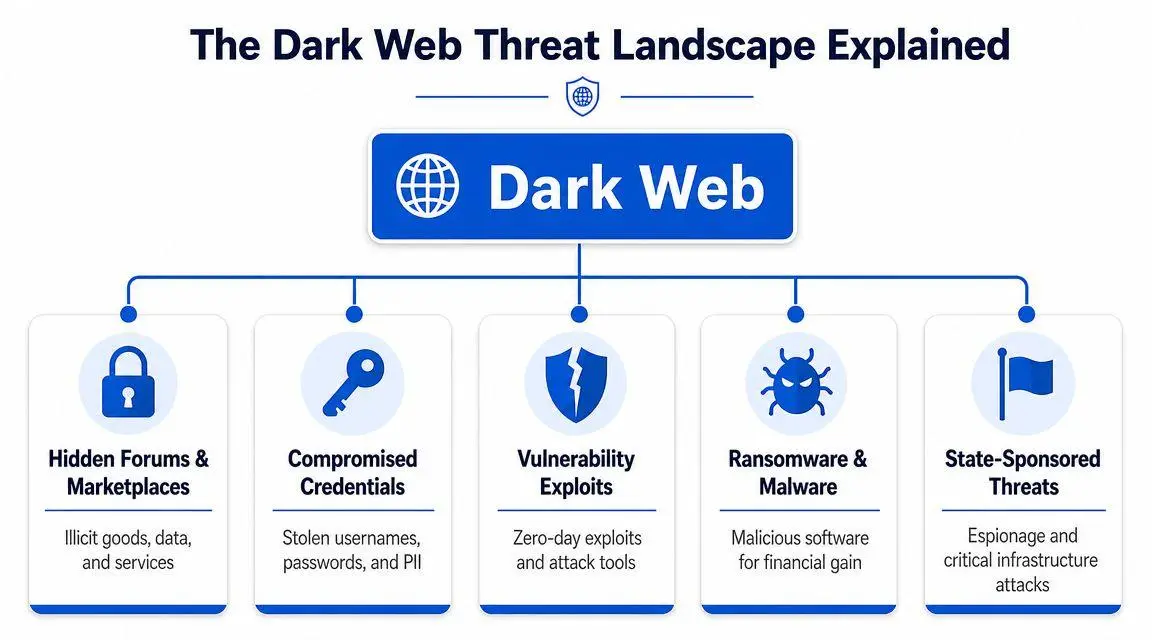
Executives often hear “dark web” and picture a single hidden website. That’s the wrong model. Instead, it’s an ecosystem of closed forums, criminal marketplaces, breach repositories, paste sites, and encrypted chat communities where data is traded, discussed, verified, and weaponized.
The scale is not theoretical
The threat surface is large enough that casual monitoring won’t do. Market.us reported around 30,000 active hidden services, more than 2.5 million daily visitors in 2023, and an estimated 60% of dark web websites involved in illegal activity. The same source stated that compromised credentials available on the dark web exceeded 15 billion as of 2021, as summarized in these dark web statistics from Market.us.
For an executive, those numbers matter for one reason. They explain why your exposure doesn’t remain confined to the original breach event. Once credentials, inbox data, internal files, or personal identifiers enter this ecosystem, they can be copied, repackaged, and resold across multiple channels.
What this landscape means for a high-profile target
A family office principal and a public company CEO face different public pressures, but their risk map overlaps:
- Compromised credentials: Corporate logins, personal accounts, and assistant-managed accounts can all appear in breach compilations or criminal listings.
- Sensitive communications: Mailbox content, attachment metadata, and contact lists can support extortion or targeted impersonation.
- Internal business material: Deal documents, cap tables, legal drafts, board materials, and strategic plans attract both opportunists and competitors.
- Personal exposure: Home addresses, family identifiers, travel patterns, and private numbers can migrate from breach data into doxing campaigns.
If your team stores machine credentials badly, your exposure widens fast. Executives who want a concise technical refresher should review this piece on managing API secrets, because leaked keys and tokens create a different class of access problem than ordinary password reuse.
The dark web isn’t one place you inspect once. It’s a moving market where stale data, fresh theft, and targeted abuse coexist.
That is why broad language about “monitoring for leaked data” isn’t enough. You need to know which channels matter, which exposures create immediate risk, and which findings are mere noise.
How a Professional Dark Web Monitoring Service Works
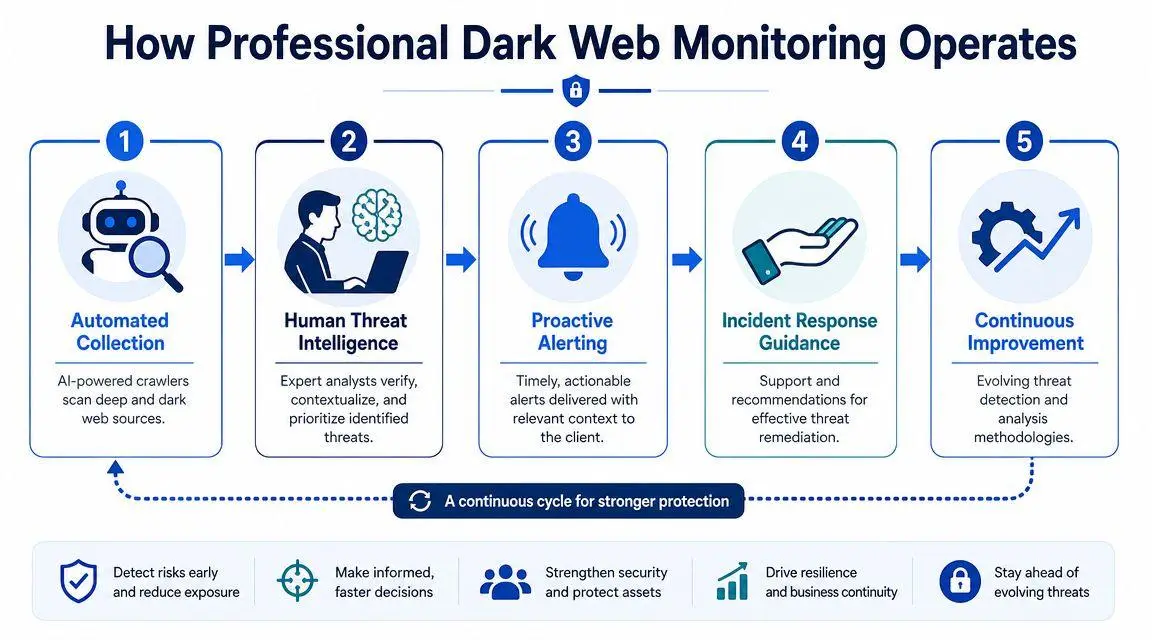
A commodity alerting tool searches for a domain or an email address and forwards a match. A professional dark web monitoring service does more. It collects, verifies, enriches, and prioritizes. That difference is what separates signal from panic.
Automation gathers the volume
At scale, collection has to be automated. Monitoring systems continuously search hidden forums, marketplaces, leak sites, and related channels for references to domains, executive names, email patterns, credentials, and sensitive assets. CrowdStrike notes that these tools continuously search millions of sites and can feed results into broader threat-intelligence systems, which is why enterprises use them for early warning.
Automation is necessary, but it’s only the first layer. Machines can retrieve data. They can’t reliably tell you whether a mention is harmless chatter, recycled breach material, or an active threat tied to your environment.
A short overview is useful here:
Human intelligence decides what matters
The quality layer is human analysis. Analysts review findings, assess source credibility, identify duplication, and connect the raw material to actual business risk. This matters most in closed communities, invitation-only channels, and contexts where criminal slang, partial screenshots, or coded references obscure the meaning.
Recorded Future puts the core point well in its discussion of dark web monitoring. Effective systems add value by correlating raw forum and marketplace findings with a client’s specific assets and threat context, which is essential for determining whether a mention is benign or a material compromise requiring immediate response.
That correlation step is where serious providers earn their fee.
Correlation is the product
If an analyst sees an executive email in a dump, that alone tells you very little. The question set is broader:
- Is the password current or obviously old
- Does the same identity appear alongside tokens, API keys, or internal references
- Is the source known for fresh theft, resale, or recycled breach material
- Does the identity tie back to privileged access, assistants, counsel, or family members
- Is the mention paired with extortion, impersonation, or leak-site discussion
A real service should also translate findings into plain business consequences. One option in this category is ContentRemoval.com, which offers dark web monitoring and removal support for exposed information. That type of combined monitoring and remediation model is more useful than standalone alerting because high-profile clients rarely need one without the other.
If your provider cannot distinguish a stale credential dump from a live access risk, you’re not buying intelligence. You’re buying anxiety.
Critical Risks a Monitoring Service Detects
The term “exposed data” is too vague to help an executive act. What matters is the class of exposure and the likely consequence. Some findings trigger a password reset. Others trigger legal intervention, executive protection measures, or a reputational containment plan.
Access compromise
The most urgent category is unauthorized access material. That includes employee and executive credentials, admin logins, session artifacts, and secret-bearing data that can open systems or cloud services.
The danger isn’t just account takeover. Once an attacker reaches an inbox or collaboration platform, they can impersonate leadership, harvest additional contacts, and time disclosures for maximum pressure. For a public-facing executive, private and corporate accounts often intersect through assistants, shared workflows, and travel logistics. Attackers know that.
Strategic leak material
A second category involves business documents that alter negotiation advantage or public perception. Draft agreements, investor communications, internal complaints, board materials, and pre-announcement strategy documents can all cause harm even if no system remains actively compromised.
Here the damage is often asymmetrical. A single leaked file can trigger speculation, press scrutiny, regulatory attention, or litigation positioning. Monitoring matters because early detection gives counsel and communications teams a narrow window to prepare.
Personal targeting and family exposure
For high-net-worth families and public figures, the dark web can function as a staging ground for personal threat activity. Doxing data, contact details, family information, travel references, or location clues may circulate as part of extortion attempts, grievance campaigns, or obsessive targeting.
This category is routinely underestimated because it looks less “technical.” That’s a mistake. Private information in criminal channels can migrate into stalking, impersonation, swatting, or coordinated harassment.
Treat family-related exposure with the same urgency as executive credential exposure. The downstream harm can be faster and less reversible.
Brand abuse and insider signals
Some findings don’t show theft directly. They show intent. A threat actor advertises access to your company. A forum user solicits information about an executive. Someone posts internal terminology that suggests insider familiarity. A fake profile, cloned domain, or impersonation setup appears before a public scam.
These aren’t abstract intelligence artifacts. They’re early indicators. A mature monitoring service should treat them as pre-incident signals and escalate them accordingly.
Evaluating a Professional Monitoring Service
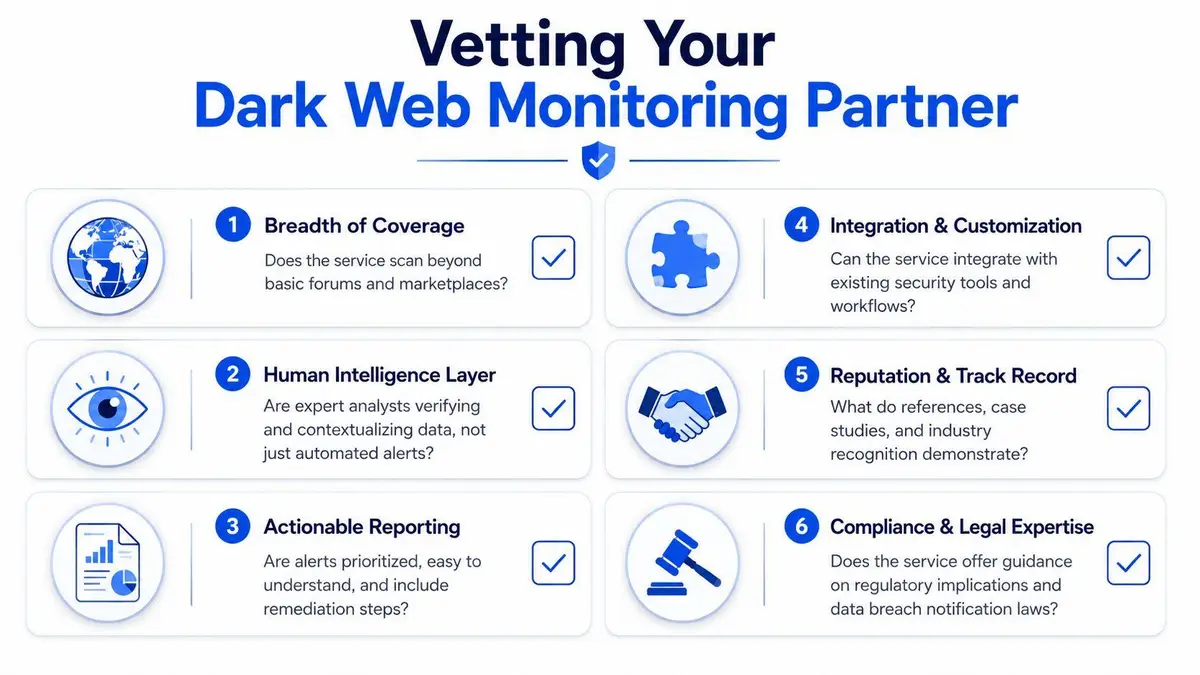
Most providers market coverage. Few explain decision quality. The right question isn’t “Do you monitor the dark web?” The right question is “Can you tell me, with clarity and speed, whether a finding requires containment, investigation, takedown, or no action at all?”
What to demand from a provider
A serious provider should meet several essential standards.
- Broad source coverage: The service should monitor beyond basic hidden sites. Criminal activity moves across forums, marketplaces, paste sites, and encrypted channels such as Telegram.
- Human verification: Automated scraping without analyst review produces clutter. You need context, source assessment, and prioritization.
- Operational reporting: Alerts should explain impact in executive language, not just dump raw findings into a portal.
- Remediation capability: Detection without post-alert support leaves the most important work unfinished.
- Discretion: High-profile matters require strict confidentiality, careful handling of personal identifiers, and controlled communications.
- Workflow fit: Your provider should coordinate with counsel, security, communications, and executive assistants. That’s how response happens.
For broader brand and executive oversight, many clients pair dark web detection with a dedicated reputation monitoring program, because underground exposure and public narrative risk often converge.
Key evaluation criteria for a monitoring service
| Criterion | Why It Matters | What to Look For |
|---|---|---|
| Breadth of coverage | Narrow collection misses meaningful exposure | Monitoring across forums, marketplaces, paste sites, and encrypted criminal channels |
| Human intelligence layer | Raw matches create false urgency | Analyst validation, context, and prioritization |
| Actionable reporting | Executives need decisions, not technical clutter | Plain-language alerts with clear next steps |
| Integration and customization | Findings must move into existing workflows | Coordination with legal, security, and leadership response teams |
| Reputation and track record | Sensitive matters require trust | Evidence of discreet handling and mature escalation practices |
| Compliance and legal expertise | Mishandled response can create new liability | Guidance that respects privacy, jurisdiction, and breach obligations |
The simplest vendor test
Ask one practical question: “When you alert us, who helps decide what happens next?”
If the answer is a dashboard, keep looking.
From Alert to Remediation Your Response Workflow
Many services fall short. They detect. They notify. Then they stop. Wiz has noted this market gap directly in its analysis of dark web monitoring: the core issue is not visibility alone, but which exposures are actionable, how fast teams must respond, and what remediation steps reduce risk rather than add alert fatigue.
A professional workflow should move through four stages. Each has a different owner and a different time horizon.
Triage and verification
The first task is to establish whether the alert is real, current, and relevant. That means validating the source, identifying the exposed asset, and confirming whether the data maps to an active account, person, or system.
At this stage, avoid two common mistakes. Don’t dismiss the alert because it looks messy, and don’t trigger a full-scale crisis response before basic verification. Good triage narrows uncertainty fast.
Containment and mitigation
If the exposure is actionable, containment starts immediately. That can include credential resets, token revocation, account review, device checks, privileged-access review, and protective measures around executive and family accounts.
This step isn’t purely technical. It may also require communications lockdown, assistant briefing, vendor outreach, or law firm coordination. If the exposure carries reputational implications, teams should also review the public-facing implications in parallel. This guide on handling reputational damage from a data breach is useful because the legal, operational, and narrative tracks need to run together.
Investigation and assessment
Containment closes the immediate window. It doesn’t explain the underlying issue. Investigation should answer where the data came from, whether the compromise is isolated or systemic, and who else may be affected.
Use a disciplined assessment structure:
- Origin review: Determine whether the data stems from a known breach, malware infection, insider activity, or third-party compromise.
- Exposure mapping: Identify every account, person, document set, or environment tied to the finding.
- Impact review: Assess legal, operational, financial, and reputational consequences.
- Escalation decision: Decide whether counsel, law enforcement, insurers, or executive protection teams need to engage.
A dark web alert is rarely the whole incident. It’s usually the first visible artifact of a larger chain.
Remediation and takedown
The final stage is where risk is reduced. Depending on the case, remediation may involve removing exposed content where possible, pursuing source-level takedowns, documenting evidence, notifying affected parties, tightening access controls, and building watchlists for reappearance.
For executives and public figures, this often extends beyond system hygiene. If leaked data supports impersonation, blackmail, or online harassment, remediation should include domain abuse review, platform complaints, search-index management, and reputation containment planning. The goal isn’t only to close access. It’s to reduce the adversary’s practical advantage.
Legal Considerations and Your Confidential Assessment
Dark web monitoring touches privacy, employment, evidence handling, and jurisdiction. A clumsy provider can create legal exposure while trying to solve a security problem. Monitoring employee-related data, preserving evidence for potential claims, coordinating with counsel, and pursuing removals all require care.
That is why you should avoid firms that treat this as a purely technical feed. The work sits at the intersection of intelligence, law, reputation, and discretion. High-value matters often involve multilingual records, foreign hosts, and sensitive personal documents. When those materials need cross-border handling, secure chain-of-custody practices matter. For readers dealing with multilingual evidence or sensitive records, this guide to secure language solutions is a useful reference.
My advice is simple. Don’t wait for a vague alert to become a public problem. Put a response structure in place before you need it. The right partner won’t just tell you what surfaced. They’ll tell you what to verify, what to contain, what to remove, and what to prepare for next.
If you’re dealing with executive exposure, leaked credentials, impersonation risk, or sensitive data appearing in underground channels, ContentRemoval.com can start with a confidential assessment of your risk profile and response options. The objective is clear. Determine whether the alert is noise or a material threat, then move quickly on containment, removal, and reputation protection.
Frequently asked questions
What does a dark web monitoring service do that a breach alert tool does not?
It verifies, enriches and prioritizes. Analysts assess source credibility, remove duplicates and connect raw mentions to actual assets and threat context, so you know whether a finding is recycled breach data or a live compromise needing action in the next hour.
What should happen after a dark web alert about an executive?
Triage whether it is real, current and relevant, then contain: credential resets, token revocation, account and device review, protective measures for executive and family accounts, and communications lockdown. Investigation and remediation, including takedowns and search-index management, follow.
Is family information on the dark web as serious as leaked credentials?
Yes. Doxing data, contact details, travel references and location clues can migrate into stalking, impersonation, swatting or coordinated harassment. Treat family exposure with the same urgency as executive credential exposure; the downstream harm can be faster and less reversible.