
Free dark web monitoring checks whether a submitted email, phone or password appears in known breach datasets and sends simple match alerts. It confirms past exposure but does not watch private forums or closed channels, judge whether data is fresh or weaponized, or remove anything. For executives and family offices it is a trigger for action, not a security strategy.
Key facts
- A clean result means only that the tool did not find that identifier in the datasets it can access.
- Executive risk comes from aggregation: breached inbox, old passwords, phone numbers, staff details and property records combined.
- Monitoring tools find leaked data; they do not remove it or prevent it being used, per Fortinet.
- DIY posture checks: rotate reused passwords, enforce MFA, audit sessions, recovery emails, forwarding rules and delegates.
Where ContentRemoval.com comes in. When a free scan turns up a match and the next question is what someone can do with it, ContentRemoval.com takes over: source-level takedown attempts, de-indexing of exposed URLs, impersonation reporting and monitoring for material that keeps resurfacing. A chief of staff or family office manager usually makes the call after the midnight search. A free 15-minute Exposure Scan maps what is exposed across breach data, search and brokers, and the report is yours to keep. Get a Free, Confidential Exposure Scan or read how our personal data removal work is done.
At 11:40 p.m., an executive gets a message from legal. A credential dump has surfaced. Someone on the team found a personal email address tied to old login data, and now the obvious search begins: dark web monitoring free.
That instinct is reasonable. If your name, email, phone number, or a family office domain may be circulating in criminal channels, you want an immediate answer. You want a scan, a result, and preferably reassurance.
For a high-net-worth individual, that reassurance is often misplaced. The issue isn’t whether free dark web monitoring has any value. It does. The issue is whether it matches your risk profile. If your exposure can trigger account takeover, impersonation, extortion pressure, corporate intrusion, or family targeting, a free scan is not a security strategy. It’s a first look at a much larger problem.
The Initial Search for Answers
The search usually starts in a hurry. A chief of staff checks Have I Been Pwned. An assistant runs a free scan. The principal wants a quick yes or no before midnight.
That response is reasonable. It is also incomplete.
For a high-profile executive, family office principal, or public-facing investor, exposure is rarely limited to one email address showing up in an old breach corpus. The primary risk is aggregation. Criminal buyers combine a breached inbox, prior passwords, phone numbers, executive assistant details, property records, travel clues, and vendor relationships into a usable targeting package. That is how a minor-looking leak turns into account takeover, impersonation, extortion pressure, or a customized intrusion against the company.
Why the search for a free answer happens
People reach for free monitoring because they want speed, privacy, and a low-friction first check. They are trying to answer one immediate question. Has any of my information already surfaced in places it should not be?
That instinct makes sense. The volume of stolen credentials and exposed personal data online is large enough that a quick screening step feels prudent. For lower-risk consumers, it often is.
For high-risk clients, the mistake is not using a free tool. The mistake is treating it like a decision engine.
Immediate rule: If you are a public-facing executive or principal, use free monitoring to confirm exposure, not to assess risk.
What you need to know is more operational. Which identities are exposed. Whether the exposed data is current, stale, or enriched. Whether it creates a path into personal accounts, staff accounts, or corporate systems. Who needs to act tonight. Free tools rarely answer those questions with enough depth to guide containment.
Many bad decisions start in that gap. A clean result can create false reassurance. A positive result can trigger panic without giving you a remediation path.
What Free Dark Web Monitoring Actually Does
A free dark web scan answers a narrow question. Has a specific identifier already shown up in breach data that someone has indexed and made searchable?
That is useful, but only at the first-pass level.
Free services usually check known breach repositories for an email address, phone number, password, or other submitted identifier. They are built for lookup, not for protective operations. If you are a high-profile individual, that distinction matters because your risk rarely comes from one exposed field in isolation. It comes from correlation. An old email, a mobile number, public property data, and staff contact details can be tied together into a targeting profile long before a basic free alert reflects the problem.
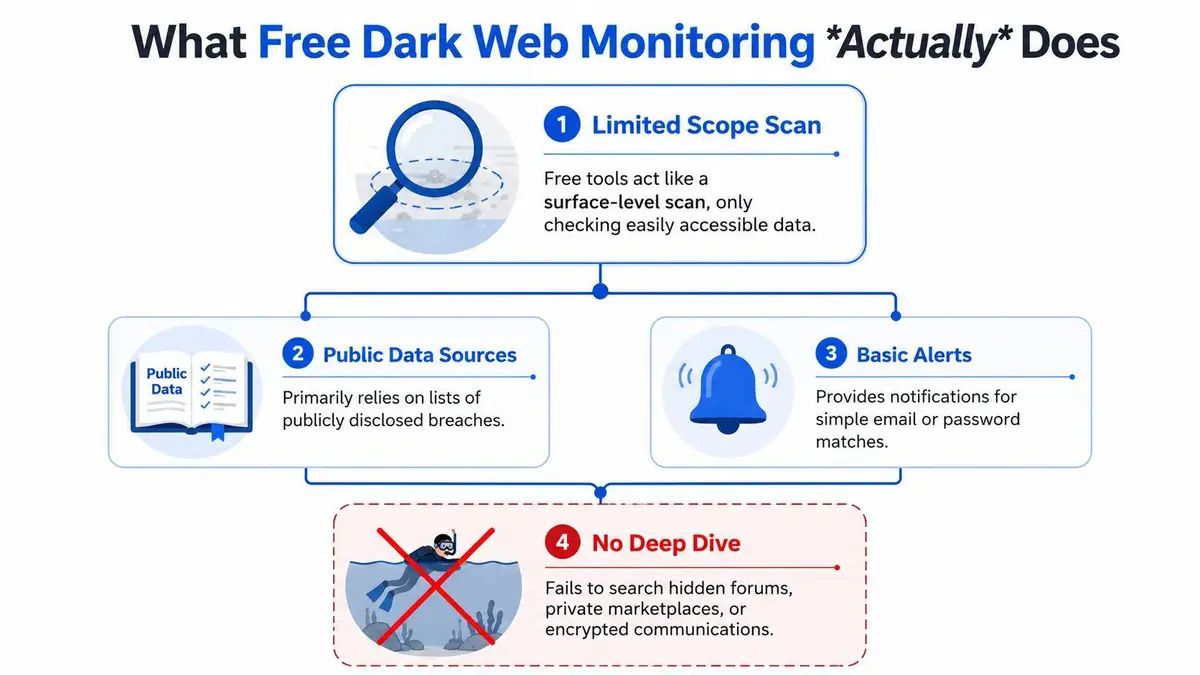
For that reason, free monitoring works more like a breach record check than an active security function. It can confirm prior exposure. It does not tell you who is using the data, whether the record is being repackaged with fresh context, or whether the exposed identifier now connects to your residence, family office, travel patterns, or support staff. That last point is where executive risk escalates. Data broker records often fill those gaps, which is why reviewing how data brokers expose executive privacy and security risks belongs in the same conversation.
Some free services also send simple alerts when they detect a new match tied to the identifiers you entered. That can help with basic hygiene. You reset credentials, tighten MFA, review account recovery settings, and watch for fraud. Those are sensible steps. They are not a full exposure assessment.
It checks for matches, not intent
The output from free monitoring is usually narrow:
- Match found: Your submitted identifier appears in a known exposed dataset.
- No match found: The service did not find that identifier in the sources it can search.
- Basic alerting: The provider notifies you when it sees another matching record in its monitored data.
That output has value. It gives you evidence that an identifier needs attention.
It does not explain whether criminals are discussing you by alias, trading a package tied to your assistant or estate manager, or testing account recovery flows against services linked to your number. It also does not account for temporary numbers and burner accounts that can be used in impersonation and sign-up fraud. If you want context on how easily those numbers can be obtained, review your 2026 guide to free virtual numbers.
| What free tools usually do | What they usually do not do |
|---|---|
| Check known breach records for submitted identifiers | Monitor multiple private markets and closed channels in depth |
| Alert on simple matches | Assess whether the exposure is current, enriched, or being weaponized |
| Confirm that data appeared in past exposed datasets | Remove data from source locations or suppress redistribution |
| Support basic user triage | Run remediation across personal, staff, and corporate exposure points |
A free scan is a historical lookup with light alerting. It is not an executive protection capability.
Use it as a trigger for action, not as proof that your exposure is understood. For low-risk consumers, that distinction may be academic. For executives, founders, family offices, and public figures, it is the difference between spotting a leak and managing a live threat.
The Critical Limitations of Free Monitoring
The danger with free monitoring isn’t that it’s useless. The danger is that it looks more complete than it is.
A high-risk client sees “no exposure found” and assumes safety. That conclusion is often wrong. It usually means only that the tool didn’t find your submitted identifier in the datasets it can access.
The blind spots are structural
Commercial monitoring platforms are built to scan across hidden services, private forums, invite-only markets, and encrypted channels, while many free options remain basic checks with limited coverage and manual effort, as CrowdStrike explains in its overview of dark web monitoring coverage differences. That distinction isn’t cosmetic. It’s the difference between checking archived evidence and watching active trafficking routes.
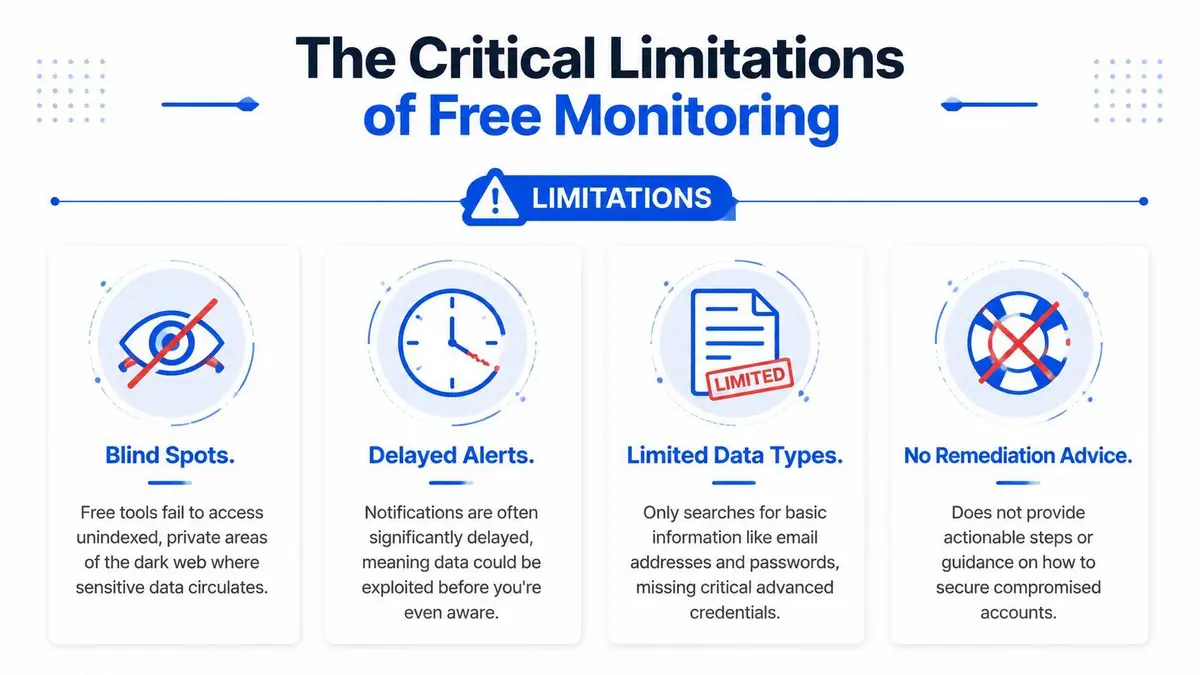
If your credential appears in a closed group before it reaches a public breach index, a free scan may show nothing. If a threat actor posts a fresh package after your one-time check, you won’t know. If your exposure is discussed indirectly through aliases, executive references, company nicknames, or supplier context, many free tools won’t surface that either.
Free monitoring answers presence, not operations
For serious risk management, you need to know more than whether data exists somewhere. You need to know:
- What kind of data is exposed. Old credential pair, current login, personal identifier, internal document, executive contact chain.
- Whether it’s fresh or recycled. Historical noise matters less than active resale.
- Who needs to act. Security, legal, communications, executive protection, private office staff.
- What can be contained immediately. Account hardening, identity verification controls, vendor warnings, takedown steps.
That’s why a free scan often creates a false plateau. It gives a result without giving an operating picture.
One practical example: many executives use alternate phone numbers to segment public-facing activity from personal communications. That can reduce casual exposure, but temporary or virtual numbers also require disciplined handling and should never be mistaken for a full privacy layer. If you’re evaluating that piece of the stack, your 2026 guide to free virtual numbers is useful for understanding the tradeoffs before you rely on one for account recovery or public registrations.
Another issue sits outside the dark web entirely. Data brokers, people-search sites, and public aggregators often make your exposure more actionable by connecting breached identifiers to real-world identity. If you haven’t mapped that terrain, review this strategic guide to what data brokers are. For executive privacy, dark web visibility without open-web exposure reduction is incomplete.
If you’re high-profile, a “clean” free scan should not lower your guard. It should raise questions about what the tool cannot see.
Actionable DIY Security Posture Checks
A disciplined client can do useful work before bringing in a specialist. Not enough to solve the problem, but enough to expose weak points and reduce immediate risk.
Start with your own identity surface
Run deliberate searches for your name, personal email variants, company email patterns, family office references, and phone numbers. Add combinations with terms such as “password,” “leak,” “login,” “dump,” “forum,” and brand names associated with your vendors. This won’t reveal hidden-channel activity, but it often exposes cached pages, scraped data, and reposted breach artifacts.
Set alerts for your name, company, board role, and key executives. Not because alerts are complex, but because they catch lazy reuse by impersonators and opportunists.
Review the systems attackers prefer
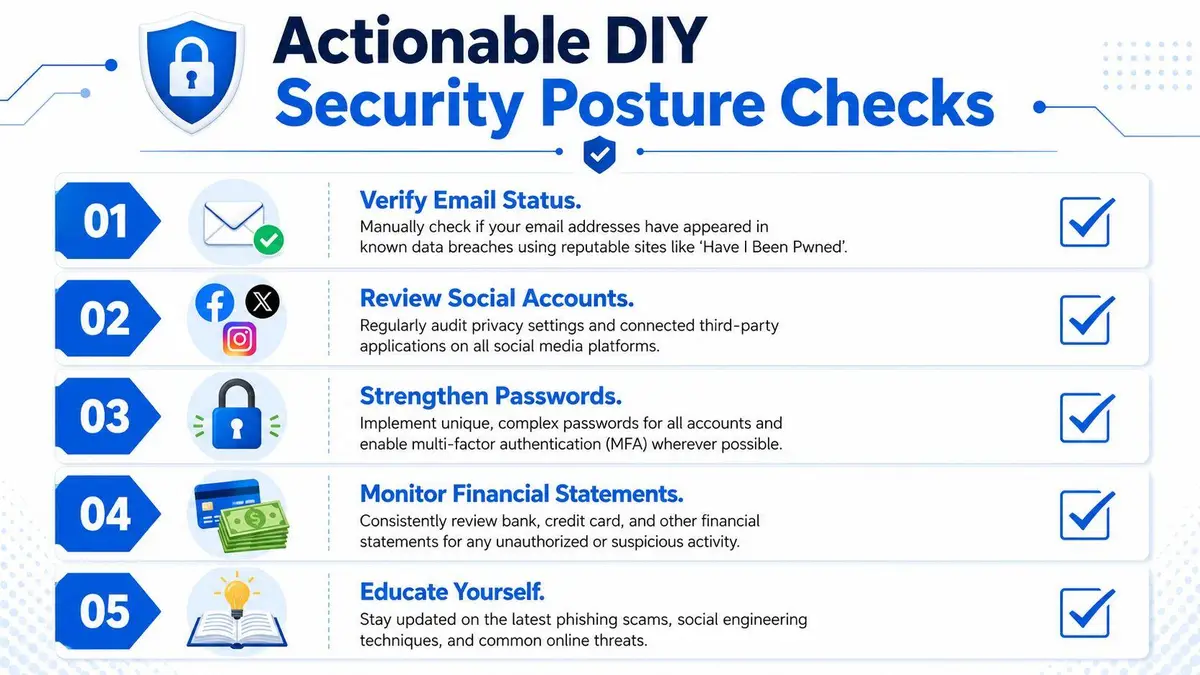
Check account security logs in Google, Microsoft 365, Apple, banking apps, social platforms, and your password manager. You’re looking for strange devices, unfamiliar sessions, unexpected recovery changes, and MFA prompts you didn’t initiate.
Then review website and publishing systems linked to your identity. A neglected personal site, foundation site, or family office WordPress install can become the pivot point for impersonation, malware, or email compromise. For a concise baseline, this roundup of WordPress security best practices is worth applying if any part of your public footprint runs on WordPress.
Treat hygiene as triage, not closure
Use reputable breach-check tools to verify whether your key email addresses have appeared in known incidents. Rotate passwords that were ever reused. Enforce MFA on every account that supports it. Remove unused third-party app connections. Audit who has delegate access to your email and calendar.
If exposed information is already visible in search, cached pages, or profile aggregators, that needs a different response path. This guide to removing personal information from Google after a data breach is a practical reference for that stage.
Baseline standard: If you can’t explain every active session, recovery email, forwarding rule, and delegated mailbox permission attached to your accounts, your posture is not under control.
These checks are worthwhile. They are not monitoring. They are hygiene.
Executive Risk Exposure What Is at Stake
A consumer breach is inconvenient. An executive breach is operational.
That difference gets missed in most discussions of dark web monitoring free because the advice is written for average users. Your problem is not average if attackers can tie a compromised credential to a public identity, a board seat, a corporate role, a known residence pattern, or family members.

Why executive exposure escalates quickly
Free offerings are usually geared toward personal one-time scans, while business-grade tools monitor broader assets such as domains, executive identities, and IPs. CBC’s reporting on Google’s free rollout captures the core gap: a single free scan can tell you about past presence, but it can miss credentials posted later and doesn’t provide ongoing exposure coverage across corporate assets, as outlined in this report on the difference between personal and corporate monitoring.
For an executive, the consequences branch immediately:
- Spear-phishing gets sharper. Attackers use leaked identifiers to craft messages that look routine, personal, and urgent.
- Impersonation gets more believable. A compromised phone number, alternate email, or assistant’s contact trail can support fake requests to banks, staff, journalists, or vendors.
- Corporate access pressure rises. Personal account exposure often becomes the route into business systems through password reuse, recovery workflows, or trusted contacts.
- Family and residence risk increases. Exposure isn’t only financial. It can become a personal safety matter when public and private details are stitched together.
The damage is often indirect before it is obvious
An executive rarely sees the first move. The first visible event may be a supplier invoice change request, a spoofed media inquiry, a suspicious wire instruction, or a fake social account using real biographical details. By then, the original exposure has already been operationalized.
That’s why incident response for high-profile individuals needs legal, communications, security, and reputation coordination. A single credential leak can feed multiple attack paths at once.
A brief primer can help clarify how criminal markets think about this ecosystem before you choose a response model.
What a serious client should assume
Assume attackers correlate data. Assume they test old credentials. Assume they review your public footprint. Assume they look for the fastest path to authority, access, money, or advantage.
The correct question isn’t “Was my email found?” It’s “What can someone credible do with the data tied to my identity right now?”
That is why free scanning remains a starting point, not a defense model.
Engaging Professional Monitoring and Remediation
The right time to escalate is earlier than most clients think. If you’re a public figure, senior executive, family office principal, or the visible face of a company, you shouldn’t wait for account fraud or extortion contact before engaging professional support.
Fortinet is blunt on the point that matters most: dark web monitoring tools are designed to find stolen or leaked information, but they do not take any action to remove your information from the dark web and cannot prevent stolen information from being used, as Fortinet states in its explanation of what dark web monitoring can and cannot do. That is the line free services never cross. Detection is not remediation.
What professional-grade response actually includes
A serious service isn’t just a scanner. It should include continuous collection across relevant sources, analyst review to separate stale noise from current risk, and a response plan tied to the type of exposure.
That response may involve account hardening, executive identity monitoring, source-level takedown attempts, de-indexing harmful URLs, impersonation reporting, platform escalation, evidence preservation, legal coordination, and longer-term suppression of exposed material that keeps resurfacing in search and social channels.
When to stop experimenting and engage specialists
Bring in professional monitoring and remediation if any of these apply:
- You hold a visible leadership role and your name can move markets, litigation, or press attention.
- Your household or staff manages sensitive logistics such as travel, residences, children, domestic employees, or private office operations.
- Your exposure includes more than one channel, such as breaches plus search visibility plus impersonation plus data broker listings.
- You need action after detection, not another alert.
For clients who need that integrated response, ContentRemoval.com frames the issue correctly: the cost question isn’t whether monitoring is cheap, but whether the response model is proportionate to executive risk. That’s the decision.
Free dark web monitoring can tell you whether smoke exists. It won’t investigate the fire, contain it, or clean the building.
If your name, family, or company carries outsized risk, a free scan isn’t enough. ContentRemoval.com works with executives, public figures, family offices, and legal teams on confidential exposure response, including monitoring, takedown strategy, de-indexing, impersonation removal, and remediation planning when leaked information starts affecting real-world security.
Frequently asked questions
Is free dark web monitoring good enough?
For low-risk consumers, often yes as a first check. For public-facing executives, principals and family offices, it confirms exposure without assessing risk, because it cannot see closed channels, fresh packages or indirect references by alias, and it offers no remediation.
What does it mean if a dark web scan finds my email?
It means that identifier appeared in a known exposed dataset. Reset that credential anywhere it was reused, tighten MFA and recovery settings, then ask the harder question: what can someone credible do with the data tied to your identity right now.
What can a professional dark web service do that free tools cannot?
Continuous collection across relevant sources, analyst review to separate stale noise from live risk, and a response plan: account hardening, source takedowns, de-indexing, impersonation reporting, evidence preservation, legal coordination and suppression of material that resurfaces.