
Dark web monitoring for MSPs is a managed risk service, not a credential alert feed. A defensible offering scopes monitoring to executive identities, domains, financial references and sector chatter, runs collection, enrichment and integration layers that filter 30 to 60 percent noise, prices by obligation rather than scan, and includes an incident playbook with pre-agreed legal and takedown escalation paths.
Key facts
- Monitor domains, IP ranges, corporate financial information, PII and industry chatter, not just employee email addresses.
- Three tiers work: embedded monitoring, an executive risk tier, and a crisis response tier with takedown coordination.
- Pilot with real authorized client assets and judge alert specificity and next-step guidance, not dashboard polish.
- First hour: validate the artifact, classify impact, brief the decision-maker, shut damage paths, preserve evidence.
Where ContentRemoval.com comes in. ContentRemoval.com is the named external escalation path an MSP can put in its playbook: when exposed personal data, leaked documents or executive material needs takedown, de-indexing or repeat-post monitoring beyond the security stack, the firm handles it under the MSP’s client relationship. MSP owners and service delivery leads set this up in advance, or call mid-incident. A free 15-minute Exposure Scan maps what is exposed and removable, and the report is yours to keep. Get a Free, Confidential Exposure Scan or read how our personal data removal work is done.
A client has just forwarded your team a screenshot from a breach marketplace. Their executive assistant’s email is listed. So is a password. There’s a file name that looks like a board pack, and a thread discussing the client’s upcoming transaction. They aren’t calling for a dashboard update. They want to know three things immediately. Is it real, how bad is it, and what are you doing about it right now.
That call is the reason dark web monitoring for MSPs can’t sit inside a commodity security bundle with a few recycled alerts and a password-reset script. If your firm serves executives, family offices, regulated businesses, professional practices, or companies with reputational exposure, monitoring is no longer a peripheral feature. It’s part of your duty of care.
Most MSPs still treat dark web findings as an IT event. That’s too narrow. A compromised executive credential can become a wire fraud attempt. A leaked internal memo can become a legal problem. A personal identifier tied to a principal or family member can become harassment, impersonation, or extortion. Once you see the issue clearly, the service has to be designed around liability, escalation, and remediation, not just detection.
The Inevitable Client Call

The weak MSP response sounds familiar. “We’ve identified exposure. Please rotate passwords, review MFA, and let us know if you need anything further.” That answer might satisfy a low-risk account. It won’t satisfy a board member, a founder in the middle of a transaction, or counsel managing a breach response under deadline.
What the client actually hears
They hear that you found a problem but don’t own the outcome. They hear that your monitoring stack can detect exposure, but your operating model stops where the actual commercial risk starts.
That gap is getting harder to defend. The dark web intelligence category isn’t niche anymore. The global dark web intelligence market was valued at approximately $0.76 billion in 2025 and is projected to grow at a compound annual growth rate of around 21.4% from 2025 to 2034, reaching an estimated value of roughly $1.66 billion, according to industry analysis on dark web monitoring importance. Buyers don’t fund that growth because they enjoy more alerts. They fund it because exposed data now sits inside the mainstream threat and reputational environment.
Practical rule: If your client would call you first when their data appears on the dark web, you need a response model, not a monitoring checkbox.
Why this is now a commercial issue
Executives buy premium MSP relationships to transfer anxiety and operational burden. They expect judgment. They expect escalation discipline. They expect you to know when a technical issue has become a legal, reputational, or personal security matter.
That changes how dark web monitoring for MSP should be sold internally and externally. Internally, it belongs with risk management and incident handling, not only with endpoint and identity tooling. Externally, it should be framed as a client retention and liability control service. If you don’t offer it competently, a more capable provider will. If you offer it badly, you’ll still own the blame.
The standard has moved
The old model was enough when buyers thought dark web monitoring meant “tell me if my password is in a dump.” The current expectation is broader. Clients want informed triage, clear remediation sequencing, and help containing downstream harm.
That’s the prevailing standard now. An MSP that can’t answer the inevitable client call with precision is exposed twice. First through the client’s incident. Then through its own failure to deliver the service the client assumed it had bought.
Defining the Modern Monitoring Mandate
The common assumption is wrong. Dark web monitoring for MSPs is not a glorified breach notification feed for email addresses and passwords. That’s the public-facing version of the concept. It’s not the version that protects a law firm partner, a family office principal, or a company preparing for litigation, financing, or an acquisition.
The scope has to match the client’s risk
For high-risk clients, effective monitoring has to extend beyond email credentials. It should include domains, IP ranges, corporate financial information, personally identifiable information, and industry-specific chatter that may flag targeted attacks or credential dumps, as outlined in DarkOwl’s guidance on what an MSSP can monitor on the darknet.
That wider scope changes the service entirely. You’re no longer checking whether a user credential has surfaced. You’re watching for evidence that a client is being mapped, discussed, packaged, or positioned for exploitation.
A disciplined monitoring mandate usually covers several categories at once:
- Identity exposure: executive email addresses, aliases, personal emails used in corporate contexts, names, home addresses, and other identifiers that can support impersonation or social engineering.
- Enterprise exposure: domains, subsidiaries, public-facing assets, financial references, internal document names, and references to confidential projects.
- Threat signaling: chatter connected to the client’s sector, geography, executives, known vendors, or legal disputes.
- Reputational material: leaked files, images, or personal content that can be used to pressure, embarrass, or extort.
Credential alerts are the floor, not the service
Plenty of MSPs still package monitoring as a simple lead-generation trick. Run a scan, show a prospect exposed credentials, close the account. That may help sales, but it doesn’t build a premium service line.
If you serve verticals with broad attack surfaces, the framing has to be more mature. Teams that already manage complex environments such as IT solutions for BPOs and schools know that asset sprawl changes risk quickly. Dark web monitoring needs the same operational seriousness. The monitored footprint must reflect the client’s actual digital estate and the human beings attached to it.
Clients don’t pay serious money to learn that a password leaked. They pay to reduce the chance that a leak becomes an incident, a headline, or a claim.
What buyers want from the service
Discerning clients don’t want raw chatter. They want relevance. They want someone to distinguish between stale breach debris and a live exposure that warrants board-level attention.
That’s why the conversation should move away from “how many sources do you scan” and toward “what decisions can your team support when something appears.” A monitoring service that can’t support defensible action is a thin wrapper around noise.
For firms advising image-sensitive or legally exposed clients, the right reference point is broader online monitoring, not just cybersecurity telemetry. That’s where professional online monitoring for peace of mind becomes relevant. The point isn’t visibility alone. The point is making visibility operational.
Architecting a Defensible Monitoring Service
The architecture matters because bad architecture creates false confidence. Executives don’t care whether your crawler stack is elegant. They care whether your team can separate a real threat from recycled junk and route the right issue to the right responder fast enough to matter.
Early in vendor reviews, ask one blunt question. How does the platform turn messy underground data into a defensible alert your SOC or service desk can act on?
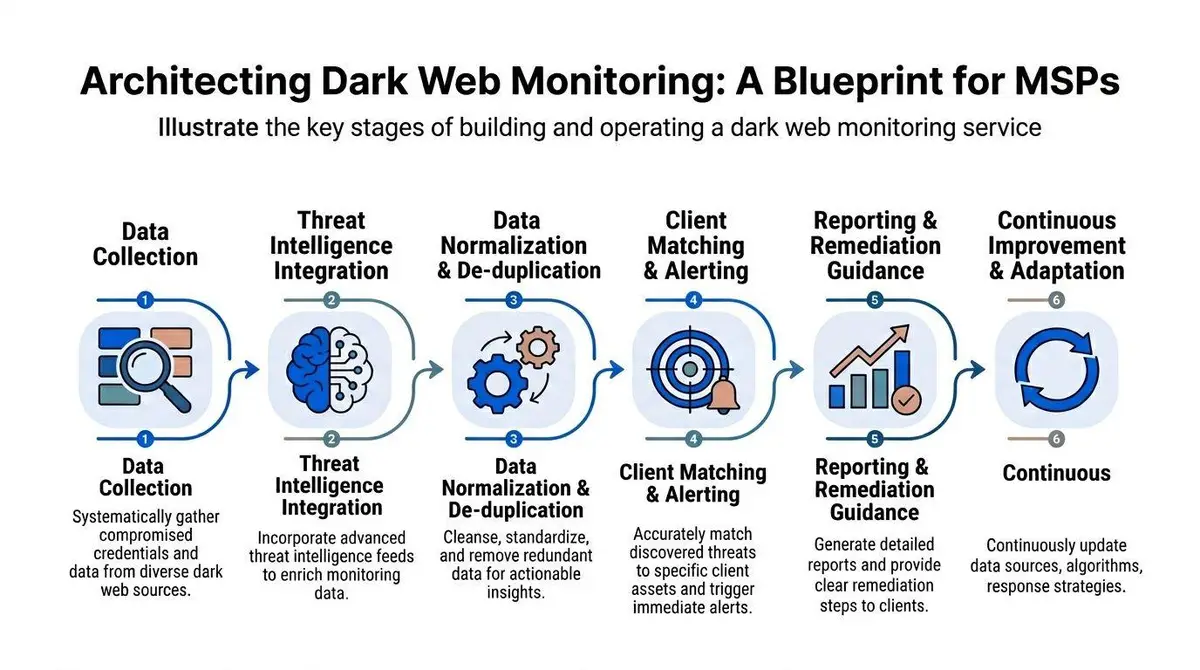
The three layers that matter
A workable service has three tightly connected layers.
First, collection. That means distributed access to dark web and deep web sources through the mechanisms serious platforms use, including Tor-based access, headless browsing, and source integrations. If collection is thin, everything downstream is compromised.
Second, normalization and enrichment. Raw material gets deduplicated, hashed, correlated, and matched against client assets. If the system doesn’t understand how a leaked credential maps to a monitored client, or how a file reference relates to a real executive or business unit, your analysts will waste time.
Third, operational integration. A good platform doesn’t stop at surfacing an alert. It pushes validated findings into the systems your team already uses, whether that’s a SOC workflow, a PSA, or a ticketing queue with escalation paths.
Noise is the real enemy
The hard part isn’t collecting dark web data. The hard part is deciding what deserves action. MSP-grade platforms process millions of dark web entries daily with noise rates of 30 to 60 percent, requiring machine-learning classifiers to prioritize high-fidelity matches like domain-specific credentials or internal IP ranges over generic mentions, as explained in Technology Marketing Toolkit’s breakdown of dark web monitoring for MSPs.
That single point should reshape how you evaluate every vendor pitch. If a partner promises broad coverage but can’t explain prioritization, triage logic, or fidelity controls, they’re selling volume, not value.
Use this table when assessing architecture:
| Layer | What good looks like | What failure looks like |
|---|---|---|
| Collection | Broad source access and steady ingestion from relevant dark web environments | Thin feeds, stale data, overreliance on licensed aggregates |
| Normalization | Clear client matching, deduplication, and context around findings | Duplicate alerts, weak asset correlation, analyst fatigue |
| Integration | Findings become tasks, incidents, or escalation events quickly | Alerts stay in a portal and die there |
A broader brand and reputation lens is often missing in technical builds. That’s why teams designing premium services should also review online brand protection services and how they support remediation workflows.
After you’ve mapped the architecture, test whether the workflow makes sense in practice.
What to insist on operationally
Ask for a live demonstration of triage, not just a portal tour. Force the platform to show how it handles a domain-specific credential, a leaked document mention, and an ambiguous reference to an executive. You want to see how the system behaves when context is messy.
If the answer to every scenario is “your analysts can investigate further,” the platform is pushing cost and risk back onto you. That isn’t partnership. It’s outsourced ingestion.
Evaluating Platforms and White-Label Partners
Most MSPs shouldn’t build this capability from scratch. They should buy it, white-label it where appropriate, and keep tight control over escalation, reporting, and client communication. The mistake is buying on coverage claims alone.
The right platform or partner is the one that strengthens your brand in front of a demanding client. The wrong one floods your team with junk, delays responses, and leaves your account managers explaining why an expensive service generated no usable advice.
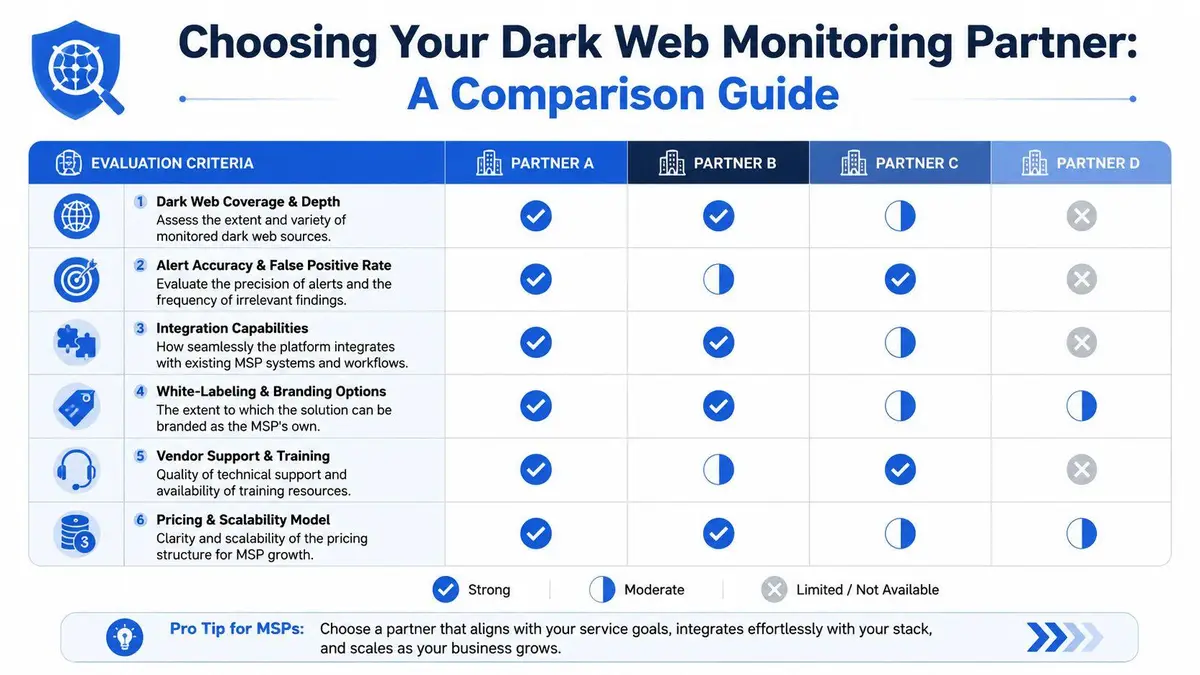
What separates a tool from a partner
The first dividing line is whether the service combines automation with analyst judgment. Such services combine algorithmic scanning with human-driven analysis to reduce false positives and provide actionable alerts, rather than merely aggregating raw dark web chatter, according to Acronis’ neutral guide to dark web monitoring tools.
That’s the baseline. From there, evaluate five issues that affect service quality immediately.
- Alert fidelity: Ask for anonymized examples of what a high-confidence alert looks like and what gets suppressed.
- Workflow fit: Demand practical integration into your existing service desk, SOC, or reporting stack.
- White-label discipline: Review whether reports, notifications, and client-facing portals can be branded cleanly without making your firm look like a reseller.
- Escalation support: Find out who helps when a finding is serious, unusual, or legally sensitive.
- Account responsiveness: Test the quality of support before you sign, not after.
Run a proof that reflects reality
Don’t run a proof-of-concept on sterile sample data. Use a limited monitored set from a real client environment with proper authorization and measure what your team receives. You’re looking for signal quality, not feature theater.
A useful pilot asks questions like these:
| Evaluation question | Why it matters |
|---|---|
| Are the findings specific to monitored assets? | Generic mentions create panic and burn analyst time |
| Does the report explain what to do next? | Clients need action, not screenshots |
| Can your team escalate fast without opening vendor tickets for everything? | Delay destroys trust |
| Does the vendor understand legal and reputational sensitivities? | Some findings require more than IT handling |
Buy the platform your service team can operate cleanly under pressure, not the one with the most dramatic product demo.
Where MSPs often get trapped
They choose the cheapest feed with the loudest dashboard. Then they discover the hidden cost. Analysts drown in irrelevance, account managers improvise explanations, and clients conclude the service is performative.
If you’re targeting premium accounts, your white-label partner has to help you look measured, discreet, and competent. A weak partner doesn’t stay in the background. It becomes visible at the worst moment.
Packaging and Pricing for High-Value Service
If you package dark web monitoring for MSP as a low-cost add-on, clients will treat it as disposable. Worse, your own team will treat it as a minor feature instead of a serious managed function. That’s the wrong commercial signal.
Sell it as a premium risk service. Price it according to monitored scope, response obligations, and the sensitivity of the client, not according to how cheaply you can buy a feed.
Bundle for ordinary accounts, separate for exposed ones
For standard commercial clients, it can sit inside a broader managed security tier if the scope is tightly defined. That works when the buyer wants predictable billing and your obligations remain limited to monitoring, triage, and standard incident guidance.
For executives, legal professionals, public figures, family offices, and image-sensitive businesses, separate packaging is stronger. It lets you define a distinct service with its own intake, monitored asset categories, notification path, and escalation rules. Clients in that bracket don’t want to discover that their personal exposure is being handled under the same assumptions as a routine SMB password leak.
A simple positioning split works well:
- Embedded monitoring tier: for standard managed security clients who need credential and asset exposure monitoring inside a broader stack.
- Executive risk tier: for high-stakes clients who need expanded monitoring, rapid triage, discreet reporting, and external escalation options.
- Crisis response tier: for clients with active exposure, urgent reputational issues, or repeat incidents requiring legal and takedown coordination.
Price the obligation, not just the scan
Three models are common in practice. Per-user pricing makes sense when the service is centered on monitored identities. Per-domain or per-entity pricing suits businesses with multiple brands, entities, or web properties. Tiered pricing by monitoring depth is often the cleanest because it aligns commercial value with actual risk coverage.
What matters is the logic behind the fee. Your margin shouldn’t come from hiding a cheap tool inside a larger invoice. It should come from managing anxiety, reducing decision time, and executing a clear escalation process when exposure appears.
Here’s the commercial difference:
| Weak offer | Strong offer |
|---|---|
| “We scan the dark web for your credentials” | “We monitor defined high-risk assets, triage findings, and coordinate next actions” |
| Cheap monthly add-on | Premium managed risk service |
| Generic report | Contextual client brief |
| Alert-only scope | Alert, verification, containment guidance, escalation |
The language that wins serious buyers
Serious buyers don’t respond to “visibility.” They respond to avoided harm. Your account team should speak in terms of reduced exposure windows, protected principals, controlled communications, and documented response.
This service also supports better client retention because it changes the relationship. You’re no longer the team that keeps systems running. You’re the team that sees risk early and handles uncomfortable facts without drama.
That’s where pricing power comes from. Not from the software. From the confidence that your firm can carry the matter properly when the client is under pressure.
Incident Playbook When Client Data Is Found
The call usually comes at the worst possible time. A client executive wants to know whether the exposed data is real, who has it, whether it can be removed, and what happens next. If your team can only confirm the finding and open a ticket, you have not solved the client’s problem. You have documented it.
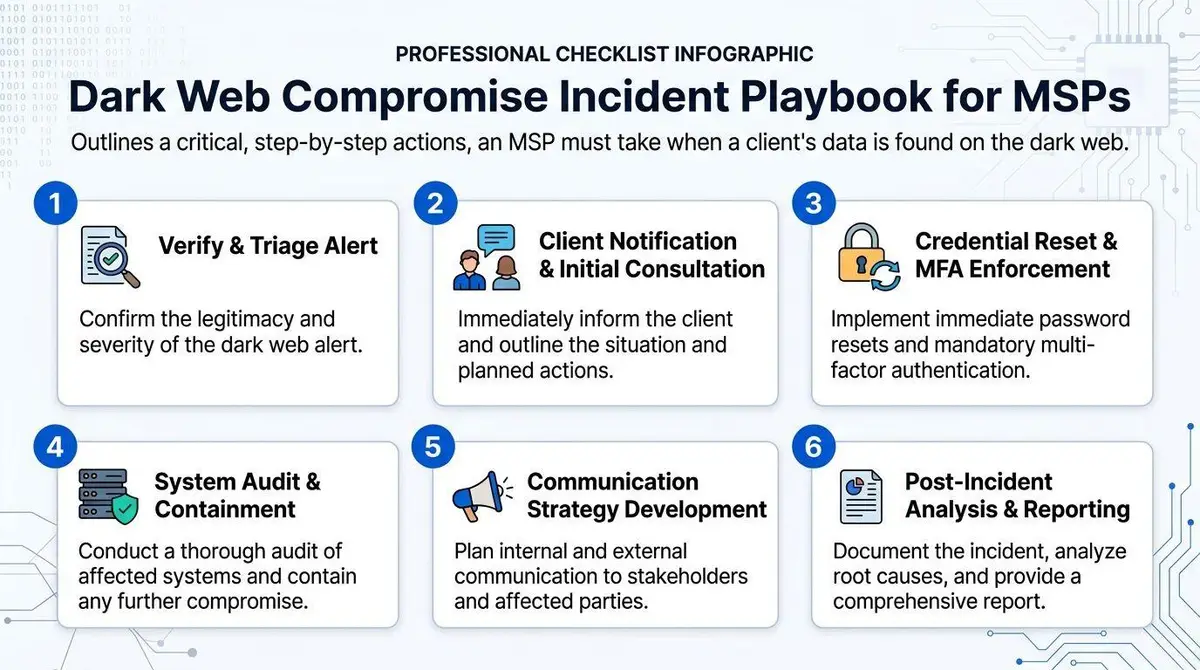
The first hour
Treat the first hour as a liability-control window. Verify the artifact, assess whether the exposure is current and credible, and confirm it belongs to the client in scope. Overreacting to stale or misattributed material wastes executive attention. Underreacting leaves the client open to account abuse, extortion, reputational harm, or regulatory scrutiny.
Then act on exposure, not just evidence. Reset credentials. Revoke active sessions. Review privileged access. Lock down any system or user path that could turn a published artifact into a live incident.
Use a triage sequence that keeps decisions tight:
- Validate the artifact. Confirm the credential, file, screenshot, record set, or identifier is genuine and relevant.
- Classify the business impact. Separate routine credential exposure from matters involving executives, regulated data, financial fraud, litigation, or public reputation.
- Brief the decision-maker. Contact the named client lead with authority to approve containment, legal escalation, and communications.
- Shut down immediate damage paths. Address credentials, sessions, privileged access, exposed portals, and impersonation risk.
- Preserve evidence properly. Keep records for counsel, cyber insurers, internal review, or law enforcement.
Detection is not a finished service
Much MSP guidance stops at detection and alerting, rarely explaining how to coordinate with external takedown specialists to remove exposed material. That gap matters because leaked data rarely stays in one place. It gets reposted, indexed, quoted, screenshotted, and repackaged. An alert without a remediation path leaves the client carrying the resulting fallout.
Your service’s maturity or exposure is revealed. If the finding involves personal data, internal documents, executive information, images, or anything likely to surface in search results or social channels, you need a response model that extends beyond IT operations. The client is not buying a scanner. The client is buying control.
A practical escalation model looks like this:
- IT containment: secure accounts, review systems, determine scope, and document what is known.
- Legal assessment: counsel decides on notice obligations, evidentiary handling, privilege, and jurisdiction-specific risk.
- Removal and suppression work: a specialist handles de-indexing requests, takedown efforts, repeat-post monitoring, and exposure reduction outside your normal toolset.
- Client communications: one approved narrative across executives, staff, customers, and third parties.
For incidents involving exposed personal information, public-facing cleanup often matters as much as technical containment. This strategic guide to removing personal information from Google after a data breach is a useful example of the removal workflow clients may need after discovery.
When a client’s data is found, the job ends when exposure is reduced, actions are documented, and ownership of the next step is clear.
One recommendation I’d make without hesitation
Build a named external escalation path before an incident forces the issue. ContentRemoval.com is one example of a specialist your team can coordinate with when exposed material requires takedown, suppression, or repeat-upload monitoring beyond normal security operations.
That is the service gap many MSPs leave open. Close it. Detection has value, but documented remediation and coordinated removal are what protect the client’s reputation and reduce your own delivery risk.
Navigating Liability and Compliance
The final issue isn’t technical capability. It’s professional responsibility. If your firm claims to protect client environments and identities, then dark web exposure sits inside your risk perimeter whether you acknowledge it or not.
Your liability begins with your service definition
The first trap is ambiguity. If your agreements talk broadly about security monitoring but say nothing precise about dark web sources, alerting thresholds, response times, or escalation boundaries, you’re inviting a dispute later. Clients remember the sales conversation, not the caveats hidden in an appendix.
Define the service carefully. Specify what assets are monitored, what constitutes a reportable finding, how quickly your team escalates, and what sits outside scope. Then define the handoff points for legal counsel, insurers, forensics, and reputation specialists. A vague promise creates expensive expectations.
Detection without action can become a problem of its own
In regulated or privacy-sensitive matters, finding exposed data is only half the issue. A client may need to show that it acted reasonably after discovery. That can include preserving evidence, notifying affected stakeholders, tightening controls, and taking steps to suppress or remove exposed material where possible.
MSPs often focus on the first two items and ignore the last. That’s risky. For clients operating across jurisdictions or holding personal data tied to executives and employees, your records should show not only that you detected the issue, but that you initiated a coherent response.
Consider the practical implications:
| Liability area | What a mature MSP does |
|---|---|
| Scope disputes | Uses clear SLAs and client-specific monitoring schedules |
| Missed escalation | Defines severity thresholds and named contacts |
| Compliance pressure | Maintains documented response steps and evidence handling |
| Reputational fallout | Builds external legal and takedown pathways in advance |
The duty of care has changed
If your firm still treats dark web monitoring as an optional upsell, you’re behind the market and behind the client’s expectations. The service belongs in a professional security practice because the consequences of exposure no longer stay inside IT.
That doesn’t mean every client needs the same depth. It does mean every MSP executive team should decide, deliberately, what standard of care it intends to offer and defend. Once a client’s data surfaces and your team is on the call, that standard becomes visible immediately.
The firms that handle this well do three things. They define scope precisely. They respond with discipline, and they recognize that some incidents require remediation outside the traditional managed services lane.
When your client’s data appears on the dark web, detection alone won’t protect them. If the matter involves exposed personal information, leaked documents, reputational risk, or the need for coordinated takedown action, speak with ContentRemoval.com for a confidential assessment and a clear remediation plan.
Frequently asked questions
How should an MSP price dark web monitoring?
By obligation, not by scan. Per-user pricing suits identity-centered monitoring, per-entity pricing suits multi-brand clients, and tiered pricing by depth aligns fee with risk. Margin should come from triage, escalation and documented response, not from hiding a cheap feed in a larger invoice.
What should an MSP do when a client’s data is found on the dark web?
Validate the artifact, classify the business impact, brief the client lead with authority, reset credentials and revoke sessions, and preserve evidence. Then route to legal assessment, removal and suppression specialists, and a single approved client communication.
Should an MSP build dark web monitoring or white-label it?
Most should buy and white-label, keeping control of escalation, reporting and client communication. Judge partners on alert fidelity, workflow fit, clean branding, escalation support and responsiveness, and run the proof on real authorized assets.