
Dark web monitoring for business is an intelligence function, not an IT subscription. It collects from criminal forums, ransomware leak sites, stealer logs and marketplaces, matches findings against your domains, brands, executives and sensitive project names, verifies freshness and relevance, then routes alerts to security, legal, communications and executive protection so containment, takedowns and evidence preservation start before fraud does.
Key facts
- Risk runs in tiers: compromised data, leaked intellectual property, brand abuse, and direct threats to principals and families.
- Brand abuse is often the earlier signal; attackers test logos, headshots and identities before phishing or extortion.
- Alert response: triage credibility and materiality, contain access immediately, preserve evidence, then remediate across disciplines.
- Ask a vendor how it handles executive and family exposure and what happens after a credible alert.
Where ContentRemoval.com comes in. ContentRemoval.com covers the response side that most monitoring tools stop short of: when an alert involves leaked documents, executive impersonation, leaked media or harmful material that is hosted or indexed, the firm handles removal, de-indexing and re-upload monitoring alongside the security and legal teams. CISOs, general counsel and family office heads usually make contact. A free 15-minute Exposure Scan maps what is circulating and removable, and the report is yours to keep. Get a Free, Confidential Exposure Scan or read how our personal data removal work is done.
A private equity principal forwards a screenshot to the CEO at 6:40 a.m. An executive’s personal email, mobile number, and an old password are being sold in a criminal channel. By 7:15, the general counsel wants to know whether the company has a disclosure problem, the CISO is checking session exposure, and the chief of staff is wondering whether the executive’s family details are circulating too. That is how dark web exposure usually arrives. Not as an abstract cyber topic, but as a leadership problem with legal, financial, reputational, and sometimes physical implications.
For high-value businesses and high-profile principals, the old separation between personal risk and corporate risk is gone. An executive’s compromised identity can become a wire fraud attempt against finance, an advantage in litigation, a pretext for impersonation, or the first breadcrumb in a coordinated smear campaign. If your board still treats dark web monitoring as a narrow IT control, your risk model is outdated.
An Unseen Liability A Board-Level Imperative
Dark web exposure is a board issue because the targets that matter most to attackers are the same ones that matter most to the business. Executive identities. Deal documents. Source code. Customer records. Payment data. Internal communications. Once that material appears in criminal channels, the problem is no longer confined to security operations. It touches governance, insurance, public disclosure, regulatory posture, and brand trust.

The market has already moved. One market report valued the global dark web monitoring market at $1.2 billion in 2025 and projected $4.1 billion by 2034, implying a 14.6% CAGR over 2026 to 2034, according to DataIntelo’s dark web monitoring market report. That growth matters because it reflects a structural change in how organizations manage cyber risk. Continuous scanning of Tor sites, paste sites, criminal forums, and illicit marketplaces is becoming standard practice for leaders who want earlier warning and faster response.
Why executives can’t delegate this blindly
A CISO can own the workflow. The board still owns the consequence.
Dark web monitoring for business shouldn’t be framed as a software subscription that occasionally finds leaked passwords. It is an intelligence function. It tells you whether someone is already discussing your company, selling access to your systems, circulating your internal documents, impersonating your leadership, or preparing an abuse campaign around your brand.
Practical rule: If an exposure can trigger legal review, investor concern, customer distrust, or executive protection measures, it belongs on the board’s risk agenda.
What changes when you treat it as strategic intelligence
The conversation shifts immediately. Instead of asking whether your vendor found old breach data, you ask harder questions.
- What are we monitoring against? Your domains, brands, executives, known aliases, and sensitive project names.
- Who receives alerts? Not just security. Legal, fraud, communications, and executive protection may need the same signal.
- What happens after detection? Password resets are basic. Takedowns, evidentiary preservation, law enforcement liaison, and reputation containment are where the real work starts.
That is the undeniable reality. If your leadership team learns about underground exposure after a journalist, fraud investigator, or threat actor acts on it, you are already late.
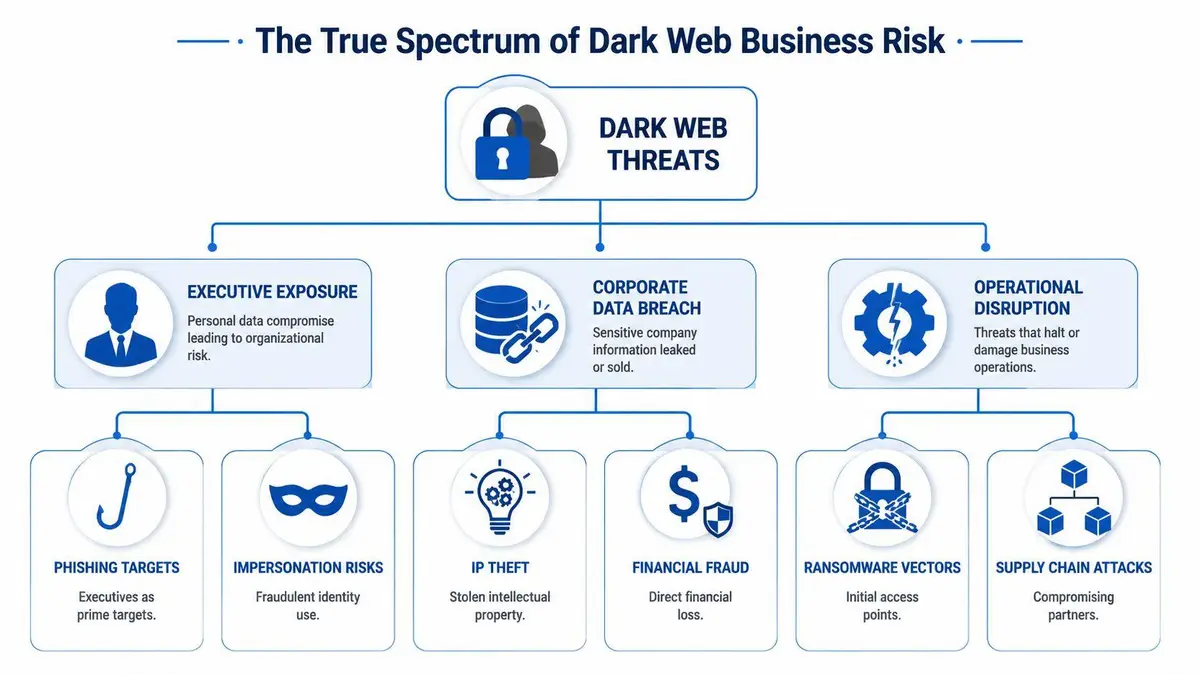
The True Spectrum of Dark Web Business Risk
The biggest mistake companies make is reducing dark web risk to stolen credentials. Credentials matter, but they are only one part of the exposure surface. Senior leadership should think in tiers, because each tier triggers a different response and a different business consequence.
At the commodity end of the criminal economy, the scale is already obvious. In 2025, dark web listings reportedly included more than 140 million stolen credit card records, and stolen U.S. Social Security numbers were selling for as little as $1 to $6 each. Another industry source said its threat intelligence team monitors over 7 billion leaked credential and PII databases, according to Panda Security’s dark web statistics overview. Those figures matter because cheap identity data fuels credential stuffing, phishing, invoice fraud, and account takeover against employees, customers, and executives.
Compromised data is only the first layer
Every business understands the immediate danger of exposed credentials, payment data, and customer records. That is the visible risk. Attackers use those assets to get into accounts, pressure support teams, bypass trust controls, and build convincing fraud narratives around real information.
But compromised data also creates secondary exposure. Once attackers know which employees exist, which vendors they use, and which accounts are linked to which roles, they can conduct targeted social engineering against finance, HR, legal, and leadership.
For companies assessing providers, resources on dark web monitoring for businesses can help clarify the baseline capability you should expect. The key question, however, is whether your program covers more than credential checks.
Leaked intellectual property changes competitive and legal risk
When source code, product roadmaps, internal financials, investor decks, or transaction materials surface, the damage isn’t limited to security. You may be facing deal disruption, valuation pressure, contract disputes, or evidentiary issues in litigation.
Three exposures tend to be underestimated:
- Source code and technical documentation can reveal architecture, dependencies, and exploitable weaknesses.
- R&D and product plans can hand competitors an unearned view into timing and direction.
- M&A and financing materials can destabilize negotiations before leadership controls the message.
Brand abuse is often the earlier signal
Many campaigns start with reputation abuse, not intrusion. Attackers test stolen logos, executive headshots, marketing assets, and domain-adjacent identities before they launch phishing, counterfeit account creation, or extortion.
The first alert that matters may not be a breach artifact. It may be evidence that someone is assembling the pieces for fraud under your name.
That is why dark web monitoring for business has to include impersonation indicators, leaked media, counterfeit account ecosystems, and chatter around planned brand abuse.
Direct threats to principals are where cyber and personal security merge
For founders, public-company executives, family offices, and public figures, the final tier is personal. Doxing, family information, travel references, extortion attempts, and hostile commentary can migrate from hidden channels into real-world confrontation.
This is the point where an “IT tool” framing becomes absurd. If an executive’s home address, family details, and corporate role are circulating together, the issue sits at the intersection of cyber, legal, communications, and protective security. Narrow monitoring misses that convergence. Strategic monitoring is built for it.
How Dark Web Monitoring Intelligence Is Gathered
Most executives have seen low-end “breach check” tools. Enter an email address, receive a recycled result, move on. That is not intelligence. Professional dark web monitoring for business works more like a targeted collection and analysis cycle.
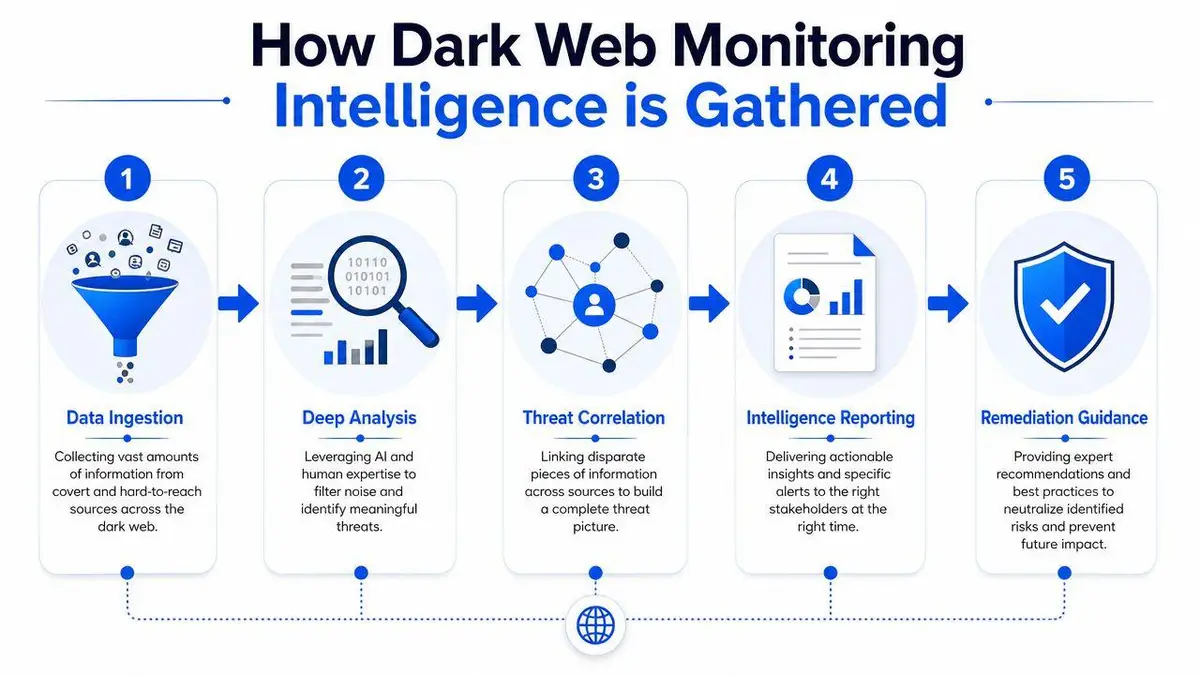
Business-grade monitoring is most effective when it is continuous and entity-scoped. Platforms can scan criminal marketplaces, ransomware leak sites, hacker forums, stealer logs, and real-time channels, then match exposures against an organization’s domains, brands, executives, and system identifiers. The core pipeline is collection, asset matching, verification and enrichment, and automated alerting into SIEM or SOAR workflows, as described in Breachsense’s guide to dark web monitoring for business.
Collection is wider than most buyers assume
Good providers don’t limit themselves to public breach dumps. They look across the places where threat actors trade and coordinate. That can include ransomware leak sites, criminal forums, stealer logs, marketplaces, and fast-moving channels where data appears before traditional breach reporting catches up.
The strategic question is simple. Are you paying for access to meaningful signal, or for a nicer dashboard on top of old data?
Asset matching determines whether alerts are useful
Raw collection produces noise unless the service knows what matters to you. That means mapping the monitoring scope against the organization’s real exposure footprint.
A serious program usually tracks:
- Corporate identifiers such as domains, sub-brands, and sensitive project references
- Leadership exposure including executive names, aliases, personal contact points tied to business use, and known impersonation vectors
- Operational assets such as system identifiers and terms associated with privileged access or strategic initiatives
Verification is where cheap services fail
This is the hardest part. Criminal channels are full of duplicates, stale data, recycled breach compilations, and low-value chatter. A provider has to verify freshness, reduce duplication, add context, and distinguish between incidental mention and active threat relevance.
A flood of unverified alerts creates the same executive outcome as no monitoring at all. You still don’t know what requires action.
Enrichment matters because decision-makers need context, not just detection. Was the item newly posted or long-circulating? Does it reference an active executive? Does it suggest imminent fraud, reputational abuse, or technical compromise? Which internal team should own it?
Alerting has to feed action, not inboxes
If alerts land in a portal nobody checks, you bought theater. High-value monitoring should feed existing response channels and decision-makers with enough precision to support action.
That means different outputs for different stakeholders:
- Security teams need immediate containment tasks.
- Legal teams need preservation, jurisdictional context, and takedown posture.
- Communications and brand teams need escalation thresholds for public-facing abuse.
- Executive protection stakeholders need fast clarity when a signal affects a principal or family member.
That workflow is why intelligence gathering matters more than scanning. The purpose isn’t to prove the dark web exists. The purpose is to identify credible threat relevance early enough to change the outcome.
Strategic Use Cases for Executive and Brand Protection
The value of dark web monitoring becomes obvious when you look at what early warning prevents. Not theoretical breaches. Concrete business damage.
Dark web monitoring also functions as adversary-centric intelligence on attack preparation and brand abuse. Organizations use it to uncover evolving tactics, techniques, and procedures, including impersonation, leaked documents, source code, and executive information circulating in underground channels, as outlined in Kroll’s analysis of deep and dark web monitoring for business. The practical advantage comes from correlating raw sightings with context, then routing the alert to the right owners across security, legal, fraud, or brand protection.
Executive impersonation before the payment request
An attacker doesn’t need to breach your environment to hurt you. If they gather an executive’s personal details, communication style, prior credentials, and corporate hierarchy, they can build a convincing impersonation kit. That kit can then support a fraudulent payment request, a fake legal instruction, or a pressure campaign against staff.
The win is not catching the fraud after funds move. The win is spotting the assembly phase early enough to tighten approvals, warn likely targets, and cut off the impersonation infrastructure before it scales.
Confidential deal material before public exposure
Suppose references to a transaction codename, draft diligence files, or executive travel tied to a negotiation appear in an underground channel. That doesn’t just create cyber concern. It affects bargaining power and can destabilize trust among counterparties.
A mature response often includes legal review, internal document tracing, access control checks, and a rapid decision on whether any part of the leak requires containment outside the security function. For broader reputational containment strategy, executive teams often need integrated guidance alongside online brand protection services.
Counterfeit ecosystems and brand abuse
Luxury brands, consumer platforms, creators, and founder-led companies face a different problem. Attackers use stolen logos, creative assets, leaked media, and insider information to build counterfeit account networks or false “official” channels. That activity often starts in private communities before it reaches mainstream platforms.
When monitoring catches those signals early, the company can preserve evidence, map the network, and move against the infrastructure in a coordinated way. That beats chasing copies one by one after customer harm starts.
Signals that point to personal threat
For high-net-worth principals and family offices, some alerts belong nowhere near a generic security queue. If a monitoring program surfaces doxing references, extortion framing, family identifiers, or discussion that links online exposure to offline movement, the response must be immediate and tightly controlled.
The critical judgment is not whether the content is merely offensive. It is whether it is operational. If it can facilitate contact, coercion, stalking, or physical approach, treat it as a protection issue.
This is why dark web monitoring for business has to serve executive protection as well as cybersecurity. High-value clients aren’t just defending systems. They’re defending people, negotiations, and trust.
Evaluating and Selecting a Monitoring Partner
Most procurement processes get this wrong. They compare feature lists, screenshots, and price tiers as if they were buying any other security tool. You are not buying software alone. You are choosing an intelligence and response capability that may end up handling executive exposure, extortion indicators, leaked corporate material, and cross-border reputation threats under pressure.
What matters more than the dashboard
Source coverage is the first test. If a provider only checks public breach repositories and recycled dumps, it isn’t giving you a strategic view. You need visibility into high-signal environments, including the channels where abuse planning, impersonation setup, and leaked materials appear before the broader market notices.
Intelligence quality is the second test. An executive team doesn’t need thousands of alerts. It needs a disciplined method for filtering noise, validating relevance, and assigning severity. Ask exactly how the provider handles duplicates, stale records, and ambiguous references. If the answer is vague, the service will generate confusion when you need clarity.
Response capability separates vendors from advisors
A monitoring partner should help you decide what to do next. That may involve containment guidance, legal escalation, evidentiary handling, platform reporting, communications planning, or content-removal support.
Many tools demonstrate a common shortcoming. They alert. They do not resolve.
A practical example is ContentRemoval.com, which provides monitoring and remediation services tied to content removal and digital reputation protection. That matters when an alert involves leaked media, impersonation, or harmful material that needs action beyond internal security handling.
Vendor Capability Assessment Criteria
| Capability | Basic Service (Low Value) | Strategic Partner (High Value) |
|---|---|---|
| Source coverage | Public or recycled breach data | Broad collection across criminal forums, leak sites, stealer sources, and fast-moving abuse channels |
| Matching scope | Email-only checks | Entity-scoped monitoring across domains, brands, executives, and sensitive business identifiers |
| Alert quality | High volume, low context | Validated, enriched alerts with clear severity and business relevance |
| Human analysis | Minimal or absent | Analyst review that separates noise from actionable threat intelligence |
| Response support | Portal notification only | Integration with legal, fraud, brand, communications, and technical response workflows |
| Executive reporting | Generic technical summaries | Discreet briefings tailored to leadership decisions and reputational exposure |
| Confidentiality posture | Standard SaaS handling | High-discretion operating model suitable for sensitive principals and privileged matters |
Questions worth asking before you sign
- How do you handle executive and family exposure? If the provider only speaks in terms of corporate credentials, it is not built for high-risk principals.
- What happens after a credible alert? You need more than “we notify your team.”
- Can your reports support legal and reputational action? Evidence quality matters when decisions move beyond IT.
- Who sees our data internally? Discretion is not a luxury when sensitive individuals are involved.
Choose the firm that can help you act, not just observe.
A Framework for Alert Response and Remediation
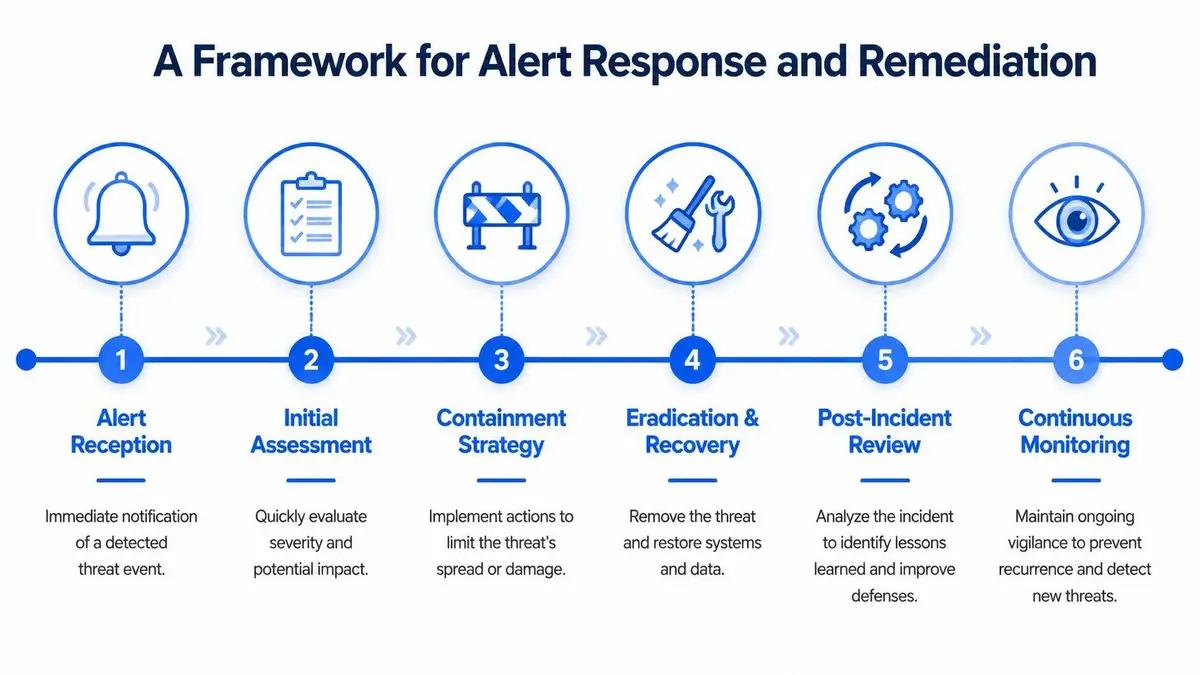
An alert is not a result. It is the start of a clock. If your organization doesn’t know who owns the first thirty minutes, the next four hours, and the next two days, monitoring won’t protect you.
A lot of market commentary still frames dark web monitoring around stolen credentials and breach detection. That misses the more urgent use cases around impersonation, leaked media, counterfeit account ecosystems, and brand-abuse content across Telegram, paste sites, and closed communities. The stronger view is that monitoring is an early-warning signal for abuse orchestration, not just proof of a completed compromise, as discussed in DarkScouts’s perspective on dark web monitoring tools for SMBs.
Triage first and fast
Start by deciding whether the alert is credible, current, and material. Don’t let a junior analyst make that judgment alone if the alert touches an executive, transaction, or sensitive document set.
Key triage questions include:
- Is the exposure new and actionable? Old recycled data may still matter, but urgency differs.
- Who or what is affected? A finance executive and a dormant shared mailbox don’t carry the same risk.
- What kind of harm could follow? Fraud, extortion, reputational damage, regulatory exposure, or physical security concerns each require a different owner.
Containment cannot wait for perfect certainty
If the exposure involves credentials or access artifacts, contain immediately. Reset passwords, revoke sessions, review privileged access, and isolate potentially affected accounts or devices. If the alert concerns documents, media, or impersonation assets, preserve evidence while preparing platform, legal, and communications action.
Where leaked files or sensitive materials are involved, organizations often need a parallel removal path. Guidance on removing leaked business documents from the internet is useful because the response usually requires more than technical cleanup.
Treat preservation and remediation as parallel tracks. If you destroy evidence while rushing to suppress content, you may weaken later legal options.
Investigation has to cross disciplines
Security should determine scope and entry path. Legal should assess privilege, disclosure, and takedown options. Communications should prepare holding language if public exposure becomes likely. Fraud teams should review whether the leaked material could support impersonation or payment abuse.
This phase often answers the question executives care about most. Is this a narrow exposure, or is it part of a broader campaign?
Remediation should be coordinated, not improvised
A complete remediation plan may involve:
- Technical action to close access and harden controls.
- Legal action to preserve rights, support platform complaints, or escalate enforcement.
- Content removal where leaked or abusive material is hosted or indexed.
- Stakeholder communication if customers, partners, employees, or investors may be affected.
- Protective measures when principals or family members face direct targeting.
The firms that handle this well don’t treat alerts as isolated tickets. They treat them as incidents with operational, legal, and reputational dimensions.
Measuring the ROI of Strategic Intelligence
If you try to justify dark web monitoring only by asking whether it prevents a single technical breach, you will undervalue it. The stronger return sits in what it allows leadership to avoid, contain, and decide sooner.
Dark web monitoring for business protects negotiating position when sensitive deal material starts circulating before counterparties lose confidence. It protects brand equity when impersonation or counterfeit account infrastructure is interrupted before customers see it. It protects leadership credibility when executive exposure is caught before it becomes a fraud attempt or public embarrassment. For some clients, it also supports personal security in a way that no standard security stack was designed to do.
The real return is decision advantage
Boards understand insurance. They should also understand intelligence advantage.
A credible monitoring program helps leadership answer four questions faster than they otherwise could. Is our data already circulating. Is someone preparing to abuse our name. Does this affect a principal, not just a system. What action has to start now. That clarity has value even before you quantify avoided loss.
Ignorance is not a neutral position. For high-profile businesses, it is a preventable liability.
What sophisticated buyers should expect
You should expect signal, not noise. You should expect discretion. You should expect a workflow that connects detection to legal, reputational, and technical response. You should also expect the provider to understand that a leaked file, a fake executive profile, and a doxing thread may be parts of the same campaign.
For executives evaluating budgets and governance, frameworks for justifying the cost of online monitoring services are useful because they shift the discussion away from commodity tooling and toward resilience, response speed, and protected enterprise value.
The blunt conclusion is simple. If your company, brand, or principals are valuable enough to target, dark web visibility is not optional. The only real choice is whether you build that visibility before an incident forces it on you.
If you need a confidential assessment of executive exposure, leaked content, impersonation risk, or brand abuse, ContentRemoval.com can help you evaluate the threat surface and define a discreet response plan. For high-stakes matters, detection without remediation isn’t enough.
Frequently asked questions
What does dark web monitoring actually find for a company?
Beyond credentials: source code, product roadmaps, deal materials, internal communications, executive identities, family details, stolen brand assets and chatter about planned abuse. Serious programs match findings to domains, brands, executives and project names rather than email addresses alone.
What should a business do when an executive’s data appears on the dark web?
Decide fast whether the alert is credible, current and material, contain credentials and sessions immediately, preserve evidence while planning platform and legal action, then run technical, legal, content removal, stakeholder communication and protective tracks together.
Why is dark web monitoring a board issue rather than an IT issue?
Because the targets attackers want most, executive identities, deal documents, customer data and internal communications, are the ones that touch governance, insurance, disclosure, regulatory posture and brand trust once they surface in criminal channels.