
A criminal record expungement lawyer earns their fee by controlling risk: diagnosing mismatched dispositions before filing, choosing the right court and remedy, framing the petition for judicial discretion and handling prosecutor objections. Hiring one is a two-track decision: the court order changes legal status but does not clean the copies that survive on background screeners, data brokers and search results.
Key facts
- Only 6.5% of legally eligible people obtained expungement within five years in one empirical study.
- Full-scope representation produced record clearing for 70% or more within six to seven months versus 13% self-help.
- Georgia offers record restriction, not destruction; California offers dismissal or sealing rather than true erasure.
- Red flags: promised outcomes, vague answers on the state remedy, no discussion of post-order cleanup, immediate fee pressure.
Where ContentRemoval.com comes in. ContentRemoval.com handles the second track once the lawyer has the order: serving certified copies on background screeners and data brokers, takedown outreach to mugshot and court-reference pages, de-indexing stale search results and monitoring for republication. The expungement attorney or the client’s chief of staff usually makes the introduction. A free 15-minute Exposure Scan maps where the record still appears online, and the report is yours to keep. Get a Free, Confidential Exposure Scan or read how our court record removal work is done.
An old charge can lie dormant for years, then reappear at the worst possible moment. A board appointment is moving forward. A financing process is in diligence. A family office is reviewing principals. Then a background report pulls up a case you assumed was long buried.
That’s the moment many individuals make a poor decision. They either panic and hire the first lawyer who mentions expungement, or they underestimate the problem and treat it like a clerical filing. Both mistakes cost time, credibility, and control. If your name, business interests, or public profile matter, you need to think about expungement as a two-track problem: first the court record, then the digital residue that survives long after the judge signs the order.
First Steps Gauging Your Eligibility and Case Complexity
The first question isn’t whether you’re embarrassed by the record. The first question is whether your case is legally eligible, and the second is whether it’s simple enough to handle administratively or complex enough to require a specialist.

Start with the record you actually have
Pull the exact case information before you call anyone. You need the charge, disposition, court, filing jurisdiction, and whether the matter ended in dismissal, acquittal, diversion, plea, or conviction. Clients often describe a case as “dropped” when the docket says something materially different. That difference controls strategy.
If you need a practical primer before you speak with counsel, Brian Hansford Law’s guide on how to clear a criminal background is a useful orientation tool. Use it to frame the issue, not to replace legal analysis.
A separate but related problem is what third parties are already seeing. A court outcome and a background report are not always aligned, which is why you should also review a strategic assessment of whether a mugshot will show up on a background check before you assume the damage is limited to the courthouse file.
Complexity decides the path
Some matters are basically administrative. Others are contested, multi-jurisdictional, or factually messy. Don’t confuse old with easy.
Look for these complexity signals:
- Multiple jurisdictions. If charges, related arrests, or companion cases sit in different courts, the filing burden and sequencing become more technical.
- Conviction history. Non-convictions are usually more straightforward than convictions. A plea or sentence often changes eligibility entirely.
- Time-calculation issues. Waiting periods may run from discharge, completion of sentence, or other specific legal events rather than the arrest date.
- Data integrity problems. Clerks, law enforcement databases, and commercial background providers often carry inconsistent information.
- Public-facing exposure. If your concern includes search visibility, investor scrutiny, licensing, or media review, a court petition alone won’t solve the full problem.
Practical rule: If your matter involves more than one court, any conviction, or any professional licensing consequence, treat it as a strategy problem, not a paperwork problem.
Most eligible people never complete the process. An empirical study identified a severe uptake gap, with only 6.5% of legally eligible individuals obtaining expungement within five years, and the same study found that successful lawyer-assisted expungement correlates with a 22% average wage increase within one year according to the National Reentry Resource Center summary of the empirical study.
That number matters less for its economics than for what it reveals. People lose opportunities because they delay, misread eligibility, or file badly. If you’re an executive or founder, delay has a reputation cost that won’t wait for your convenience.
The Strategic Value of an Expungement Advocate
A criminal record expungement lawyer earns their fee by controlling risk. That’s the standard. Not friendliness. Not advertising volume. Not the promise of a “fresh start.”
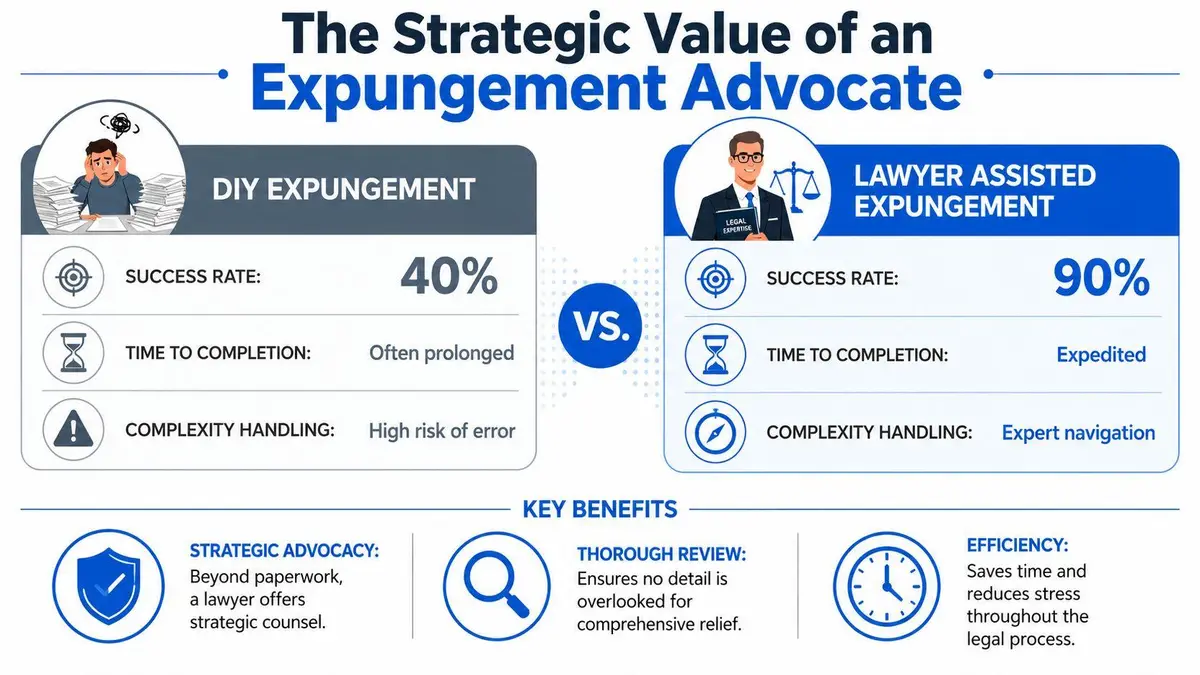
The gap between self-help and full representation is wide enough that you shouldn’t pretend this is a neutral choice in a serious case.
What a real advocate does
The useful lawyer is not the person who downloads forms. The useful lawyer is the one who spots the failure points before the court does.
That usually means the attorney is doing work in four lanes at once:
- Record diagnosis: finding mismatched dispositions, incomplete dockets, and missing discharge information before filing.
- Procedural control: identifying where to file, what the court expects, and whether a hearing or prosecutorial response is likely.
- Narrative framing: presenting the petition in a way that addresses judicial discretion rather than assuming eligibility alone wins.
- Objection handling: dealing with prosecutor resistance, law enforcement records, or stale database errors that derail self-filed matters.
Why representation changes outcomes
The strongest available data cuts through the sales talk. Full-scope legal representation yields a success rate 10 times higher than self-help, and in one study 70% or more of those with an expungement lawyer achieved record clearing within six to seven months, compared to 13% of self-help subjects, according to the Access to Justice Lab’s expungement experiment analysis.
That doesn’t mean every petition needs premium counsel. It means complicated petitions do.
The strategic lawyer shortens uncertainty. That’s often more valuable than the filing itself.
For a high-stakes client, the hidden value is predictability. Your lawyer should be able to tell you where the record sits, which agency controls the next step, what objections are plausible, and what “success” means beyond a signed order. If they can’t explain that clearly, they’re acting as a document preparer.
A board candidate, acquisition target, or public-facing founder doesn’t need a cheap filing. They need a controlled process with as few surprises as possible. That is what an expungement advocate is for.
How to Vet and Interview Your Legal Counsel
You don’t need a charismatic lawyer. You need one who knows the courthouse, the statute, the clerk’s office, and the practical consequences of a record that still circulates online after legal relief is granted.
A generic criminal defense attorney may be excellent at trial work and still be the wrong hire for expungement. This is a narrow, procedural, locally sensitive practice area. Treat your intake call like diligence, because that’s what it is.
Questions that expose real expertise
Ask direct questions. Then listen for specificity.
- Ask about your exact court and county. If the lawyer can’t discuss how petitions are handled in your jurisdiction, they’re guessing.
- Ask what records they review before filing. A capable attorney should mention the docket, disposition history, sentencing or discharge status, and agency record consistency.
- Ask how they deal with objections. You want to hear a process, not optimism.
- Ask what remedy is available. If they blur expungement, sealing, dismissal, and restriction into one promise, that’s a warning.
- Ask how they define a successful outcome. The right answer isn’t always “record erased.” Sometimes it’s narrower legal relief paired with downstream cleanup.
If you want a useful model for disciplined screening, the attorney ranking methodology used by the UCMJ Lawyer Directory is worth reviewing. Not because military law maps onto expungement, but because the methodology forces you to separate reputation from demonstrable fit.
Red flags you should take seriously
Some warning signs are obvious. Others are subtle.
| Red Flag | Why It Matters |
|---|---|
| Guaranteed outcome | Honest counsel doesn’t promise a judicial result they don’t control |
| Vague answer on state remedy | They may not understand the difference between expungement and sealing |
| No discussion of post-order cleanup | They’re treating the matter as closed too early |
| Immediate fee pressure | Good lawyers diagnose first and scope second |
| No questions about your public exposure | They don’t understand reputational stakes |
Screen for judgment, not just credentials. A lawyer who tells you a simple non-conviction matter may not require full representation is often more trustworthy than one who insists every file is a major battle.
For executives dealing with parallel reputational issues, it also helps to study how serious counsel structures sensitive online matters. This guide to an internet defamation attorney consultation for executives is useful because the vetting logic is similar: define the remedy, the process, the pressure points, and the endpoint before you sign.
The right criminal record expungement lawyer should sound measured, local, and operationally precise. If they sound theatrical, keep looking.
Decoding Legal Fees and Avoiding Hidden Costs
Fee anxiety is rational. Expungement pricing varies widely, and sloppy engagement letters create more problems than high fees. You should know exactly what you’re buying.
A clean proposal separates the legal work from the court ecosystem around it. That means attorney time, filing preparation, court appearances if needed, certified records retrieval, and follow-up with agencies should all be described with enough precision that you can compare firms on substance rather than tone.
The fee structures you’ll usually see
Some matters are well suited for a flat fee. Others are not.
| Fee Structure | How It Works | Best For | Potential Pitfall |
|---|---|---|---|
| Flat fee | One set amount for a defined scope of work | Straightforward, single-jurisdiction matters | “Scope” may exclude hearings, agency follow-up, or record corrections |
| Hourly | Time billed as work is performed | Complex or contested matters with unknown resistance | Total cost can drift if no budget discipline exists |
| Hybrid | Base flat fee plus hourly billing for contingencies | Matters with a predictable filing stage but uncertain objection risk | Clients often misunderstand what triggers extra billing |
What should be in the engagement letter
Don’t accept vague language like “handle expungement matter.” That says nothing.
Your engagement should identify:
- Included legal work: petition drafting, filing, hearing prep, court appearance, prosecutor response handling.
- Excluded work: appeals, separate agency disputes, digital takedowns, private database cleanup.
- Third-party costs: filing fees, certification costs, courier charges, and document retrieval.
- Communication terms: who handles the file and how updates are delivered.
- Outcome definition: what happens after the order is entered.
A serious lawyer will also tell you when not to hire them. That matters. In some jurisdictions, simple non-conviction records may be handled through free or low-cost channels. For example, Maryland offers nonprofit and legal-aid assistance regardless of income in some expungement matters, and Georgia allows direct application to law enforcement for a fee of up to $50 in certain cases, as summarized by People’s Law on referrals and help with expungements.
Where clients overpay
Clients overpay when they buy prestige instead of fit, and when they fail to separate legal relief from reputation cleanup. A simple dismissal may not justify bespoke litigation-style billing. A multi-court conviction history often does.
The ethical criminal record expungement lawyer tells you which category you’re in. If the matter is basically administrative, they should say so. If it is not, they should explain why in plain terms.
That level of candor is usually a better sign than a low quote.
The Reality of State Laws and Shifting Timelines
A client sees “expunged” in a headline, assumes the problem is solved, and then learns the hard way that their state offers a narrower remedy, a longer wait, or no relief for that record at all. That mistake costs time, money, and advantage.
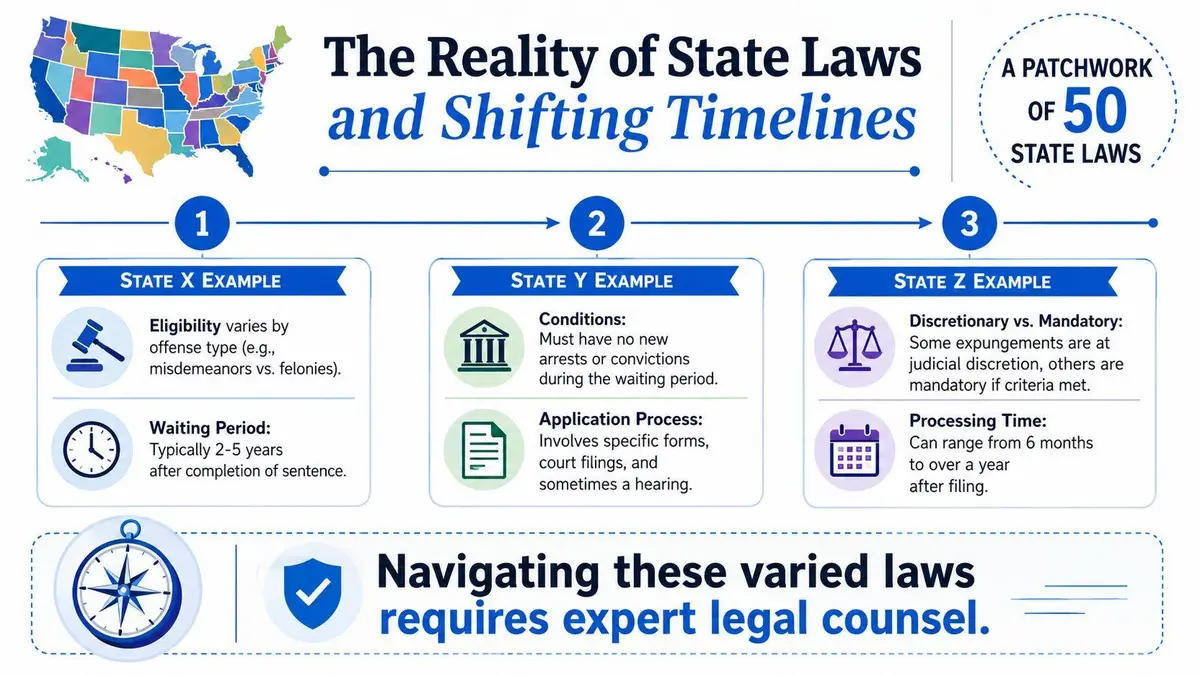
Expungement is a state-law problem with local friction layered on top. The statute defines the remedy. The clerk, prosecutor, judge, and agency workflow determine how long you wait and how many avoidable problems hit your file.
The same word means different things in different states
Clients use “expungement” as shorthand for total deletion. That is often wrong, and the distinction matters.
In Georgia, the operative concept is record restriction, not destruction of the file. Public access may be limited while law enforcement and other authorized entities still retain access. California takes a similarly narrow view. Courts there explain that true erasure generally is not available, and the available remedies are dismissal, sealing, or related forms of record relief, as discussed in this explanation of Georgia expungement and record restriction distinctions.
That is not semantics. It affects licensing disclosures, background screening, insurance underwriting, and online reputation strategy. A court can change official status while old copies of the record remain indexed, republished, or sold by private databases.
Fragmented law means fragmented timelines
Virginia is narrow and procedure-heavy. Under section 19.2-392.2, relief is limited to specific circumstances such as acquittal, nolle prosequi, certain dismissals, identity theft, or absolute pardon, and the petition must be filed in the circuit court tied to the originating charge, according to this summary of Virginia expungement eligibility.
Ohio uses a different trigger. Waiting periods run from final discharge, not conviction, and an intervening conviction can reset the clock. Ohio also excludes certain offenses, including violent felonies and DUI-related matters, while allowing some lower-level felony relief under broader sealing rules, as explained in these discussions of Ohio expungement timing rules and Ohio sealing and qualification limits.
California went further by automating relief for many eligible records under AB 1076. The policy shift matters because it shows how quickly a state can change both eligibility and workflow. It does not create a national template, and it does not eliminate the separate cleanup problem that follows a court or agency update. The California Courts’ public guidance on cleaning your record and automatic relief under recent law is a better reference point here than broad national summaries.
Your timeline is legal first, reputational second
Clients make a strategic error when they treat the court order as the finish line. It is the midpoint.
Even in states with simplified relief, timing breaks into two separate tracks. First, you have the legal track: eligibility, waiting periods, filing, objections, hearing dates, and entry of the order. Second, you have the information-distribution track: court databases updating, agencies syncing records, background screeners refreshing files, and search engines dropping stale results. Those systems do not update on the same clock.
If you want a practical roadmap for the second track, review this guide on removing public court records from Google after legal relief. It addresses the gap many lawyers leave untouched once the signed order is in hand.
State-specific record categories complicate the analysis even more. In Georgia, for example, DUI-related records carry their own reputational and legal consequences, which is why the discussion of the impact of DUI on Georgia records is worth reviewing before you assume a single expungement strategy will cover every file in your history.
Beyond the Court Order The Digital Expungement
A judge signs the order. Your background check still flags the case. A client, lender, or reporter searches your name and finds the old record on a data broker site by lunch.
That is the gap clients underestimate.
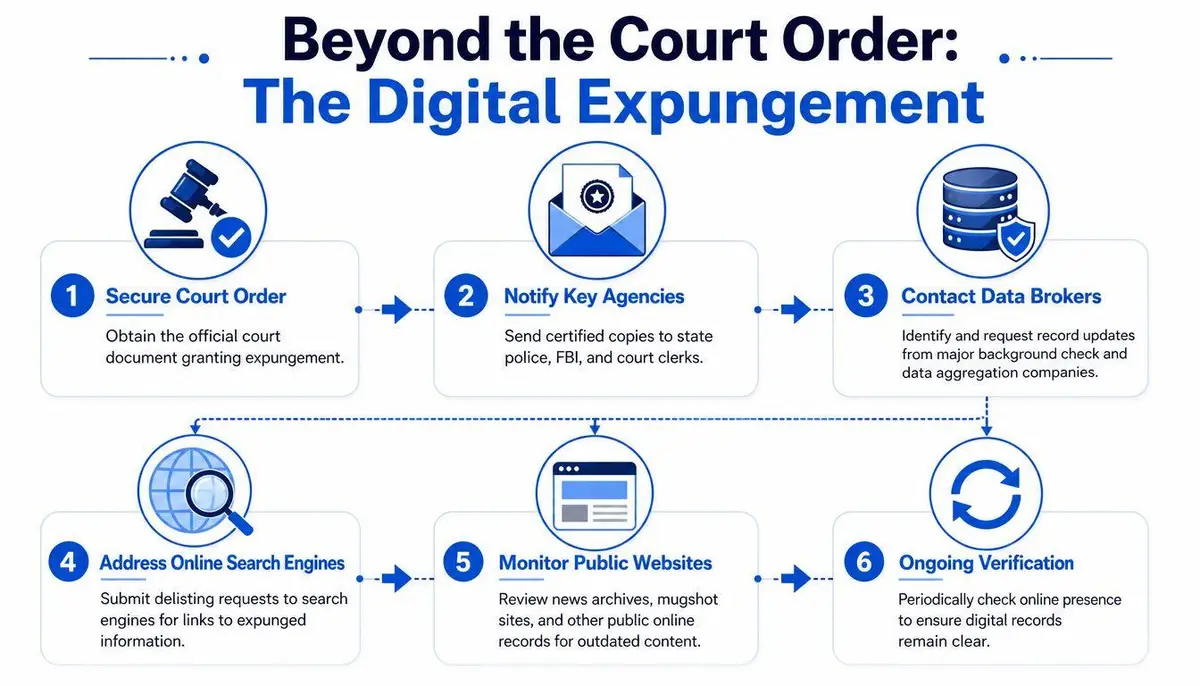
A court order changes your legal status inside the official system. It does not clean the commercial copy of that record once it has been scraped, sold, indexed, and republished across the internet. If your goal is employment, licensing, financing, board service, or privacy, the digital record matters as much as the court file.
What survives after legal relief
Automatic relief laws make this point clear. A state can clear or update official records at scale, and old information can still remain visible through private distribution channels. That is not a legal contradiction. It is a data distribution problem.
The usual holdouts are predictable:
- Background screening databases that copied the file before the court or agency update
- People-search and data broker sites that republish court and arrest data
- Mugshot and arrest-content pages built to rank in search and collect traffic
- Search engine results that continue surfacing stale pages after the official record changes
If you need a practical playbook for the search side, start with this guide on removing public court records from Google after legal relief. It explains the point many law firms leave unfinished. Google does not receive your expungement order from the court and clean up the results for you.
Here is a concise explanation of the issue from another format:
The post-order workflow that matters
Digital cleanup requires a separate execution plan. Treat it that way.
- Get certified copies of the order. Third parties need proof they can verify.
- Confirm the official record changed everywhere it should. Court systems, repositories, and agencies do not always update on the same schedule.
- Map where the record still appears. You need a list of background screeners, broker sites, mugshot pages, and indexed URLs before you start sending demands.
- Send targeted correction or removal requests. Generic outreach gets ignored.
- Handle source removal and search suppression as separate tasks. Deleting a page and removing its search visibility are related, but they are not the same job.
- Monitor for republication. Old records often reappear through mirrors, resellers, and cached pages.
A court order changes legal status. It does not clean up downstream distribution.
That distinction matters most for clients with reputational exposure. Investors, counterparties, school officials, journalists, and screening vendors do not limit themselves to the courthouse database. They search the broader web, and they often act on stale information.
Some firms stop after the order enters. That is incomplete representation if the client’s business problem is visibility, not just eligibility.
One available operational option is ContentRemoval.com, which handles post-expungement document service, takedown outreach, de-indexing work, and monitoring as part of a digital cleanup process. That work does not replace local legal counsel. It sits after the legal remedy and focuses on execution across search results, data brokers, and public-facing sites.
If the record is affecting your reputation, financing, licensing, board eligibility, or family privacy, ContentRemoval.com can assess the online side confidentially and map the cleanup steps that follow a court order. The right strategy has two parts. Get the order. Then remove the record’s digital footprint where the market still sees it.
Frequently asked questions
Do I need a lawyer to get my record expunged?
Not always. Simple non-conviction matters in a single jurisdiction can sometimes be handled through free or low-cost channels, and honest counsel will say so. Multiple jurisdictions, any conviction, licensing consequences or public exposure make it a strategy problem that benefits from full representation.
What questions should I ask an expungement lawyer before hiring them?
Ask about your exact court and county, which records they review before filing, how they handle objections, which remedy is available in your state, and how they define a successful outcome. Listen for specifics rather than optimism.
Will an expungement remove my record from Google and background check sites?
No. Google does not receive the order from the court, and screeners, people-search sites and mugshot pages often copied the record before the update. Digital cleanup is a separate execution plan of correction requests, source removal, de-indexing and monitoring.