
To cancel a CheckPeople.com subscription, log in, go to My Account then Subscriptions, complete the cancellation and screenshot the confirmation, then call support and ask for immediate cancellation with a confirmation code and email. Cancellation stops billing only. Your profile stays live unless you send a separate data erasure request under CCPA or GDPR.
Key facts
- Use the web portal and the phone; treat the process as incomplete until a confirmation email arrives.
- Refund requests and data erasure requests both go to support@checkpeople.com as separate written demands.
- If charges continue after cancellation, a bank chargeback with proof of cancellation is the enforcement tool.
- Profiles often remain in view-only mode after cancellation; deletion is not automatic.
Where ContentRemoval.com comes in. Stopping one subscription does not remove your name, addresses and relatives from people-search databases, and CheckPeople is one of many. ContentRemoval.com handles that wider cleanup for executives, public figures and families, often at the request of a family office or an assistant. A free 15-minute Exposure Scan maps what is exposed and what can be removed, and the report is yours to keep. Get a Free, Confidential Exposure Scan or read how our content removal work is done.
You signed up for a quick background check, paid a nominal trial fee, and moved on. Then the recurring charges started. Or worse, you thought you canceled, saw no clear confirmation, and now you’re trying to work out whether the billing stopped and whether your personal information is still sitting inside a people-search database.
Treat this as two separate risks. The first is recurring financial exposure. The second is persistent data exposure. Most cancellation guides only address the first problem, and even those do it poorly. A proper checkpeople.com cancel subscription response has to shut down billing, preserve evidence, and push for data erasure.
The Anatomy of a CheckPeople.com Subscription Trap
You run a quick background search for a small fee, close the tab, and assume the transaction is finished. Weeks later, your card statement says otherwise. At that point, you are not dealing with a simple membership cancellation. You are dealing with an active billing risk and a separate exposure problem tied to a people-search record that can continue to circulate long after the charge stops.

The trap is predictable. A low-cost entry point lowers resistance. Then the burden shifts to the customer to identify the recurring plan, find the cancellation path, complete it correctly, and keep proof. That delay has value for the vendor and creates risk for you.
Treat the problem like a disputed recurring service. Act early, document everything, and assume you may need to prove your timeline to support staff, your card issuer, or both.
Why users get stuck
The failure point is usually not signup. It is exit. Users report unclear account paths, inconsistent cancellation experiences, and support interactions that do not produce immediate written confirmation. That pattern should change your approach from the first minute.
Build your record before you click anything.
Operational rule: A cancellation is not complete until you have independent proof, including screenshots, timestamps, confirmation emails, call notes, or a reference number.
There is also a reputation issue that many cancellation guides ignore. CheckPeople operates in the same broad market as other people-search and data broker services. If your goal is to reduce exposure, stopping the subscription is only step one. You also need to understand how these services fit into the larger data broker ecosystem and the executive privacy risks it creates.
What this means for your response
Use a controlled shutdown process, not an improvised one.
| Risk area | What usually happens | Correct response |
|---|---|---|
| Billing | A trial or one-time search rolls into recurring charges | Cancel through every available official channel and record each attempt |
| Confirmation | The user leaves without reliable proof | Get a confirmation email, case number, screenshot, or agent name before ending contact |
| Records | The user has no evidence for a dispute or chargeback | Save account screens, bank alerts, emails, and a dated call log |
| Privacy | Billing stops but the person-search listing remains live | Send a separate data removal request and keep a copy of that demand |
The visible charge is only the first problem. The larger risk is leaving your data in place after the subscription ends. If you cancel but do not press for deletion, you may stop paying while your profile, aliases, addresses, or relatives remain searchable. That is a reputational liability, and it deserves the same level of documentation as the billing dispute.
Primary Cancellation Protocol Via Phone and Web Portal
Use the web portal first, but don’t trust it alone
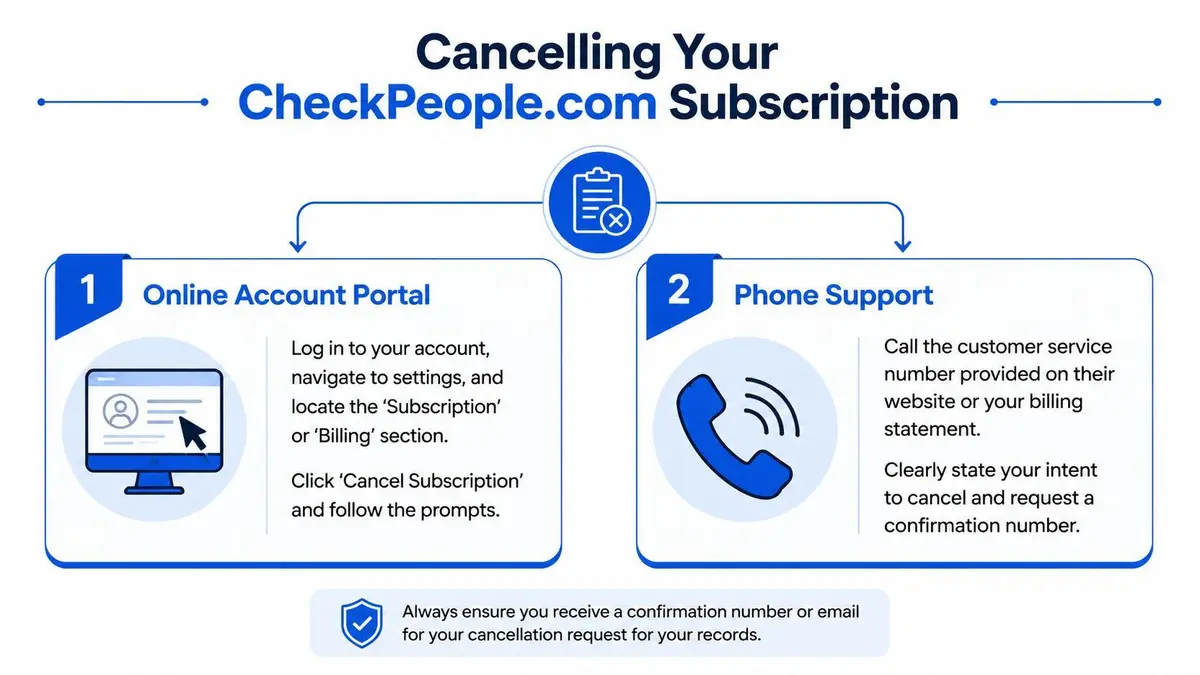
Log in using the same credentials used at signup. Go to My Account and then Subscriptions. Look for the active subscription and the cancellation control.
If the button is present, complete the full sequence and watch for a final confirmation screen. Don’t close the page early. Don’t assume a click equals cancellation.
Use this short portal checklist:
- Sign in with the original account. If you created multiple emails, confirm which one was billed.
- Go to My Account and Subscriptions. Stay on the page until the final status updates.
- Capture evidence. Screenshot every page, especially any cancellation message, date, or account status.
- Check for email confirmation. If no email arrives, treat the process as incomplete.
Move to the phone immediately
The phone call is the practical control, not the backup. When you call, have the identifying information ready before the agent answers. You want the interaction to be fast, direct, and documented.
Say this plainly:
“I want immediate cancellation of my CheckPeople subscription. Do not renew it. Do not reactivate it. Send email confirmation and give me the confirmation code now.”
That wording matters. It keeps the call from drifting into retention scripting and establishes a clear record of your request.
What to request from the agent
Don’t end the call with “okay, thanks.” End it with proof.
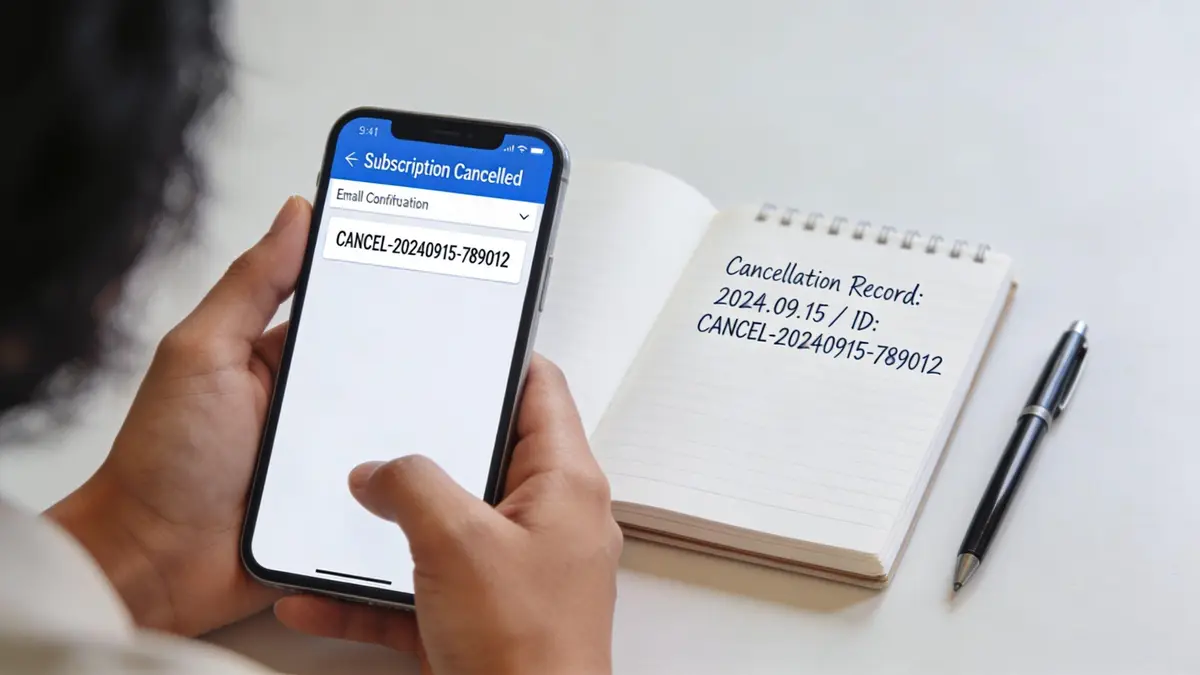
- A confirmation code. Ask for it verbally and write it down while on the call.
- A confirmation email. Ask the agent to send it during the call and wait for receipt.
- The effective date. Confirm whether cancellation is immediate or only at cycle end.
- The account identifier used. Make sure the agent canceled the correct subscription.
If the portal worked first, still make the call. If the call worked first, still log in afterward and inspect the account status. A checkpeople.com cancel subscription effort should be redundant by design.
Don’t measure success by what the agent says. Measure success by what you can prove.
Securing Proof of Cancellation and Demanding Refunds
Cancellation without evidence is a weak position. That weakness shows up later, when a new charge posts and you need to prove what happened. Verified reporting states that since 2018 the Better Business Bureau has documented over 1,200 complaints against CheckPeople, with 85 percent involving unauthorized charges after cancellation attempts. The same reporting says the company’s policy may permit refunds within 3 days of signup, yet only 20 to 30 percent of affected users recover their funds without escalation, according to Xpendy’s verified summary.
Build a cancellation file
Create a single folder for everything related to the subscription. Save screenshots, emails, bank screenshots, and a simple call log with dates, times, the number dialed, and the name of the representative if provided.
Your record should include:
- Billing evidence showing the descriptor and posted or pending charge
- Portal screenshots from the account area before and after the cancellation attempt
- Email records including subject lines, timestamps, and message bodies
- Call notes documenting what you requested and what the agent promised
This file becomes the basis for both a refund demand and any later chargeback.
Use a firm refund email
Send the refund request to support@checkpeople.com immediately if you’re within the stated refund window or if a charge posted after a cancellation attempt. Keep it short and precise.
Refund demand template
Subject: Cancel Subscription and Refund RequestI am requesting immediate cancellation of my CheckPeople subscription and a refund of the charge posted to my account. I canceled, or attempted to cancel, the subscription on [date] and preserved records of that request.
Account details:
Full name: [Name]
Email used on account: [Email]
Phone number: [Phone]
Last four digits of payment card: [1234]Confirm in writing that the subscription is canceled, that no further charges will be processed, and that the current charge is being refunded.
Please reply with written confirmation and any cancellation reference number.
[Your name]
What not to do
Don’t send a vague message saying you “want help.” Don’t omit account identifiers. Don’t rely on chat transcripts alone, and don’t wait for several billing cycles to “see if it stops.”
A disputed recurring charge gets harder to unwind when you look disorganized. Be organized instead.
Advanced Recourse When Direct Contact Fails
Direct contact is only the first layer. If CheckPeople charges you after cancellation, stops responding, or refuses to resolve the issue, move to the bank. That isn’t aggressive. It’s standard financial risk control.
Verified data from aggregated user reporting says phone cancellations show a 92 to 97 percent immediate success rate, yet up to 22 percent of users still face post-cancellation charges. In those cases, initiating a bank chargeback with proof of cancellation offers a nearly 100 percent stoppage rate. The same verified source says using the phrase “immediate cancellation” can boost agent compliance by 40 percent, according to the YouTube-based cancellation analysis cited in the verified data.
Chargeback is the practical enforcement tool
Banks care about documentation, not outrage. Give them a clean packet.
Present the dispute as a recurring subscription charge that continued after cancellation or after a documented attempt to cancel. Include your screenshots, confirmation email if you have one, call notes, and the refund demand email. If you have a confirmation code, place it at the top of the file.
Use language like this with the bank:
- Recurring charge after cancellation
- Unauthorized post-cancellation billing
- Merchant failed to honor cancellation request
- Proof attached
That framing is factual and hard to misunderstand.
Complaints create pressure and a paper trail
If the merchant doesn’t resolve the matter, file complaints with the Better Business Bureau and the Federal Trade Commission. Those complaints won’t replace a chargeback, but they create a formal record and increase pressure on the company to respond.
If a site refuses to remove information or ignores direct requests, this broader guide on what to do when a website won’t remove your information lays out the escalation logic that applies beyond billing.
A company can ignore an annoyed customer. It’s much harder to ignore a documented bank dispute and a formal complaint trail.
Escalation threshold
Don’t keep negotiating after the facts are clear. Once you have proof of cancellation and a post-cancellation charge appears, escalate. Repeating the same request through the same failed channel wastes time and increases the chance of another billing cycle.
Beyond Cancellation Erasing Your Digital Footprint
This is a frequently overlooked step. You stop the subscription, breathe out, and assume the matter is closed. It isn’t. Verified guidance identifies a major gap in most cancellation advice: after cancellation, profiles often remain in a “view-only” mode, and the platform does not automatically delete profiles upon subscription termination. To reduce that exposure, users must use privacy rights under CCPA or GDPR and send a formal erasure request to support@checkpeople.com, according to Rocket Money’s privacy-focused cancellation guidance reflected in the verified data.

Cancellation and deletion are different legal requests
A billing cancellation tells the company to stop charging you. A deletion request tells the company to stop holding or displaying your personal data where privacy law applies. Those are separate asks and should be sent as separate, explicit instructions.
For executives, public figures, attorneys, and family offices, that distinction matters. A lingering profile can expose addresses, relatives, historical records, and other identifying data even after the card stops getting billed.
Send a formal data erasure request
Use direct language. Don’t ask whether they “can” remove the profile. Tell them what you are demanding under applicable privacy rights.
Data erasure template
Subject: Privacy Request for Data Erasure and Profile RemovalI am submitting a formal privacy request for deletion of my personal data and removal of any profile or record associated with me on CheckPeople. My subscription status is not relevant to this request.
Please delete my personal information, remove any public-facing or searchable profile connected to my identity, and confirm completion in writing.
Identifying details to locate the record:
Full name: [Name]
Current and prior locations, if needed: [City/State]
Email: [Email]
Phone: [Phone]If you require identity verification, reply with the exact requirements.
[Your name]
Verify removal instead of assuming it happened
After sending the request, search for the profile again using the same variations of your name that originally surfaced the result. Save the search result pages before and after. If the profile persists, continue the privacy request trail in writing.
If your concern goes beyond one database entry and you need a broader strategy, this guide to digital footprint cleanup explains how to approach removal systematically across search, people-search databases, and residual records.
One canceled subscription doesn’t solve a data exposure problem. It only stops one payment stream.
Proactive Reputation Defense in a Data-Driven World
CheckPeople is a useful case study because it shows how fast a minor transaction can turn into a layered liability. One low-cost search can trigger recurring billing, administrative friction, and continued exposure of personal information. That combination is exactly why reactive cleanup is expensive in time and attention.
Serious reputation defense works differently. It starts with monitoring. It continues with documented removal workflows, privacy requests, dispute readiness, and disciplined review of every service that touches personal data. Executives and high-net-worth families should treat people-search platforms the way they treat physical access to a residence. Limit it, monitor it, and revoke it quickly when it creates risk.
The right posture is simple. Don’t wait for a charge to remind you that a profile exists. Don’t assume a canceled card charge means a profile is gone, and don’t leave sensitive identity data sitting in databases you no longer control.
If you searched for checkpeople.com cancel subscription, the urgent issue may be one recurring charge. The deeper issue is whether your name, family, locations, and related records are circulating in systems that are difficult to audit and even harder to unwind without a methodical approach.
If you need discreet help removing exposed personal information, de-indexing harmful search results, or coordinating a broader privacy cleanup beyond one subscription, ContentRemoval.com provides confidential assessments and execution-focused remediation for executives, public figures, family offices, and legal teams.
Frequently asked questions
Does canceling CheckPeople delete my profile?
No. The platform does not automatically delete profiles when a subscription ends, and records often stay in a view-only mode. You need to send a separate, formal erasure request citing CCPA or GDPR rights and then confirm removal by searching for your name again.
What should I say when I call CheckPeople to cancel?
Ask plainly for immediate cancellation, no renewal and no reactivation, and request a confirmation code and email while still on the call. Confirm the effective date and the account identifier the agent canceled so the right subscription is closed.
What if CheckPeople keeps charging me after I canceled?
Escalate to your bank with a clean packet: screenshots, the confirmation email or code, call notes and your refund demand. Frame it as a recurring charge after cancellation. Complaints to the BBB and FTC add a formal record but do not replace the chargeback.