
You cannot delete an individual Facebook review as a page owner; that ability was removed in 2017. Three indirect paths remain: report the review for a policy violation such as threats, harassment, fake customer status or privacy breach, ask the reviewer to edit or delete their post, or disable the Reviews tab, which hides future display but not existing content.
Key facts
- Page administrators lost the ability to delete individual reviews in 2017; the Reviews tab toggle dates from 2014.
- Cited benchmark: false or spam reviews are removed about 35 percent of the time when properly reported.
- Reviews containing threats of violence are removed with near certainty, while legitimate negative reviews almost never are.
- Facebook lets the reviewer edit or delete their own review at any time, but the business cannot.
Where ContentRemoval.com comes in. ContentRemoval.com handles Facebook review problems that have outgrown the report button: coordinated review bombing, false accusations of fraud or misconduct, reviews exposing family or personal data, and screenshots migrating into search results and forums. Founders, family office principals and their counsel usually make contact when a junior team cannot afford to make a discoverable mistake. A free 15-minute Exposure Scan maps what is removable, and the report is yours to keep. Get a Free, Confidential Exposure Scan or read how our review removal work is done.
A bad Facebook review usually lands at the worst possible moment. A board member sees it. A journalist screenshots it. A competitor amplifies it. The instinct is simple: delete it.
That instinct is wrong.
If you’re asking can you remove Facebook reviews, the core issue isn’t whether a button exists. It doesn’t. The issue is which removal path fits the facts, the platform’s rules, and your risk tolerance. Most businesses waste time arguing with Facebook about sentiment. Facebook doesn’t care about sentiment. It cares about policy violations, user control over their own content, and whether you are willing to shut the review channel down entirely.
A serious response starts with triage. Is the review removable under policy? Is it non-removable but negotiable? Is it defamatory enough to justify legal escalation? Or is the cleanest move to contain visibility and redirect social proof elsewhere? Those are strategic questions. Treat them that way.
The Inconvenient Truth About Facebook Review Removal
The myth is persistent because people assume page ownership means content control. It doesn’t. Facebook removed that assumption years ago. According to Content Removal’s review removal analysis, page administrators lost the ability to delete individual reviews in 2017, and the only direct page-level control left is disabling the Reviews tab, a feature introduced in 2014.
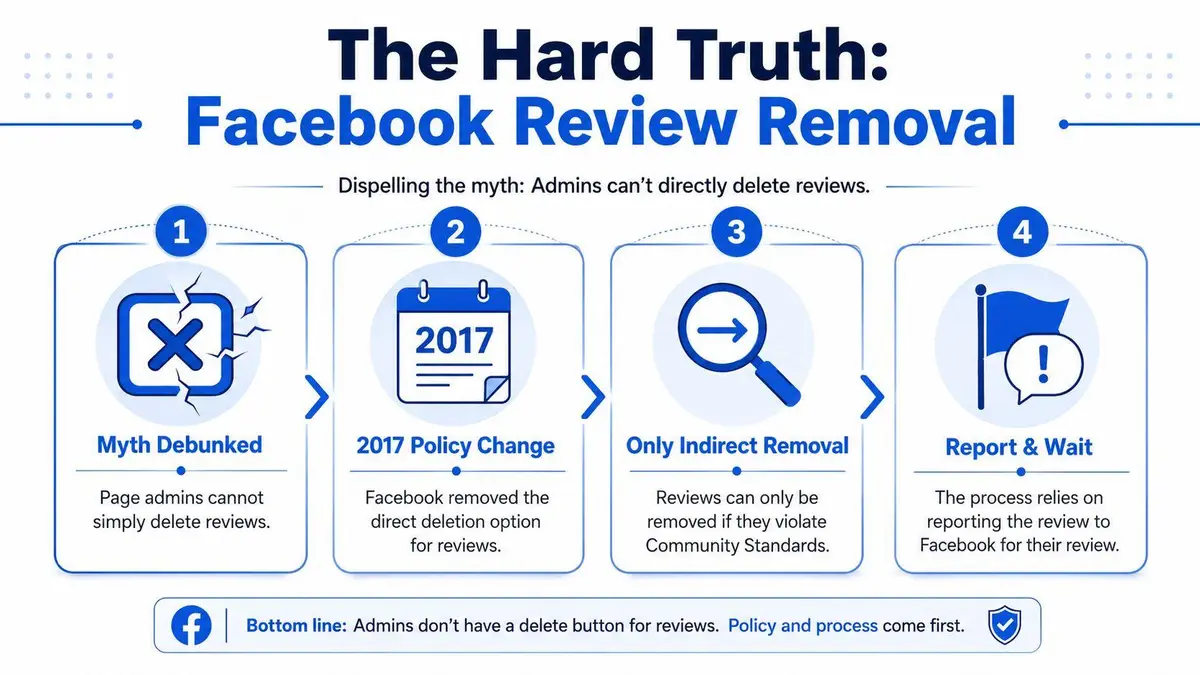
That single policy change reframed the entire problem. You’re no longer deciding whether to delete a review. You’re choosing between three indirect paths.
The three paths that actually exist
The first path is reporting. If the review violates Facebook’s standards, you report it and wait for Facebook to decide. That is not a customer service request. It is a policy enforcement request.
The second path is containment. You disable the Reviews tab and stop the public display of the review surface. That is blunt, but sometimes blunt is the right instrument.
The third path is reviewer action. The author can remove or edit their own review. You can’t.
Practical rule: Stop asking whether Facebook gives you a delete button. Ask which actor has control over this specific review: Facebook, the reviewer, or you through page settings.
This is why generic tutorials tend to fail under pressure. They focus on clicks, not impact. If you want a broader operational view of how businesses structure response systems across platforms, it’s worth reviewing resources that learn about review management in a more disciplined way. The key is to separate emotional urgency from platform reality.
What a strategic actor should do first
Start with classification, not outrage. A false accusation of criminal conduct is different from a harsh but lawful opinion. A fake customer review is different from a former employee venting through a customer-facing channel. A post exposing private information is different from a one-star recommendation with no detail.
If you misclassify the problem, you choose the wrong remedy. That is how businesses burn days in internal debate while the review stays live, indexed, and screenshot-ready.
Identifying Actionable Violations in Negative Reviews
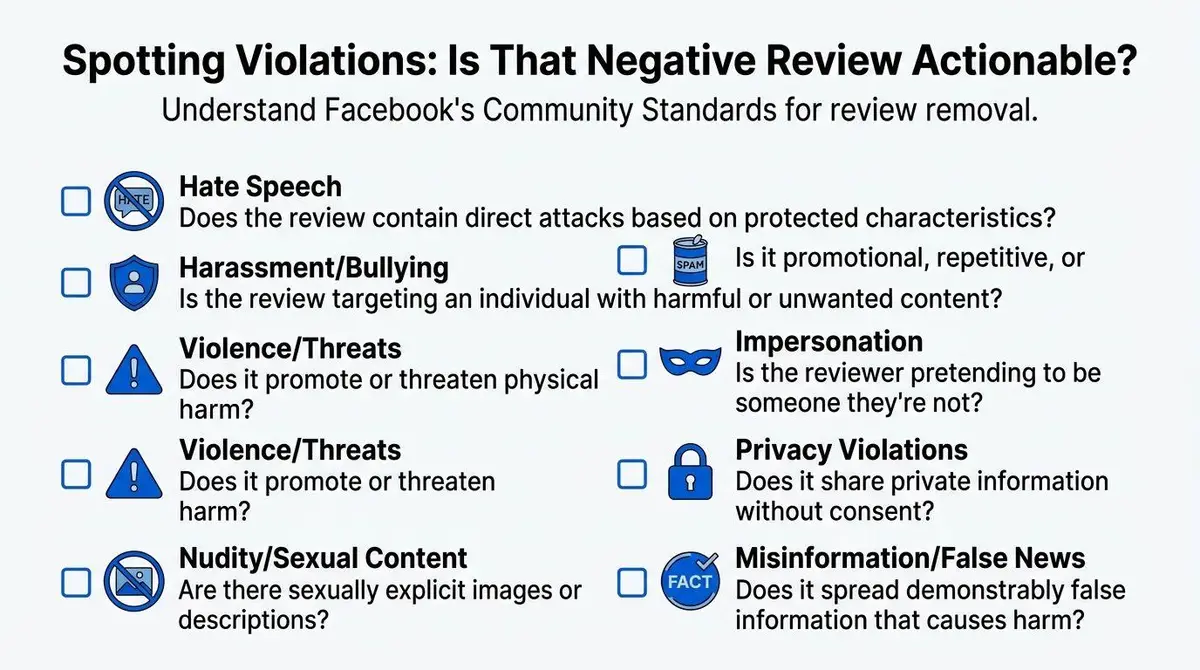
Most negative reviews are not removable. That’s the hard line. A review that says your service was poor, your staff was rude, or the experience wasn’t worth the price is usually protected opinion, even if it’s unfair, exaggerated, or written by someone with an obvious agenda.
The actionable category is narrower. It turns on whether the review crosses into a policy violation that Facebook is willing to enforce.
What Facebook is more likely to act on
According to the factual benchmark cited earlier, false or spam reviews are removed at a rate of roughly 35% when properly reported, while legitimate negative reviews are almost never removed. Reviews containing threats of violence are removed with near 100% certainty, as noted in the earlier source discussion.
That difference matters. You should think in categories:
- Threats and violent language
If a review threatens physical harm, the issue isn’t reputation management first. It’s safety and platform enforcement. Preserve evidence immediately. - Harassment directed at an individual
Reviews that target a named employee, executive, or family member with abusive language can move beyond criticism into harassment. - Fake customer status
If the reviewer never transacted with you, and you can prove it, the review may fit the fake or false-content path better than a generic complaint. - Privacy violations
Doxxing, publication of direct contact details, medical details, financial data, or personal identifiers can create a stronger removal basis than the underlying criticism itself.
A review becomes actionable when you can point to a rule Facebook recognizes and evidence Facebook can evaluate.
What feels fake but usually isn’t enough on its own
Poor spelling doesn’t prove falsity. A vague complaint doesn’t prove a competitor posted it. An anonymous profile doesn’t automatically establish impersonation. Many executives lose removal opportunities because they report what they believe, not what they can substantiate.
Use a legal filter. Separate statements of opinion from statements of fact. “I hated working with them” is ugly but usually not removable. “This company stole my funds” is a factual accusation. If false, that can justify a more aggressive response, including a defamation analysis. If you’re evaluating whether the content crosses that line, review a specialist framework for removing defamatory online content.
The reporting choice should mirror the strongest provable violation. If you choose “spam” because it feels easy when the actual issue is privacy or threats, you weaken your case.
A useful explainer on the mechanics sits below, but don’t confuse mechanics with judgment. Judgment is what gets reviews removed.
Executing the Takedown Reporting Process
Once you’ve identified a genuine violation, precision matters more than indignation. Facebook’s reporting path isn’t a one-click delete tool. The documented route is to open the review, use the three-dot menu, choose the reporting reason, and submit it for Facebook’s review through the workflow described by Reputation Rhino’s step-by-step Facebook review guide.
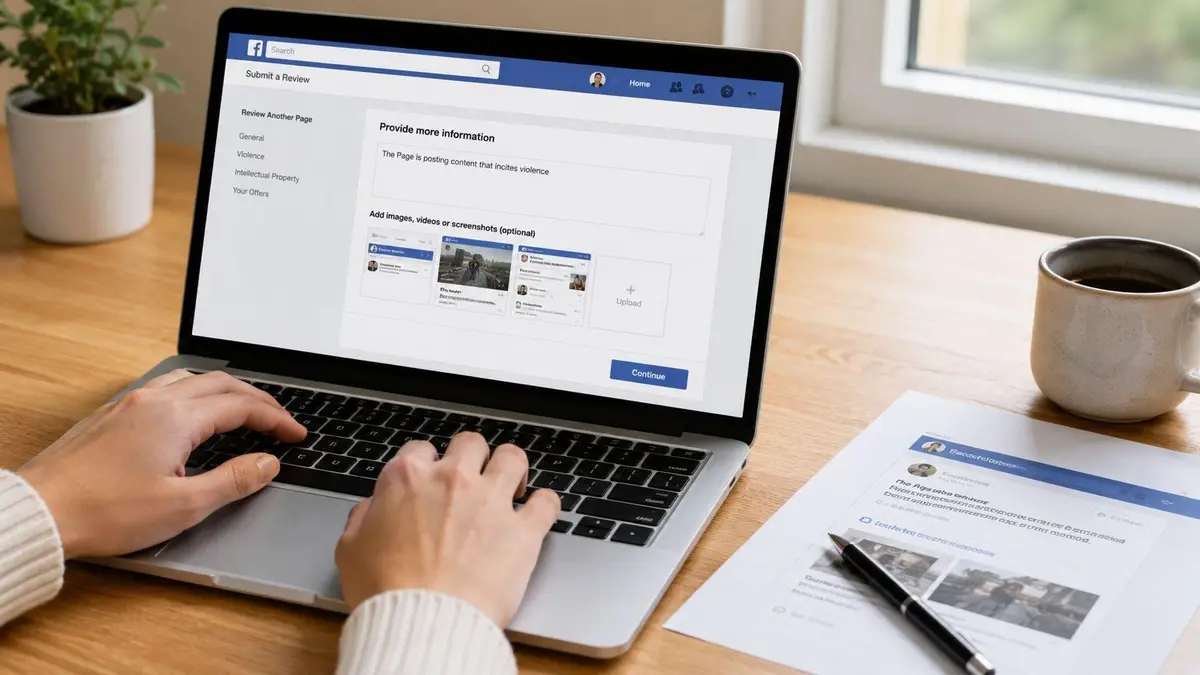
That sounds simple. It isn’t. The difference between a weak report and an effective report is the evidentiary package behind it.
Build the file before you click report
Do not start inside Facebook. Start inside your own records. Pull booking logs, CRM data, payment records, call logs, support tickets, visitor logs, or account history that establish one of two things: the reviewer was never a customer, or the factual claims in the review are false.
Use a short evidence bundle:
- Screenshot the review in full
Include the profile name, date, and the page URL context. - Capture supporting records
If no transaction exists, document the absence clearly. If a claim is false, isolate the record that disproves it. - Draft a one-paragraph policy narrative
State the violation, identify the false statement, and attach the supporting record. Write for a moderator with limited time. - Preserve escalation copies
Save everything outside the platform in case the review spreads or the matter escalates into legal correspondence.
Match the report category to the strongest violation
Many businesses fail in this respect. They choose the most emotionally satisfying category instead of the most defensible one.
A clean report sounds like this:
This review contains false factual claims and appears to be posted by someone who was not a customer. Our records show no transaction under the stated name or date range. Attached records support that discrepancy.
That is far more effective than “This review is unfair and damaging.” Facebook doesn’t adjudicate fairness. It reviews policy alignment.
If the issue extends beyond a review into a broader Facebook abuse problem, such as a harmful post you don’t control, the escalation logic changes. In that situation, use a more targeted strategy for removing a Facebook post that is not yours, because the reporting posture and evidence framing are different.
Timing and restraint
File once, file accurately, and avoid flooding the system with inconsistent reports from multiple staff members. Contradictory submissions create noise. Assign one person to own the file, one person to own evidence, and one approved narrative.
If the review implicates criminal allegations, extortion, impersonation, or exposure of private information, preserve evidence before any outreach. You may need the original version later.
Advanced Strategies for Non-Compliant Reviews
The most dangerous reviews are often the ones that don’t clearly violate policy. They can be false in spirit, highly damaging in effect, and still difficult to remove through ordinary reporting. That is where a strategic actor stops treating Facebook as the only decision-maker.
Facebook states that a user can edit or delete a business review they wrote at any time, while businesses cannot, according to Facebook’s help guidance on recommendations and reviews. In practical terms, that means the reviewer may be your only direct removal channel for a non-violating post.
Negotiation is often the shortest route
Contact the reviewer with discipline. Not anger. Not defensiveness. Not a legal memo on first touch unless the facts require it.
A strong outreach message does three things. It acknowledges the complaint, identifies any factual inaccuracy with precision, and asks for one specific action, edit or deletion. If you offer a remedy, make it legitimate and documented. Never condition compensation on removal in a way that creates a new compliance problem.
A workable structure looks like this:
- Open with recognition
Acknowledge that the reviewer had an experience or believes they did. - Correct only what you can prove
If the review says your company never delivered, point to delivery records. If it names the wrong person or date, correct that. - Ask for a narrow fix
Request deletion if the entire post is false. Request an edit if part of the post is accurate and part is not.
Ask for the smallest concession that solves the reputational problem. People resist total surrender. They sometimes accept a factual correction.
When the issue is legal, treat it as legal
Some reviews don’t belong in a customer service workflow. They belong in a legal file. False accusations of crime, fraud, professional misconduct, abuse, discrimination, or regulatory violations can move from platform problem to defamation problem quickly.
That doesn’t mean you threaten suit reflexively. It means you evaluate jurisdiction, provable falsity, damages, anonymity, and whether the platform record should be preserved for later use. In serious matters, counsel may send a preservation notice, a cease and desist letter, or initiate proceedings to identify an anonymous poster.
You should also consider collateral impact. If the same allegation appears on Google, industry forums, Reddit, or in search results, a Facebook-only approach is too narrow.
Pressure without panic
A reviewer who ignores one polite request may still respond to a more formal notice from counsel. A reviewer who posted out of anger may edit after receiving a factual rebuttal they can’t refute. A reviewer engaged in extortion or coordinated abuse requires a different posture entirely.
This is also the point where solutions diverge. Some matters call for legal counsel, some for internal compliance records, and some for specialist removal support. ContentRemoval.com provides Facebook content removal services for harmful platform content, among other remedies, but the right escalation depends on whether your issue is false speech, policy abuse, or broader reputational contamination.
The Nuclear Option Disabling Your Reviews Tab
Disabling reviews is not a cleanup tool. It is a containment tool. The only deterministic way to eliminate future Facebook reviews is to disable the review surface in page settings, and Blue Corona’s explanation of turning off Facebook reviews correctly notes that this is preventive, not retroactive.
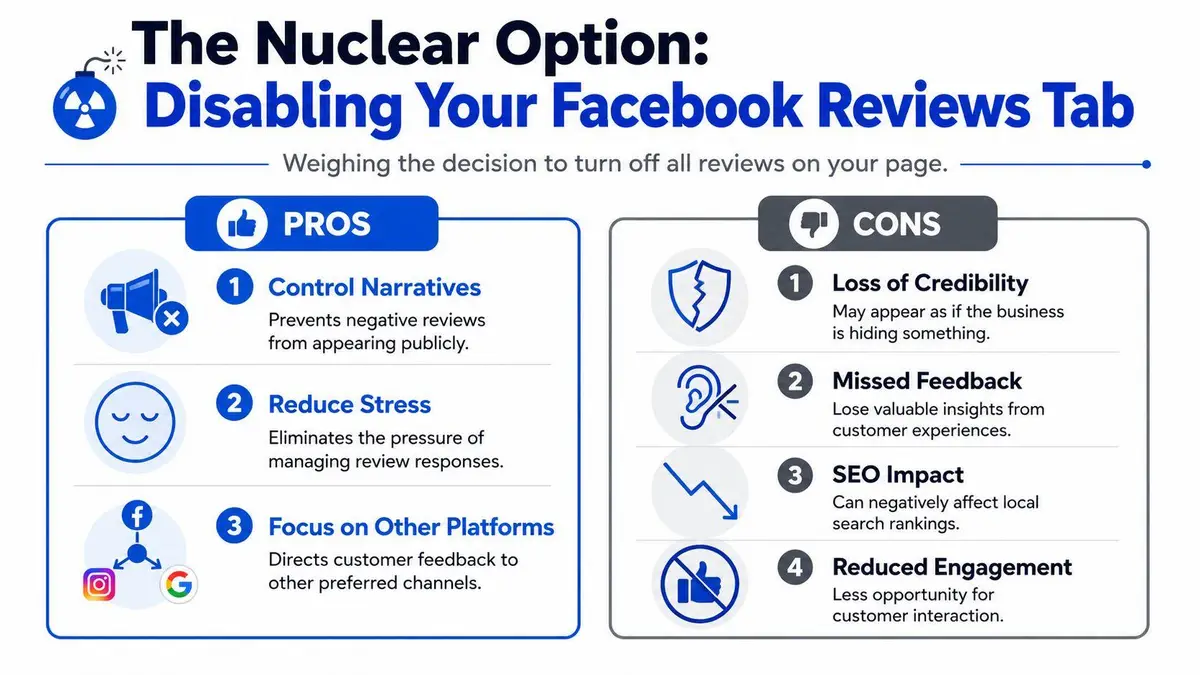
The distinction is important. If you’re asking can you remove Facebook reviews, disabling the tab doesn’t answer that question for existing content as many might expect. It changes visibility and future exposure. It does not function like a selective deletion tool.
When disabling reviews makes sense
This move is rational when the Facebook page is no longer a core trust asset. If your business generates little meaningful conversion through Facebook, but carries recurrent review risk, shutting off the channel may be efficient.
It also makes sense during a concentrated crisis. If you are facing coordinated hostility, public controversy, or a temporary wave of bad-faith interaction, removing the review surface from public view can buy time while other measures run.
A simple decision table helps:
| Situation | Better move |
|---|---|
| One or two isolated damaging reviews | Report, negotiate, or escalate legally |
| Suspected fake review cluster | Preserve evidence and pursue targeted takedowns |
| Ongoing public controversy on Facebook | Consider temporary containment through disabling |
| Facebook not material to revenue or trust | Permanent disablement may be justified |
The cost most businesses underestimate
You lose more than a problem channel. You also lose a public feedback venue that can validate your legitimacy when sentiment is positive or mixed. Turning reviews off can signal caution, but it can also signal retreat.
If you disable reviews, do it as a deliberate reputation architecture decision, not as a late-night reaction to a single ugly post.
If your brand depends on visible social proof, disabling the tab should be paired with a plan to strengthen reputation signals elsewhere. If Facebook is peripheral, the tradeoff is easier. Either way, decide with a clear view of what you’re sacrificing.
When to Escalate to a Professional Reputation Firm
Self-help is appropriate when the facts are clear, the stakes are modest, and the review is isolated. It becomes inadequate when the review is part of a larger attack pattern, when privacy or defamation issues are involved, or when the person handling the matter can’t afford mistakes.
The trigger isn’t frustration. The trigger is complexity.
Clear signs the matter has outgrown internal handling
Some situations justify immediate outside involvement:
- Coordinated review bombing
Multiple reviews appear in a short window, often with similar language, disposable accounts, or ties to a business dispute. - Defamation with business consequences
The review accuses you or your company of criminal, financial, or professional misconduct and the allegation is false. - Privacy and identity risk
The content names family members, reveals personal data, or targets an executive personally. - Cross-platform spread
The review is no longer just a Facebook issue. Screenshots migrate to search results, forums, social posts, or press inquiries. - Confidentiality concerns
A founder, celebrity, or family office principal can’t have junior staff fumbling outreach or creating discoverable mistakes.
What professionals do differently
An expert firm doesn’t merely submit the same report you can submit yourself. It classifies the claim, structures the evidence, evaluates legal advantage, and decides whether removal, suppression, containment, or parallel action is the proper objective.
That is especially true for executives who need a framework rather than another checklist. A more complete view of that posture appears in this guide on the strategic approach to online review removal services for executives.
Professional escalation also protects against self-inflicted damage. Internal teams often over-contact reviewers, misstate legal claims, report under the wrong category, or lose their advantage by showing their entire hand too early. High-stakes reputation work is not just about being right. It is about sequencing.
The practical threshold
If the review can affect financing, partnerships, employment decisions, family privacy, or pending litigation, treat it as a strategic risk event. The cost of amateur handling can exceed the cost of expert intervention very quickly.
The platform’s rules are narrow. Your options don’t have to be.
If a Facebook review is false, abusive, privacy-invasive, or part of a larger reputational attack, ContentRemoval.com can assess the facts confidentially and map the right response, whether that means platform reporting, legal escalation, or broader containment across search and social surfaces.
Frequently asked questions
How do I report a Facebook review for removal?
Open the review, use the three-dot menu, choose the reporting reason and submit. Before that, build the evidence file: a full screenshot, records showing the reviewer was never a customer or that a factual claim is false, and a one-paragraph policy narrative written for a moderator with limited time. File once, accurately, under the strongest provable category.
Does turning off Facebook reviews delete the existing ones?
No. Disabling the Reviews tab is preventive and hides the review surface from public view, but it is not a selective deletion tool. The article suggests it for pages that are not core trust assets or during a concentrated crisis, weighed against the loss of visible social proof.
Can I ask a reviewer to remove their Facebook review?
Yes, and for a non-violating review the reviewer may be the only direct removal channel. Acknowledge the complaint, correct only what you can prove, and ask for one narrow action, an edit or a deletion. Never condition compensation on removal in a way that creates a new compliance problem.