

California mugshots from Los Angeles County spread from agency records into search results, image search, mugshot sites and data brokers. Removal runs on two fronts at once: a legal track that seals or clears the source record under Penal Code 851.91 or SB 731, and a technical track of publisher demands, de-indexing and monitoring. Court relief alone never clears Google.
Key facts
- Penal Code 851.91, filed on Form CR-409, allows sealing of arrests that did not lead to conviction.
- Senate Bill 731 broadened record-clearing relief for many people who completed their sentence requirements.
- Assembly Bill 994, effective January 1, 2024, requires agencies to remove nonviolent-arrest mugshots from social media within 14 days.
- The First Amendment Coalition reports 68 percent of California public records requests for mugshots are denied or delayed.
Where ContentRemoval.com comes in. ContentRemoval.com handles the technical front for Los Angeles County mugshot cases, taking on publisher takedowns, Google web and image de-indexing and repost monitoring while criminal counsel pursues sealing or expungement. Executives, physicians, lawyers and family office principals usually reach out through their general counsel or assistant once a booking photo surfaces before a financing, board review or licensing check. A free 15-minute Exposure Scan maps what is removable, and the report is yours to keep. Get a Free, Confidential Exposure Scan or read how our mugshot removal work is done.
At 6:12 a.m., a chief executive opens Google before a board call and sees a Los Angeles County booking photo ranking beside their name. By 6:20, the general counsel has a screenshot. By 7:00, a recruiter, investor, journalist, or competitor can find the same result. The legal merits of the arrest barely matter in that first wave of damage. The image does the work. It suggests risk, instability, and scandal before anyone reads a word.
A core difficulty with California mugshots in Los Angeles County lies in their widespread dissemination. They don’t stay confined to a courthouse file or a sheriff’s database. They spread into search results, data brokers, social posts, copied directories, and long-tail pages that remain obscure until a due diligence check uncovers them. For high-net-worth clients, the issue isn’t curiosity. It’s an advantage. The mugshot becomes a shortcut others use to question judgment, reduce trust, or renegotiate power.
If you’re dealing with this now, stop treating it like a one-step cleanup. It isn’t. A complete response has to address both the underlying record and the online copies that survive long after a case changes status. If you miss either side, you stay exposed.
The Moment of Discovery and the Path Forward
The first call usually sounds controlled. The second doesn’t.
An executive says the image “might be old” or “shouldn’t still be public.” Their spouse has already seen it. Their assistant has started checking search results from another browser. A family office principal wants to know who else has access. Nobody cares about internet theory at that point. They want containment, discretion, and a plan that starts immediately.
Los Angeles County creates a particular kind of pressure because arrest information is easy to rediscover once a name enters circulation. If you’re trying to confirm what’s currently visible, one practical starting point is checking publicly available LA County arrestee information to understand what identifiers and custody details may already be surfacing. That isn’t the solution. It’s triage. You need to know what others can see before you can shut it down.
What matters in the first 48 hours
The early mistake is emotional overreaction. People email websites from personal accounts, threaten vague lawsuits, and trigger fresh indexing. That often makes the situation worse.
A disciplined response focuses on three questions:
- What is the source record? Arrest only, dismissed case, no-file, conviction, or old felony now potentially eligible for relief.
- Where is the image visible? Search results, image search, law enforcement pages, scraped archives, reputation attack pages, or social media reposts.
- What is the business threat? Employment review, transaction diligence, licensing issue, media exposure, family office concern, or political vulnerability.
Practical rule: Don’t contact every site at once. Sequence matters. The wrong outreach can preserve the page, alert mirrors, or create new screenshots.
The path forward has to be private and methodical. First, identify every visible instance. Then separate the official record problem from the internet distribution problem. Then push both tracks at the same time. That’s how you regain control.
Mapping the Damage Where LA County Mugshots Surface
Before you remove anything, map everything. A weak inventory leads to weak results.
Official sources are only the starting layer. They may include custody information, booking references, and agency-controlled records. The more serious exposure usually comes later, when third parties scrape, republish, and optimize the arrest data around your name. Those sites know exactly what they’re doing. They rely on shame, urgency, and search engine persistence.

Start with the primary publication chain
The first task is to identify where the image likely originated and how it moved.
- Agency-controlled records: These may contain the original booking photograph, arrest details, and identifying data.
- Search engine results: Web results and image results often diverge. A page may vanish from one and remain in the other.
- Third-party mugshot sites: These pages are often designed to rank for names, cities, and arrest terms.
- Data broker spillover: Personal data aggregators may attach arrest references to profile pages.
- Secondary republication: Blogs, forums, and gossip pages often copy from the mugshot sites, not from the government.
If you want a clearer understanding of that ecosystem, this analysis of how mugshot sites work is useful because it explains why simple takedown requests rarely solve the full problem.
The permanence problem is bigger in Los Angeles County
This isn’t just about one image on one site. Los Angeles County is deploying a multimodal biometric identification system expected to house data on up to 15 million subjects, integrating fingerprints, mug shots, iris scans, and palm prints. The data is retained indefinitely regardless of conviction status, creating a permanent digital fingerprint and facial archive for every individual encountered by law enforcement, according to Reveal’s reporting on the county’s biometric system.
That changes the strategic outlook. It means you should assume the official capture of identity data is durable, even if your public-facing web footprint can be reduced or removed.
Build a real damage map, not a casual search
Use a structured review, not a single Google query from your office Wi-Fi. Check branded search terms, image search, name-plus-city combinations, and cached variations. Review copied snippets and URL patterns. Pay attention to pages that don’t rank on page one today. Those often resurface later during news cycles, lawsuits, promotions, or opposition research.
The biggest mistake is stopping after the obvious result disappears. That only means the first page changed. It doesn’t mean the threat is gone.
A complete damage map lets you prioritize. Remove what is visible now, suppress what’s likely to rise next, and monitor the sites most likely to republish.
The Two Fronts of Removal Legal vs Technical
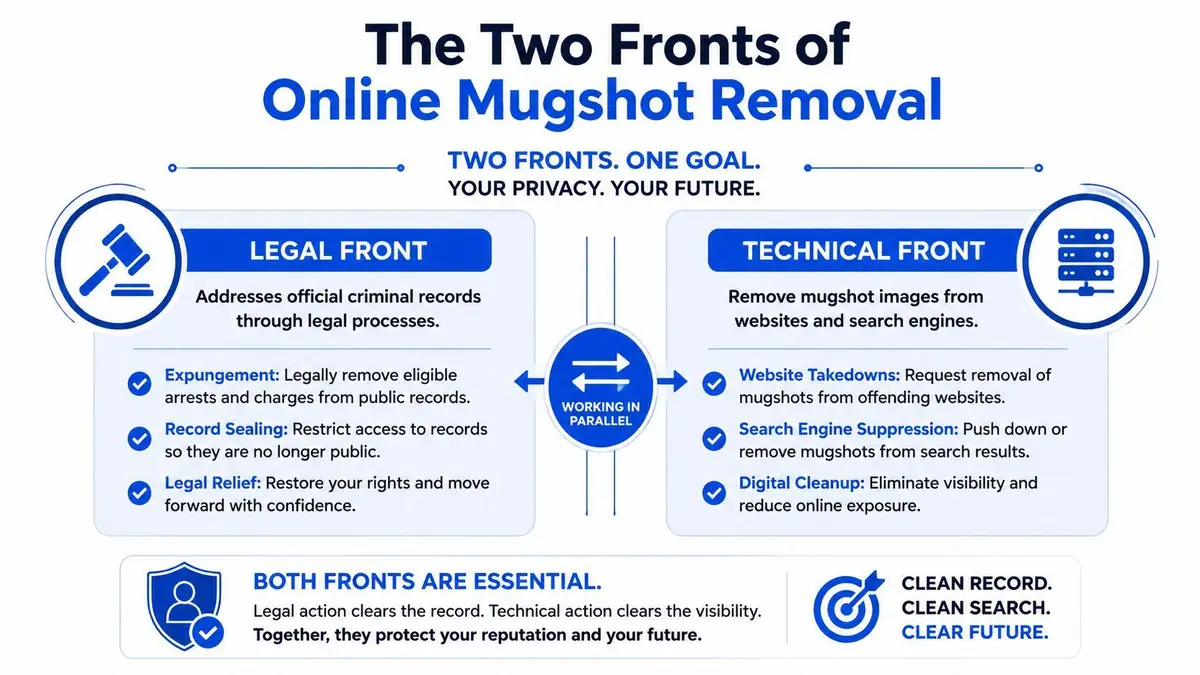
A common strategic error lies in choosing the wrong battlefield: the assumption that clearing the court record clears the internet, or that deleting a page from search results solves the underlying legal exposure. Neither is true.
A proper strategy for California mugshots in Los Angeles County runs on two tracks at once. The legal front addresses the source record through California procedures such as sealing or record-clearing relief. The technical front targets public copies, search visibility, indexing, and republishment.
Why legal success doesn’t erase Google
A judge can grant relief affecting the official record. That matters enormously. But search engines and private publishers don’t automatically scan court dockets and remove old copies because your status improved. If a mugshot site copied the image years ago, that site may continue displaying it unless someone forces a separate outcome.
The same problem exists in reverse. You can sometimes get a page removed, de-indexed, or suppressed without changing the official record at all. That may solve the immediate reputation threat, but it doesn’t fix licensing disclosures, background review issues, or future record pulls.
California’s gray area helps mugshots persist
The law around access is not clean. No California case law explicitly confirms whether booking photos must be released under the Public Records Act, and 68% of public records requests for mugshots in California are denied or delayed, according to the First Amendment Coalition’s discussion of CPRA access to mugshots. That uncertainty cuts both ways. It creates hesitation inside agencies, but it also leaves room for inconsistent practices and aggressive publication behavior by third parties.
Here’s the practical difference:
| Front | What it targets | What it can accomplish | What it won’t do |
|---|---|---|---|
| Legal | Arrest or court record status | Can make records non-public in some contexts or clear eligible convictions | Won’t automatically remove old internet copies |
| Technical | Websites, search engines, image results, reposts | Can reduce or eliminate public visibility online | Won’t change the official legal record |
Strategic advice: If you choose only one front, choose based on your immediate threat. If a financing event or board review is imminent, technical action often comes first. If licensing, immigration, or long-term disclosure risk is central, legal action must start immediately.
The strongest outcomes come from coordination. Legal relief gives you an advantage. Technical removal turns that advantage into practical invisibility.
Clearing the Source California Legal Remedies
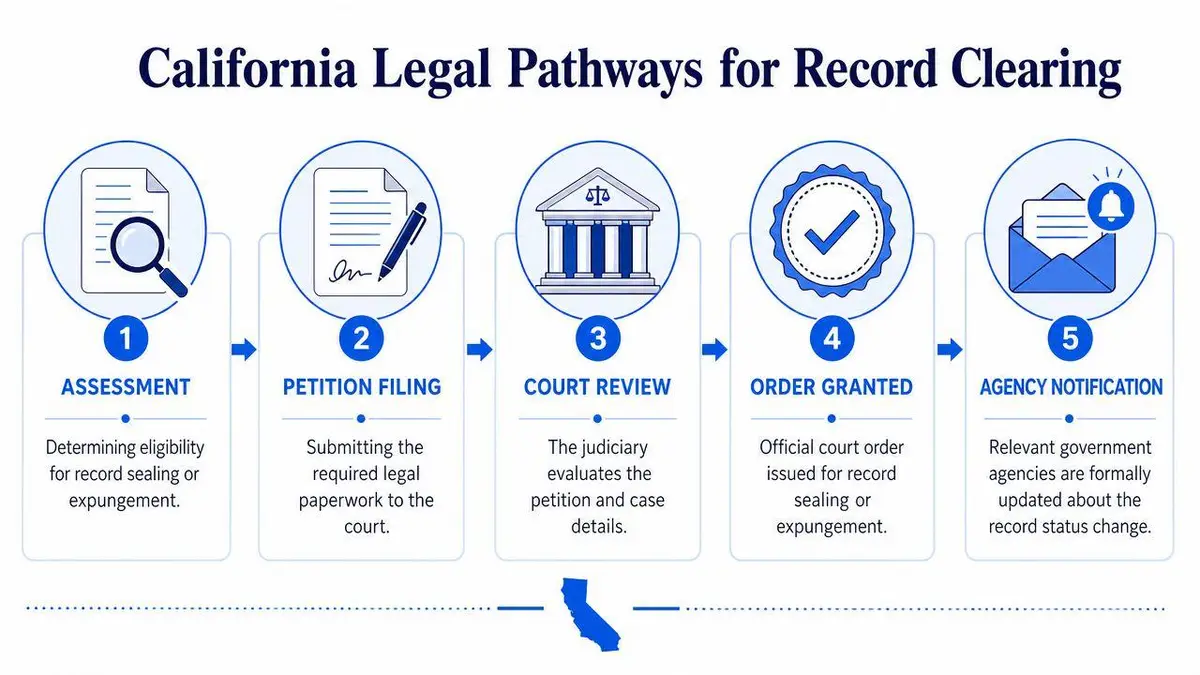
Your name surfaces in a board packet, a lender’s diligence memo, or opposing counsel’s background file. If the underlying California record is still publicly exposed, online cleanup alone will not protect you. Legal relief changes the posture of the case at its source. That is what gives later removal demands real force.
Arrest with no conviction
For arrests that did not lead to a conviction, California Penal Code Section 851.91 is often the first statute to examine. It allows eligible individuals to petition to seal arrest records, commonly using Form CR-409. If granted, the record is removed from public access in the ordinary sense, while certain government entities may still retain access for limited purposes.
That distinction is decisive. Sealing improves your public record position. It does not wipe every internal government database or erase every copy already scraped by third-party publishers. Clients who misunderstand that point lose time and money.
Use the right remedy for the facts:
| Situation | Likely legal route | Strategic value |
|---|---|---|
| No charges filed | 851.91 petition | Strong basis to restrict public visibility at the source |
| Case dismissed before trial | 851.91 petition | Stronger footing for later takedown demands |
| Diversion or DEJ completed | 851.91 may apply | Frequently missed, often worth review |
| Not guilty verdict | 851.91 petition | Strong legal posture and strong narrative posture |
Convictions and the SB 731 shift
Many high-risk clients assume an old conviction leaves no meaningful path to record relief. That assumption is outdated. California expanded relief through Senate Bill 731, and CalMatters’ reporting on SB 731 explains how the law broadened access to record clearing for many people who have completed sentence requirements and remained out of trouble.
Do not treat that change as automatic erasure. Eligibility, timing, and case posture still matter. Some matters qualify for dismissal or sealing relief. Others do not. The strategic point is simpler. Old convictions that were once written off should now be reviewed with care, especially if reputational exposure affects licensing, capital access, fiduciary roles, or family office scrutiny.
A separate path may exist where factual innocence can be established. That is a narrower and more aggressive remedy. It is not a catch-all option for dismissed cases, and weak filings undercut credibility.
What good counsel does differently
A standard criminal record clearing filing is often too narrow for a reputation-sensitive matter. You need a record strategy built for downstream enforcement. Case numbers, arrest dates, booking identifiers, agency names, and disposition language must line up cleanly across court papers, agency records, and later takedown submissions.
That is where legal and technical work meet. If your court order, docket language, and agency references are sloppy or inconsistent, publishers and search platforms get an excuse to deny removal. If the source record is sealed with precision, technical removal becomes far more defensible and far more effective. For a broader legal framework, this guide to content removal in California privacy and reputation law connects record status, privacy arguments, and online enforcement.
This video gives a useful overview of California record-clearing mechanics:
The outcome you want
Clients often ask for “an expungement” as if the label settles the strategy. It does not. The objective is to change the status of the source record, reduce lawful public access, and create a stronger foundation to remove copied versions from websites and search results.
Counsel’s view: Choose the remedy that changes exposure, not the remedy with the most familiar name.
A sealed arrest record can do more for reputation control than an ill-fitting expungement request. Precision matters. Source relief and online removal are different fronts, and serious damage control requires both.
Executing Technical Takedowns from Public View
Technical removal is where most DIY efforts collapse. People assume a mugshot page is just another bad result that can be talked down, reported, or shamed offline. It usually isn’t. Many operators are anonymous, offshore, unresponsive, or monetizing the pain directly. Sending one angry letter rarely changes that.
The technical side requires a disciplined campaign against visibility itself. The objective is simple. Remove the source where possible, de-index where necessary, and stop reuploads before they create a second crisis.

What technical work actually includes
A professional takedown program is not one email template. It usually combines several lines of attack:
- Publisher-facing demands: These target the hosting site with specific arguments based on accuracy, privacy posture, status of the case, and site-specific policy weaknesses.
- Search engine de-indexing: If a page can’t be deleted, reducing its discoverability can still neutralize the threat.
- Image result suppression: This is separate from ordinary web search and needs its own attention.
- Monitoring for mirrors and reuploads: Removal without surveillance is temporary.
If your immediate concern is search visibility, this protocol for getting a mugshot off Google Images shows why image-based enforcement differs from ordinary page removal.
California law helps in one narrow but useful area
Law enforcement social media used to be a stubborn source of republication. California changed that. Assembly Bill 994, effective January 1, 2024, requires law enforcement agencies to automatically remove mugshots of individuals arrested for nonviolent crimes from their social media accounts within 14 days, as explained in this analysis of AB 994 and law enforcement mugshot posting.
That doesn’t solve the internet. It does remove one public amplifier, and in some cases that matters a great deal because reporters, bloggers, and copycat accounts often pull images from agency social posts.
Why professionals outperform DIY outreach
The difference isn’t magic. It’s strategic application, sequencing, and pattern recognition.
A specialist knows which sites respond to privacy-based arguments, which require legal-status documentation first, which search pathways produce de-indexing opportunities, and which operators ignore direct complaints unless the request is framed correctly. Some firms also maintain monitoring systems and established workflows that let them move fast when a page reappears. ContentRemoval.com is one example of a service provider that handles mugshot and arrest record removal, de-indexing, and ongoing monitoring as part of a broader reputation protection process.
Most clients don’t need more outrage. They need fewer URLs, fewer indexed images, and fewer copies sitting one click away from a name search.
Technical takedowns are also where discretion matters. Personal outreach from the subject of the mugshot often confirms identity, supplies fresh contact information, and creates a paper trail the publisher can exploit. Controlled outreach through counsel or a specialized removal team avoids that mistake.
Your Action Plan Timelines Costs and Next Steps
Your name shows up in a Los Angeles County mugshot result on Monday morning. By Tuesday, a lender, board contact, or opposing party has seen it. At that point, delay becomes expensive.
Treat this as a two-track matter from day one. One track deals with the underlying record through sealing, expungement, or related court relief. The other deals with what the public sees right now: copied mugshots, indexed pages, image search results, and reposted summaries. If you ignore either side, the problem stays alive.
First 72 hours. Control the exposure.
Start with evidence and discipline. Capture the live search results, image results, and every direct URL. Save screenshots with dates. Record which pages rank first, which include your photo, and which appear on page one for your full name.
Then stop personal outreach.
Direct contact with publishers usually makes the situation worse. It confirms identity, gives operators fresh contact information, and creates a written record that can undermine later removal efforts. Use counsel or a specialized removal team instead.
At the same time, assemble the documents needed for legal review. That usually means booking information, case numbers, court disposition records, and any proof of dismissal, no-file decision, acquittal, or completion of a diversion program. As noted earlier, California record-clearing options may limit public access to the source record. They do not automatically erase the copied pages already sitting on third-party sites.
The next 30 days. Run legal and technical work in parallel.
Waiting for court relief before starting online removal is a strategic mistake. Courts work on their own schedule. Search results do not.
Use this sequence:
- Build a full inventory. Include search, image, news, social, people-search, and mugshot-site results.
- Sort by source type. Separate official agency pages from mugshot publishers, data brokers, forum posts, and news archives.
- Prioritize by business risk. Start with name-search results, image thumbnails, and pages likely to be reviewed by employers, investors, regulators, or counterparties.
- Begin legal review at once. Determine whether sealing, expungement, or another form of relief applies to the underlying record.
- Start technical removals at the same time. Seek publisher takedowns, search de-indexing where available, and suppression of copied images.
- Monitor for reposting. Assume at least some content will reappear.
This is the part many people get wrong. Legal relief addresses the source. Technical removal addresses distribution. You need both if the goal is actual reputation protection rather than a file-stamped court result that still leaves your photo ranking in Google.
Timelines and cost discipline
Legal remedies often take months. Technical results can happen faster, sometimes within days or weeks, depending on the site, the facts, and the quality of the submission.
Speed has value.
If a financing event, licensing review, custody dispute, board appointment, or media inquiry is pending, public-facing cleanup usually deserves immediate attention even while the legal process continues in the background. Public visibility creates the immediate harm. Source-record relief strengthens the case and reduces future republication.
Cost should be judged against exposure, not filing fees alone. For a founder, senior executive, physician, lawyer, investor, or family office principal, the central issue is whether this result affects credibility, negotiations, underwriting, internal trust, or household privacy. A cheap, fragmented approach often costs more because it fails, triggers reposting, or forces a second round of work under tighter time pressure.
Bring in specialists immediately if any of these apply
- More than one site has published the mugshot. That usually means copying has already spread.
- The matter involves dismissal, no-file, acquittal, or outdated allegations. Those cases require careful framing.
- You hold a public-facing or licensed role. Informal outreach is too risky.
- Image results are ranking for your name. Visual search exposure raises the urgency.
- You need discretion. Friends, assistants, or in-house staff should not be improvising this process.
The objective is control. Remove what can be removed, suppress what cannot, and clear the source record wherever the law allows.
The right next step is a confidential assessment that evaluates legal eligibility and maps the online exposure at the same time. That gives you a timed plan, a budget tied to risk, and a clear order of operations.
If your Los Angeles County mugshot or arrest record is affecting negotiations, employment, licensing, family privacy, or search visibility, ContentRemoval.com can evaluate the legal and technical removal paths in parallel and provide a confidential action plan focused on source record relief, takedowns, de-indexing, and monitoring.
Frequently asked questions
Does expunging or sealing a California arrest record remove the mugshot from Google?
No. Sealing under 851.91 or relief under SB 731 changes the official record, but mugshot sites that copied the image years ago and search engines do not scan court dockets. Online copies need a separate technical removal effort, which is why the article recommends running both tracks in parallel.
Should I contact mugshot websites myself to ask for removal?
The article advises against it. Direct outreach from the subject confirms identity, hands operators fresh contact details and creates a paper trail that can undermine later removal. Controlled outreach through counsel or a specialized removal team avoids those mistakes.
How long does it take to remove a Los Angeles County mugshot?
Legal remedies often take months, while technical results can come within days or weeks depending on the site, the facts and the quality of the submission. If a financing event, licensing review or media inquiry is pending, public-facing cleanup usually deserves immediate attention while the court process continues.