

C-suite online reputation protection is a digital defense framework, not a PR function. It starts with a forensic audit of the executive’s footprint, removes personal data from broker sites, hardens accounts, deploys continuous monitoring and builds owned authoritative content. When damaging material appears, the toolkit is DMCA notices, court-ordered removal, terms-of-service escalation and de-indexing, with source removal the goal.
Key facts
- Research cited says 40 percent of C-suite leaders report having been subjected to a cyberattack.
- Five threat categories: data broker exposure, impersonation, defamation, hacked or leaked information, misleading search results.
- Research cited ties 70 percent of a company’s reputation to public perception of its CEO.
- Simple copyright claims can resolve in under 48 hours; hostile offshore defamation may take weeks or months.
Where ContentRemoval.com comes in. ContentRemoval.com works as the specialist partner this guide describes for chief executives, founders and board members: triage and threat classification, legal and technical takedowns, de-indexing and verification that content is gone from source and search caches. A chief of staff, general counsel or the board’s advisers usually make contact, and every engagement runs under NDA on encrypted channels. A free 15-minute Exposure Scan maps what is removable, and the report is yours to keep. Get a Free, Confidential Exposure Scan or read how our reputation management work is done.
For a C-suite executive, an online presence is no longer a professional accessory; it is a core component of corporate value and a significant source of strategic risk. C-suite online reputation protection is not a matter of vanity but a framework for digital defense. This discipline moves beyond reactive public relations into proactive, technical, and legal countermeasures designed to neutralize threats before they inflict damage upon an executive and, by extension, the enterprise they lead.
Understanding the Executive Digital Footprint

An executive’s digital footprint is a mosaic of every data point available about them online, extending far beyond a LinkedIn profile and company biography. It is a sprawling, often uncontrolled web of personal details, media coverage, social media history, public records, and forum comments that collectively create a vast attack surface.
This footprint is not a static archive. It is a dynamic entity that directly influences shareholder confidence, merger and acquisition valuations, and the ability to attract top-tier talent. An executive with an unmanaged digital life represents a direct corporate liability.
The Digital Shadow as a Corporate Liability
Executives operate under intense scrutiny, casting a “digital shadow” that extends beyond the control of any internal security apparatus. This shadow comprises a complex trail of personal accounts, historical addresses, family connections, and past political donations, all of which are systematically scraped and stored by data brokers.
This is not a theoretical vulnerability. Research indicates C-suite leaders are prime targets, with 40% reporting they have been subjected to a cyberattack. Adversaries understand that an executive’s personal data is often the weakest link for accessing sensitive corporate information. Unchecked, this exposure allows damaging content, from leaked emails and false narratives to sophisticated impersonation schemes, to dominate an executive’s search results and hijack their public narrative.
Below is an analysis of the most common digital threats executives face and their direct impact on business operations.
Digital Threats to C-Suite Reputation
| Threat Category | Specific Examples | Direct Business Impact |
|---|---|---|
| Data Broker Exposure | Personal addresses, phone numbers, and family details on “people-finder” sites. | Facilitates harassment, doxxing, and physical security risks for the executive and their family. |
| Impersonation & Brandjacking | Fraudulent social media profiles (LinkedIn, X, Facebook) created in the executive’s name to spread misinformation or scam stakeholders. | Erodes trust, confuses stakeholders, and can be leveraged to manipulate stock prices or commit fraud. |
| Negative Media & Defamation | Coordinated smear campaigns, manufactured “news” articles, or blog posts engineered to discredit the executive. | Damages personal credibility, complicates capital raising, and can trigger sharp declines in stock value. |
| Hacked & Leaked Information | Compromised personal email accounts, legacy forum posts, or private documents released publicly. | Causes severe reputational harm, provides ammunition for adversaries, and can expose confidential corporate strategy. |
| Misleading Search Results | Outdated legal matters, negative articles concerning previous ventures, or simple mistaken identity dominating search results. | Creates a negative first impression for investors, partners, and new hires, raising questions of judgment and character. |
These threats underscore the necessity of a specialized approach to protect the modern executive.
Moving Beyond Traditional Defense
Traditional public relations teams and internal IT departments are not equipped to handle these specialized threats. PR is designed to manage public perception after a crisis materializes, not to execute the technical and legal work required to prevent one. Similarly, a corporate firewall provides no protection for an executive’s personal online life, which is the origin point for most of these vulnerabilities.
A reputational attack on a CEO is not a public relations problem; it is a direct assault on a core business asset. The response must be equally direct, precise, and executed by specialists equipped for digital conflict, not media relations.
The first step is a mental shift: C-suite executives are, for all intents and purposes, public figures. Acknowledging this reality reframes the entire issue, clarifying why a specialized and aggressive defense is non-negotiable. The threats are specific, they escalate rapidly, and they carry immediate financial consequences.
Creating Your Digital Defense System

Effective C-suite online reputation protection is not about reacting to a crisis but about constructing a system so robust that the crisis is prevented. This requires a shift from a reactive posture to a state of constant readiness, a framework built upon a forensic audit of the executive’s digital footprint and continuous, intelligent monitoring.
The process begins with a comprehensive assessment of an executive’s complete online presence. We methodically identify every potential vulnerability, from forgotten social media accounts and public data broker profiles to fragmented information scattered across the web. The objective is to map the entire digital battlefield before an adversary does.
Analyze and Harden Your Digital Footprint
The initial action is a forensic-level audit of the executive’s digital footprint. This is not a cursory Google search but a methodical investigation into every piece of publicly accessible information that could be weaponized.
This hardening phase involves several key actions. First, we secure every personal account, from active social media profiles to dormant email addresses, with advanced security protocols to prevent takeovers. Second, we locate personal information exposed on data broker and “people-finder” websites and execute its removal, as these sites are the primary source for doxxing and targeted harassment. Finally, a robust defense must extend beyond the visible web; it requires scanning for compromised data. Specialized tools for Dark Web Monitoring can uncover stolen credentials or personal details being traded, providing an opportunity to act before they are used in an attack.
By methodically closing these digital backdoors, you dramatically shrink the attack surface and make it significantly more difficult for an adversary to find a point of entry. This foundational work is a non-negotiable prerequisite to active monitoring.
Deploy Intelligent Monitoring
Relying on basic tools like Google Alerts to protect a high-profile executive is analogous to using a screen door for home security; it is fundamentally inadequate. A professional-grade defense employs proprietary monitoring technology that operates 24/7, functioning as a dedicated intelligence-gathering operation. This is the difference between a smoke detector and a fully staffed security command center.
A proactive defense system functions as a digital early-warning radar. It is designed to detect the faint signals of an impending attack, a negative comment in an obscure forum, a newly created imposter account, or credentials appearing on the dark web. This detection provides the critical window needed to neutralize the threat before it becomes public.
These advanced systems utilize sophisticated AI to track an executive’s name and associated brand mentions across millions of sources, including news sites, blogs, forums, and social media. The technology instantly analyzes sentiment and flags potential threats in real time for immediate review by human analysts. Our guide on professional-grade reputation monitoring details the operational mechanics of these systems.
This constant flow of intelligence is what separates proactive protection from reactive damage control. It allows your team to get ahead of a crisis and intercept it, converting a potential catastrophe into a non-event.
Build Your Digital Fortress
The final layer of a resilient defense is to seize the offensive by actively shaping the digital environment. This involves constructing a “digital fortress”, a buffer of positive, authoritative content that you own and control.
By creating and promoting high-quality digital assets such as a personal website, thought leadership articles on respected platforms, and fully optimized professional profiles, you build a powerful defensive wall. This strategy ensures that when partners, investors, or journalists search for your executive, the first thing they encounter is the accurate, compelling narrative you have constructed, not one left to chance or defined by adversaries.
Your Toolkit for Removing Damaging Content
When a reputation-damaging story about an executive appears online, the standard public relations playbook of “getting ahead of the story” is often rendered useless. The objective is not to manage the narrative but to make the damaging content disappear. This requires a specific set of tools and tactics that exist outside the capabilities of a typical communications department.
This is not a matter of reporting a post and hoping for platform compliance. A proper response is a surgical operation, employing the correct legal and technical instruments to excise the problem at its source. It means leveraging powerful, often non-public channels to compel removal.
Legal Takedowns and De-Indexing
The most potent weapons in this arsenal are legal instruments. Instead of making polite requests, these strategies create a legal obligation for a website to act. A specialist firm first diagnoses the harmful content to identify the most efficient and effective legal pathway for removal.
Key legal strategies include Digital Millennium Copyright Act (DMCA) Notices. This is the primary defense when intellectual property, such as proprietary company reports, internal slide decks, or personal photos, is stolen and published. A properly filed DMCA notice places a legal obligation on a hosting provider to remove the infringing material expeditiously or risk losing their “safe harbor” protection. For cases of clear defamation, libel, or slander, a Court-Ordered Removal is the definitive solution. Once a judge rules that specific content is illegal, search engines like Google and web hosts almost always comply immediately to avoid the legal exposure of hosting unlawful material. Finally, all platforms have rules. Content involving doxxing, impersonation, harassment, or hate speech constitutes a clear Terms ofService (ToS) Violation. An expert knows how to navigate complex policy documents and has the back-channel contacts to escalate the issue beyond the standard user reporting queue for expedited takedown.
Overlooking these digital threats creates a significant blind spot for corporate leadership. This is a direct business risk, especially when considering that research suggests 70% of a company’s reputation is tied to its CEO’s public perception. A strategic and aggressive response can reverse the damage. In one engagement, we enabled an executive to reclaim 80% of their first-page Google results by systematically removing negative content and displacing what remained.
Source Removal vs. Search Engine De-Indexing
It is crucial to distinguish between removing content from a website (source removal) and removing it from Google’s search results (de-indexing). These are distinct actions, and understanding which to pursue is key to managing expectations and achieving a true resolution.
De-indexing is a powerful containment strategy, making harmful content invisible on search engines. However, source removal is the only true form of victory, as it erases the content from the internet entirely, preventing it from being re-discovered or re-indexed.
De-indexing is the process of requesting a search engine to hide a specific URL from its results. The page still exists on the source website, but for practical purposes, it becomes invisible to the public as it cannot be found through search. This is an effective tactic for immediate damage limitation.
Source Removal, however, is the ultimate objective. This is the complete deletion of the content from the server where it is hosted. Whether achieved through a court order or direct negotiation, the result is the same: the content is gone permanently. It cannot be shared, archived, or re-indexed. Our firm focuses on this definitive outcome. You can learn more about our strategies to remove online content to understand this process. It is the only way to ensure a threat is eliminated permanently.
When reputation is under attack, there is no time for committee decisions. Every second is critical. Responding to a direct attack on a C-suite executive is not a public relations exercise; it is a tactical, behind-the-scenes operation designed to neutralize a digital threat before it spirals out of control.
This response is analogous to digital emergency medicine. The moment a threat is flagged, the clock starts. The first priority is containment. We immediately work to limit the damaging material’s visibility and prevent it from going viral. The attacker’s greatest advantage is exposure, so our first move is to take that away.
Triage and Threat Classification
With the immediate damage contained, the process shifts to diagnosis. Each reputational attack is unique, and applying a generic solution is a formula for failure. An experienced firm will meticulously classify the threat to map the fastest, most effective path to removal.
This triage process answers three critical questions:
- What is the nature of the attack? Is it classic defamation, a leak of confidential information, copyright infringement, or a sophisticated impersonation? Each requires a distinct toolkit.
- Where is it hosted? We must pinpoint the exact website, forum, or social platform. The physical location of the server is crucial, as it dictates which laws and legal strategies are applicable.
- Who is the adversary? The attacker could be a disgruntled former employee, a competitor, an anonymous actor, or part of an organized disinformation campaign. Identifying the “who” and “why” helps anticipate their next moves and construct a more resilient defense.
Answering these questions allows for the selection of the correct legal and technical instruments. Precision is essential.
The flowchart below illustrates our core workflow, which integrates legal action, technical execution, and search engine intervention into one streamlined process.
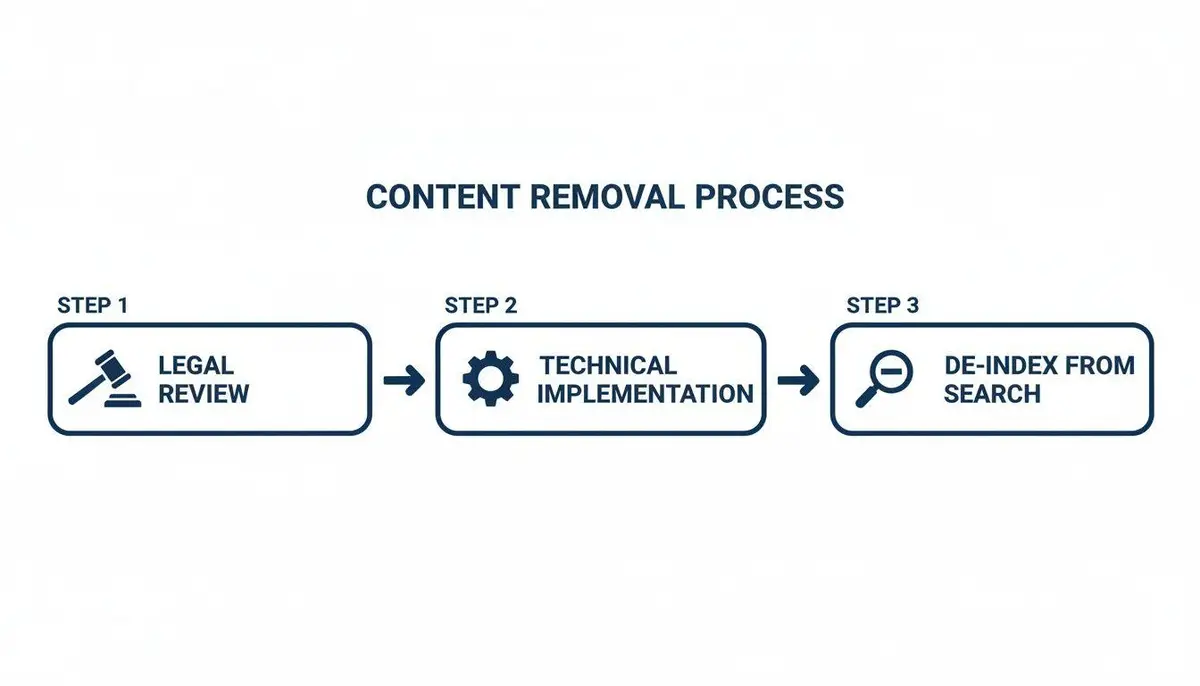
This integrated approach ensures the problem is attacked from every angle simultaneously, which dramatically accelerates removal and helps ensure the resolution is permanent.
Comparing Response Protocols
Many organizations default to their internal public relations or communications teams during a crisis. While these teams are vital for managing public perception, they are not structured for the technical and legal complexities of content removal.
The following table contrasts a standard internal response with the specialized protocol of a reputation protection firm.
Incident Response Protocol Comparison
| Stage | Standard Internal Response | Specialized Firm Protocol |
|---|---|---|
| Detection | Relies on manual discovery or brand mentions. Often reactive. | Proactive 24/7 monitoring detects threats in near real-time. |
| Assessment | Internal meetings to discuss PR and brand impact. | Immediate technical and legal assessment of the content, host, and attacker. |
| Strategy | Focuses on public statements and damage control. | Develops a multi-pronged legal/technical removal and de-indexing strategy. |
| Execution | Submits reports through public-facing web forms. | Leverages non-public back-channels with hosts, platforms, and search engines. |
| Timeline | Days or weeks, often with no clear resolution. | Hours to days, with a clear objective of permanent removal. |
| Verification | Assumes removal is complete once a confirmation email is received. | Continuous crawling to verify permanent deletion from source and search caches. |
The difference lies in shifting from managing a story to eliminating a problem at its source. While internal teams are drafting press releases, a specialized firm is already executing takedowns and petitioning search engines.
Execution and Verification
Once a clear strategy is defined, success hinges on execution. This is where experience and established relationships are critical. Instead of submitting a report through a generic web form and waiting, we utilize established, non-public channels to contact decision-makers at hosting companies, social media platforms, and search engine legal departments.
These back-channels allow us to bypass the standard bureaucracy and escalate the case directly to an individual with the authority to act immediately.
A professional crisis response is measured in hours, not days. The goal is to get the damaging content removed or de-indexed before it gets cached, archived, and endlessly copied across the internet. Once that happens, a full cleanup becomes exponentially harder.
For cases requiring legal action, such as securing a court order for defamation, our legal partners are prepared to file the necessary motions with urgency. As soon as an order is granted, it is served to the relevant platforms, compelling their compliance. Concurrently, our technical team ensures that once the content is removed, it is also scrubbed from search engine caches.
The final step is verification. We do not take a platform’s confirmation at face value. Our systems continuously monitor the web to confirm the content is permanently gone and no longer indexed by Google, Bing, or any other search engine. This final check provides certainty that the threat has been fully neutralized.
How to Select a Reputation Protection Partner
Entrusting your digital reputation to a third party is a significant decision. The market is saturated with firms making vague promises of “reputation management.” For C-suite protection, however, you require a partner with the precision of a surgical team, not a public relations firm. Selecting the wrong one can exhaust your budget, prolong your exposure, and in some cases, exacerbate the problem.
The demand for this specialized expertise is accelerating. The global online reputation management market is projected to reach USD 14.01 billion by 2031, a figure driven by the sharp increase in reputational attacks on leaders. This signals a clear understanding among executives that their digital footprint is a critical asset demanding expert defense. You can discover more insights about executive online security as a core business risk to understand the full scope of the threat.
Vet for Expertise, Not Empty Promises
The first step is to distinguish generalists from true specialists. A genuine protection partner operates more like a boutique law firm than a marketing agency. Their core competency lies in the technical and legal mechanics of content removal, not merely attempting to suppress it with positive press.
When evaluating a potential partner, certain criteria are non-negotiable. They must articulate, in clear terms, their legal and technical playbook for content removal. This includes specifics about copyright law (DMCA), court orders for defamation, and their process for navigating platform Terms of Service. Inquire about their proprietary technology for monitoring. A firm merely running basic Google Alerts is insufficient; you need a partner with technology built to scan the surface, deep, and dark web for threats 24/7. Finally, given that attacks can originate anywhere, your partner must demonstrate global reach and real-world experience navigating different legal systems and international data privacy laws.
Evasiveness or an inability to provide direct answers on these points is a critical red flag.
Demand Proof, Not Just Promises
You must see verifiable proof of their capabilities. While client confidentiality precludes naming specific clients, any credible firm can provide anonymized case studies. These should detail the initial threat, the strategy employed, the resolution timeline, and the final outcome.
When discussing fees, demand absolute clarity. A firm confident in its ability to deliver will often structure its fees based on success, meaning they are fully compensated only when the content is verifiably removed. This results-based model ensures their incentives are perfectly aligned with yours.
Insist on a complete understanding of their process. A legitimate specialist will map out their incident response workflow, from threat detection to final neutralization, without hiding behind jargon. This transparency is an indicator of competence and is essential for establishing trust.
Finally, discretion is paramount. The engagement must be governed by a robust non-disclosure agreement (NDA), with all communication conducted via secure, encrypted channels. Confidentiality is not an optional feature; it is the foundation of C-suite reputation protection. The partner you choose must operate as a silent, invisible force working on your behalf.
Setting Expectations: Timelines, Costs, and Outcomes
When an executive’s reputation is under threat, the primary questions are always the same: How quickly can this be resolved? and What is the cost? The answers are rarely simple, but understanding the variables is key to navigating the pressure with strategic clarity.
This process should be viewed not as a PR expense but as a strategic investment in risk management. The potential damage from an unmitigated reputational attack (eroded shareholder confidence, failed transactions, or a permanently tarnished legacy) will almost certainly exceed the cost of a swift, expert response.
Realistic Timelines for Getting It Done
Every situation is unique, and the timeline for resolving a threat is dictated by the nature of the problem and the required strategy. While there is no universal timeline, most cases follow a predictable path.
Immediate containment actions can often be initiated within 24 to 48 hours. This triage phase is focused on stopping the spread of damaging content through urgent takedown requests for clear violations of copyright or platform rules. However, more complex challenges require a methodical approach.
A defamatory article hosted on an uncooperative server in a foreign jurisdiction, or a sealed court record that persists in search results, necessitates a different playbook. These situations can take several weeks, or even months, to fully resolve as they often involve navigating complex international legal systems or securing court orders.
A true specialist will provide a clear, phased action plan with estimated timelines for each stage, from initial takedown attempts to final verification of removal.
What Does a Successful Outcome Actually Look Like?
Success is not defined by vague promises of “improving online sentiment.” It is defined by a concrete, measurable result: the complete removal or permanent suppression of the damaging content.
Real-world examples of successful outcomes include the takedown of a defamatory article, where a false, reputation-damaging news story is completely scrubbed from the publisher’s website and all search engine results. Another is the de-indexing of a negative court record, where a sealed or expunged legal matter that still appears on Google is successfully removed from public view. A third is the dismantling of a smear campaign, where a coordinated attack using fake blogs and social media profiles is taken apart piece by piece, with imposter accounts shut down and defamatory posts removed.
The Cost Is an Investment, Not an Expense
An executive’s reputation is a core corporate asset. Research has established that 70% of a company’s overall reputation is directly linked to the public perception of its leader. The consequences are tangible: a staggering 69% of prospective employees report they would decline a job offer from a company with a poor reputation. You can discover more insights about how leaders can proactively protect their online reputations on ChiefExecutive.net.
Given the stakes, the cost of professional intervention should be budgeted as an essential business protection, alongside liability insurance or top-tier legal counsel. While the complexity and cost vary by case, our guide on the true cost of professional content removal provides a clearer financial picture.
This investment is a small price to pay to avert the catastrophic financial and career damage that an unmanaged reputational crisis can inflict.
Answering Your Key Questions
When a leader’s reputation is at risk, direct and clear answers are required. Executives and their legal counsel frequently approach us with similar, urgent questions regarding the mechanics of this process.
Removal vs. Suppression: What’s the Difference?
Removal is the complete eradication of damaging content from its source website. This is the primary objective, as it provides a permanent solution.
Suppression is a secondary strategy for content that cannot be legally removed. It involves creating and promoting a wealth of positive, authoritative content to outrank and displace negative material in search results, effectively making it invisible. While powerful, removal is always the preferred outcome.
How Long Does This Actually Take?
The timeline is dictated by the nature of the challenge. A straightforward copyright claim against a major, cooperative platform can often be resolved in under 48 hours.
Conversely, confronting a defamatory article on a hostile, uncooperative site, particularly one hosted overseas, is a more complex undertaking. Such cases may require weeks of legal work to secure a court order. We provide a realistic timeline based on the specific variables of your case from the outset.
Can You Guarantee Removal?
No ethical firm can offer a 100% guarantee. Any firm that does so is not being transparent. The outcome is contingent on factors such as legal jurisdiction, host platform cooperation, and the specific facts of the case.
What we provide is confidence based on an extensive track record. We align our success with yours, often structuring our engagements on a success-fee basis. If the content is not removed, we have not succeeded.
This methodology is effective. In a 2015 case involving an executive targeted by a tabloid publication, we combined direct removal tactics with an aggressive personal branding campaign to help them secure 80% of their first-page Google results, neutralizing the threat. You can learn more about how leaders proactively protect their online reputations with ChiefExecutive.net.
How Do You Protect My Privacy?
Confidentiality is the bedrock of our practice. Every engagement begins with a comprehensive non-disclosure agreement (NDA), and all communications are conducted through encrypted channels.
We operate with the absolute discretion required when handling sensitive personal and professional matters. Your privacy is non-negotiable and fully protected.
When your reputation is under fire, you need a partner with the tactical, technical, and legal skills to secure a win. ContentRemoval.com delivers fast, discreet, and definitive solutions to safeguard your name.
Contact us for a confidential assessment.
Frequently asked questions
What is the difference between removal and suppression for an executive’s search results?
Removal deletes the content from its source website, which is permanent and the primary objective. Suppression creates and promotes positive, authoritative content to outrank material that cannot legally be removed. The article treats suppression as a secondary strategy.
How long does it take to remove damaging content about an executive?
Immediate containment can often begin within 24 to 48 hours for clear copyright or platform rule violations, and a straightforward copyright claim against a cooperative platform may resolve in under 48 hours. A defamatory article on an uncooperative foreign host, or a sealed court record still in search, can take weeks or months.
How should an executive choose a reputation protection firm?
Ask for the firm’s legal and technical playbook covering DMCA, court orders and platform terms, proof of monitoring beyond Google Alerts, global reach, anonymized case studies, and an NDA with encrypted communications. Evasive answers on any of these are a red flag, and no ethical firm promises certain removal.