
Business reputation protection in 2026 treats reputation as an enterprise asset and a live attack as an evidence, removal and platform escalation problem before it is a communications problem. The threat matrix now includes fake executive profiles, cloned brand pages, AI-generated statements, insider escalation and security-linked attacks, so the response requires legal, security, operations and communications under one command structure.
Key facts
- Group Caliber cites reputation at up to 63 percent of market value and 28 percent of S&P 500 capitalization.
- OpenAI reported disrupting more than 20 deceptive networks using its tools between late 2024 and early 2025.
- The incident sequence is detection and assessment, containment and mitigation, communication and restoration, then adaptation.
- Engage specialists when the attack spans platforms, mixes legal and technical routes, involves synthetic identity or recurs after takedown.
Where ContentRemoval.com comes in. ContentRemoval.com is the external operator in the legal and technical lane this guide describes: taking down fake executive profiles, cloned pages, fabricated statements and manipulated media, de-indexing the residue and watching for recurrence while in-house teams handle security and stakeholder communication. General counsel, the CISO or the head of communications usually makes the call. A free 15-minute Exposure Scan maps what is removable, and the report is yours to keep. Get a Free, Confidential Exposure Scan or read how our reputation management work is done.
At 6:40 a.m., your general counsel forwards a screenshot. A fake executive profile is posting “statements” about layoffs that haven’t happened. A cloned brand page is replying to customers with a malicious link. Search results are already shifting. Your investor relations team wants language for a holding statement. Your CISO says the issue may connect to a compromised vendor account. Your head of communications wants to get ahead of the story.
Most companies err in their approach to live reputation attacks. They treat a live reputation attack as a messaging problem first.
It usually isn’t. It’s an evidence problem, a removal problem, a platform escalation problem, a security problem, and only then a communications problem. If you start with public reassurance before you understand the attack surface, you risk amplifying false content, validating impersonators, and giving bad actors a wider audience. If you wait too long to act, indexed content spreads, screenshots multiply, and internal confusion becomes external damage.
That’s why serious executives now treat online exposure as a strategic risk category, not a press nuisance. If you need a sharper framework for that shift, this guide on content removal and reputation risk for executives is worth reading before the next incident forces the issue.
The Unseen Liability on Your Balance Sheet
The first loss in a reputation event rarely appears on the first day’s P&L. It appears in trust. Customers hesitate. Employees speculate. Partners pause. Reporters start asking better questions than your own team can answer.
That delay is dangerous because it fools leadership into thinking the threat is still manageable through ordinary communications. Meanwhile, harmful material is being copied, reposted, indexed, cached, and translated across channels you don’t control.
What a live attack actually looks like
A business reputation attack now tends to arrive in clusters, not as a single bad post. One false review becomes a coordinated review pattern. One fake executive profile becomes a network of impersonation accounts. One data leak rumor becomes a screenshot circulating in private chats, then on social platforms, then in search.
The operational problem is speed. Internal teams usually split the issue into separate lanes. Legal looks at defamation. IT looks at account security. PR drafts language. HR worries about employee reaction. That division of labor is necessary, but without a single command structure, it slows the one thing that matters most at the start: containment.
The market doesn’t wait for your internal alignment. Attackers exploit the gap between discovery and coordinated response.
Why ordinary PR instincts fail
Traditional PR starts with narrative. Digital threat remediation starts with control. If a fake profile, cloned page, manipulated image, or false article is still live, public messaging alone won’t solve the underlying exposure.
A company that confuses visibility with resolution will spend money explaining a problem it should have removed, de-indexed, or escalated. That’s not strategy. It’s drift.
Defining Reputation as a Quantifiable Corporate Asset
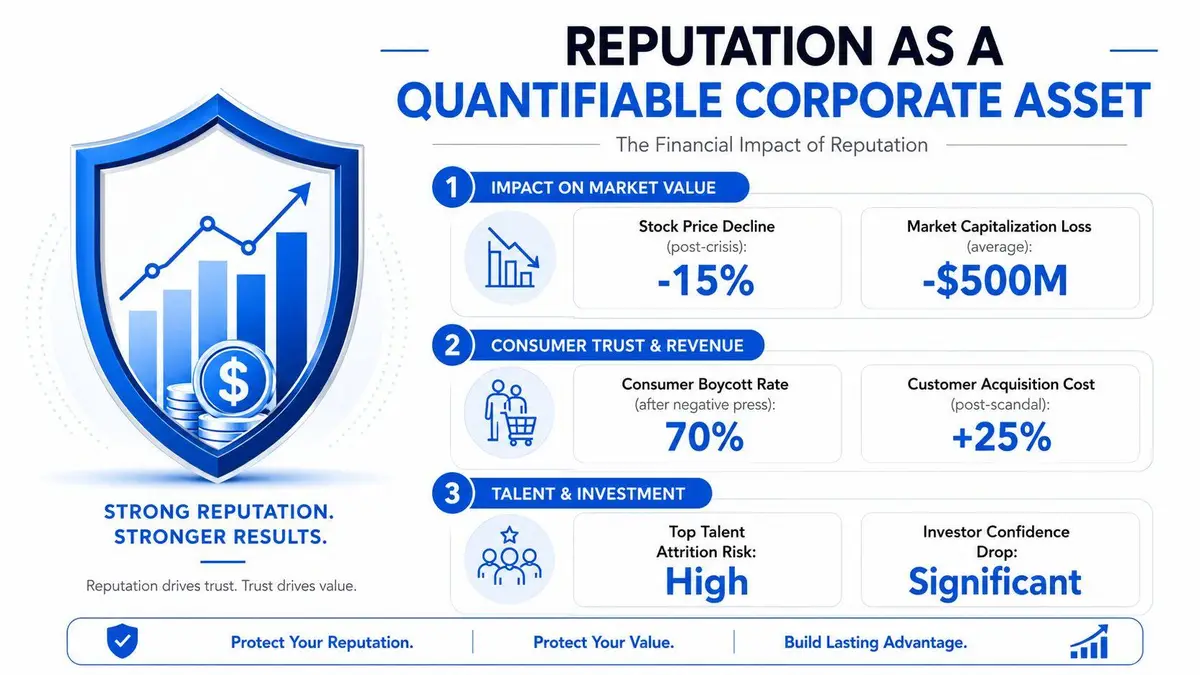
A fake executive statement spreads overnight. By market open, counterparties are asking questions, employees are forwarding screenshots, and the legal team is still deciding whether this is a PR issue or a security issue. That classification error is expensive. Reputation loss does not sit in the abstract. It shows up in delayed deals, higher scrutiny, lower confidence, and a weaker valuation story.
Executives still assign reputation to marketing or public affairs. That is an outdated governance model. Reputation belongs under enterprise risk because it affects revenue durability, market confidence, and the company’s ability to defend itself against digital abuse.
Group Caliber’s summary of reputation research says reputation can account for up to 63% of a company’s market value, and cites Echo’s Reputation Dividend report, which found reputation represented 28% of total market capitalization across the S&P 500, equal to about $11.9 trillion in 2024 in Group Caliber’s analysis of why reputation matters more than ever.
Stop budgeting for reputation as if it were a media function
If reputation influences enterprise value, investor trust, and recurring revenue, it requires controls, owners, escalation paths, and documented remediation procedures. It also requires a budget that reflects the asset at risk. Group Caliber’s same analysis notes that reputation can contribute 3% to 7.5% of annual revenues. That places protection spend in the category of asset defense, not discretionary communications support.
This distinction matters because digital reputation threats are often remediable. A cloned executive profile, AI-generated false statement, manipulated image, or fraudulent domain can often be challenged through platform enforcement, domain registrar action, search de-indexing requests, evidentiary preservation, and legal takedown processes. Traditional PR cannot remove a fake asset from circulation. It can only address audience perception after exposure has already occurred.
The board issue is asset impairment
Here is the standard I would apply in any boardroom. If reputation carries measurable value, unmanaged impersonation, synthetic content, and false attribution create a real impairment risk.
That changes the operating model. Legal cannot be brought in late. Security cannot treat impersonation as a side case. Communications cannot own the problem by default. The company needs a coordinated system that can verify the threat, preserve evidence, establish chain of publication, identify the hosting and platform layers, and push for removal fast.
A related exposure is self-created. Public thought leadership increases authority, but it also creates material that can be cloned, revoiced, or misquoted by bad actors. If leadership is formalizing a public voice, get expert help for your book so the asset is structured, attributable, and easier to defend if someone copies or distorts it.
| Asset category | Old view | Correct view |
|---|---|---|
| Reputation | Communications concern | Enterprise asset |
| Online attacks | Annoying noise | Asset impairment and liability risk |
| Response owner | PR only | Legal, security, operations, and communications |
| Budget logic | Discretionary | Protective spend tied to enterprise value |
The Modern Threat Matrix for Business Reputation
Most companies still defend against the last generation of reputation threats. They watch review sites, monitor mentions, and prepare statement templates. That’s necessary but no longer sufficient.
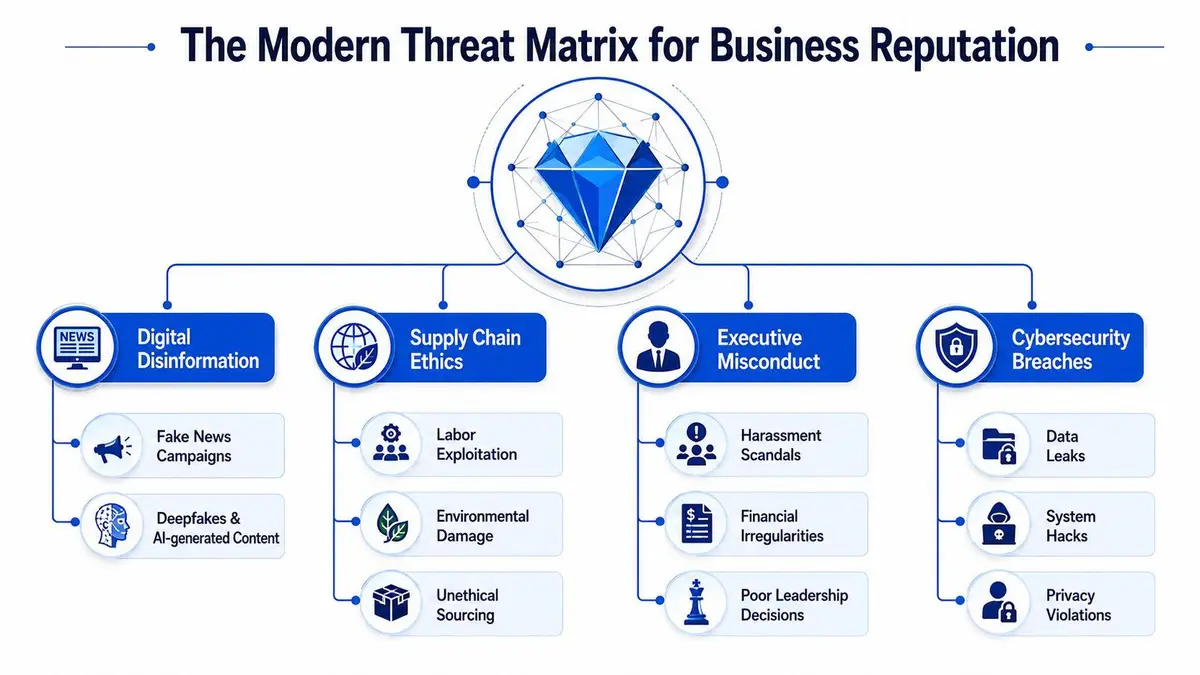
The active threat set now includes impersonation, synthetic content, cloned executive identities, manipulated screenshots, coordinated harassment, false complaints, and platform-native fraud that looks authentic enough to survive initial scrutiny. Business reputation protection has moved out of the PR silo and into digital adversarial operations.
Four classes of threat you need to map
- Impersonation threats
Fake executive profiles, cloned corporate pages, lookalike seller accounts, and fraudulent support identities are often designed to steal trust before they steal data. They also create downstream liability because customers and counterparties may believe they interacted with your company. - Synthetic media and AI-generated falsehoods
Many leadership teams are still behind on this issue. OpenAI said it disrupted more than 20 deceptive networks using its tools between late 2024 and early 2025, and Microsoft’s 2025 Digital Defense Report said adversaries are increasingly using AI to scale social engineering and impersonation tactics, as summarized in this report on protecting business reputation from potential crises. That matters because a false narrative can now be produced at scale, in multiple formats, and across jurisdictions quickly enough to outrun manual review. - Insider and ex-insider escalation
Disgruntled employees, former contractors, and aggrieved founders know where to aim. They understand naming conventions, internal terminology, and the pressure points that make false claims sound plausible. - Security-linked reputation attacks
Not every breach becomes a reputation crisis, but nearly every visible breach has a reputation component. The attacker may not need to exfiltrate much if the public allegation alone is enough to trigger fear.
Why generic social monitoring fails
A standard alert for brand mentions won’t catch enough of this. It won’t reliably identify cloned accounts that use slight spelling variations. It won’t flag manipulated imagery before reposts spread. It won’t distinguish a real stakeholder complaint from a coordinated falsehood designed to trigger moderation systems or journalist outreach.
Practical rule: If your monitoring stack only tells you that people are talking about you, you’re already late. You need systems that identify whether the speaker is real, authorized, and linked to a broader campaign.
What executives should ask their teams this week
Use these questions as a diagnostic:
- Account integrity: Can we identify fake executive or brand profiles across major platforms fast enough to stop audience confusion?
- Content provenance: Can we tell whether an image, quote graphic, or statement attributed to leadership is authentic?
- Escalation authority: Who can approve legal notices, platform reports, and security actions within hours rather than days?
- Cross-channel visibility: Are search, social, review sites, messaging apps, forums, and media monitoring connected, or are they still separate reporting lanes?
If your team can’t answer those clearly, your threat matrix exists only on paper.
Active Defense Monitoring and Risk Assessment
Monitoring isn’t a dashboard. It’s a control system. If your vendor sends weekly sentiment summaries, you don’t have active defense. You have delayed awareness.
Info-Tech frames online reputation protection as a continuous control loop: assess the current reputation, identify threats, develop a communication strategy, manage comments and feedback, promote transparency and accountability, then evaluate and adjust, as outlined in Info-Tech’s online reputation protection framework. That model is correct because harmful content rarely appears in one place at one time.
Build the baseline before the incident
You can’t detect deviation if you haven’t established normal. Start by identifying what must be protected: executive identities, brand pages, official domains, product naming conventions, high-value search terms, customer support channels, and any content that attackers are likely to mimic.
Then define what counts as escalation. A fake account targeting customers is not the same as a hostile review. A manipulated executive statement is not the same as an unfavorable article. Different threat types require different owners, evidence standards, and response clocks.
A practical place to tighten this discipline is your reputation monitoring program. The point isn’t passive visibility. The point is actionable detection tied to a removal and response pathway.
What a serious monitoring stack should cover
Use a layered model rather than a single tool:
- Surface monitoring: Search results, news mentions, social platforms, review sites, forums, marketplaces, and video platforms.
- Identity monitoring: Executive names, leadership photos, official logos, product imagery, and common impersonation variants.
- Security-adjacent monitoring: Signals that a phishing page, fake support flow, or compromised vendor relationship could spill into public trust damage.
- Evidence capture: Screenshots, URLs, timestamps, account metadata, and change logs preserved before the content disappears or mutates.
Assessment has to change as the threat changes
Too many teams write one policy and call it governance. That won’t hold. Monitoring criteria should evolve as attackers change formats. The rise of synthetic content alone requires tighter verification workflows for public statements, image use, and leadership communications.
A reputation defense program works only if detection, legal review, platform escalation, and stakeholder communication operate on the same clock.
Response Frameworks Legal Takedowns vs PR Damage Control
Companies under pressure often ask the wrong question: should we go legal or should we go PR? The correct question is simpler. What removes the harm fastest, with the least collateral exposure?
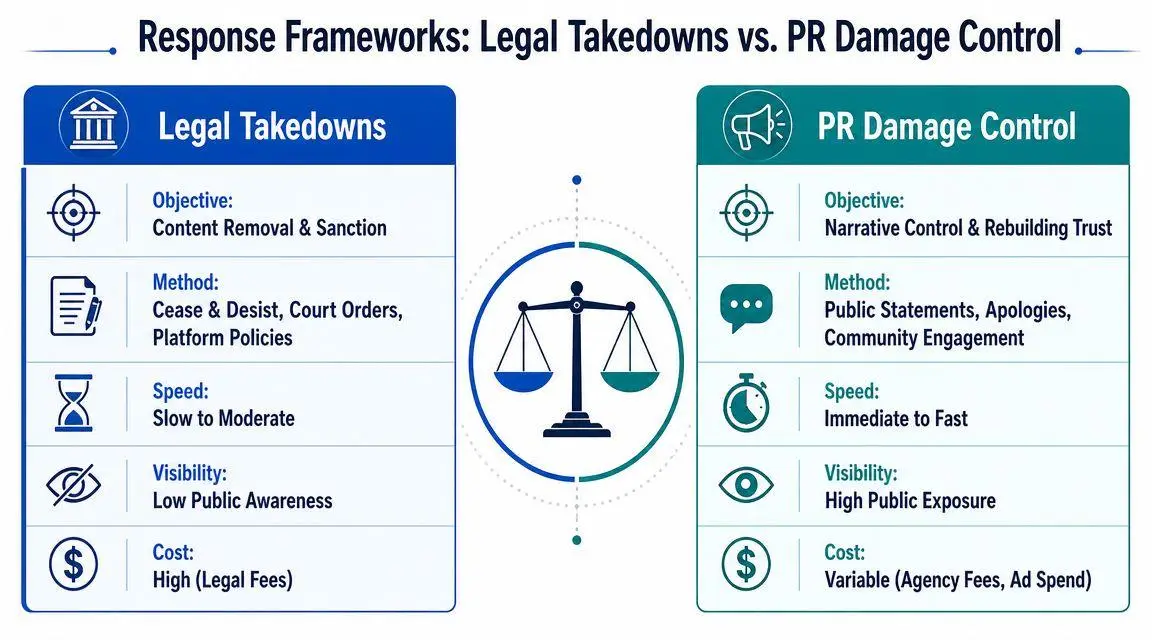
Legal and technical remediation aim to reduce the availability of harmful content. PR aims to manage audience interpretation. Those are different jobs. If leadership confuses them, the company either over-communicates and amplifies the issue or under-communicates and loses control of stakeholder expectations.
When legal and technical remediation should lead
If the problem is false, unauthorized, infringing, impersonating, or privacy-invasive, your first objective should usually be removal, de-indexing, account seizure, or platform enforcement. That includes fake executive profiles, cloned pages, fabricated statements, manipulated media, and fraudulent review patterns where policy violations can be documented.
In those scenarios, a public statement can make things worse. It gives journalists and search engines a fresh peg. It may also validate content that many people had not yet seen.
When PR has a necessary role
PR becomes essential when facts are already public, legitimate stakeholders need reassurance, or the issue cannot be addressed discreetly. If a real operational failure occurred, silence won’t work. Customers, employees, regulators, and investors may need direct communication.
But PR should be used with discipline. It should answer real stakeholder questions, not serve as emotional relief for executives who feel they must “say something.” A weak statement issued too early often creates discoverable contradictions that later complicate legal positions.
A practical comparison
| Criterion | Legal and technical remediation | PR damage control |
|---|---|---|
| Primary objective | Remove or restrict harmful material | Stabilize stakeholder trust |
| Best for | Impersonation, false content, platform abuse, privacy violations | Confirmed incidents, operational failures, stakeholder reassurance |
| Public visibility | Usually lower | Usually higher |
| Risk of amplification | Lower if handled quietly | Higher if mishandled |
| Success measure | Content down, access cut, indexing reduced | Audience confidence and clarity |
Don’t ask which discipline is more important. Ask which one solves the actual problem in front of you.
One practical option in the legal and technical lane is ContentRemoval.com, which provides monitoring, removals, de-indexing, and impersonation takedowns across search engines, websites, and social platforms. That kind of service fits situations where in-house legal, PR, and security teams need an external operator focused on suppression and enforcement rather than narrative management alone.
An Executive Playbook for Incident Response
When a reputation threat breaks, most damage comes from disorder. The wrong person approves outreach. Evidence isn’t preserved. A platform report gets filed under the wrong policy category. Someone posts reassurance before legal has reviewed the facts. Good teams still make bad decisions when the process is loose.
The FTC’s guidance is useful here because it starts with fundamentals. Companies should inventory where sensitive information is stored, restrict access with strong passwords and multi-factor authentication, use firewalls and access controls, maintain central log files or intrusion detection to spot attacks early, and require service providers to notify them of incidents quickly, according to the FTC’s guide to protecting personal information in business. Those recommendations belong in reputation response because many public trust crises start as security or access failures.
Start with a simple operating sequence.
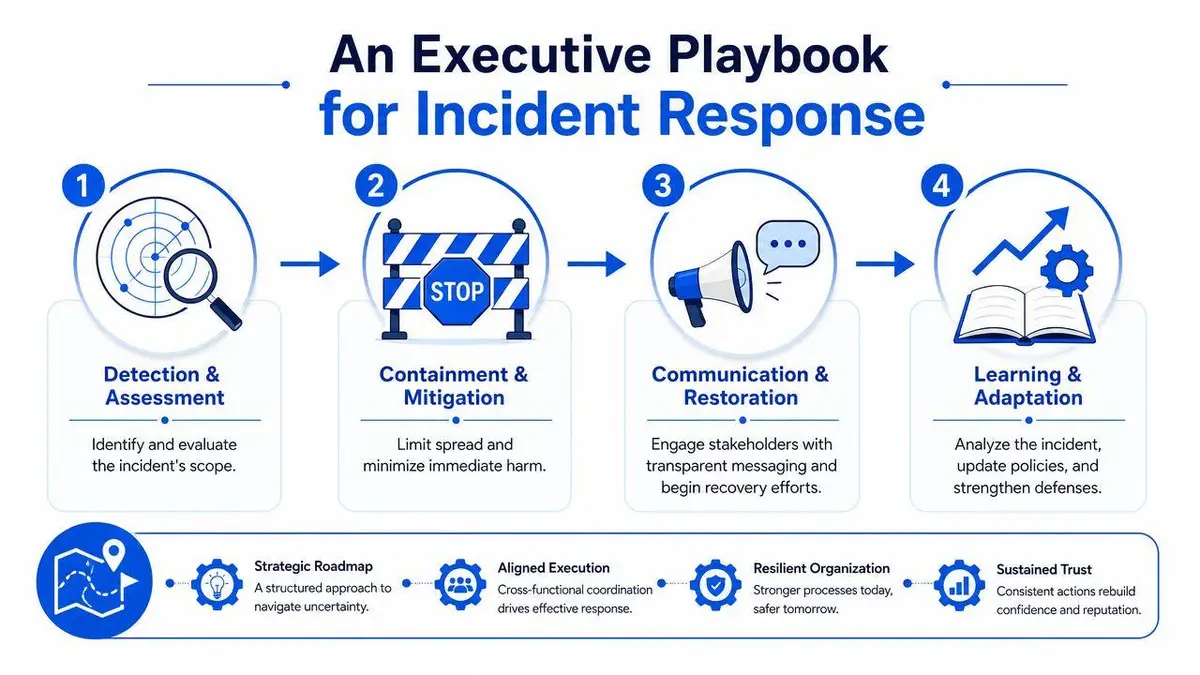
Detection and assessment
The first task is verification. Is the content authentic, manipulated, spoofed, leaked, or merely unattributed? Which platforms are involved? Has anyone internal already engaged publicly and made things worse?
Build a fast incident file. Preserve URLs, screenshots, timestamps, account handles, cached versions, search visibility, and any internal signals that connect the issue to compromised credentials, vendors, or former insiders. If you don’t preserve evidence immediately, you lose your advantage later with platforms, counsel, and investigators.
Containment and mitigation
Containment means stopping spread, not drafting reassurance. Lock compromised accounts. Freeze risky access. Escalate to platforms under the correct impersonation, privacy, trademark, fraud, or policy channels. If a vendor or contractor may be involved, trigger contractual notice obligations immediately.
Use a short command list:
- Control access: Rotate credentials, enforce multi-factor authentication, and restrict permissions where abuse may have originated.
- Preserve records: Keep logs, screenshots, internal chat records, and platform responses in a central file.
- Stop unauthorized messaging: Pause informal responses from sales, support, and regional teams until approved guidance exists.
- Map the spread: Identify where the content originated and where it has already been reposted or indexed.
This short video is useful context for how executives should think about pressure, timing, and coordinated response.
Communication and restoration
Only after the facts are stable should you communicate outward. Tailor the audience. Customers need different information than employees. Investors need different detail than journalists. Counsel should review anything that touches attribution, culpability, remediation, or future commitments.
One helpful reference point after the immediate fire is this post-crisis online reputation repair checklist for executives. It’s the right stage to think about search recovery, narrative correction, and long-tail cleanup.
If your first external message creates a second incident, the response process failed before the market judged the original event.
Learning and adaptation
Every incident should end with control changes, not just relief. Review which approvals slowed action, which vendors lacked escalation paths, which public assets were easiest to impersonate, and which platforms were hardest to move. Update policies, access controls, executive account protections, and evidence-handling procedures.
If your team treats post-incident review as optional, you are choosing to repeat the event under a different headline.
When to Engage Professional Remediation Services
A clear handoff point exists. It arrives when the incident stops being a communications problem and becomes a legal, technical, and evidentiary problem.
If your team is arguing over whether a fake executive profile violates platform policy, whether an AI-generated voice clone supports a fraud claim, or whether a de-indexing request will prejudice later litigation, you are already outside normal in-house capacity. The issue is no longer message discipline. It is chain of custody, rights enforcement, platform escalation, cross-border process, and recurrence control.
The threshold where in-house stops being enough
Engage outside remediation services immediately when any of these conditions appear:
- Multi-platform propagation: The same false claim, impersonation asset, or manipulated media appears across search results, social platforms, review sites, forums, marketplaces, and press pickup.
- Legal and technical overlap: Removal depends on privacy law, trademark rights, copyright claims, fraud indicators, account recovery, domain abuse analysis, or host-level complaints at the same time.
- Synthetic identity abuse: Fake executive accounts, cloned websites, AI-generated audio or video, fraudulent customer support channels, or spoofed employee identities create operational risk.
- Cross-border exposure: The poster, registrar, host, platform, and target sit in different jurisdictions, with different notice standards and response windows.
- Recurrence after takedown: The content returns through mirror domains, reposts, burner accounts, or slight edits designed to evade moderation.
- Balance-sheet sensitivity: The incident can affect sales cycles, lender confidence, commercial partnerships, regulatory posture, or pending transactions.
This is the practical test. If resolution requires counsel, security, IT, search specialists, and platform policy experts to act in parallel, hire specialists.
What a specialist firm should actually do
A competent remediation firm does more than submit reports and draft talking points. It preserves evidence for legal use. It maps the threat infrastructure, including domains, accounts, hosting, registrars, and amplification channels. It selects the right removal path for each asset, whether that means trademark enforcement, defamation review, impersonation complaints, privacy requests, source suppression, or search de-indexing. It also monitors for reappearance, because first-wave removal is rarely the end of the matter.
That operating model is different from traditional PR. PR can help shape perception after the facts are contained. It does not remove a cloned investor relations page, stop a synthetic CEO video from being reposted, or build the evidentiary record needed for coordinated takedowns.
How to vet a remediation firm
Ask for process, not promises.
Require a clear explanation of evidence handling, platform escalation paths, legal coordination, de-indexing methods, confidentiality controls, and post-removal monitoring. Ask who will run the matter day to day. Ask how they handle impersonation recurrence, hostile reuploads, and cases where the platform refuses initial action. Ask what your legal, security, and communications teams must provide in the first 24 hours.
The right firm functions like an extension of incident command with specialized legal and technical capability. If your company is dealing with impersonation, false content, fake reviews, leaks, or a search-driven reputation crisis, ContentRemoval.com offers confidential assessments focused on legal and technical remediation. The value is straightforward. Remove the harmful material, reduce recurrence, and stop a digital threat from turning into a durable corporate liability.
Frequently asked questions
Should a company issue a public statement when a fake executive profile appears?
Usually not first. If the problem is false, impersonating or privacy-invasive, the priority is removal, account enforcement and de-indexing, since a statement can give journalists and search engines a fresh peg and validate content most people had not seen. PR becomes necessary once facts are public or stakeholders need reassurance.
How much of a company’s value is tied to its reputation?
The article cites Group Caliber’s summary that reputation can account for up to 63 percent of market value and contributes 3 to 7.5 percent of annual revenues. That is why it argues reputation belongs under enterprise risk rather than marketing.
What should a business monitor to detect a reputation attack early?
A layered stack: surface monitoring of search, news, social, reviews, forums and marketplaces, plus identity monitoring of executive names, leadership photos and logos. Add security-adjacent signals like phishing pages and vendor compromise, and capture evidence before content mutates or disappears.