
Attorney reputation management is the discipline of protecting a lawyer’s search results, reviews and directory profiles separately from legal defense, because prospective clients judge before any docket is read. It combines continuous monitoring, fortified owned profiles, careful review handling, and a triage-based takedown and suppression workflow that respects confidentiality and professional duties.
Key facts
- Cited research: 80 percent of prospective clients read attorney reviews before hiring, 49 percent trust them like referrals.
- Removals often succeed on impersonation, harassment, privacy, copyright or terms-of-service grounds, not only defamation.
- An early threat letter can trigger republication and fresh indexing of a hostile blog post.
- Suppression should run in parallel while any takedown request is pending, not after it.
Where ContentRemoval.com comes in. ContentRemoval.com supports attorneys and law firms whose names are attached to defamatory blogs, coordinated review attacks, fake profiles or stale articles that keep ranking. The managing partner, the firm’s marketing lead or outside counsel usually reaches out once a result begins affecting intake or referrals, and the work runs alongside any legal strategy without disturbing privilege. A free 15-minute Exposure Scan maps what is removable, and the report is yours to keep. Get a Free, Confidential Exposure Scan or read how our reputation management work is done.
You see it on a Tuesday evening, between a call with opposing counsel and a client dinner you’re already late for. A review accuses you of dishonesty. A niche blog post suggests misconduct without saying it plainly enough to trigger an easy complaint. A search for your name now returns something you didn’t authorize, didn’t deserve, and can’t ignore.
Your first instinct is legal. Identify the speaker. Preserve evidence. Assess defamation. Send a letter if warranted. That instinct is useful, but it is not sufficient. Search results don’t wait for pleadings. Prospective clients don’t read a docket before they form an opinion. They scan, infer, and move on.
That’s why attorney reputation management has become a separate discipline from legal defense. You’re not only protecting against liability. You’re protecting trust, intake, referrals, and the professional standing that took years to build and one page of search results to destabilize.
The Inevitable Digital Courtroom
A strong practice used to rest on courtroom record, peer respect, and referrals. Those still matter. They’re no longer the first filter.
A prospective client hears your name, searches it, and forms a judgment before your office answers the phone. According to LegalFit’s analysis of attorney review behavior, 80% of prospective clients review an attorney’s online reviews before hiring them, and 49% trust online reviews as much as personal referrals. If you’ve built your practice on reputation, understand the obvious implication. Your reputation now lives on third-party platforms you do not control.
What attorneys get wrong first
Most successful attorneys assume a good offline reputation will carry them online. It won’t. The internet does not grade on professional merit. It rewards visibility, repetition, and search placement.
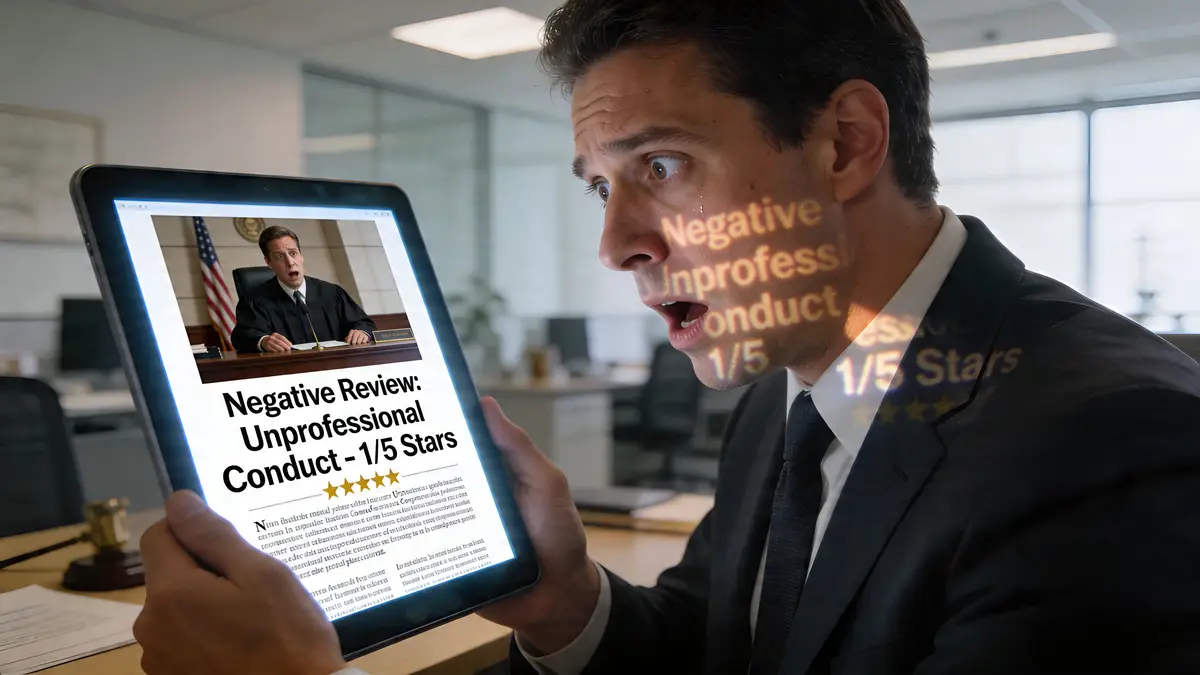
A single hostile review can outrank your publications. An old article can eclipse a decade of competent work. A forum thread with no evidentiary value can still become the first thing a general counsel, referral partner, or prospective client sees.
Your online reputation is not a mirror of reality. It is a contest over what appears credible at first glance.
That’s why “I’ve done nothing wrong” is not a strategy. Plenty of lawyers with excellent ethics and excellent outcomes still face digital attacks. Some come from unhappy former clients. Some come from adversaries. Some come from competitors, anonymous posters, or publications that never update the story after the facts change.
Why this problem is permanent
This isn’t a temporary irritation you solve once and forget. Search results shift. Review platforms change. Social content gets screenshotted, reposted, and detached from context. Any attorney with a meaningful profile eventually enters a digital courtroom where accusation travels faster than proof.
Treat that as inevitable, not exceptional.
If you accept that premise early, you stop reacting emotionally and start building systems. You monitor your name, your firm, your practice areas, and the content most likely to be weaponized against you. You distinguish criticism from defamation. You separate what can be removed from what must be outranked. You build enough positive, accurate, high-authority content that one hostile result doesn’t define you.
That is the essential starting point for attorney reputation management.
The Two Courts Navigating Legal Versus Reputational Strategy
Your legal training tells you to narrow statements, avoid admissions, and speak only when the record supports it. That discipline protects clients and often protects you. It can also destroy you online if you apply it blindly.
The problem is structural. The Court of Law and the Court of Public Opinion do not use the same rules, the same timelines, or the same standards for persuasion. In one venue, restraint is often wise. In the other, silence is often interpreted as guilt, weakness, or indifference.
According to Elite Lawyer’s discussion of attorney reputation conflicts, a critical disconnect exists between legal counsel for the “Court of Law” and crisis management for the “Court of Public Opinion,” and traditional legal responses like strategic silence can amplify reputational damage online.
The legal instinct can work against you
If a false accusation appears online, many attorneys default to one of three moves. They say nothing. They threaten immediately. Or they respond defensively in public.
All three can backfire.
Silence leaves the allegation uncontested in the place where prospects are looking. An early threat letter can provoke reposting, commentary, and a fresh round of indexing. A defensive public reply can reveal irritation, disclose too much, or create a searchable record that extends the story.
That doesn’t mean legal action is wrong. It means legal action has to be integrated into a broader reputation strategy instead of substituted for one.
Different objectives, different tactics
A legal strategy asks, “What can we prove, preserve, or challenge without harming the case?”
A reputation strategy asks, “What are people seeing right now, what are they inferring, and how do we reduce the visibility and credibility of harmful content while protecting legal position?”
Those are related questions. They are not the same question.
Here’s the simplest way to view it:
| Arena | Primary concern | Winning move | Common mistake |
|---|---|---|---|
| Court of Law | Liability, evidence, procedure | Precision and restraint | Assuming procedure controls public interpretation |
| Court of Public Opinion | Trust, perception, search visibility | Speed and narrative control | Treating silence as neutral |
What a workable balance looks like
You need a coordinated approach where counsel protects privilege and exposure, while a reputation team handles platform complaints, search suppression, review response language, publisher outreach, and content architecture. If those efforts aren’t coordinated, one side often undermines the other.
For example, a lawyer may correctly avoid discussing facts of a dispute. Fine. But that still leaves open several safe, non-prejudicial moves: correcting profile information, reporting impersonation, documenting false factual claims, strengthening owned search results, and drafting short public language that neither waives rights nor fuels the story.
Practical rule: If your response would satisfy a judge but confuse a prospect, it is incomplete.
Why generic advice fails attorneys
Most online reputation advice is written for restaurants, e-commerce brands, or local service businesses. It tells you to “respond authentically,” “be transparent,” and “engage openly.” That may be harmless for a plumbing company. It is reckless for a lawyer navigating confidentiality, litigation risk, and professional duties.
Attorneys need narrower language, tighter process, and better judgment. You cannot argue with reviewers the way a retailer might. You cannot casually disclose background facts to “set the record straight.” You cannot rely on a generalist PR shop that treats every issue like a messaging exercise.
You need a system that respects both courts at once. Otherwise, your legal discipline becomes reputational paralysis, and your reputational panic creates legal exposure.
That gap is where most damage occurs.
Mapping Your Digital Attack Surface
Most attorneys think the threat is “bad reviews.” That’s only one layer. Your actual attack surface is wider, messier, and more interconnected than most firms realize.
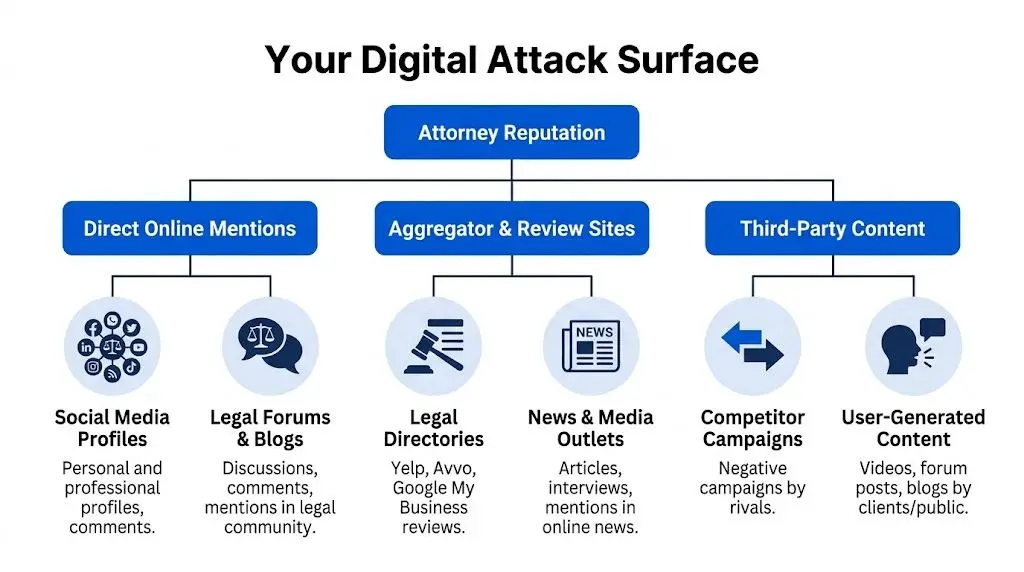
A negative Google review may be annoying. A defamatory article ranking for your name is worse. A copied allegation that appears on a legal forum, then gets cited in a directory discussion, then gets screenshotted onto social media becomes a search ecosystem problem, not a single-post problem.
Where attorneys are most exposed
Think in three categories.
First, there are high-intent review and directory platforms. Google, Avvo, Lawyers.com, and similar profiles influence the people already looking for counsel. These users are near a decision. They are comparing names, credentials, and signals of trust.
Second, there is search-optimized third-party content. This includes blogs, complaint sites, old news coverage, scraped profile pages, and “investigative” posts designed to rank for your name. These results don’t need to be fair to be damaging. They only need to be plausible enough to slow trust.
Third, there are distributed mentions across social platforms, forums, comments, and reposts. Individually, some look minor. Collectively, they create corroboration theater. Prospects assume volume means truth.
According to Jasmine Directory’s analysis of reputation ROI for law firms, a single negative online article can deter 22% of potential clients, and four or more negative results can deter 70%. That’s not a vanity issue. That’s pipeline damage.
A useful risk map
Use this framework when auditing your own exposure:
- Search-result threats: Content ranking for your name, firm name, or branded search terms.
- Conversion threats: Reviews, star ratings, and directory snippets that influence action once someone is already considering you.
- Narrative threats: Articles, blog posts, or posts that create a recurring accusation or insinuation.
- Identity threats: Impersonation, fake profiles, hijacked accounts, and misleading biographical pages.
- Legacy threats: Old coverage, resolved disputes, outdated discipline references, or context-free mentions that remain searchable.
That list matters because each category requires a different response. A review dispute is not handled like a copyright issue. A stale article is not handled like a hacked profile. A fake profile is not handled like a legally protected opinion.
What to look for during a serious audit
A proper audit is not your assistant searching your name once on a logged-in browser. It requires disciplined searching across name variants, practice-area modifiers, firm associations, old jurisdictions, and image results. It also requires checking the platforms your clients use, not just the ones lawyers talk about internally.
If your footprint is messy, a broader digital footprint cleanup for attorneys and executives becomes necessary. That means identifying duplicate profiles, inaccurate bios, old contact details, dormant social accounts, weak search-result assets, and pages you didn’t know existed until they became a problem.
Search is where reputation becomes discoverable. If you haven’t mapped what appears for your name, your firm, and your key partners, you’re managing blind.
The business issue behind the reputational issue
Attorneys often treat online attacks as personal insults, and of course they are. But if you stop there, you miss the operational consequence. Search results affect intake quality, referral confidence, recruiting, speaking invitations, and opposing-side advantage.
A hostile article does not need to convince everyone. It only needs to introduce hesitation into enough decisions that your momentum changes. That is how reputational damage shows up in practice. Not as a dramatic collapse, but as friction. Fewer calls returned. More skepticism in consultations. More explaining. More doubt where there used to be trust.
That is why mapping the attack surface comes before any meaningful defense.
Proactive Defense Monitoring and Fortification
The attorneys who fare best online are not the ones with the cleanest history. They’re the ones with the strongest systems. They know what is being said, where it is being said, and what owned assets can absorb or displace damage.
Passive optimism is useless here. You need monitoring and you need fortification.

Monitoring has to be continuous
Start with the obvious tools. Google Alerts is basic, but still worth using for your name, your firm, and key combinations of both. Social Mention and similar web-monitoring tools can help identify public chatter that won’t appear in a standard review check.
Then go beyond that. Monitor name variants, misspellings, old firm affiliations, high-risk practice areas, and common accusation terms paired with your name. Watch image results. Watch video platforms. Watch professional directories where a negative comment can sit unattended for months because nobody on your staff considers it “marketing.”
For firms under visible pressure, a dedicated reputation monitoring workflow is the better answer. The point isn’t software for its own sake. The point is speed, preservation, and escalation. You want alerts early enough to act before a post gets copied, indexed, discussed, and normalized.
Fortify the assets you control
Monitoring tells you where the fire is. Fortification determines whether one spark becomes a reputational event.
Claim and fully complete every major profile tied to your practice. That includes your firm site biography, Google Business profile, legal directories, professional social profiles, and any recurring speaking or publication pages. Incomplete or inconsistent profiles create space for weaker third-party pages to rank.
Then build content that deserves to rank for your name. Not filler. Not keyword sludge. Publish substantive attorney bios, practice-area pages, articles, interviews, commentary, case insights where permitted, and media pages that present a coherent professional record. Your objective is simple. When someone searches your name, they should find enough accurate, authoritative material that fringe content struggles to dominate.
Measure sentiment like a business asset
Many firms still handle reputation by instinct. That is amateur thinking. If clients repeatedly recommend one partner and complain about another, that isn’t anecdotal. It’s operational intelligence.
One useful metric is Net Promoter Score, based on the question, “On a scale from 0 to 10, how likely are you to recommend our services?” As Rocket Clicks explains in its reputation metrics overview, scores of 9 to 10 are promoters, 7 to 8 are passives, and 0 to 6 are detractors, with NPS calculated by subtracting detractors from promoters. For attorneys, that matters because client loyalty and referral readiness are often visible in feedback before they’re visible in revenue.
Use that feedback carefully. Segment by attorney, office, and matter type. If one practice area generates confusion, delayed responses, or repeated dissatisfaction, that operational issue will eventually become a reputational issue. Fixing the source of resentment is cheaper than cleaning up after it surfaces publicly.
A short explainer is useful here:
| Reputation asset | What to strengthen | Why it matters |
|---|---|---|
| Owned profiles | Accuracy, completeness, consistency | Reduces confusion and weak third-party ranking opportunities |
| Client feedback systems | Post-matter surveys, review requests, escalation routes | Identifies detractors before they publish |
| Search-visible content | Bios, articles, commentary, interviews | Gives Google and prospects better material to trust |
After you have the basics in place, this video gives a helpful non-technical overview of why reputation response has to be structured rather than improvised.
Review strategy without ethical self-sabotage
You should ask satisfied clients for reviews. You should not script fake enthusiasm, incentivize dishonesty, or outsource your judgment to a receptionist with canned replies.
Review acquisition works when timing and selection are disciplined. Ask after a matter concludes positively, after a meaningful milestone, or after a client has explicitly expressed appreciation. Make it easy to leave feedback. Respond to criticism professionally, briefly, and without disclosing facts.
The public response is not where you win the argument. It is where you show restraint, seriousness, and control.
Build a reputation file before you need one
Create a standing file with current bios, credential summaries, headshots, publication links, authoritative references, and approved response language for common scenarios. When a problem appears, delay is expensive. If your team has to draft everything from scratch while harmful content spreads, you’ve already surrendered time you won’t get back.
The attorneys who recover fastest are usually the ones who prepared before they were angry.
Crisis Response The Takedown and Suppression Workflow
When harmful content appears, your job is not to “do something.” Your job is to do the right things in the right order. Most attorneys lose time by reacting emotionally, escalating publicly, or chasing the wrong remedy.
A credible crisis response follows a workflow: triage the threat, choose the correct removal path, and run suppression in parallel where removal is uncertain or impossible.

Triage the content before you touch it
Not all negative content is removable. Some is false and actionable. Some violates platform rules. Some is copied from elsewhere. Some is opinion, unfair but protected. If you misclassify the content, you will waste days on the wrong channel.
Start with four questions:
- What exactly is the content type? Review, article, forum post, social post, image, video, profile, or account compromise.
- Where is it hosted? The platform determines the complaint path and the evidence needed.
- What rule does it violate, if any? Defamation is not the only route. Many removals succeed because of impersonation, harassment, privacy, copyright, or terms-of-service breaches.
- How visible is it already? A low-visibility post may require quiet handling. A ranking article may require immediate suppression support.
Preserve screenshots, URLs, cached versions if available, timestamps, and account details before making contact. Content often changes once challenged.
Choose the correct removal lane
Attorneys often jump straight to legal threats because that’s familiar terrain. It’s not always the fastest lane.
Some content is better handled through platform reporting with tightly documented evidence. Some requires host or publisher outreach. Some supports DMCA-based claims if copyrighted material is being used improperly. Some warrants direct legal action. The decision should be based on strategic value, speed, and the probability of creating a larger story.
Here is the practical comparison:
| Scenario | Primary response | Secondary response |
|---|---|---|
| Fake profile or impersonation | Platform identity complaint | Search de-indexing request if needed |
| Copied material using your owned content | Copyright-based complaint | Host escalation |
| False factual attack on a blog or site | Publisher demand with documented inaccuracies | Legal review and suppression |
| Negative but non-removable article | Suppression and search displacement | Ongoing monitoring |
For attacks involving compromised social profiles, the account itself can become the reputational event. If a hijacked LinkedIn account is publishing spam, impersonating you, or exposing your network, the operational steps matter as much as the messaging. This guide on recovering from a hacked LinkedIn account is a useful reference because it focuses on restoring control quickly before the fallout spreads.
Run suppression while removal is pending
Many lawyers make an avoidable mistake by waiting for a takedown outcome before doing anything else. That leaves harmful content sitting unchallenged in search.
Don’t wait.
Build or strengthen pages likely to rank for your name. Update bios. Publish substantive articles under your own site and other authoritative placements where appropriate. Refresh directory profiles. Correct inconsistent citations. If the harmful result cannot be removed promptly, your objective is to crowd it down with stronger, more relevant assets.
That’s also where specialist execution matters. Services such as online content removal and de-indexing support handle the procedural side of removal requests and search-result mitigation when the issue sits across multiple platforms and requires coordination rather than one complaint form.
A takedown strategy answers, “Can this be removed?” A suppression strategy answers, “What will prospects see while we’re trying?”
Keep response language tight
The public-facing language should be short and carefully drafted. No argument. No facts that belong in confidential channels. No emotional retaliation.
A workable response usually does one of three things. It states that the matter is disputed and being addressed through proper channels. It invites offline contact without validating false claims. Or it says nothing publicly while private remediation proceeds.
That discipline matters because online conflict creates archives. Every angry reply becomes another searchable result. Every overwrought denial becomes a screenshot. Every procedural mistake becomes a gift to the other side.
Know when not to engage directly
Some publishers want a fight because conflict drives visibility. Some anonymous posters are baiting you into amplification. Some complaints are better routed through platform systems and intermediaries without announcing your intentions.
A strategic workflow is partly about action and partly about restraint. You don’t need to win every argument. You need to reduce visibility, remove what you can, preserve your legal position, and keep the damage from hardening into your digital identity.
Case Files When to Engage Reputation Specialists
There are situations you can manage internally. A single unreasonable review with low visibility may require only a measured response and closer monitoring. Beyond that, do not flatter yourself that DIY persistence is strategy.
The review-bombing file
A litigation boutique sees a burst of hostile reviews across multiple platforms over a short period. Some reviewers have no identifiable client history. Others use language that suggests coordination. The managing partner’s first response is to have staff reply one by one.
That usually makes the footprint larger. It also burns time that should go into evidence preservation, account history review, platform escalation, and pattern analysis. When multiple reviews appear coordinated, the issue is no longer customer service. It is attack attribution and platform policy enforcement. Specialists become necessary because the actual task is not “responding well.” It is proving inauthenticity, packaging evidence correctly, and reducing search visibility while complaints are reviewed.
The defamatory blog file
An attorney discovers a blog built around his name. The post mixes true biographical details with false allegations, enough to look credible to strangers and slippery to hosts. He sends a legal threat. The publisher republishes it, adds commentary, and the page gains more attention.
Here, specialist handling earns its value. Standard legal pressure can trigger escalation if it is not paired with a removal path, search strategy, and publisher mapping. A specialist assesses whether the better route is host escalation, search de-indexing arguments, platform-level complaints, exercising copyright for copied materials, or suppression through a stronger asset network. The point is not theatrics. It is reducing the practical harm.
The moment a hostile page starts ranking for your name, the issue stops being theoretical. It becomes an intake problem.
The old article file
A once-accurate article about an investigation or allegation remains prominent long after the matter changed, resolved, or became more nuanced than the original story reflects. Legally, the article may be difficult to challenge. Reputationally, it is still toxic because prospects read the headline, not the chronology.
Internal teams often fail here because they think in binary terms: remove it or live with it. That is lazy thinking. In reality, these matters often call for a layered response. Request updates where justified. Improve context on owned channels. Publish authoritative, current material. Strengthen neutral third-party references that reflect the attorney’s present standing. Monitor for derivative reposts. Push the stale narrative down.
The self-diagnosis test
Bring in a specialist when any of the following are true:
- The issue spans platforms: Reviews, social posts, articles, and search results are interacting.
- The content ranks for your name: Visibility has already crossed into client-facing damage.
- Your legal options are real but slow: You need harm reduction while formal processes unfold.
- The facts are sensitive: Confidentiality, privilege, or professional duties limit what can be said publicly.
- The attacker is adaptive: Content gets reposted, mirrored, or reframed after each challenge.
At that point, you are no longer buying convenience. You are buying speed, discretion, process discipline, and the ability to act across several channels at once.
Your Action Plan for Reputational Integrity
Treat attorney reputation management as a standing risk function, not a cleanup exercise.
Start with an audit. Search your name, firm, and partner names across the platforms that matter to clients and referral sources. Identify ranking threats, weak profiles, duplicate listings, stale bios, and anything false or misleading.
Then install monitoring. If your name matters commercially, you need alerts, review checks, and a defined internal owner for escalation. Silence caused by nobody owning the issue is still negligence.
Build a crisis protocol before you need one. Decide who preserves evidence, who speaks publicly, who handles platform complaints, and when legal review is required. Draft short response language in advance.
Define escalation triggers. If content ranks for your name, spreads across platforms, involves impersonation, or intersects with live legal matters, move it out of general marketing and into specialist handling immediately.
If you want to understand the client-side consequence of visible trust signals, even outside legal marketing, this guide on how to choose a personal injury lawyer is a useful reminder that prospects evaluate credibility fast and often superficially. That’s exactly why your digital record has to be managed with precision.
If your name, firm, or partners are facing harmful content, false allegations, impersonation, or search-result damage, ContentRemoval.com can start with a confidential assessment and outline the fastest viable path for removal, de-indexing, suppression, and ongoing monitoring. For attorneys under pressure, speed and discretion matter as much as technical capability.
Frequently asked questions
Should a lawyer respond publicly to a false online review?
Only briefly and without disclosing facts. The article suggests a response that states the matter is disputed and being addressed through proper channels, or invites offline contact, since every argumentative reply becomes another searchable record.
When should an attorney hire a reputation specialist instead of handling it in-house?
When the issue spans platforms, the content ranks for your name, legal options are real but slow, the facts are sensitive, or the attacker keeps reposting after each challenge. At that point the task is evidence packaging, platform escalation and search visibility, not customer service.
How can a law firm monitor its online reputation?
Set alerts for your name, firm name, name variants, old affiliations and common accusation terms, and check image and video results as well as directories like Avvo and Lawyers.com. Pair that with a defined internal owner for escalation and a prepared file of bios and approved response language.