
Reputation management for high net worth individuals is a fundamentally different discipline than reputation management for everyone else. The stakes are higher, the attack surface is wider, and the standard playbook, publish flattering content until the problem sinks, was never designed for people whose names attract sustained, motivated attention. When your family’s wealth is a matter of public record or public speculation, a negative search result is not a marketing problem. It is a targeting problem, a security problem, and in some cases a physical safety problem.
This guide is written for principals, family office executives, and the advisors who protect them. It explains how wealth changes the reputation equation, why removal-first strategies outperform suppression for this audience, how to extend protection to spouses and children, and what discretion standards you should demand from any firm you engage. We work on the removal side of this industry, taking harmful content down at the source rather than burying it, so this reflects the operational reality of the work, not the brochure version.
If you take one idea from this guide, take this: for a high-net-worth family, online exposure compounds like interest. Every data broker listing, every press mention of a home purchase, every tagged photo of a child narrows the gap between a stranger’s curiosity and your front door. The families who manage this well treat it the way they treat physical security, as a continuous program with clear ownership, not a one-time cleanup.
Why wealth changes the reputation equation
Wealth is an attention magnet
Most people’s online presence attracts no one. A high-net-worth individual’s presence attracts everyone with an incentive: journalists working a story, plaintiffs’ attorneys building leverage, short sellers, disgruntled former employees, estranged business partners, activists, scammers running social-engineering campaigns, and ordinary people who resent visible wealth. The same net worth that opens doors also guarantees that anything negative published about you will be found, read, screenshotted, and shared by people who are actively looking.
This asymmetry matters strategically. For an anonymous person, a bad article decays naturally. Nobody searches for them, so the content loses relevance. For a principal whose name is searched daily by counterparties, lenders, club membership committees, and prospective business partners, negative content never decays. It sits at the top of the results and gets re-validated by every click. That is why suppression-based approaches, which depend on search engines gradually losing interest in the negative item, tend to underperform for this audience. The searches never stop, so the interest never fades.
Privacy exposure is a physical security risk
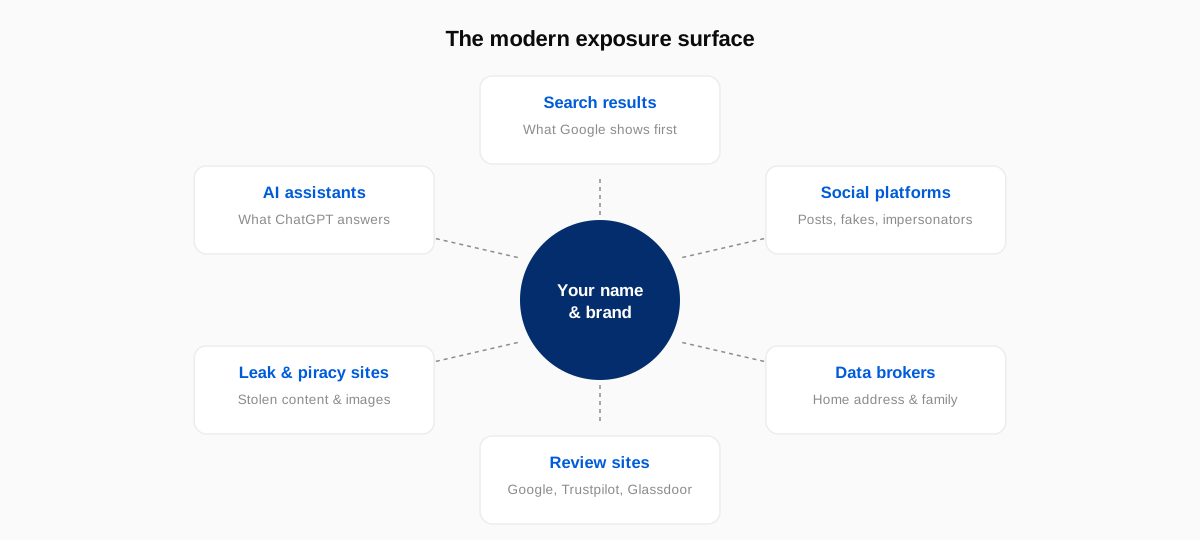
For most families we work with, the most dangerous content online is not an unflattering article. It is the quiet stuff: data broker profiles listing home addresses and family members, property records tied to a searchable name, geotagged photos, charity gala attendee lists, flight-tracking accounts following the family aircraft, and social posts from household staff or contractors. Individually each item looks harmless. Aggregated, they form a targeting package, who you are, what you have, where you sleep, when you travel, and who your children are.
Kidnapping-for-ransom assessments, executive protection details, and home security investments all assume an adversary has to work to build that picture. Increasingly, they don’t. A data broker removal program and a systematic sweep of address and family exposure is often the highest-return security spend a family office can make, precisely because it raises the cost of targeting back to where your physical security planning assumes it is.
The family is the perimeter
Principals are usually the best-protected member of the family and the least likely point of failure. Adversaries know this, which is why exposure travels through the softest connected node: a teenager’s public Instagram revealing the family’s location in real time, a spouse’s board bio listing the home neighborhood, an adult child’s startup press mentioning the family name, a nanny’s tagged photos. Any serious program covers the household, not just the principal, and does it with enough sensitivity that teenagers cooperate rather than route around it.
Key takeaway: For high-net-worth families, reputation and privacy exposure is a security problem before it is an image problem. Treat the online footprint as part of the physical security perimeter and fund it accordingly.
Removal first, suppression second
What most of the industry sells
The dominant model in online reputation management is suppression: create positive websites, profiles, and articles about you, optimize them, and push the negative item off page one. It can have a place. But you should understand its structural weaknesses before building a family’s protection around it, because they bite hardest at exactly your level of visibility.
Suppression leaves the harmful content live, still there for journalists, opposing counsel, and due-diligence firms who read past page one as a matter of professional habit. It requires manufacturing a public footprint for people whose entire preference is a smaller public footprint; flooding the internet with content about a privacy-minded principal is a strange trade, and it is rented ground: search algorithms shift, the negative item resurfaces, and the retainer continues indefinitely because the underlying problem was never solved.
What removal-first actually means
A removal-first approach starts from a different question: can this content be taken down at the source? In practice, a substantial share of harmful content can. Defamatory posts and articles may violate platform policies or be legally actionable. Private photos, doxxing content, and leaked documents violate the terms of nearly every major platform. Data broker listings can be suppressed through opt-out processes and kept down through continuous monitoring. Copyright, impersonation, and privacy claims each open removal paths that a suppression-only vendor never pursues. When the content itself comes down, de-indexing from search typically follows, and the problem is solved rather than hidden, including for the readers who never stop at page one.
Honesty requires the caveat: not everything is removable. Accurate reporting by legitimate news organizations, court records, and truthful reviews generally are not, and any firm guaranteeing otherwise should be shown the door. The professional standard is a candid, item-by-item assessment. This is removable and here is the pathway; this is not, and here is the containment strategy. Where removal genuinely is not available, suppression and narrative work become the right tool. The order of operations is the point: remove what can be removed, then protect what remains. You can see how this plays out in practice in our case studies.
Know what a targeting package on your family looks like. Our free confidential Exposure Scan maps addresses, family connections, and harmful content across search, brokers, and social, walked through live on a 15-minute call, and the findings are yours either way.
Book Your Free ScanThe flashpoints: press and litigation
When the family becomes a story
Most families operate below media attention for years, then hit a flashpoint: a company sale, a divorce filing, a lawsuit, an estate dispute, a child’s arrest, an activist campaign. At that moment, everything already online becomes raw material. Reporters pull data broker profiles, old social posts, property records, and forum threads within hours. The single best predictor of how bad a media cycle gets is how much material was sitting exposed before it started.
This is why the strongest programs are built in peacetime. A family that has already removed its broker listings, locked down family social accounts, cleared old harmful content, and established continuous monitoring enters a media event with a dramatically smaller attack surface. The family that starts cleanup after the first article publishes is doing demolition during a fire.
Litigation and the permanent record
Litigation creates its own exposure: filings quoted out of context, opposing parties feeding documents to reporters, and coverage that outlives the dispute by decades. Nothing in this guide is legal advice, and removal work must always be coordinated with counsel, timing matters, and actions that would be routine in peacetime can carry implications during active litigation. The right structure is a working relationship between your litigation team and your removal team: counsel manages the dispute, the removal firm manages the digital residue, and both understand that a settled case whose coverage still dominates page one is only half resolved.
Key takeaway: Flashpoints are won in advance. The families who fare best in press and litigation events are the ones who reduced their exposed material before anyone came looking for it.
A practical framework: the family exposure program
Here is the operating structure we recommend to family offices building this capability, whether they run it with us or independently.
Step 1: Map the full surface
Inventory every family member’s exposure: principal, spouse, children, and in higher-risk situations, key household staff. Cover search results in multiple geographies, data broker and people-search listings, social media (including tagged and third-party content), images and video, property and corporate records, forums, and increasingly, what AI assistants say when asked about the family. AI-generated answers now shape first impressions before anyone reaches a search results page, and they inherit whatever the open web says, which is another reason source-level removal has grown more valuable, not less.
Step 2: Triage by consequence
Score each item on two axes: harm if weaponized, and removability. Physical-security exposures (addresses, travel patterns, children’s locations) come first regardless of how benign they look. Defamation and false content second. Privacy leaks and unwanted images third. This is where dedicated image and video removal work applies, covering everything from leaked photos to unwanted tagged content. Merely unflattering content last, and sometimes never; chasing every negative mention wastes budget and can create the very attention you are avoiding.
Step 3: Execute removals
Work the removal pathways item by item: platform policy claims, legal takedown mechanisms through counsel where warranted, search engine removal processes, broker opt-outs, and direct negotiation with site operators. Expect realistic pricing: professional firms quote per link, and ours arrives in writing after the free Exposure Scan, so counsel and the family office can see the exact cost of each item, complex and contested matters included, before committing. Expect realistic timelines too, days for policy-violating content on responsive platforms, months for entrenched sites. Anyone quoting flat guarantees on third-party platforms they don’t control is telling you what you want to hear.
Step 4: Protect continuously
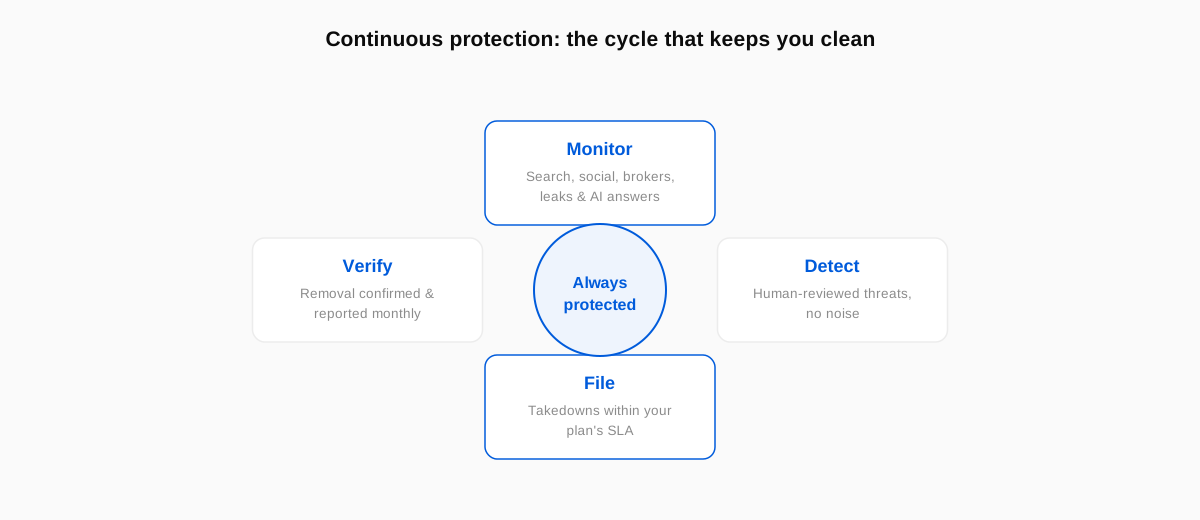
Removal without monitoring is a snapshot. Broker listings repopulate from upstream data sources, removed content gets reposted, and new items appear. The maintenance layer (continuous monitoring, rapid response to new exposures, quarterly re-sweeps) is what turns a cleanup into a posture. For families, this typically takes the form of a managed protection plan, priced to the number of family members covered, monitoring depth, and removal capacity included, against a broader market that spans $100-a-year DIY broker tools at one end and bespoke five-figure retainers at the other.
Get a baseline before the next flashpoint. The free Exposure Scan gives your family office a confidential, itemized read on what's findable about the principal and family, delivered on a 15-minute call, no obligation, findings yours to keep.
Book Your Free ScanChoosing a partner: the discretion standard
For this clientele, how a firm operates matters as much as what it can remove. The vendor you hire will hold a complete map of your family’s vulnerabilities. Vet accordingly.
Non-negotiables
NDAs before discovery, not after. A serious firm will execute confidentiality agreements before you disclose anything substantive, and will accept engagement through counsel or a family office entity so the principal’s name never appears on an invoice. Ask how client data is stored, who inside the firm can access it, and what happens to the file when the engagement ends.
A single point of contact. Family offices should not be re-briefing a rotating cast on sensitive matters. Demand one senior person who knows the full picture, is reachable during an incident, and coordinates everything behind the scenes. This is standard in our executive and principal engagements and it should be standard anywhere you spend at this level.
No publicity, ever. Be wary of firms that showcase named clients. If they publicize others, they will eventually publicize you, or at minimum treat your engagement as marketing raw material. References should come through professional channels (attorneys, security firms, other family offices) not a logo wall.
Honest scoping. The clearest integrity signal in this industry is a firm telling you what it cannot do. Guarantees of specific outcomes on platforms the firm doesn’t control, promised timelines for court-dependent processes, or “we remove anything” claims are the marks of a vendor optimizing for signature, not outcome.
Integration with your existing team
Reputation and privacy protection should not be a silo. The strongest configurations integrate the removal firm with the family’s existing infrastructure: sharing threat findings with the executive protection team (an address exposure is their problem too), coordinating with counsel on anything legally sensitive, aligning with the family’s communications advisors during media events, and looping in the family office’s IT or security lead on impersonation and phishing findings. Ask a prospective firm how they have worked inside such structures before. Firms accustomed to family office engagements will have ready answers about reporting cadence, secure communication channels, and escalation protocols; generalist marketing shops will not.
Key takeaway: You are not buying deliverables, you are extending your security perimeter. Hold a reputation firm to the same discretion, vetting, and integration standards you hold your security detail and your counsel.
Frequently asked questions
How is this different from what a PR firm or publicist does?
Complementary, not overlapping. Communications firms shape narrative, what gets said and how the family is presented. A removal-first firm changes what exists: taking down defamatory content, private images, and data broker exposure at the source, and keeping it down. The best outcomes for prominent families usually involve both: PR manages the story, removal shrinks the raw material the story can be built from. What PR firms generally cannot do is make harmful content disappear; that is a distinct technical and procedural capability.
Can you remove news articles about our family?
Sometimes, and honesty about which times matters. Accurate reporting by established outlets is generally not removable, and no reputable firm will promise otherwise. However, articles that are defamatory, that violate privacy in legally recognized ways, that have been updated or retracted, or that appear on low-quality aggregator sites often have viable pathways: editorial appeals, legal mechanisms through counsel, de-indexing requests, or removal from the syndication copies that do most of the ongoing damage. Our defamation removal work starts with a candid assessment of which category each item falls into.
What does a family-wide program actually cost?
Individual removals are quoted per link, in writing, after a confidential Exposure Scan. The family office sees the exact figure beside each URL before anything is authorized. Continuous family protection plans are sized to the number of family members, risk profile, and monitoring depth. The wider market spans consumer DIY tools under a few hundred dollars a year (useful for basic broker opt-outs, blind to everything else) up to bespoke five-figure monthly retainers. The right comparison point is not marketing spend. It is your physical security budget, because that is the risk category this addresses.
Our children are on social media. How do you handle that without a family fight?
Carefully and collaboratively. The goal is not deleting a teenager’s online life; it is closing the specific exposures that endanger the family: real-time location, home identification, wealth signaling, and searchable links between the child’s accounts and the family name. In practice this means privacy-setting hardening, removal of high-risk third-party content and tags, and a briefing delivered in terms teenagers actually accept (their own safety and autonomy, not surveillance). A privacy-focused program that treats family members as stakeholders rather than problems gets durable cooperation.
The gap between families who manage this well and families who don’t is rarely sophistication. It is simply whether anyone is accountable for the family’s digital exposure before it becomes a crisis. If no one currently owns that mandate in your family office, start with a clear-eyed baseline: book a free confidential Exposure Scan and see, in one 15-minute session, exactly what a motivated stranger can assemble about your family today, and exactly what can be taken off the board.