
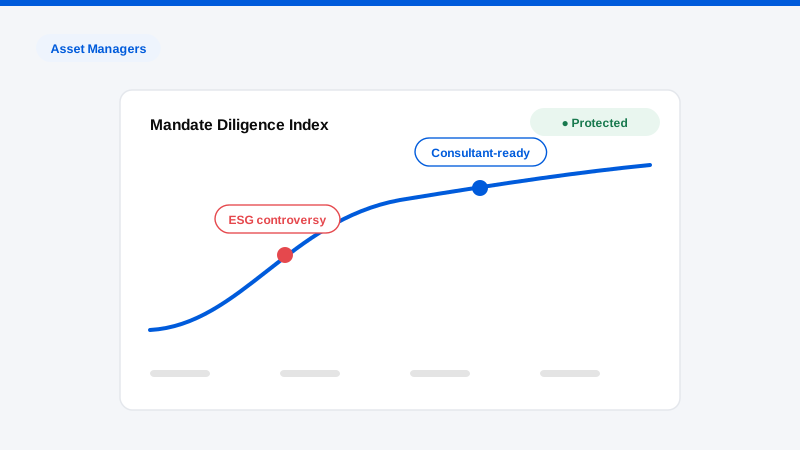
Reputation management for asset managers is the practice of controlling what institutional investors, consultants, platform gatekeepers, and journalists find when they research a firm, a strategy, or a named portfolio manager, and removing the damaging content that would otherwise decide the outcome of mandate diligence before the first meeting is ever granted. Asset management is a business in which the product is a promise kept over decades, the buyers are professionally obligated to look for reasons to say no, and the sale is conducted largely in the buyer’s own research process. A firm’s search results are, functionally, a standing due-diligence file that anyone can read and almost anyone can write into, and in this industry, that file is read by people whose job description is skepticism.
The structural vulnerability is the gap between how carefully asset managers control their official communications and how little control they have over everything else. Compliance-constrained firms publish cautiously and rarely, which leaves their search footprint thin, and thin footprints are fragile. A hostile ESG campaign, an anonymous post about a star manager’s departure, a regulatory footnote resurfaced without context, a forum thread speculating about outflows: any of these ranks immediately against a name that has almost nothing else competing for the page, and stays there for years. This guide describes how these threats operate against asset managers, the mechanisms through which search damage converts into lost mandates and shrinking AUM, why conventional PR and SEO responses fail this industry, and what professional, removal-first protection looks like. It is written for CEOs, CIOs, heads of distribution, COOs, and general counsel, the people who know that in this business, nobody tells you why you didn’t make the shortlist.
Why asset managers are targeted
Asset managers occupy a distinctive position: enormous sums under stewardship, minimal consumer visibility, and a small set of named individuals in whom the franchise’s credibility is concentrated. The threat landscape reflects that shape.
ESG and activist narratives are engineered for the diligence screen. Asset managers are targeted from both directions of the ESG argument: campaigns attacking holdings, stewardship records, or perceived hypocrisy on one side, and political campaigns attacking ESG commitments themselves on the other. The content is built to rank: reports, petitions, and coverage designed to surface when an institution searches the firm’s name. Long after a campaign’s moment passes, its artifacts remain in the index, waiting for the next RFP screen to find them.
Star-manager departures generate coverage that outlives the facts. When a named portfolio manager leaves, or is rumored to be leaving, the coverage, speculation threads, and industry-forum commentary attach permanently to both the firm and the individual. Departure stories skew negative by construction: they imply instability, succession risk, and outflows, and they keep ranking for the strategy’s name years after the transition was absorbed. For the departing manager, the framing of that coverage follows them to every future venture.
Personal attacks on named managers are attacks on the AUM. In a franchise built around key persons, the individual is the efficient target. Divorce filings, old litigation, compensation leaks, misattributed statements, anonymous culture allegations, and data-broker profiles listing home addresses all surface in key-person diligence, and in the research of every allocator, journalist, and adversary who looks. The firm’s most valuable asset walks around with an unguarded personal search page.
Regulatory footnotes resurface stripped of context. A settled matter from a decade ago, a routine deficiency letter, a disclosure event long since remediated, each exists somewhere in the public record, and each can be excavated and republished by an adversary, a journalist on deadline, or an aggregator site that monetizes regulatory data. Presented without context or date emphasis, an old footnote reads, in an adverse-media screen, exactly like a current problem.
Former employees and lift-out disputes create insider-credentialed adversaries. Compensation disputes, team departures, and succession fights generate ex-insiders with real grievances and fluent vocabulary. Employer-review platforms and finance forums give them durable, searchable venues, and a handful of detailed posts alleging cultural or ethical problems can dominate a firm’s thin search presence indefinitely.
Performance narratives harden into permanent labels. A bad year, a crowded-trade unwind, or a strategy drawdown produces coverage and commentary that never leaves the index. The fund may recover fully; the search page keeps serving the drawdown story to every future screener, because nothing the firm is permitted to publish ever displaces it.
What damaging content costs asset managers
The costs are concentrated in the industry’s decisive, invisible processes.
Mandate diligence is built to surface exactly this content. Investment consultants, OCIO platforms, pension staff, endowments, and sovereign allocators run structured operational due diligence that includes adverse-media and background screens on the firm and its key persons. These screens do not weigh context; they surface hits. An unresolved item (a hostile campaign artifact, an anonymous allegation, a decontextualized footnote) becomes a line in a diligence memo, and in searches where dozens of qualified managers compete for every mandate, a line in a memo is a quiet exclusion from the shortlist. The firm hears nothing; the mandate simply goes elsewhere.
Consultant gatekeeping multiplies every hit. A single consultant’s internal flag propagates across every client that consultant advises. Content that cools one diligence analyst does not cost one mandate; it costs a channel, and because consultant research is confidential, the firm never learns which piece of content did the damage or that damage was done at all.
Retail and platform distribution reads the same internet. Wealth platforms, fund supermarkets, and financial advisors screen managers before placing products on menus and in model portfolios, and advisors’ clients search fund and manager names themselves. Hostile content suppresses flows at every layer of the distribution stack simultaneously.
Redemption thresholds drop when narratives are live. Institutional capital is slow to arrive and fast to leave. Hostile content rarely triggers redemptions by itself, but it lowers the threshold: when performance wobbles, the allocator re-reading a departure story or an outflow-speculation thread reaches for the redemption notice a quarter earlier. For listed managers, the same dynamics are tracked by analysts and priced into the equity as flow risk.
Talent diligence runs both directions. Senior investors and distribution leaders research firms before joining, and a search page dominated by instability coverage or culture allegations raises the price and lowers the quality of every hire. In a franchise business, the inability to recruit the next generation of named managers is an existential cost that first appears as a quiet recruiting problem.
AI assistants now sit inside the diligence workflow. When an allocator’s analyst asks an AI tool to summarize a firm or a manager, the model synthesizes from the full visible record (the campaign artifact, the anonymous thread, the decontextualized footnote) and delivers it as neutral fact, upstream of any conversation the firm is ever invited to.
Why generic PR and SEO approaches fail
The industry’s default responses fail against this threat model for reasons specific to asset management.
Compliance constraints neutralize the standard playbook. Asset managers cannot flood the zone with content, testimonials, and aggressive messaging; regulation constrains what they may publish about performance and themselves. Suppression-oriented SEO, which depends on publishing volume, runs directly into those constraints, which is precisely why thin-footprint firms stay fragile under generic programs.
Suppression does not survive diligence anyway. Institutional diligence is not a glance at page one; analysts and screening tools read deep, and AI research assistants read everything indexed. Content buried to page four is still surfaced by an adverse-media screen and still quoted by a chatbot summarizing the firm. Only removal and de-indexing actually change what the diligence process can find.
Public rebuttals convert items into stories. A firm that publicly disputes an allegation or a campaign creates a second round of coverage and links the rebuttal to the attack in the permanent record. In a confidence-sensitive business, the strategically correct response is usually the quiet one (removal, de-indexing, containment) which is exactly the work generalist PR retainers are not built to execute.
Generic vendors do not understand the diligence audience. Reputation firms serving consumer brands optimize for star ratings and sentiment. Asset managers need the specific items that trigger ODD flags identified and eliminated: a different target set, a different standard, and a different craft.
What removal-first protection looks like
Professional protection for an asset manager runs a strict sequence (assessment, removal, de-indexing, monitoring) mirroring the diligence process it defends against.
Assessment. The engagement begins with a full exposure audit conducted the way an allocator’s screen would run: the firm’s name, each strategy and vehicle, and each named manager and executive, across search, news archives, forums, employer-review platforms, regulatory aggregators, data brokers, and AI-generated answers. Every damaging item is mapped and graded by severity, diligence relevance, and removability. We run this as a free, confidential Exposure Scan, live results on a 15-minute call, yours to keep either way.
Removal at the source. Defamatory posts, false or policy-violating reviews, impersonation accounts and cloned sites, doxxed personal information, and data-broker records on named managers are all frequently removable, through different mechanisms per platform, argued in each platform’s own terms by specialists who have done it at volume. The honest caveat, stated up front: removal decisions belong to platforms and publishers, and no credible firm guarantees a specific item will come down. What specialists change is the probability, the speed, and how much of the target set falls.
De-indexing from search. Content that cannot be removed from its host can often be removed from the search results where diligence actually happens, under search engines’ own policies covering exposed personal information and related categories. For a manager whose home address circulates on a grudge site, or an old record aggregated out of context, de-indexing closes the discovery path even when the page itself persists.
Monitoring on a standing footing. Attacks on asset managers cluster around catalysts: performance news, personnel changes, fund launches, proxy seasons, fundraising cycles. Continuous monitoring across search, forums, review platforms, data brokers, and AI answers catches new items while they are one post rather than a narrative, and our Protection Plans pair that monitoring with reserved removal capacity so response begins within hours. The difference between hour-one response and month-three discovery is the difference between an item nobody saw and an item in a consultant’s file.
Protecting named managers as individuals
In asset management, key persons are disclosed by name in every offering document, which makes their personal search results part of the firm’s product. Allocators run key-person screens as a matter of process; journalists profile the individuals, not the LLC; and adversaries know the person is the softer target.
The personal surface has its own geography: data-broker profiles exposing home addresses and family members, divorce and litigation records surfaced out of context, compensation leaks, impersonation accounts and fake investment schemes trading on the manager’s name, and AI-generated biographies that repeat every allegation as established fact. This content endangers families, contaminates key-person diligence, and follows managers across every firm and fund they ever launch. Protecting principals as individuals (quietly, and with the same confidentiality the firm applies to everything else) is the core of our digital executive protection practice, and for asset managers we typically run it alongside firm-level protection as one engagement, because diligence screens the firm and its key persons as one file.
Frequently asked questions
Can old regulatory matters be removed from our search results?
The underlying official record generally cannot be removed, and no credible firm claims otherwise. What can often be addressed are the secondary layers that do the actual damage: aggregator sites republishing the matter out of context, hostile posts mischaracterizing it, and search visibility that presents a decade-old settled item as current news. An item-by-item assessment determines which layers are realistically addressable in your case.
An anonymous forum thread is speculating about our flows and a manager’s departure. What can be done?
The thread gets decomposed into items, and each gets the strongest available treatment. Elements that cross into false statements of fact, doxxing, or platform-policy violations can be attacked directly with the host; the remainder is contained through de-indexing where eligible so it stops surfacing in diligence-path searches. What we will not do is respond publicly on your behalf, in this industry, amplification is usually the greater risk.
Our compliance team is cautious about any reputation work. How does this fit?
Removal-first work is generally more compliance-compatible than conventional reputation marketing, because it involves eliminating third-party content rather than publishing promotional claims. We work alongside compliance and counsel, structure engagements to leave no footprint, and stay strictly out of legal advice, when litigation or regulatory engagement is the right tool, we say so and support counsel’s lead.
Do we need this if nothing negative has ever been written about us?
A clean page is worth defending precisely because thin footprints are fragile, the first hostile item to appear will rank instantly and alone. Firms that engage pre-crisis get their key persons’ data-broker and personal exposure cleared, establish monitoring, and enter the next fundraise or news cycle with standing response capability. An exposure scan will also often find items (old records, broker profiles, forum mentions) that the firm did not know existed.
How is success measured in an engagement like this?
Against the target set from the initial assessment: items removed, items de-indexed, personal exposure eliminated, and what a fresh diligence-style screen of the firm and its key persons returns afterward. We scope item by item and report against that scope, not against vague sentiment metrics. No outcome controlled by a third party is promised, and we tell you which items fall into that category before you commit.
Every mandate your firm competes for this year will be preceded by a screen you never see, run on the firm and on the individuals whose names carry it. Find out what that screen returns before the next consultant does. Our free, confidential Exposure Scan maps every damaging item attached to your firm, your strategies, and your named managers, reviewed live on a 15-minute call, with the findings yours to keep whether or not we ever work together.