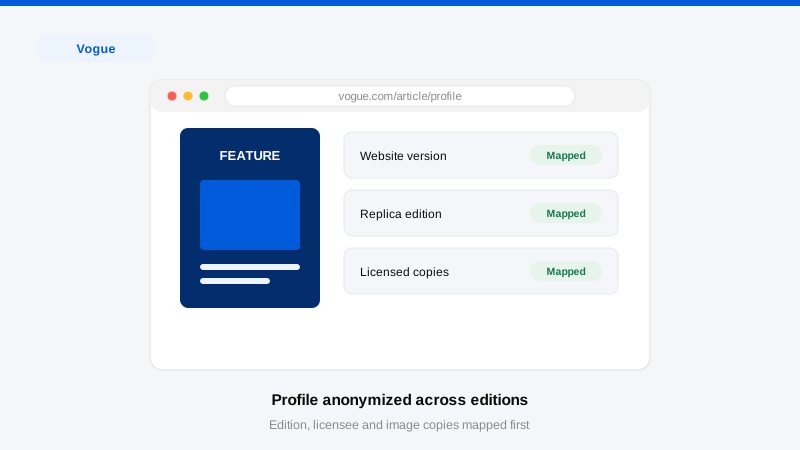
Removing a Vogue article means asking the relevant Condé Nast edition to unpublish, amend or anonymize it, or removing the piece from the search results for the name. Magazine archives are rarely deleted. Amendment, name removal, image withdrawal, de-indexing and suppression are the outcomes that resolve most of these matters.
Key facts
- Vogue is a Condé Nast title, and the edition carrying the article decides who can act on it, which country’s law applies and whether an erasure right exists at all.
- Condé Nast publishes in many countries, some directly and some through local publishing partners under licence, so the entity behind an edition may not be the company whose name is on the cover.
- Where the publisher sits in the United Kingdom or the European Union, UK GDPR and the EU General Data Protection Regulation give a right to erasure supporting both a request to the publisher and a delisting request to Google.
- Where the publisher sits in the United States, there is no right to be forgotten and no mechanism to compel removal of a lawful article, so unpublication is editorial discretion alone.
- Section 230 of the Communications Decency Act concerns a platform’s liability for material posted by others, so it bears on comments and reposts around a piece rather than on the publisher’s own copy.
- Rights in commissioned magazine photography usually sit with the photographer or the publisher rather than the subject, which limits copyright routes for a family but gives the rights holder real leverage over unlicensed copies.
- Magazine features are republished by the title itself in anniversary lists and themed collections, so an old profile can return to prominence without anyone new writing about it.
- Google will consider taking a URL out of searches for a person’s name, but it weighs every request against the public interest in the material staying findable.
Why a magazine profile is a different problem
A news article ages. A magazine profile does not. It was written to last, it is written about a person rather than an event, it carries photographs commissioned for the piece, and it is republished by the title itself on anniversaries and in themed collections. For a family that agreed to a feature five years ago and now wants it gone, the durability that made the piece attractive is exactly the problem.
Society, wedding, heir and family office coverage is the category we see most. Somebody consented, or a relative consented, or nobody consented and a photograph was licensed anyway. Years later the marriage has ended, the children are older, the family has a security posture, and a glossy profile naming a house and a fortune sits at the top of a name search. An anonymised engagement of this shape is written up as our family holding case study.
Who actually publishes the article you are looking at?
Vogue is a Condé Nast title, and this is the question that decides everything else. Condé Nast publishes editions in many countries, some directly and some through local publishing partners under licence. The edition that carries the article determines who can act on it, which country’s law applies, which regulator if any is relevant, and whether an erasure request has any force at all.
A British edition article and an American edition article are, for these purposes, two different problems. Getting this wrong at the first approach costs you the strongest version of your argument, and the second approach is always weaker than the first.
Which law applies?
If the article sits with a United States publisher, there is no right to be forgotten. Truthful reporting and commentary are constitutionally protected and courts do not order lawful articles removed, so an American edition moves by persuasion or it does not move at all. Section 230 of the Communications Decency Act is often raised in these conversations, but it concerns a platform’s liability for material posted by others, so it bears on the comments and reposts around a piece rather than on the publisher’s own copy.
If the article sits with a United Kingdom or European publisher, UK GDPR and the EU General Data Protection Regulation give a right to erasure, which supports both a request to the publisher and a request to Google to delist the URL from searches for the name. Our right to be forgotten guide sets out how those are assessed against the public interest in the material remaining available.
What about the photographs?
Often the images are the real exposure, not the text. Magazine photography is licensed, syndicated to picture agencies, and reused across editions and social accounts long after the article stops mattering. Rights in those images usually sit with the photographer or the publisher rather than the subject, which limits copyright based routes for the family, but it also means a single conversation with the right rights holder can affect where the images appear.
Where an image is being used by third parties without licence, the copyright holder has real leverage and we coordinate that with them. Where the concern is a child, a residence or a security exposure, platform privacy policies and publisher discretion carry more weight than law.
Which route fits which problem?
That depends on the edition holding the article, on the age of the piece and on whether the concern is accuracy, privacy or safety. Timelines depend on the route and the publisher, and they are set out in writing after the free Exposure Scan.
Get a Free, Confidential Exposure Scan
How an engagement runs
We establish who actually controls the archive, which with this title is rarely obvious from the masthead. We map everything that exists: the article, the print version, the international reruns, the licensed images and the search positions for every name that matters to you. We tell you which outcomes your facts genuinely support before you commit, including when the honest answer is that the archive will stay. Then we pursue every ground that applies, at the publisher, at the images and in the results, at the same time rather than one after another. You approve the approach before anything is sent, and what comes back is verified, evidenced to you and monitored.
What we need from you to start
The first thing we need is enough to identify the publishing entity: the URL, the edition, the publication date, whether the piece also ran in print, and the issue number if you have it. Nothing sensible can be drafted until we know who actually controls that archive, and in a licensed edition that is often not the company most people assume.
Then the material that supports the ask. Where the concern is accuracy, we want whatever shows what was wrong. Where the concern is privacy or security, the useful material is different and more specific: what was published that was never public, whether a residence is identifiable from the photographs, and whether children are named or pictured. Where consent is in issue, we want any release, contract or exchange from the time the feature was produced, because a written record of what was agreed is far stronger than a recollection.
Finally we need written authority to act for the individuals named. In family matters a family office director, a private client lawyer or a chief of staff signs under a confidentiality agreement, and the family never corresponds with the publisher directly.
Timelines and what usually happens first
The first phase is identification and assessment rather than correspondence, and with a title published across many markets it takes longer than people expect. Nothing is drafted until we know who controls the archive.
After that, timelines depend on the route and the jurisdiction, and you get ranges in writing item by item rather than a completion date. A United States edition is the slowest and least predictable of all of them, because nothing compels a decision and the answer can simply be no.
Common mistakes that make it harder
- Writing to the wrong edition. A letter to the wrong Condé Nast entity spends your strongest argument on a company that cannot act, and the second approach is always weaker than the first.
- Opening with a lawyer’s demand. With a title of this kind a legally weak letter hardens the position and occasionally becomes a story about a family trying to erase a profile.
- Arguing that consent was withdrawn, and nothing else. Consent given at the time cannot simply be revoked, and an argument built on it alone invites a refusal that closes the file.
- Forgetting the photographs. Images outlive the text, sit with agencies, and reappear on social accounts and stock platforms long after the article stops mattering.
- Publicly complaining. Society and media titles cover exactly this, and the complaint becomes the new coverage.
- Deleting the family’s own pages and profiles. It removes the assets that were ranking usefully for the name and leaves the feature with less competition.
How this works alongside your lawyer, PR team or security team
Private client lawyers usually lead where a family’s affairs, a trust structure or a settlement is involved, and we work behind them on the editorial, image and search layers. Where a UK or EU erasure right applies, counsel and we normally run in tandem, because a formal data protection position and an editorial conversation reinforce each other when they are sequenced properly and undermine each other when they are not.
With PR advisers the division is simple. They handle what is said publicly, including whether the family says anything at all, which in these matters is frequently the right answer. We handle what is filed, to which entity, on which ground, and what a name search actually returns afterwards.
With security teams the priority list is specific and it comes first: an identifiable residence, a school, a routine, a vehicle, a child’s face, a staff member’s name. Those details are often removable from a feature that is otherwise staying online, and a publisher that will not delete an archive piece will frequently agree to blur an image or cut a paragraph when the reason is safety rather than embarrassment.
Who instructs us
Almost always a chief of staff, a family office director, a private client lawyer or a PR agency acting for the family, rather than the person named. The 15-minute call is short and specific. We look at the article, tell you which edition holds it, say which of the outcomes is realistic, and tell you plainly when the answer is that the archive will stay. Confidentiality and an NDA are standard, our involvement stays invisible unless strategy dictates otherwise, and we work alongside counsel, publicists and security teams. The written report is yours to keep.
We do not promise outcomes. Some magazine features stay online permanently, and the honest work is then about what a searcher meets first.
Frequently asked questions
We agreed to the feature at the time. Can we withdraw consent now?
Consent given years ago cannot simply be revoked as against a publisher, but changed circumstances are a genuine argument, particularly where children, a security concern or a private family are involved. In the United Kingdom and Europe data protection rights give that argument formal weight. In the United States it is a matter for editorial discretion.
Will Vogue remove a profile from its archive?
Magazine archives are treated as a record and full removal is the least likely outcome. Amendment, the removal of specific details such as an address or a child’s name, and de-indexing are more achievable, and they usually solve what the family is actually worried about.
The article was reprinted by other Vogue editions. Does that need separate work?
Yes. International editions are frequently separate publishing entities, so each one is its own conversation, and a result at one edition does not carry across automatically.
Can the photographs be taken down?
Sometimes, and it is worth pursuing separately from the text. Where rights sit with the photographer or the publisher rather than the family, a copyright argument is not the family’s to make, so the leverage has to come from somewhere else. Where a security or child protection concern exists, publishers and platforms are usually more responsive than a rights argument alone would suggest.
Is a lawyer’s letter the right opening move?
Rarely with a title of this kind. A legally weak demand hardens the position and occasionally becomes a story about a family trying to erase a profile. Where the facts justify legal action we work alongside your counsel rather than in place of them.
How do we find out which entity publishes the edition we are worried about?
It is part of the scan, and it is one of the more useful things the scan produces. Where a local partner holds the licence rather than Condé Nast itself, both the correspondence route and the applicable law change. We confirm it before anything is drafted rather than assuming from the masthead.
The feature keeps reappearing in anniversary and best of lists. Can that be stopped?
It can be raised as part of the ask, and it is a reasonable request even where deletion is refused. A title that will not remove an archive piece will often agree not to resurface it in curated collections, and that alone changes how often the article climbs back up a name search.
Can you deal with the images on stock and social platforms?
Yes. The images are frequently the real exposure and they are treated as part of the same project rather than as somebody else’s problem. Where a child, a residence or a security concern is involved, platforms tend to be more responsive than a rights argument on its own would suggest.
Start with a free, confidential Exposure Scan. It identifies the publishing entity, maps the article, the images and the international reruns, and comes back as a written report that is yours to keep. Our process sets out what follows.