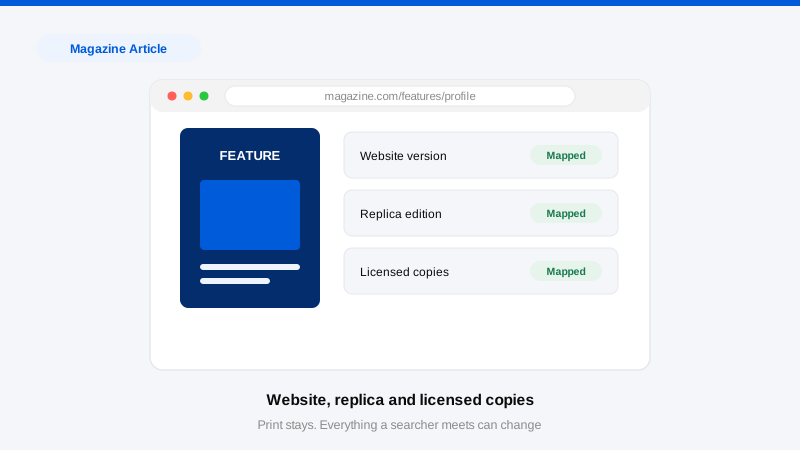
Removing a magazine article means asking the publisher to unpublish, amend or anonymize the online version, and dealing separately with the print edition, the digital replica and the licensed database copies. Magazine archives are rarely deleted. Amendment, name removal, de-indexing and suppression resolve most of these matters.
Key facts
- A magazine article exists in several places at once: the print issue, the digital replica edition, the website version, syndicated partner copies and licensed copies inside commercial research databases.
- Licensed database copies do not disappear when a publisher amends or removes the original, and they are the copies a diligence analyst at a bank or a law firm is most likely to find.
- Digital replica editions are distributed by third party newsstand platforms with their own removal processes, separate from the publisher’s website.
- Where the publisher sits in the United Kingdom or the European Union, data protection gives a right to erasure supporting both a request to the publisher and a delisting request to Google.
- Where the publisher sits in the United States, there is no right to be forgotten and no mechanism to compel removal of a lawful article, so unpublication is editorial discretion alone.
- Many international magazine brands publish local editions through licensed partners, so the entity that controls the archive may not be the company whose name is on the cover.
- Rights in commissioned photography usually sit with the photographer or the publisher rather than the subject, which limits copyright routes for the person featured.
- Print cannot be recalled, and back issues stay in libraries and private collections whatever happens online.
Why magazines are harder than newspapers
A newspaper article reports an event and ages out of relevance. A magazine article is written about a person or a company, is designed to be read years later, and is republished by the title itself in anniversary lists, best of collections and themed rounds ups. It also carries commissioned photography, which has its own life.
There is a second difference that surprises people. A magazine piece exists in more places than a news article. There is the print issue, the digital replica sold through app stores and newsstand services, the website version, the version syndicated to partner sites, and, for business and trade titles, licensed copies sitting inside research databases used by banks, law firms and diligence providers. Each of those is a separate conversation.
What are the realistic outcomes?
Amendment. The online article is corrected, updated or retitled. The most achievable meaningful result, and often the one that matters most because the headline is what appears in search.
Name removal. The article stays and the individual is no longer identified, so the page stops ranking for the name.
Unpublication. The online version comes down. The least common outcome, and the one publishers resist most, because the archive is treated as the record.
De-indexing. The article stays online and leaves search results for the name.
Suppression. Nothing changes at the source and the article stops being the first thing a searcher meets.
Print cannot be recalled. What can change is everything a searcher will actually encounter.
What happens to the licensed copies?
This is the part most people miss. Business and trade magazine content is routinely licensed to commercial research and news database services, where it is stored, indexed and served to subscribers. A diligence analyst running a name through one of those services can find an article that no longer exists on the publisher’s own site.
Those copies do not disappear because the publisher amended or removed the original. They are a separate problem with a separate answer, and an engagement that stops at the website has not finished the job for anyone whose real exposure is a bank’s diligence screen. The same is true of the digital replica editions, which live on third party newsstand platforms rather than with the publisher.
Which law applies?
It depends entirely on who publishes the title, not on where you live. If the publisher is in the United Kingdom or the European Union, data protection gives a named individual a right to erasure, which supports both a request to the publisher and a request to Google to delist the article from searches for the name. Our right to be forgotten guide explains how those are assessed against the public interest in the material staying available.
If the publisher is in the United States, there is no right to be forgotten and no mechanism to compel removal of a lawful article, so an American title moves by persuasion or it does not move at all. Many international magazine brands publish local editions through licensed partners, so the entity behind the article you are looking at may not be the one whose name is on the cover. Our Vogue page sets out how that plays out with a title published across many markets.
Which route fits which copy?
Each copy is its own conversation, and which of them matters most depends on who is actually looking your principal up. Timelines depend on the copy, the publisher and the jurisdiction, and they are set out in writing after the free Exposure Scan.
Get a Free, Confidential Exposure Scan
How an engagement runs
We identify who actually controls the archive, which with a licensed edition is frequently not the company on the cover. We map every copy that exists, including the replica edition, the syndicated versions, the images and the licensed database copies your bankers and lawyers can see. We tell you which outcomes your facts genuinely support before you commit, including when the answer is that the feature stays online. Then we pursue every ground that applies, at the publisher, at the copies and in the results, at the same time rather than one after another. You approve the approach before anything is sent, and what comes back is verified, evidenced to you and monitored.
An anonymised engagement involving a private family and durable feature coverage is written up on our family holding case study page.
What we need from you to start
We need enough to identify the publishing entity before anything else: the URL, the title and edition, the issue date, whether the piece ran in print, and the issue number if you have it. In a licensed edition the company that controls the archive is frequently not the one people assume, and a request sent to the wrong entity spends the strongest version of the argument.
Then the supporting material. Where the concern is accuracy, we want whatever establishes what was wrong. Where the concern is privacy, consent or security, the useful material is more specific: what was published that was never public, any written agreement from the time the piece was produced, whether children are named or pictured, and whether a residence is identifiable.
We also ask what you already know about the copies: which database services your bankers or lawyers have seen it in, which partner sites reran it, and which images have turned up elsewhere. Finally we need written authority to act, normally signed by a chief of staff, family office director, general counsel or agency principal under a confidentiality agreement.
Timelines and what usually happens first
The first phase is identification and inventory rather than correspondence, because the copy that matters to a client is often the one inside a diligence tool rather than the one on the website.
After that, timelines depend on the copy, the publisher and the jurisdiction, and you get ranges in writing item by item rather than a single date. Suppression is different in kind again, because it is continuous rather than complete.
Common mistakes that make it harder
- Stopping at the website. It is the most common failure in magazine work. The replica edition and the licensed database copies survive the amendment everyone celebrated.
- Writing to the brand rather than the publisher. A request to a licensor about a licensee’s article achieves nothing except a record that you asked.
- Opening with a lawyer’s demand. With a society, business or trade title a legally weak letter hardens the position and can itself become copy.
- Relying on withdrawal of consent alone. Consent given at the time cannot simply be revoked, and an argument built on it alone invites a refusal that closes the file.
- Forgetting the photography. Commissioned images sit with agencies and reappear for years, long after the text has stopped mattering.
- Deleting your own pages and profiles. It removes the material that was ranking usefully and leaves the feature with less competition.
- Publicly complaining. Titles that cover media and society will write about the complaint, and the second piece is worse than the first.
How this works alongside your lawyer, PR team or security team
Where a UK or EU erasure right applies, counsel and we normally run in tandem, because a formal data protection position and an editorial conversation reinforce each other when they are sequenced properly. Where the publisher is American, we say plainly at assessment that nothing compels a decision, which usually saves the cost of a legal opinion reaching the same conclusion. Private client lawyers lead where a trust, a family structure or a settlement is involved, and we work behind them on the archive, the licensed copies and the search layer.
With PR advisers the division is clear. They own what is said publicly, and with a durable feature the right answer is very often to say nothing. We own what is filed, to which entity or platform, on which ground, and what a name search returns afterwards.
With security teams the priority list is specific and it comes first: an identifiable residence, a school, a routine, a vehicle, a child’s face, a staff member’s name. Publishers that will not remove an archive feature will frequently agree to cut a paragraph or blur an image when the reason given is safety rather than embarrassment.
Who instructs this work
Almost always a chief of staff, a family office director, a general counsel or a PR agency acting for the person named. The 15-minute call is short and specific. We identify the publisher, tell you which of the outcomes is realistic, and say plainly when the answer is that the feature will stay online and the work belongs in search. Confidentiality and an NDA are standard, our involvement stays invisible unless strategy dictates otherwise, and we work alongside counsel, publicists and security teams. The written report is yours to keep whether or not you engage us.
We do not promise outcomes. Some magazine features stay online permanently.
Frequently asked questions
Can a magazine be made to delete an old profile?
Only where the publisher agrees, or where a legal right applies in the publisher’s own jurisdiction. In the United Kingdom and Europe data protection gives real leverage. In the United States it is a matter of editorial discretion, and archives are usually kept.
We took part in the article. Does that end the conversation?
No, though it changes the argument. Participation makes a consent based objection weaker and makes changed circumstances, privacy, security and the age of the piece the stronger grounds, particularly where children or a family’s safety are involved.
What about the printed issue?
Print cannot be withdrawn from the people who already have it, and back issues stay in libraries and collections. In practice the harm being complained of is nearly always the online version and the search result, and those are the things that can change.
Why do the copies matter so much?
Because a searcher, an analyst or a journalist will find whichever copy ranks or is indexed, whatever the publisher’s own site now says. Handling the original alone is the most common failure in this work.
Will an approach make the magazine write about us again?
It can, particularly with a title that covers media or society. Assessing that risk is part of the assessment, and there are matters where the recommendation is to leave the publisher entirely alone and work only at the search layer.
Which database services actually carry magazine content?
Commercial news and research services licensed by publishers, of the kind used by banks, law firms, corporate diligence teams and recruiters. Which ones carry a given title depends on the publisher’s own licensing arrangements. Establishing that list is part of the scan, because those copies are usually the ones causing the commercial harm.
The article helped us at the time. Can it simply be updated instead?
Often, and it is frequently the better ask. An update that reflects what happened afterwards, a changed role, a resolved dispute, a corrected figure, preserves the piece and removes what is actually damaging, and a publisher that would refuse a deletion will consider an update on documented facts.
We are a company rather than an individual. Do the same routes apply?
The editorial and search routes are the same, and the licensed database copies usually matter more, because commercial counterparties search databases as well as Google. What changes is the legal position: erasure rights attach to individuals rather than to companies, so a corporate matter leans harder on accuracy, on the search layer and on what a diligence screen returns.
Start with a free, confidential Exposure Scan. It identifies the publishing entity, maps every copy including the licensed ones, and returns a written report that is yours to keep. Our process sets out what happens after that.