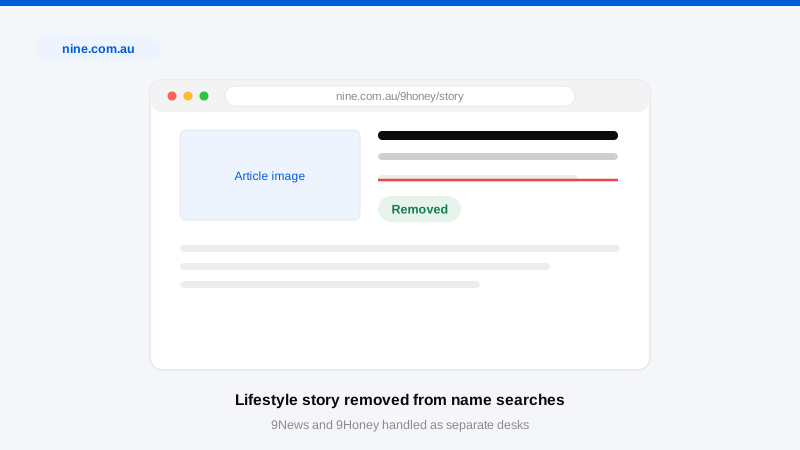
Removing a nine.com.au article means asking Nine Entertainment to unpublish, correct or anonymize a 9News or 9Honey story, or removing it from the search results for the name. Deletion is the least likely outcome. Amendment, name removal, de-indexing and suppression resolve most matters involving the network.
Key facts
- nine.com.au is the digital front door of Nine Entertainment Co, and it carries several distinct products including 9News, 9Honey and sport, each edited by a different desk.
- A 9News item often begins as a television story with a broadcast script behind it, so the online article, the video and the transcript are three separate assets with separate search footprints.
- Australian commercial television is subject to industry codes of practice overseen by the Australian Communications and Media Authority, and broadcast complaints normally go to the broadcaster first.
- Written journalism from participating publishers falls under the Australian Press Council’s Standards of Practice, whose remedies are corrective rather than deletive.
- 9Honey material is heavily republished by aggregators and portal partners under their own branding, so copies frequently sit on domains Nine does not control.
- Australia’s uniform defamation scheme, as amended from 2021, includes a serious harm element and makes a concerns notice a formal prerequisite to proceedings, with a limitation period generally of one year.
- Australia has no general right to erasure of the kind that exists in the United Kingdom, so search level work here stands on narrower ground than clients expect.
- The eSafety Commissioner administers statutory schemes under the Online Safety Act covering adult cyber abuse and image based abuse, which are separate from both press and broadcast regulation.
What is nine.com.au?
nine.com.au is the digital front door of Nine Entertainment Co, one of Australia’s largest media groups. The domain carries several distinct products: 9News, which is the online arm of the television news operation, 9Honey, the lifestyle, relationships and celebrity vertical, sport coverage, and links into the group’s other assets, which include national newspaper publishing and radio.
Those products are not run the same way, and that is the first thing to establish. A 9News item often begins as a television story with a broadcast script behind it. A 9Honey feature is written for the web and edited by a lifestyle desk. The route, the recipient and the argument differ accordingly.
Why does 9Honey coverage cause a specific problem?
9Honey publishes a high volume of personal, relationship and family material, frequently about people who are not public figures and who never expected to be written about. It performs strongly in search, it is heavily shared, and it is picked up by content aggregators and portal partners that republish it under their own branding.
For a private individual this is the worst combination: a story with thin ongoing public interest, an outsized search footprint, and copies on domains the original publisher does not control. It is also, for the same reasons, one of the more workable situations, because age, privacy and the absence of continuing public interest are exactly the grounds that persuade a lifestyle desk and support search level applications.
What are the possible outcomes?
Unpublication. The URL is taken down. Least common, most available for lifestyle material about private people, older items, and anything that was wrong.
Amendment. The article or headline is changed, corrected or updated with what happened next.
Name removal. The story stays and the person is no longer identified.
De-indexing. The page stays online and leaves search results for the name.
Suppression. The article stays and stops being the first thing a searcher sees.
What complaint routes exist for a broadcaster’s website?
Start with the network’s own corrections and audience contact channels, with documents attached rather than adjectives. Beyond that, the applicable regulator depends on the product. Australian commercial television is subject to industry codes of practice overseen by the Australian Communications and Media Authority, and complaints about broadcast news are normally made to the broadcaster first, with the regulator available if the response is unsatisfactory. Written journalism from participating publishers falls under the Australian Press Council’s Standards of Practice, whose remedies are corrective rather than deletive.
So the routes exist, and which one your matter belongs to depends on which desk produced the item. Where the material is online abuse rather than journalism, including the pile on that follows a story, a separate statutory regime applies altogether. Getting that distinction wrong is how a first approach gets wasted.
What does Australian law give a named individual?
Australia’s uniform defamation scheme requires a serious harm element following the reforms that began in 2021, makes a concerns notice a formal step before proceedings, and applies a limitation period generally of one year from publication that a court may extend. There is no general Australian right to erasure, so search level work stands on narrower ground than it does in the United Kingdom, and our overview of legal removal requests explains how that layer gets assessed. We are not a law firm and we work alongside your Australian counsel where a formal step is warranted.
Which route fits which problem?
That is the judgment the engagement buys, and it turns on which desk produced the item, how old it is and how far the portals have carried it. Timelines depend on the route and on the publisher, and they are set out in writing after the free Exposure Scan.
Get a Free, Confidential Exposure Scan
How the work runs
We establish everything that exists, which with this publisher usually means an article, a video, a transcript and a row of portal copies rather than the one link you sent. We tell you which of the five outcomes your facts genuinely support before you commit, including when the honest answer is that the story stays and the work belongs in search. Then we pursue every ground that applies, at the source and in the results, at the same time rather than one after another. You approve the approach before anything is sent, because a network that reports on media stories can turn a complaint into one. What comes back is verified, evidenced to you and monitored.
Broader Australian context sits on our content removal Australia page, and an anonymised Australian founder matter is written up as our wellness founder case study.
What we need from you to start
The first thing we ask for is the full inventory, because a Nine matter is rarely one URL. We want the article link, the date, the vertical it sits in, the link to any video player or television segment, and every republished copy you have already found on portals and aggregators. A story that exists as an article, an embedded video and a syndicated copy on a portal is three problems with three routes.
Then the documents, whatever establishes that the account published is incomplete or wrong. Where the concern is privacy we ask what was published that was never public and whether children are identifiable. 9Honey matters are unusually often privacy matters rather than accuracy matters, and what makes the difference there is different.
We also ask for everything already sent to the network. Finally we need written authority to act, normally signed by a chief of staff, in house counsel or an agency principal under a confidentiality agreement, so the individual never has to correspond with Nine directly.
Timelines and what usually happens first
The opening days are assessment, and with this publisher that is the part people underestimate. Portal republication means that by the time anyone calls us, the same 9Honey piece can be live on half a dozen domains with different headlines and different rankings.
After that, timelines depend on the route and on the desk, and you get ranges in writing item by item rather than a single date. Suppression is different in kind, because it is ongoing rather than finished.
Common mistakes that make it harder
- Ignoring the video. The television segment, the embedded player and the transcript rank separately, and clearing the article while the video stays up solves half a problem.
- Ignoring the portal copies. A result at Nine that leaves six syndicated versions live has not changed what a searcher meets.
- Approaching a lifestyle desk with legal threats. A 9Honey privacy request is usually granted on human grounds and refused on aggressive ones.
- Sending a concerns notice first. It is a formal step for your Australian solicitors, and used without serious harm behind it it hardens the position and can create fresh coverage.
- Replying publicly. A network that reports on media stories will report on your complaint, and the article gets a second life.
- Deleting your own posts and profiles. It removes evidence of context and takes down pages that were ranking usefully for the name.
- Paying anyone who promises to make it disappear. Nothing is delivered and the payment becomes reportable.
How this works alongside your lawyer, PR team or security team
Anything formal under the Australian defamation scheme belongs with Australian solicitors, and we work behind them. Their job is the legal position. Ours is the network: the broadcast route, the portal republications, the aggregators, the social spread and the search applications that a litigation team is not resourced to run in parallel. Where the serious harm element cannot realistically be met, or the limitation period has run, we say so at assessment.
With PR advisers the boundary is clear. They own what is said publicly and to whom. We own what is filed, to which desk or regulator, on which ground, and what the search results show afterwards. With a broadcaster this coordination matters more than usual, because an on air remedy is itself a piece of publicity and needs planning rather than accepting by default.
With security teams, addresses, schools, vehicles, routines and identifiable images of a residence are pursued first and separately. Those details are frequently removable even where the article and the segment are staying up.
Who contacts us, and what happens on the call?
Usually a chief of staff, a family office manager, in house counsel or the agency acting for the person named. The 15-minute call is a working conversation: we look at the article and its copies, say which of the five outcomes the facts support, and tell you when the honest answer is that the article will stay and the work belongs in search. Everything is confidential, an NDA is standard, and we work alongside counsel, PR and security teams. The written report is yours to keep whether or not you go further.
We do not promise outcomes. Some nine.com.au articles stay exactly where they are.
Frequently asked questions
Is 9Honey easier to deal with than 9News?
They are different desks with different considerations rather than easier or harder. Lifestyle material about private individuals is often supported by stronger privacy and relevance arguments, while news reporting on a matter of public record sits on firmer editorial ground.
The story is on MSN and half a dozen other sites. Can those be cleared?
Republished and aggregated copies are handled as part of the same project rather than as a separate job. A change at the source that leaves the copies live has not solved the search problem, and with this publisher the copies are often the better ranked result.
There is a television segment as well as the article. Does that change anything?
Yes. A broadcast item involves a different complaint route and different remedies, and the online video and its transcript are separate assets with their own search footprint. All of it goes on the map before anything is sent.
We are worried that complaining will restart the story. Is that realistic?
It is a real risk, particularly with a network that reports on media matters. Assessing backfire risk is part of the work, and sometimes the recommendation is to leave the newsroom alone entirely and act only at the search layer.
How long before anything changes?
It depends on the route and on the desk, and honest ranges only exist once someone has looked at your specific article and its copies. You get those in writing after the scan, item by item rather than as a single date.
There is an on air correction on offer. Should we take it?
Not automatically. A broadcast correction is itself a piece of publicity and it can reintroduce the story to an audience that had forgotten it. Sometimes it is exactly the right remedy, particularly where a misidentification needs undoing. That decision is made with your PR advisers before the complaint is framed, not after the offer arrives.
Can the video be removed even if the article stays?
Often, yes, and it is worth pursuing separately. The player, the transcript and any copies uploaded to video platforms are distinct assets, and video results carry disproportionate weight in a name search because they are visually prominent.
The story is about a private family matter. Does that help?
It is the strongest category on this publisher. Thin ongoing public interest, an identifiable private individual and an outsized search footprint make a real difference to what a lifestyle desk will do, and they help at the search layer at the same time.
Begin with a free, confidential Exposure Scan covering the article, its copies and the search results around the name. Our process sets out how an engagement runs from there.