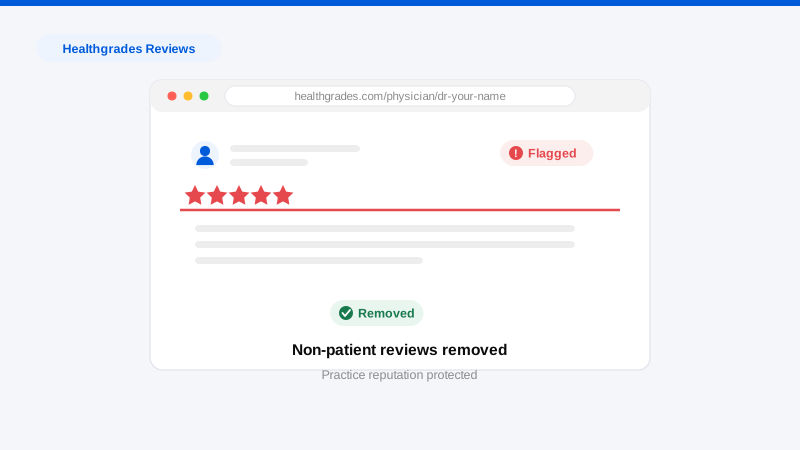
Healthgrades removes patient reviews only when they violate its published survey and commenting guidelines, reviews that aren’t from an actual patient or caregiver, contain profanity or threats, disclose other people’s private information, or otherwise breach its content rules. It does not remove reviews for being negative, and physicians face a constraint no restaurant owner does: HIPAA. You cannot confirm the reviewer was your patient, reference their visit, or correct their clinical narrative, even when it’s false, without risking a federal privacy violation that dwarfs the review’s damage. That asymmetry is why medical review removal is a specialist discipline: the case must be built and argued without ever breaching patient privacy. This page, part of our review removal hub, explains how it’s done.
Can this Healthgrades review be removed?
A review is a genuine removal candidate when it violates Healthgrades’ guidelines:
- The author was never a patient or caregiver. Healthgrades surveys are meant for genuine patient experiences. Reviews from estranged relatives, ex-employees, competitors’ staff, or strangers recruited from a dispute elsewhere fall outside the rules.
- It targets the wrong provider. Physician name confusion is rampant: a review describing a different doctor, specialty, or city is challengeable on identification grounds.
- It contains profanity, threats, or harassment of the physician or staff.
- It discloses private information about others: other patients’ details, staff members’ personal information.
- It reviews something other than care experience: a billing dispute framed as clinical incompetence can sometimes be challenged as misdirected, though expect a higher bar.
- It’s part of a campaign: clustered reviews after a staff termination, a personal dispute, or an activist wave, where coordination can be documented.
Not removable: a genuine patient’s negative account of their experience: waiting times, bedside manner, outcomes as they perceived them. Healthgrades protects that speech, and the physician’s tools are the compliant response and volume of genuine feedback, not deletion.
What Healthgrades actually removes, and the HIPAA trap
Healthgrades moderates comments against its guidelines before and after publication, and providers can dispute reviews through their claimed profile or provider support, citing the specific violation. There is no paid removal, and advertising with Healthgrades buys no moderation influence. The trap to understand first: any response acknowledging the reviewer was your patient is a HIPAA disclosure, even if they identified themselves publicly, regulators have fined practices for exactly this. Every dispute, response, and escalation must be written as if the reviewer’s patient status is unknowable. This is where general-purpose reputation advice endangers medical practices, and why our physician reputation services treat compliance as the starting constraint.
The removal process, step by step
- Preserve the review (screenshots with dates, reviewer handle, and any detail suggesting authorship) without annotating it with patient information anywhere outside your compliance-controlled file.
- Claim your Healthgrades profile so disputes, corrections, and responses run through a verified provider account.
- Dispute on guideline grounds, in privacy-safe language. “This comment violates the requirement that reviews reflect a genuine patient experience” works; “this person was never seen at our practice, and here is their chart absence” must be framed carefully, practice-records attestations can be made without disclosing any patient’s PHI, and this is where specialist drafting earns its keep.
- Escalate patterns as incidents. Review clusters tied to a termination or a personal dispute should go to Healthgrades support as one documented campaign with a timeline.
- Respond publicly, generically. A compliant response acknowledges feedback and states your commitment to care without confirming any treatment relationship: “We take all feedback seriously and invite anyone with concerns to contact our office.” It reads as professional to prospective patients, which is its entire job.
- Reserve legal escalation for provably false factual claims, a defamation action and eventual court order can compel removal, and it permits the factual rebuttal HIPAA forbids you from making publicly.
The evidence we build
Medical review cases require evidence that persuades without disclosing. We build: authorship analysis connecting reviews to ex-employees, competitors, or personal disputes through public information alone: writing patterns, timing, account histories; compliance-framed practice attestations establishing non-patient status without exposing any records; documentation of coordinated timing across platforms; and preserved threats where they exist. Every document can be shown to a platform, lawyer, or regulator without creating a privacy incident. That dual constraint (prove it, disclose nothing) is the craft.
What doesn’t work
- Detailed public rebuttals. Correcting the clinical story confirms the treatment relationship, a HIPAA violation with fines attached. The angriest response you can safely publish is a generic one.
- Mass-flagging genuine negative reviews. Platforms discount serial disputants, and your legitimate disputes lose force.
- Suing patients reflexively. Defamation suits against genuine patients usually amplify the review, and anti-SLAPP statutes in many states make weak cases expensive. Litigation is for provable falsehoods with real damages.
- Fake positive reviews. Astroturfing violates platform rules and, for medical practices, invites board and FTC attention.
- Ignoring the profile. Healthgrades ranks on page one for most physician-name searches; an unclaimed profile with one angry review becomes your de facto homepage.
Get a Free, Confidential Exposure Scan
Timelines and honest success expectations
Guideline disputes typically resolve in one to four weeks; escalated campaigns take longer; legal routes run months. Honest odds: non-patient reviews, wrong-provider reviews, and content violations are removed with reasonable consistency when documented compliantly. Genuine patient criticism stays, any vendor promising to wipe it is lying or planning something that will hurt you. The durable fix pairs targeted removals with compliant responses and steady genuine survey volume. The same playbook extends to RateMDs and Zocdoc, where we typically run parallel campaigns, attacks on physicians rarely stay on one platform, and Google reviews are usually the third front.
Frequently asked questions
Can a doctor pay Healthgrades to remove a bad review?
No. Healthgrades’ provider products buy profile enhancements and visibility, never moderation outcomes. Removal happens only through guideline-violation disputes or author deletion. Services claiming a paid inside track are misrepresenting the platform.
Can I respond to a Healthgrades review without violating HIPAA?
Yes, if the response never confirms the reviewer was a patient. Use generic language, “we take all feedback seriously”, and invite offline contact. Never reference visits, conditions, billing, or dates. Have counsel approve standard response templates once and reuse them.
The reviewer was never my patient. How do I prove that without breaching privacy?
Through carefully framed attestations: your practice can state that a review does not correspond to a genuine patient encounter without publishing anyone’s records. Pair that with public-source authorship evidence (an ex-employee’s writing pattern, a competitor link) and the case is made.
What about a review that’s about the wrong doctor entirely?
Dispute it on identification grounds, point to the mismatched specialty, location, procedure, or timeframe. Wrong-provider reviews are among the cleaner removals on medical platforms, and Healthgrades corrects them with fair consistency.
Should I sue a patient over a false review?
Only when the review makes provably false factual claims causing measurable damage, and after weighing anti-SLAPP exposure and the publicity cost. A court order is the strongest removal instrument available, but litigation against genuine opinion typically makes everything worse. Get a candid legal read first.
For a physician, one malicious review can outrank a career of good outcomes. Our free, confidential exposure scan maps your review exposure across Healthgrades, RateMDs, Zocdoc, and Google, flags what’s removable under each platform’s actual rules, and shows you our compliant process before you commit to anything.