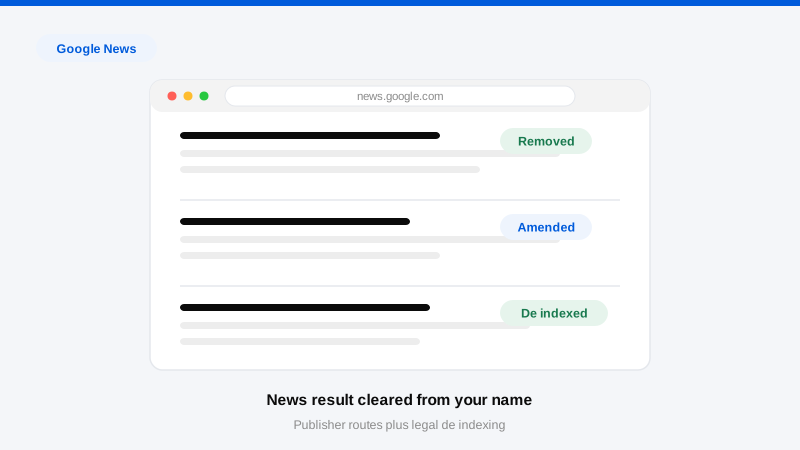
Removing an article from Google News means either getting the publisher to unpublish, amend or de-index it, or getting Google to take the URL out of results on legal or policy grounds. Google will not remove an accurate, lawfully published news article simply because it is damaging to you.
Key facts
- Google indexes the open web rather than editing it, so the publisher, not Google, controls whether an article exists.
- A publisher can take an article out of Google News and Search while leaving the page live for the record, which is often the outcome clients actually want.
- Google acts on court orders, defamation findings and content unlawful in a named country, and the outcome is frequently country level rather than global.
- In the European Union and United Kingdom, individuals can ask for results on their name to be de-listed under the right to be forgotten, which does not apply to companies.
- Google’s personal information policies cover intimate imagery shared without consent, doxxing content, and financial or identity document numbers, with no court involvement needed.
- Caches and stale snippets survive after a page changes, which is why an article can appear to be gone and still be visible to someone searching your name.
Google News, Google Search and Discover are three different things
Clients usually say “Google News” and mean “the article is everywhere”. Separating the surfaces matters, because each one is fixed differently.
Google News is a curated product fed by publishers Google recognises as news sources. It has its own app and tab, and it surfaces recent coverage. An article can leave Google News and still rank in ordinary search.
Google Search is the surface that matters most for your name, because that is where a lender, a board, a partner or a journalist looks. This is where de-indexing has the effect people actually want.
Discover is the personalised feed on Android and in the Google app. It pushes stories to people who did not search for anything, which is why coverage can suddenly reach an audience days after publication.
Top Stories and AI Overviews are blocks within Search that draw on news content. They refresh on their own schedule, so a claim can be repeated back at you for a while after the original is gone.
What will Google actually remove?
Google’s position is that it indexes the open web rather than editing it, and that the publisher owns the content. The exceptions are real, but they are narrower and more defined than most people assume, and they turn on the article being unlawful, or on it carrying something Google has already decided it will not host.
For an individual in the European Union or the United Kingdom, there is also the right to be forgotten, which lets a person ask for results on their name to be de-listed where the information is inadequate, irrelevant or excessive relative to the public interest. Journalism attracts a strong public interest defence, so recent, serious or role relevant coverage usually survives, and old, minor, personal matters often do not. It belongs to a natural person, which is why a company cannot use it and a named director sometimes can. See our pages on Google legal removal requests and the right to be forgotten.
What Google will not do is remove a true, lawfully published article because it is old, unflattering, commercially inconvenient, or about a matter that was later resolved quietly. That work happens at the publisher.
Timelines depend on the route and the publisher, and are set out in writing after the free Exposure Scan.
Get a Free, Confidential Exposure Scan
The publisher side is where the real outcomes are
A publisher can do things Google cannot, and this is where the outcomes clients actually want tend to come from.
A title can unpublish, which is rare at major mastheads and more common at local and trade titles. It can update or correct, which is often the strongest available outcome: charges dropped, case dismissed, a regulator’s finding reversed, a business sold. An accurate update or an editor’s note frequently turns a damaging result into a neutral one, and it changes what an AI assistant says about you, because the assistant reads the current page. A title can also keep the article on its site for the record while taking it out of search entirely, which editors who will not delete history are often willing to do because it costs them nothing journalistically. In much of Europe, and increasingly elsewhere, it can redact the name, so the piece survives but stops being about you.
This is slow, relationship led work and it is the opposite of firing off templates. It is also the part clients most often damage before they call anyone. See removing news articles for the fuller treatment and our press practice for the corrective side.
What about the copies?
One story rarely stays one URL. Wire services syndicate it, partner sites republish it, aggregators scrape it, and content farms rewrite it. Each copy is a separate page with its own publisher, its own host and its own search result.
The order in which those are dealt with matters more than the volume, and getting it wrong wastes months: clear the copies while the original is still live and search simply promotes the next one. Anonymised examples of how this runs are in our family holding case study and wellness founder case study.
How we run a Google News matter
We map every live copy first, across every surface it appears on, then form an honest view of what is genuinely available on each one and what is public interest journalism that will not move. Publishers are approached properly, through the right person and with the correction evidenced, and alongside your counsel where the matter needs it. Everything that can be run in parallel is.
The outcome we are working toward is not always deletion. Often it is an amendment, a name redaction, or the article staying online while it stops appearing to the people searching for you. We verify on your name and your company name, in the country you care about and in the countries your counterparties search from, and we keep monitoring, because syndication copies resurface. You see the evidence, not the paperwork.
What the law and the press rules say
Two bodies of rules decide most of what is possible here, and neither of them sits with Google.
Data protection law gives individuals in the European Union and the United Kingdom the right to ask a search engine to de-list results on their name where the information is inadequate, irrelevant or excessive compared with the public interest in it. Journalism attracts a strong public interest defence, so recent, serious or role relevant coverage usually survives, while old, minor or personal matters often do not.
Defamation law decides whether the article itself is unlawful, and it is national. In England and Wales the Defamation Act 2013 requires serious harm to reputation, with serious financial loss for a trading company, and it provides defences of truth, honest opinion and publication on a matter of public interest. Australia added a comparable serious harm element in 2021. In the United States there is no equivalent right to be forgotten and the constitutional protection for lawful publication is very strong.
Underneath both sits press self regulation, which most people have never heard of and which is worth more than they expect where a title is a member of a scheme. Whether any of these is realistically available to you is exactly what the Exposure Scan tells you.
What we need from you to start
- Every URL you have, including any copies you have already found.
- What is factually wrong, stated precisely, with the documents that prove it.
- What has changed since publication, which is often the stronger argument. Charges dropped, case settled, findings overturned, business sold.
- Whether the subject is an individual or a company, because that decides whether the right to be forgotten is available at all.
- The countries whose search results matter to you, because legal outcomes are often country level.
- Written authorisation for us to correspond with publishers on your behalf, and confirmation of who is permitted to sign a correction request.
Timelines and what usually happens first
The first week is mapping and assessment rather than action: every live copy, every surface it appears on, and an honest read of what is available on each one.
Publisher work is the slowest and the most valuable, and it is measured in weeks or months rather than days. Search side outcomes can be quicker. You get the realistic range for your matter in writing after the scan, and nobody honest gives you a date for something a newsroom decides.
Common mistakes that make it harder
- Emailing the journalist angrily. It becomes a follow up story, and it moves the matter to the wrong desk.
- Sending a legal letter as the opening move. Many titles publish them, and a threat can convert a quiet correction into a defended position.
- Trying to use the right to be forgotten for a company. It is refused, and the refusal is on record when you later bring something that could have worked.
- Starting with the copies rather than the source. Search simply promotes the next copy while the original stays live.
How this works alongside your lawyer, PR team or security team
Your counsel decides whether the article is unlawful and owns any pre action correspondence, any complaint that relies on a court finding, and any application in the relevant jurisdiction. We give them the mapped copies, the falsity evidence and the archive, and we take on the platform and regulator filings that do not require a lawyer.
Your PR team owns the relationship with the newsroom, and where that relationship already exists it is usually better than anything we could build cold. What we add is everything underneath it: which copy is actually ranking, what is realistically winnable, and what happens to the other surfaces afterwards.
Your security team matters where the coverage publishes an address, a family member or a routine, or where it has produced direct threats. That is a personal information policy removal and a security question at the same time, and both should start on the same day.
Who usually makes first contact and what the 15 minute call covers
Chiefs of staff, general counsel and PR agencies as often as principals, and for family offices it is usually the person who manages the family’s affairs.
Before the call we look at what is currently ranking on the name in the countries you care about. The call is fifteen minutes and it is a working conversation: what will move, what will not, and whether the realistic outcome is removal, amendment or suppression. Confidentiality and an NDA are standard, and the written assessment is yours to keep whether you engage us or not.
Frequently asked questions
Can an article be removed from Google News but stay online?
Yes, and it is one of the more achievable outcomes. A publisher can keep the article on its site for the record while taking it out of Google News and Search entirely. For most clients that is the practical result they wanted, and editors resist it far less than they resist deletion.
Does the right to be forgotten work for a company?
No. It is a data protection right belonging to individuals, so a company cannot use it, although a named director sometimes can in respect of results on their own name. For corporate coverage the routes are publisher engagement, legal grounds where the article is inaccurate or unlawful, and suppression.
The charges were dropped. Why is the article still first?
Because search rewards the authority of the publisher and the age of the link, not the fairness of the outcome. That is exactly the case where an update, an editor’s note or a name redaction is both achievable and worth more than a removal attempt, because the headline a searcher sees changes.
Will AI assistants keep repeating it after it is gone?
For a while, yes. Assistants draw on cached, syndicated and training data that lags the live web, so an article can be gone and still be quoted back at you. Changing what they say is part of the job rather than an afterthought.
Who normally handles this with you?
Chiefs of staff, general counsel and PR agencies as often as principals. We are used to working as one workstream inside an existing team, under NDA, and reporting in the format your side needs. See what we do for chiefs of staff.
What does it cost and what happens on the call?
Fees are quoted in writing after the free Exposure Scan, once we have mapped the copies and know which routes are real. The 15 minute call is a working conversation, not a pitch, and the assessment report is yours to keep either way.
Can you get a story out of Discover and Top Stories?
Not directly. Both are surfaces that draw on indexed news content rather than separate products you can file against, so they clear once the underlying page has changed or been de-indexed. They refresh on their own schedule, which means there is usually a lag between the source changing and the feed catching up.
What if the publisher simply refuses to engage?
That is common, and it is not the end of the matter. There is usually something left, whether that is the press regulator where the title is a member, a legal ground, de-listing for an individual in the European Union or United Kingdom, or the copies the original title does not control. We will tell you which of those is realistic for you before you spend anything.
Send us the URLs, including the copies you have already found. Start with a free, confidential Exposure Scan or read how we work. If the honest answer is that an article will not move, we will tell you that, and tell you what will.