
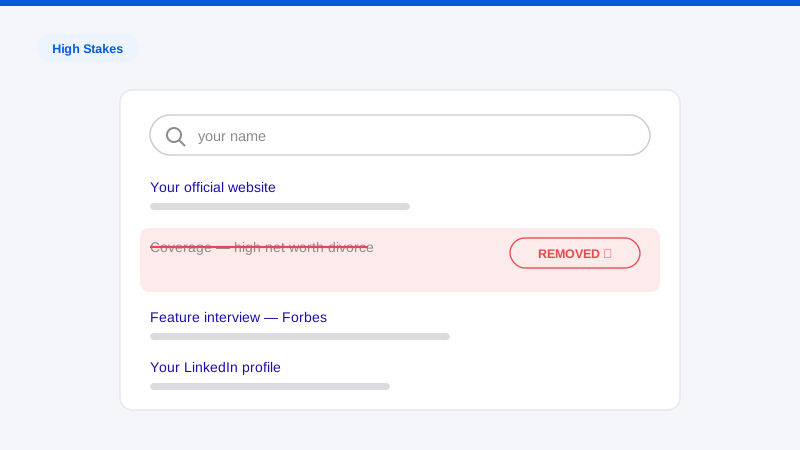
Reputation management during a high-net-worth divorce is the protection of a family’s public search footprint through the one legal proceeding that is simultaneously the most personal and, when wealth is involved, the most publishable. Divorce filings put a family’s finances, conduct, parenting, and private communications into documents that are, in many jurisdictions, presumptively public. When the parties are prominent, those documents do not stay in the courthouse. They become articles, forum threads, gossip-site posts, and eventually the top search results under both spouses’ names, and sometimes their children’s.
An ordinary divorce is painful and private. A high-net-worth divorce is painful and interesting: to financial press covering the asset division, to local media covering the prominent family, to gossip aggregators covering the conduct allegations, and to anonymous forums covering all of it with none of the restraint. The adversarial structure of the proceeding supplies a steady stream of material (each motion, declaration, and exhibit drafted by one side to be as damaging to the other as the rules allow) and the web supplies permanent distribution.
This guide explains the reputational mechanics specific to this situation: how filings leak and rank, how briefed-against coverage works, why children’s digital exposure demands its own workstream, and what professional, removal-first protection looks like for the families and family offices navigating it. Content Removal LLC is not a law firm; everything described here operates in coordination with family-law counsel, and nothing in this guide is legal advice.
What a high-net-worth divorce does to your search page, and to AI answers
The damage pattern in a prominent divorce is distinct from any other reputational event, because the source material is both intimate and official.
Filings become the story. Petitions, financial declarations, custody motions, and attached exhibits carry the credibility of court documents while containing the claims of an adversary. When they leak or are simply pulled from public dockets, coverage reproduces their most sensational contents (the alleged conduct, the spending, the texts) under headlines that attach permanently to both names. A single covered filing can restructure the first page of results for people who previously had pristine footprints.
Briefed-against coverage. In contested prominent divorces, information reaches reporters through channels that are rarely accidental. Stories appear that reflect one side’s theory of the case with suspicious fidelity, sourced to “people familiar with the matter,” timed near hearings or settlement talks. Whether or not anyone can prove who briefed whom, the reputational effect is the same: coverage engineered as leverage, indexed as news. The other spouse wakes up to a search page curated by opposing counsel’s strategy.
Forum and gossip-site speculation. Beneath the press layer sits the unedited one: community forums, gossip boards, neighborhood groups, and anonymous accounts dissecting the marriage, inventing details, naming affairs, and speculating about finances and fitness as parents. This material is often the most vicious and the most defamatory, and because it is continuously updated, it can outrank restrained press coverage under long-tail searches.
Children inherit the record. The most lasting harm often lands on the people with no role in the dispute. Children’s names appear in custody coverage and forum threads; their schools, activities, and photos circulate; data-broker profiles link them to addresses and family wealth at precisely the moment public attention, and occasionally genuine security risk, is highest. Years later, their college admissions officers, employers, and acquaintances will search their names and find their parents’ worst year.
AI answers make it permanent-feeling. Ask an assistant about either spouse during or after the proceeding and it synthesizes the indexed corpus (filings coverage, briefed stories, and whatever forum content crossed into indexed visibility) into a tidy biographical paragraph in which the divorce allegations feature prominently. Without remediation of the underlying content, AI summaries go on narrating the accusation era long after the decree is final.
Key takeaway: A high-net-worth divorce generates official-looking documents written by adversaries, distributed by press and forums, and inherited by children. No other reputational event combines intimacy, credibility, and permanence this way.
Timeline dynamics: the proceeding’s clock and the damage clock
Before filing. For families who see the dispute coming, this is the quiet window: auditing both spouses’ and children’s existing footprints, clearing data-broker exposure, tightening what is publicly findable, and, through counsel, understanding what the jurisdiction makes public and what can be sealed. Work done here happens before there is a story to attach it to.
Filing and first coverage. The petition is indexed by docket services within hours; in prominent cases, first coverage follows in days. The syndication clock starts: every day, the initial story propagates to more aggregators, gossip sites, and mirrors. Early containment, addressing unlawful and defamatory satellites while they number in the handfuls, is dramatically more effective than the same effort a year later against dozens of copies.
The contested middle. Motions and hearings supply periodic fresh material; briefed stories arrive at strategically interesting moments; forum threads accumulate. This is a monitoring-intensive phase: knowing within hours that a new filing has been picked up, a document has leaked, or a thread has turned defamatory preserves options (for counsel, for communications, and for removal) that decay fast.
Settlement and decree. Resolution changes the landscape. Coverage of withdrawn or disproven allegations becomes demonstrably outdated; sealed or superseded filings that remain posted on third-party sites become clear targets; publishers can be approached with documentation under their outdated-content and correction standards. As in litigation generally, the months immediately after resolution are the richest repair window, and the one exhausted families most often let pass.
The long aftermath. Absent deliberate cleanup, the divorce coverage simply becomes both parties’ permanent search identity, and the children’s inherited one. With it, the record can be brought to reflect the resolution rather than the war.
Know what your family's names return, before opposing counsel checks.Free confidential Exposure Scan, live results on a 15-minute call, covered by strict confidentiality.
Book Your Confidential ScanWhat professional protection looks like
Divorce reputation work is removal-first, family-wide, and sequenced against the proceeding. It runs in coordination with family-law counsel (who control what is filed, sealed, and sayable) and, where engaged, with the family’s communications advisors and family office.
The family exposure audit. Not just the principals: both spouses, the children, and closely associated names (household staff, family entities) are mapped across search, news, forums, gossip sites, people-search databases, and AI answers. The deliverable is a complete picture of what is findable about the family at the moment scrutiny begins, including the pre-existing vulnerabilities the divorce will amplify.
Containment of the unlawful layer. The active-proceeding workstream targets what is legitimately removable while the case is live: defamatory forum and gossip content asserting invented facts; unlawfully published private material (intimate images, private communications, medical and financial details) which platforms treat under their strongest policies; doxxing of family members; sealed or private documents posted where they should not be; and the data-broker records that convert public attention into physical-security exposure. Where court orders or statutory mechanisms are the right instrument, the work proceeds alongside counsel.
The children’s workstream. Minors’ content receives separate, prioritized handling. Platforms and search engines maintain distinct, and generally stronger, policies for content involving minors, and publishers who will defend coverage of a wealthy adult will often reconsider a child’s name and photograph. Every child’s footprint is cleared, monitored, and kept clear through the proceeding and after; for many families this is the workstream that matters most.
Monitoring as the family’s early-warning system. Continuous reputation monitoring across news, dockets-adjacent coverage, forums, social platforms, and AI answers, tuned to the family’s names and the proceeding’s vocabulary. In a briefed-against environment, detection speed is leverage: a story identified pre-syndication, a leaked document caught the day it is posted, a defamatory thread flagged at ten replies instead of a thousand.
Post-decree repair and the affirmative record. After resolution: publisher outreach with documentation, systematic pursuit of mirrors and aggregator copies, de-indexing where criteria are met, and construction of the accurate current record (professional profiles, philanthropic and business press assets) that gives search engines and AI systems something true to rank and synthesize. Families typically maintain a standing protection plan afterward, because the coverage attracts periodic anniversary interest and the children’s exposure needs indefinite watching.
Key takeaway: During the proceeding, the removable layer is the unlawful one: defamation, leaked private material, minors’ content, data-broker exposure. After the decree, the repair of the press record begins. Confusing the two phases wastes the first and squanders the second.
Why specialists beat DIY and PR alone
Self-help is uniquely hazardous mid-divorce. Every email a spouse sends a publisher, every rebuttal posted, every removal form filed is a communication that can surface in the proceeding, characterized by opposing counsel as image management, evidence consciousness, or worse. The adversary is actively looking for such material. This is a situation in which the principals themselves should touch nothing, and the work must run through professionals coordinating with counsel.
Family-law counsel cannot carry this alone. Divorce lawyers control the litigation instruments (sealing motions, protective orders, contempt remedies) and those instruments matter. But counsel does not run platform legal processes, publisher unpublishing standards, syndication tracing, people-search suppression cycles, or AI-answer remediation, and mid-trial is not when you want them learning. Parallel lanes, coordinated: that is the working model.
PR alone cannot subtract. A communications advisor can discourage a story, shape one, or place a counter-narrative, valuable, and inherently limited. PR does not remove the leaked declaration from the gossip site, the defamatory thread from the forum, the child’s name from the people-search database, or the allegation from the AI answer. In a divorce, where much of the worst material lives below the press layer on sites no communications firm has ever contacted, an addition-only strategy leaves the actual wounds open.
Your family's privacy is the asset. Protect it like one.Book a free, confidential Exposure Scan: 15 minutes, live results for every family member's name, under strict confidentiality.
Book Your Confidential ScanWhy clients call Content Removal
Content Removal LLC is the removal-first specialist that family offices, family-law practices, and private clients engage when a marriage dissolves in public. The firm’s work is source-level (takedowns, publisher corrections, de-indexing, data-broker suppression, minors’ content removal, AI-answer remediation) executed with the discretion this situation demands above all others: confidential engagement, quiet channels, and no action that creates a new story.
We coordinate with family-law counsel and communications advisors rather than substituting for either; we are not a law firm and do not provide legal advice, and we are honest about limits: accurate press coverage of public filings is rarely removable mid-case, no removal can be guaranteed, and a firm promising to scrub a covered divorce from the internet during the proceeding is not telling you the truth. What we deliver is the complete family-wide map, disciplined containment of everything legitimately addressable while the case is live, priority protection of the children, standing monitoring, and the post-decree repair campaign that determines what the family’s names mean for the next decade.
Frequently asked questions
Can articles about our divorce be removed while the case is ongoing?
Press coverage that accurately reports public filings generally cannot be removed mid-proceeding, and we will tell you that plainly rather than sell you the attempt. The productive targets during the case are different: defamatory forum and gossip content, leaked private or sealed material, content involving your children, doxxing, and data-broker exposure, categories with real removal mechanisms even while the dispute is live. The press layer becomes addressable after resolution, when outdatedness and superseded allegations can be documented to publishers.
My spouse’s side is planting stories. Can you stop that?
No one outside the proceeding can stop a party from briefing press, and claims otherwise should end the conversation. What professional protection changes is the cost-benefit of the tactic: monitoring detects placed stories early, sometimes pre-syndication; your counsel gains a documented record of the pattern to use as they judge appropriate; defamatory embellishments beyond the filings become removal targets; and the eventual cleanup ensures the planted narrative does not become the permanent one. Deterrence comes from the proceeding; containment and repair come from this work.
How do you protect our children specifically?
With a dedicated workstream that treats minors’ exposure as its own engagement: full audits of each child’s search and people-search footprint, removal requests under the stronger platform and search policies that govern content involving minors, publisher outreach on children’s names and images in divorce coverage, data-broker clearance to sever the link between the children and addresses or wealth signals, and continuous monitoring that persists after the decree. In our experience this is the workstream families are most grateful for years later. It is the one that protects people who never chose public life.
Is the Exposure Scan really confidential? My situation cannot leak.
Confidentiality is the operating condition of everything we do, and it starts before engagement: the Exposure Scan is conducted under strict confidentiality, involves no outreach to any third party, creates no public record, and notifies no one. We are examining what is already publicly findable, not touching it. Discretion is not a premium tier; families in this situation are the reason our default practices are built the way they are. Your counsel is welcome on the call.
If your family is entering, enduring, or emerging from a public divorce, the first step is seeing exactly what the world, and the other side, can find. Book a free, confidential Exposure Scan: a 15-minute call, live results for every name that matters to you, under strict confidentiality. The proceeding will end. What your family’s names return afterward is the part you can still decide.