
Escort scam threats are extortion campaigns that pair public data about a target with a fabricated escort narrative to force a fast, private payment. The response is to stop all contact with the sender, preserve every message and identifier, lock high-value accounts, bring in counsel, and report to IC3 where there is a US nexus. Paying does not end it.
Key facts
- Scammers assemble names, employers, relatives and locations from public sources, so accuracy does not prove an encounter.
- Avast reported US sextortion targeting up 137% year to date as of March 2025, driven by AI deepfakes.
- FBI IC3 logged more than 75,000 sextortion submissions in its 2025 annual report.
- Threats come in four classes: impersonation, social engineering, technical exploitation and AI-generated media.
Where ContentRemoval.com comes in. ContentRemoval.com works with executives, athletes, founders and family offices when an extortion attempt turns into fake profiles, fabricated screenshots or synthetic images seeded across platforms. We handle source removal, impersonation takedowns, de-indexing and monitoring while counsel manages reporting and privilege. A chief of staff or lawyer often makes first contact. A free 15-minute Exposure Scan maps what is removable and the report is yours to keep. Get a Free, Confidential Exposure Scan or read how our content removal work is done.
A message hits your phone late at night. The sender claims to be connected to an escort you allegedly contacted. They know your full name, your company, and enough personal details to make the threat feel uncomfortably real. Minutes later, the tone hardens. Pay now, or they contact your spouse, your board, your assistants, your investors, or the press.
For a public figure, that moment doesn’t feel like a nuisance. It feels like a live reputational event.
Treat it that way. Escort scams threats aren’t usually about a single lie or a single payment demand. They’re pressure campaigns built to exploit visibility, status, and fear of exposure. If your name carries commercial value, the attacker isn’t just aiming at your bank account. They’re aiming at your judgment.
What follows is the response protocol I would want a chief executive, founder, athlete, or family office principal to have in hand before they answer a single message.
The Anatomy of a Modern Extortion Campaign
The first mistake smart people make is assuming the message must be tied to a real-world encounter. Often, it isn’t. What looks personal is usually manufactured.
Escort-scam extortion typically follows a data-enrichment blackmail workflow. Scammers gather a target’s name, phone number, workplace, relatives, and social profiles from public-facing sources, then pair that information with a plausible escort narrative to create pressure. The coercion usually escalates after the victim responds, which is why engagement is the inflection point, as described in the PSNI warning on online escort blackmail.
What the first message is designed to do
The attacker isn’t trying to prove a case. They’re trying to collapse your decision-making window.
Practical rule: If the threat contains just enough truth to feel personal, assume the sender assembled it from your digital footprint.
That matters because it changes the frame. This isn’t evidence of guilt. It’s evidence of reconnaissance.
Why executives are especially exposed
Public-facing leaders publish more than they realize. Board bios, conference agendas, speaker pages, charitable affiliations, old press releases, real-estate records, alumni listings, and tagged social posts create a map of identity and proximity. Attackers use that map to make a generic scam look bespoke.
The same logic applies to impersonation. If a perpetrator can mimic your identity, or a person plausibly connected to you, they can widen the threat beyond private blackmail into outward-facing reputational sabotage. If you’re dealing with false accounts, cloned profiles, or someone posing as you, this guide on what to do if someone is impersonating you online is the right parallel playbook.
The correct mindset is cold and operational. You are not reacting to a personal scandal. You are containing an adversarial information attack.
Mapping the Threat Matrix From Impersonation to AI Sextortion
Most executives use the phrase “escort scam” too loosely. That’s a problem. Different attack types require different countermeasures, and misdiagnosis wastes the only thing you don’t have in a live incident, which is time.
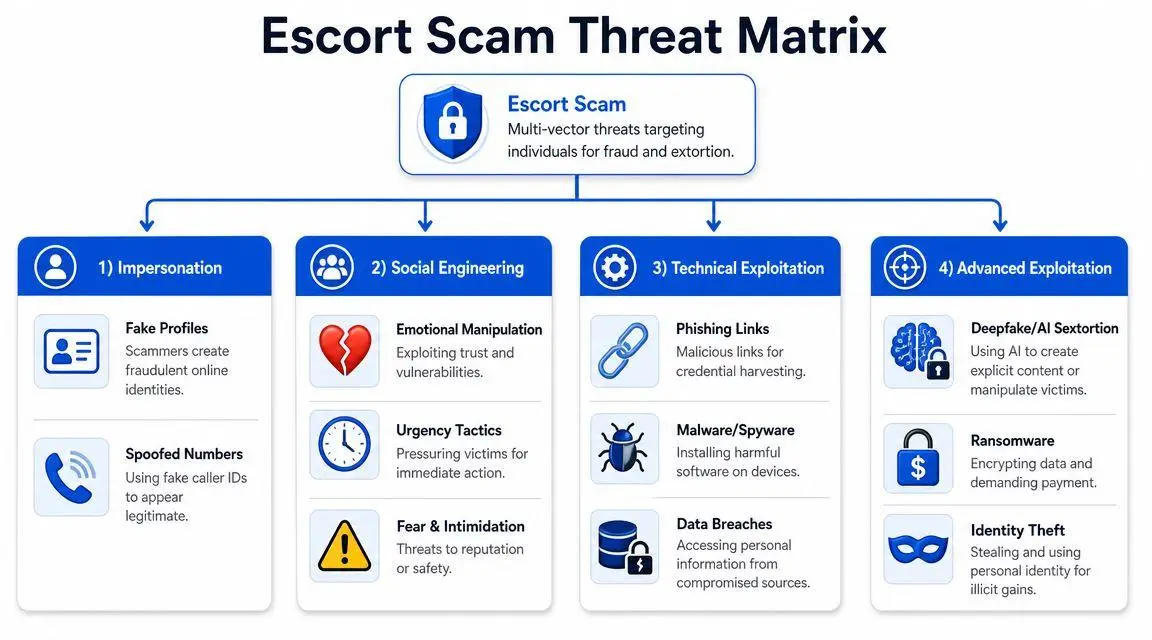
Four threat classes executives actually face
Some attacks are little more than coercive fiction. Others are built around account compromise, synthetic media, or identity misuse across multiple platforms. The practical distinction looks like this:
| Threat type | What the attacker uses | Primary risk |
|---|---|---|
| Impersonation | Fake profiles, spoofed numbers, false identity claims | Confusion inside your network |
| Social engineering | Urgency, shame, intimidation, threats to disclose | Panic-driven payment or response |
| Technical exploitation | Phishing links, malware, credential theft | Account compromise and evidence harvesting |
| Advanced exploitation | AI-generated explicit content, identity theft, broader extortion tooling | Severe reputational distortion |
The phrase escort scams threats can cover all four. That’s why generic advice fails.
The shift from crude blackmail to customized intimidation
A major change in the threat environment is the move from broad, low-effort extortion to personalized AI-assisted campaigns. Avast reported that the risk of being targeted with sextortion scams in the U.S. had risen 137% year to date as of March 2025, linking that increase to criminals using AI to generate deepfake explicit images and highly personalized threats. The same report said attackers were using Google Maps to make threats feel more local and credible, as outlined in Avast’s March 2025 report on sextortion scams.
That last detail matters. Locality creates psychological force. A threat that references your office tower, neighborhood, or city doesn’t need to be true to be effective.
A sophisticated extortion message isn’t trying to persuade you intellectually. It’s trying to force a fast, private concession before you involve counsel.
How to identify your specific scenario
If the attacker claims you contacted an escort and demands money to avoid disclosure, you’re likely dealing with coercive impersonation supported by public data.
If they send explicit imagery that appears to depict you, the issue may be synthetic media rather than leaked authentic content. If they push links, insist you verify identity, or demand app downloads, their objective may be credential theft or device compromise. If they invoke a cartel, police unit, or security agency, they are trying to borrow authority and fear.
The cleanest way to think about it is this:
- A text-only threat is usually about panic.
- A profile-based threat is usually about identity misuse.
- A link-based threat is usually about access.
- An image-based threat is usually about reputational advantage, whether genuine or fabricated.
If your incident involves sexualized threats, fake intimate media, or pressure around explicit content, the most relevant companion resource is this analysis of sextortion response and containment.
Gauging the True Impact Beyond Financial Demands
The money demand is rarely the main issue for an executive. The main issue is whether the incident can migrate from private pressure into visible reputational harm.
A chairperson can survive a nuisance scam. A public company CEO may not survive a mishandled response that allows false content, fake narratives, or direct outreach to stakeholders to spread unchecked. That’s the critical lens.
The damage categories that matter
Start by separating the incident into three risk bands.
The first band is private coercion. That’s the direct message, demand, or threat. It feels urgent, but it remains containable if you don’t feed it.
The second band is network contamination. This starts when the attacker contacts family members, assistants, board colleagues, journalists, or clients. Once the campaign leaves your phone and enters your ecosystem, the matter becomes a communications problem as much as a security problem.
The third band is public artifact creation. That includes fake profiles, fabricated screenshots, manipulated imagery, review-site smears, forum posts, and search-indexed content. At that stage, your name can become attached to a narrative that persists beyond the extortion attempt itself.
Not every threat is tied to an actual encounter
Executives under pressure often ask the wrong question first. They ask, “How did they know?” The better question is, “What did they assemble?”
Tripwire notes that perpetrators increasingly use personal data-broker information and spoofed cartel or law-enforcement personas to make threats credible, and that not all sextortion-style threats even have sexual elements. Some rely purely on fear of harm, which reframes the problem as a broader social-engineering and doxxing issue in Tripwire’s analysis of sextortion persuasion tactics.
That means an innocent target can still face a credible-looking attack. In practical terms:
- False premise, real pressure: The claimed escort interaction may be fabricated, but the attacker still uses accurate personal details.
- No encounter, visible risk: The absence of actual misconduct doesn’t prevent public embarrassment if fake content circulates.
- Authority theater: “Cartel,” “detective,” or “investigator” personas exist to suppress skepticism and accelerate compliance.
If you treat the threat as proof of underlying truth, the attacker controls the frame. Treat it as a hostile narrative operation until facts establish otherwise.
Why engagement changes the risk profile
Once you reply, negotiate, deny, explain, or pay, you disclose something valuable. You confirm the channel is active. You reveal emotional state. You may provide writing style, timing patterns, or additional identity details. You also signal that pressure works.
That is why the matter must be addressed early, even when the demand seems absurd or the content looks fake. The reputational consequence isn’t limited to publication. It includes loss of confidence among investors, internal leadership distraction, family distress, legal spend, and a permanent record of unmanaged digital abuse if false material gains search visibility.
This is a corporate crisis wearing the mask of a private shame event. Handle it accordingly.
Your Immediate Containment and Response Protocol
The first 24 hours decide whether this remains a contained extortion attempt or becomes a wider reputation incident. Most damage happens because the target improvises. Improvisation is exactly what the attacker is counting on.
Start with this checklist.
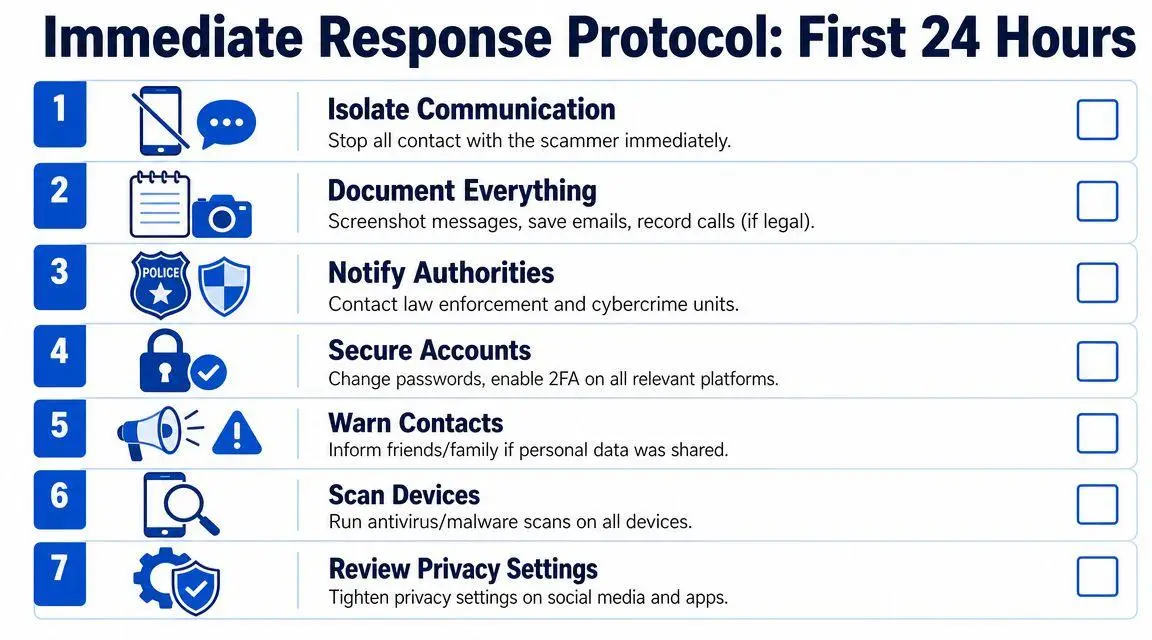
First actions that are not optional
The first rule is simple. Stop communicating with the perpetrator. No clarifications, no denials, no bargaining, no attempts to sound intimidating. Every message gives them more data and more incentive to continue.
The second rule is evidence preservation. Don’t delete messages because they disgust you. Capture them properly. Preserve screenshots showing usernames, numbers, timestamps, platform identifiers, profile URLs, and payment instructions. Save voicemails. Export email headers where relevant. If your jurisdiction allows call recording and a call occurs, preserve the recording and a transcript.
Then secure the perimeter around the likely attack path.
- Lock high-value accounts: Change passwords on primary email, Apple ID or Google account, major social profiles, messaging platforms, and cloud storage.
- Turn on stronger authentication: Use app-based authentication methods where available and review active sessions.
- Check for forwarding or recovery changes: Attackers who gain access often alter recovery email settings, forwarding rules, or trusted devices.
Operational priority: Preserve first, contain second, communicate third. Reversing that order creates avoidable risk.
Why this isn’t just a personal matter
The FBI’s IC3 said its 2025 complaint intake reached 1,008,597 complaints with $20.877 billion in reported losses, with an average reported loss of $20,699. Within that total, sextortion generated more than 75,000 submissions, and IC3 referred more than 5,700 submissions involving minors to NCMEC. The same IC3 reporting cited industry figures that digital extortion victims worldwide rose 46% in 2023, while NTT Security Holdings reported a 67% surge in extortion and ransomware cases in 2023, according to the FBI’s 2025 IC3 annual report.
That scale tells you what to do next. Escalate professionally and early. This category is not fringe. It’s part of a larger extortion economy.
A mature executive team should think in the same terms it would use for a cyber incident. If your security function lacks a documented process, it’s worth reviewing frameworks for implementing a threat detection roadmap so response decisions aren’t invented under pressure.
The escalation path for a high-profile target
Legal counsel should coordinate the response, not merely observe it. Counsel can structure evidence collection, evaluate exposure across jurisdictions, preserve privilege where possible, and decide when direct law enforcement reporting is strategically useful. If the threat has a U.S. nexus, an IC3 complaint is a rational step because it creates an official record and may help align later enforcement or platform requests.
After counsel, bring in the functions that control downstream damage. That usually means executive security, IT or digital forensics, and reputational remediation. If explicit images, real or fabricated, are involved, this guide on what to do if your nudes are leaked is directly relevant to takedowns and containment.
The communications side should also activate, but with discretion. You don’t issue a statement because an anonymous scammer wants attention. You prepare one because they may target people around you. Draft internal holding language for your chief of staff, spouse, general counsel, investor relations lead, or publicist. Keep it short, factual, and non-defensive.
Use outside help where the risk warrants it. ContentRemoval.com is one option for source removal, de-indexing, impersonation takedowns, and monitoring when harmful material appears or the attacker starts seeding content across platforms.
A short briefing can help your inner circle move in sync before the story escapes your control.
What not to do under any circumstances
Don’t pay to “make it go away.” Payment doesn’t end an extortion campaign. It proves that coercion works.
Don’t outsource judgment to shame. I’ve seen capable leaders wait too long because the allegation felt personally humiliating. Delay is exactly what allows fake content, contact lists, and search results to become harder to reverse.
Don’t start calling people ad hoc with emotional explanations. If stakeholder communication becomes necessary, it should be scripted, limited, and aligned with counsel. The aim is containment, not confession.
Building Long-Term Digital Immunity
At 6:30 a.m., your assistant flags a strange follower request sent to your spouse, your old home address appears in a people-search result, and a dormant profile with your name starts ranking in search. That is not a coincidence. It is an exposure problem, and high-profile people need to treat it like one.
If you were targeted once, assume your details are still circulating among scammers, brokers, and impersonation accounts. The objective now is to reduce what strangers can verify, limit what they can weaponize, and make the next incident slower, weaker, and easier to contain.
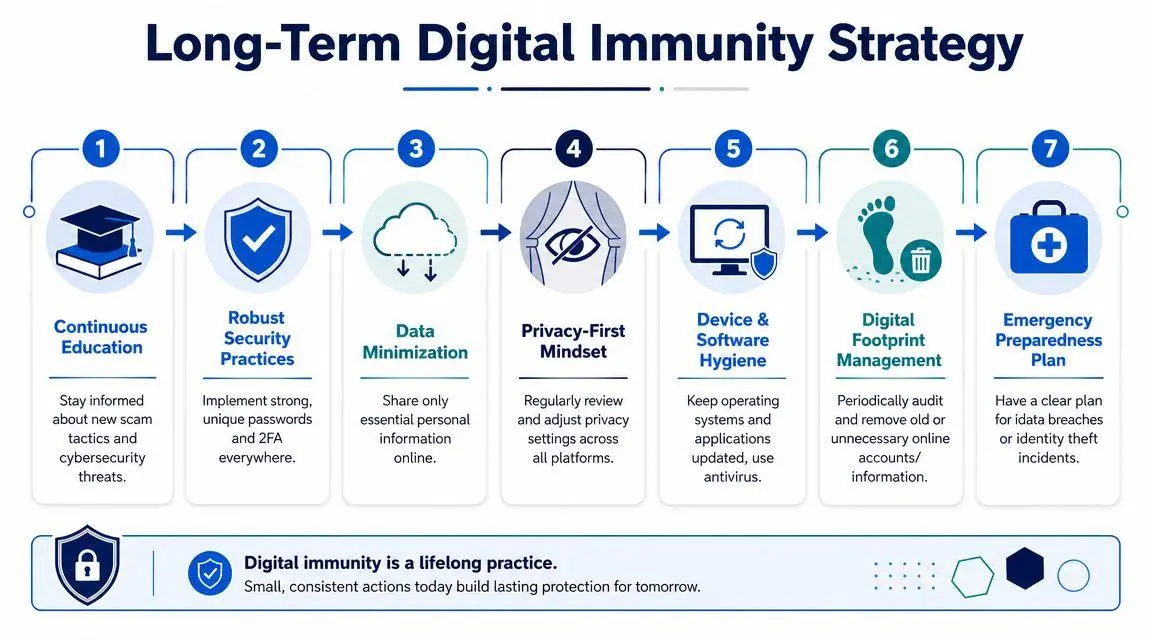
Reduce the visible attack surface
Start with public data. Your corporate bio, speaking profiles, archived staff pages, charity boards, donor listings, old campaign sites, and family-linked social posts often give an attacker enough material to build a believable threat.
Cut what does not need to be public. Remove direct phone numbers, personal email patterns, stale office locations, assistant details, family references, school names, recurring travel habits, and old headshots that make impersonation easier. Review image metadata where possible. Ask what a hostile stranger could confirm in ten minutes, then close those gaps.
Legacy clutter matters more than executives assume. Old domains, cached directories, alumni pages, event programs, and abandoned usernames are common points of failure because no one owns them until a crisis hits.
Formalize a reputation incident playbook
Public figures should not improvise under pressure. Put a written protocol in place and assign named owners before the next threat arrives.
Your playbook should cover five decisions. Who captures and preserves evidence. Who retains outside counsel. Who reports impersonation or synthetic sexual content to platforms. Who informs family or staff if contact spreads sideways. Who approves any stakeholder communication if the matter reaches donors, investors, board members, or the press.
Keep the chain of command tight. General counsel should control legal escalation. Communications should prepare language, not freelance reassurance. Executive protection, IT, and the chief of staff should know exactly when they are activated and what they are expected to do.
Run tabletop exercises. Quiet rehearsal exposes delays, bad assumptions, and missing authority before a real attacker does.
Separate personal identity from public operations
Split those functions. Use separate numbers and email addresses for public-facing activity, private relationships, account recovery, and inner-circle communications. Limit who knows each channel. Review where those identifiers appear online and in broker databases. The point is containment. If one route is burned, the rest of your life should not come with it.
This also protects response speed. Teams act faster when they know which channels are trusted and which ones can be abandoned immediately.
Monitor for reputation precursors, not just full incidents
Serious reputational harm often begins with small signals. A fake account copies your headshot. A burner profile follows your children. A scraped biography appears on a sketchy directory. A synthetic image is tested in a low-visibility forum before it reaches a journalist or stakeholder.
Track those precursors on a schedule. Review search results for your name, aliases, old usernames, and key images. Watch executive assistant inboxes, public contact forms, and family-facing accounts for unusual contact patterns. If your reputation is part of your enterprise value, monitoring is not optional maintenance. It is a standing protection function.
Long-term digital immunity is operational discipline. High-profile people who treat reputation exposure like a recurring business risk recover faster, disclose less under pressure, and give extortionists fewer angles to exploit.
Confidential Assessment and Next Steps
At this stage, broad advice has done its job. The remaining questions are specific. Which platforms are involved. Whether the images are authentic, manipulated, or wholly synthetic. Which jurisdictions matter. Whether your assistant, spouse, board chair, or investor relations lead should be told now or later. Whether the attacker is bluffing, probing, or already distributing content.
Those questions shouldn’t be answered in a vacuum.

For executives, public figures, and principals whose reputation is an operating asset, the right response combines legal judgment, evidence discipline, and communications control. Handle only one of those and you leave flanks exposed. The incident may begin as a threatening message, but the primary work is protecting search results, stakeholder confidence, family privacy, and decision-making authority.
That is why a confidential assessment matters. A proper review should identify what the attacker has, what they’ve fabricated, where the content may spread, what evidence is usable, and which interventions should happen first. In some cases, the fastest path is platform enforcement. In others, it’s counsel-led reporting, takedown work, search de-indexing, or quiet stakeholder preparation.
If you’re under live pressure, stop researching and start coordinating. Speed helps, but only if it’s directed. Calm execution is what keeps a private extortion attempt from becoming a public reputational event.
If you’re dealing with escort scams threats, impersonation, leaked or synthetic intimate content, or a coordinated blackmail campaign, ContentRemoval.com offers confidential assessments for executives, public figures, family offices, and counsel. The value isn’t generic advice. It’s a discreet action plan that addresses removal, de-indexing, monitoring, and escalation in the right order.
Frequently asked questions
Should I reply to an escort blackmail message to explain it is false?
No. Every reply confirms the channel is live, reveals your emotional state and signals that pressure works. Preserve the messages with usernames, numbers, timestamps and payment instructions, then hand the matter to counsel rather than engaging.
How do scammers know my name, company and family details?
They gather them from board bios, speaker pages, press releases, real-estate records, alumni listings, data brokers and tagged social posts. The threat is built from reconnaissance, not from a real encounter, which is why accurate details should not be read as proof.
What happens if I pay an escort extortion demand?
Payment does not end the campaign. It proves that coercion works and usually invites further demands. The better path is to stop communicating, secure accounts, preserve evidence, file an IC3 complaint where relevant and prepare short holding language for the people the attacker may contact.