
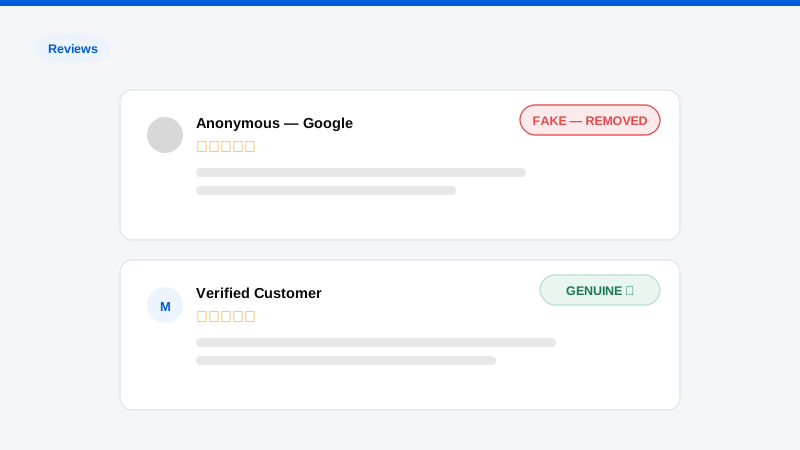
Competitor review sabotage is the review problem platforms are most willing to fix — and the one businesses are worst at proving. If you need to remove fake reviews from a competitor, you actually hold better cards than almost anyone else fighting negative reviews: every major platform explicitly prohibits competitors from reviewing rivals, treats coordinated fake reviews as fraud rather than protected opinion, and removes this content when the case is made. Unlike genuine criticism, which platforms defend, competitor fakery is content platforms want to delete, because it poisons the product they sell.
The catch is the word “proving.” Businesses under attack almost always know, with total conviction, that a competitor is behind the wave of one-star reviews — the timing is too neat, the phrasing too familiar, the reviewers too invisible in their customer records. But conviction isn’t evidence, and a flag that says “we believe our competitor did this” gets processed exactly like a business complaining about criticism: rejected. The entire game is converting your justified suspicion into documented patterns a moderator can verify without taking your word for anything.
This guide is about that conversion: what competitor abuse actually looks like across platforms, the specific evidence categories that get fake reviews removed, how to document coordination systematically, when the problem graduates from platform enforcement to legal action — and the mistakes that turn a winnable case into a stalemate.
Why competitor fake reviews are a different legal and policy animal
Understand what you’re holding. A genuine customer’s harsh review is protected speech that platforms shield. A competitor’s fake review is something else entirely, in three overlapping ways:
It violates every platform’s conflict-of-interest rules. Google’s review policies prohibit reviews posted about a current or former employer’s competitors and any review designed to manipulate ratings. Yelp bans reviewing your own business or competitors outright. Trustpilot requires a genuine, verifiable service experience. Glassdoor requires real employment. A review from a competitor fails the eligibility test on every platform before its content is even evaluated — which is why proving who the reviewer is often matters more than debating what the review says.
It’s commercial fraud, not opinion. Fake reviews posted to divert trade aren’t a First Amendment gray zone the way harsh opinions are. Deceptive fake reviews sit squarely in unfair-competition and false-advertising territory — the FTC has issued rules against fake reviews, and businesses harmed by a competitor’s fakery have civil claims genuine critics never trigger. We’re not a law firm and this isn’t legal advice, but the strategic point stands: your escalation options run deeper here than in any other review dispute.
Platforms enforce it asymmetrically in your favor. When a platform confirms competitor manipulation, consequences often extend beyond removing one review — accounts get suspended, related reviews get purged, and the offending business can face its own penalties. One proven fake frequently unravels the attacker’s whole footprint.
All of this leverage activates only on evidence — you remove fake reviews from a competitor by proving the conflict, not by asserting it. So evidence is where the work lives.
The evidence framework: proving what you can’t see
You’ll rarely get a confession. What you can get is a convergence of documented signals that makes the competitor explanation the only plausible one. We build these cases in four layers.
Layer 1: Negative proof — they were never your customer
The foundation of every fake-review case is demonstrating the reviewer had no genuine experience to review. Search your transaction records, CRM, booking system, and support history for anything matching the reviewer’s name, claimed dates, and described interaction. Document the search itself — what systems were checked, what terms, what result. Then mine the review for verifiable impossibilities: services you don’t offer, products you never sold, staff who don’t exist, locations you’ve never operated, events on days you were closed. A review describing a “terrible experience with the delivery crew” when you’ve never offered delivery is worth more than ten paragraphs of suspicion.
Layer 2: Pattern proof — the reviews are coordinated
Single fakes are hard; waves convict themselves, if you document them properly. Build a simple spreadsheet of every suspicious review across all platforms, capturing: post date and time, platform, star rating, reviewer name, account age, account review history, and the full text. Then look for the fingerprints of coordination:
- Temporal clustering — multiple negative reviews within days after months of normal cadence, especially clustered at odd hours or in tight bursts.
- Language overlap — repeated distinctive phrases, identical unusual misspellings, the same specific (false) claims appearing across “independent” reviewers.
- Account archaeology — brand-new accounts, accounts with no other reviews, or the telltale classic: accounts whose only other activity is five-star reviews of one particular competitor.
- Cross-platform synchronization — the same wave hitting Google, Yelp, and Trustpilot in the same week, sometimes with recycled text.
- Shared factual errors — multiple reviewers making the same mistake about your business (wrong owner name, wrong closing time) is a signature of a single author or shared script.
Screenshot everything with timestamps as you go. Fake reviews get edited and deleted once attackers sense scrutiny, and your dated archive is what preserves the pattern.
Layer 3: Attribution proof — connecting the wave to the competitor
This is the hardest layer and, for platform removal, often optional — platforms remove reviews proven fake even without knowing who paid for them. But attribution transforms the case, especially for legal escalation. Legitimate attribution signals include: reviewer accounts that also review the competitor glowingly; reviewer names matching the competitor’s employees or their relatives (public team pages and LinkedIn make this checkable); reviews echoing language from the competitor’s marketing or from a private dispute only they know about; and timing keyed to competitive events — the wave that starts the week you win a shared client or open near their location. Document connections factually and conservatively. Never accuse publicly, and never pad thin evidence — one overreached claim taints the credible ones.
Layer 4: Motive and context
Round out the file with the competitive backstory: the poached account, the lost bid, the price war, prior threats or confrontations. Context never wins a case alone, but it makes the pattern legible to a moderator, an investigator, or eventually a judge.
Working the platforms: policy hooks for competitor abuse
With the file built, flag with each platform’s specific competitor-abuse language — not generic “fake review” complaints:
- Google: report under conflict-of-interest and fake-engagement policies. For waves, escalate beyond one-off flags — coordinated attacks warrant escalation channels where the pattern evidence can actually be presented, which is where a documented spreadsheet beats fifty isolated flags. Watch the search layer too, since Business Profile attacks often travel with other hostile content in Google results.
- Yelp: report under conflict-of-interest guidelines. Yelp investigates coordinated manipulation, and its recommendation software already filters much of it — check whether the attack is even visible before assuming damage.
- Trustpilot: flag for no genuine experience; Trustpilot can require reviewers to document their experience, which fake reviewers by definition cannot do. A wave of verification failures builds its own record.
- Glassdoor: competitor attacks arrive dressed as “former employees.” The employment cross-check is your lever — no matching hire, no eligible review.
Two disciplines throughout. First, flag surgically: report the reviews your evidence actually supports, not everything negative — mixed flagging dilutes credibility and hands platforms a reason to dismiss you as a suppressor. Second, track every submission, decision, and date; escalations live on that record. This casework — evidence file, precise flags, documented escalation — is the core of our review removal process, and it’s the difference between “we reported it and nothing happened” and removals.
When to escalate beyond the platforms
Platform enforcement fixes the reviews. It doesn’t always fix the competitor — some attackers just rebuild with fresh accounts. Escalation options, in rising order of weight:
A preservation-and-demand letter from counsel. When attribution evidence is strong, an attorney’s letter to the competitor — citing the documented pattern, demanding cessation, and putting them on notice to preserve records — often ends the campaign overnight. Attackers who felt anonymous behave differently in discovery’s shadow.
Civil claims. Depending on facts and jurisdiction, competitor fake-review campaigns can support claims sounding in unfair competition, false advertising, defamation (for false factual statements), and tortious interference. Litigation also unlocks subpoenas — the tool that formally connects anonymous accounts to real people. It’s slow and expensive; for sustained attacks causing measurable revenue damage, it’s sometimes exactly right. Get a real litigator’s read on your file.
Regulatory complaints. Fake reviews are squarely in the FTC’s enforcement lane, and state attorneys general take deceptive-practices complaints. A regulator won’t fix your star rating this quarter, but complaints create records and, for serial offenders, consequences.
If the campaign has spilled beyond review platforms — fake complaint-site posts, smear pages, manipulated search results — you’re facing a broader attack surface, and the response belongs in defamation removal and coordinated reputation strategy rather than review-by-review whack-a-mole.
Step-by-step: remove fake reviews from a competitor
- Freeze the evidence first. Screenshot every suspicious review with URL, date, and reviewer profile — before flagging anything and alerting the attacker.
- Run negative proof. Search all customer records for each reviewer; document the searches and their null results. Catalog every verifiable impossibility in each review’s text.
- Build the pattern file. Spreadsheet the wave: dates, platforms, account ages, review histories, language overlaps, shared errors, cross-platform timing.
- Probe attribution carefully. Check reviewer accounts against the competitor’s public team and their review activity on the competitor’s own profiles. Record findings factually; accuse no one publicly.
- Flag with policy precision on each platform — conflict-of-interest and fake-engagement hooks, quoted review language, evidence summarized in moderator-sized portions.
- Escalate waves as waves. Coordinated attacks deserve pattern-level escalation, not fifty disconnected flags.
- Engage counsel when attribution is strong or damage is material — preservation letters, civil claims, and subpoenas are the tools platforms can’t offer.
- Do not retaliate. Never review-bomb back, never post publicly about the suspected attacker, never contact reviewers with accusations. Retaliation creates the evidence file used against you.
- Monitor for the second wave. Attackers whose reviews get removed frequently retry with aged accounts and better camouflage. Continuous reputation monitoring catches round two in days, when fresh fakes are easiest to kill and the recurrence itself strengthens your file.
Frequently asked questions
How do I know it’s really a competitor and not just unhappy customers?
Run the evidence before trusting the instinct. Genuine dissatisfaction looks like: reviewers you can find in your records, varied complaints in varied language, spread over time, on the platform where you actually serve customers. Sabotage looks like: no matching customers, clustered timing, recycled phrasing, empty or single-purpose accounts, impossible details, cross-platform synchronization. Businesses sometimes come to us certain of sabotage and the audit shows a genuine service problem — that’s a better outcome than it feels like, because genuine problems respond to fixes. When the pattern signals are there, though, they’re usually unambiguous.
Can I get the competitor’s business punished, or just the reviews removed?
Both are possible. Platforms that confirm manipulation can suspend the accounts involved and sanction the benefiting business — Yelp, notably, has placed public warning notices on businesses caught in review schemes. Beyond platforms, fake-review campaigns expose the perpetrator to FTC enforcement, state consumer-protection action, and civil liability to you. Practical sequencing: secure the removals first with platform evidence, then let counsel assess whether the attribution file supports going after the attacker directly.
Should I confront the competitor directly or call them out publicly?
No to public callouts, almost always no to direct confrontation. A public accusation you can’t yet prove in court invites a defamation claim against you and tips the attacker to sanitize their tracks. Direct informal confrontation does the same tipping without the leverage. If the evidence justifies contact, it should arrive as a preservation-and-demand letter from an attorney — the version of confrontation that changes behavior. Until then, silence and documentation.
The fake reviews were removed but my rating is still damaged. Now what?
Removal restores the math on most platforms — purged reviews stop counting toward your average — but recovery of standing takes longer than recovery of the number. Rebuild deliberately: a steady, policy-compliant flow of genuine customer reviews, public responses that show engagement, and attention to what ranks in search for your brand, since attack coverage sometimes outlives the attack. If the campaign was part of sustained hostilities, treat defense as permanent infrastructure — monitoring plus a standing removal arrangement — rather than a one-time cleanup. That’s precisely what our protection plans are built for.
If you suspect a competitor is behind your reviews, test the suspicion before acting on it. Our free exposure scan maps your review footprint across platforms, flags the accounts and patterns consistent with coordinated fakery, and tells you honestly whether you have a case worth building.