
Brand reputation is important because it dictates whether buyers trust your company, whether investors and lenders see it as durable, and whether senior talent will join. It behaves as a financial control rather than a communications issue: a negative page-one result raises acquisition cost, lowers the valuation multiple, tightens deal terms and drives strong candidates to withdraw quietly.
Key facts
- One industry summary puts reputation at up to 63% of market value and 40 positive reviews to offset one negative.
- In a 2024 Statista survey, 92% of consumers in Brazil and China rated brand reputation important before buying.
- Valuation drops before the income statement shows damage, because buyers reprice expected cash flow first.
- The operating framework is monitor continuously, assess severity not just visibility, then act with the matching remedy.
Where ContentRemoval.com comes in. ContentRemoval.com handles the act stage for companies and the executives behind them: source removal, de-indexing, false review takedowns and impersonation enforcement when a harmful result is shaping diligence, sales or hiring. A general counsel, CFO or founder usually gets in touch ahead of a financing round or transaction. A free 15-minute Exposure Scan maps what ranks and what can be removed, and the report is yours to keep. Get a Free, Confidential Exposure Scan or read how our reputation management work is done.
Your phone rings before 8 a.m. Sales says a late-stage prospect has gone silent after “doing some research.” HR reports a senior candidate withdrew after reviewing search results. Legal forwards a hostile post that has started appearing in branded queries. Finance asks whether this is contained. It usually isn’t.
That’s the wrong moment to ask why brand reputation is important. By then, the business has already started paying for the answer.
Executives often treat reputation as a communications issue because the damage first appears in headlines, reviews, search results, and social posts. That framing is too small. Reputation determines whether buyers trust your company, whether investors view it as durable, whether lenders see avoidable risk, and whether top talent wants your name on their résumé. If the market doubts your credibility, every commercial function gets harder at once.
For high-value brands, founders, family offices, and public-facing executives, reputation sits in the same category as liquidity, legal exposure, and governance. It requires active control. Anything less leaves a material asset exposed to public indexing, hostile amplification, and permanent rediscovery.
Reputation Is a Matter of Financial Control
A single negative result rarely stays confined to “PR.” It migrates. Sales teams begin defending the company before they can sell. Recruiters spend time neutralizing objections they didn’t create. Counsel starts evaluating defamation, disclosure risk, and platform enforcement. The leadership team loses hours in fragmented response, which is one of the first hidden costs.
That’s why brand reputation should be treated as a matter of financial control, not image management. If a damaging article or false review appears prominently when counterparties search your company or your name, it changes the conditions under which business gets done. It affects negotiation posture. It affects trust. It affects what the other side thinks they can demand from you.
What the board should assume
The board should assume that any serious buyer, lender, investor, journalist, regulator, senior hire, or litigation counterparty will run branded searches before making a decision. They won’t limit themselves to your website or official profiles. They’ll review third-party content because they trust independent signals more than self-published claims.
That means your online footprint isn’t a reflection of the business. It’s part of the business.
Practical rule: If a negative search result changes how a reasonable counterparty prices risk, the issue belongs in financial oversight, not merely in marketing.
The mistake I see most often is delay. Leaders wait for more evidence, more spread, or more internal alignment. That hesitation gives indexed content time to harden into a durable reference point. By the time the organization responds, the issue has already been copied, discussed, and linked elsewhere.
The smarter posture is early intervention, disciplined fact-gathering, and immediate containment. If you need a sober breakdown of cost exposure before acting, this strategic cost analysis of online reputation management is the right starting point.
The Direct Link Between Reputation and Valuation
A valuation discussion changes fast when a buyer, lender, or investor finds unresolved negative coverage on page one of search results. The model may still show healthy revenue and acceptable margins. The price still moves because confidence in future cash flow drops first.
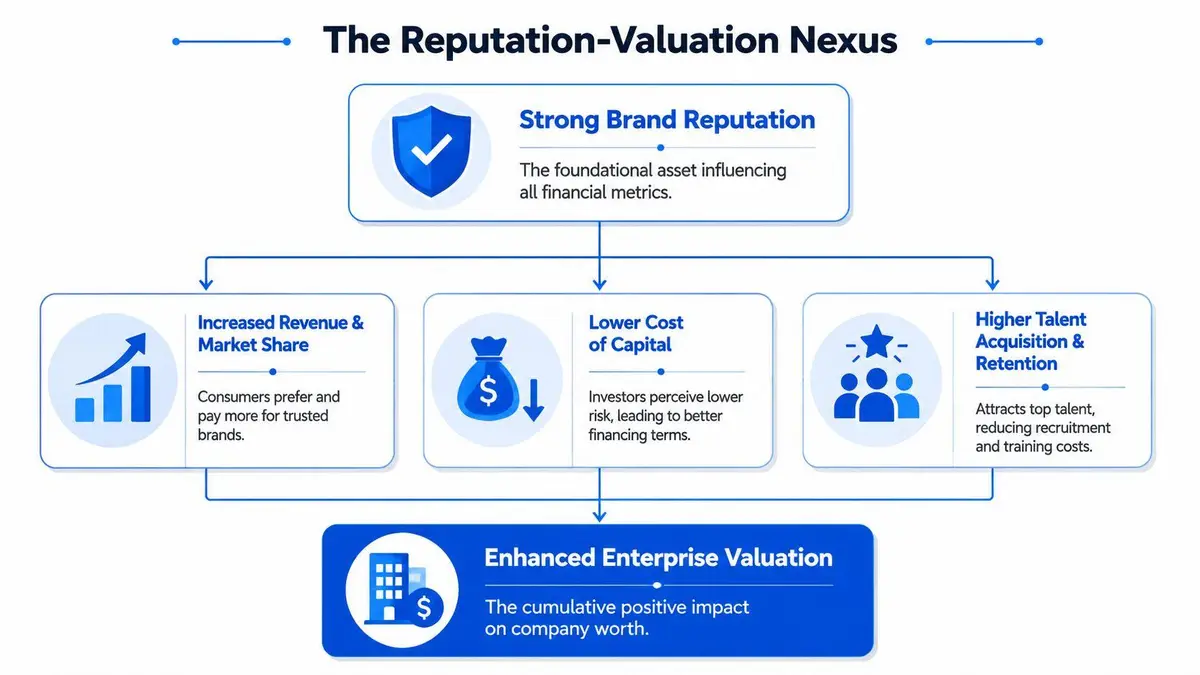
Boards should treat reputation as a valuation input. It affects how the market judges durability of demand, credibility of leadership, legal exposure, and the probability of disruption. Those judgments shape the multiple.
One industry summary reports that a company’s reputation can account for 63% of its market value, and it also notes that it can take around 40 positive reviews to counter one negative review according to reputation management statistics compiled by Electro IQ. Use those figures cautiously, but do not miss the point. A large share of enterprise value rests on confidence that can weaken far faster than revenue reports suggest.
Why valuation falls before the income statement shows the damage
Valuation reflects expected performance, not just recorded performance. Once a reputational issue raises doubts about governance, compliance, product reliability, or management judgment, investors and acquirers start pricing in lower future cash flow and higher risk. That repricing happens before the P&L fully shows slower sales, higher churn, or legal expense.
Private markets behave the same way. Family offices, private equity firms, lenders, and strategic buyers all test whether risk is contained and leadership is credible. If diligence surfaces unresolved negative content, they respond in financial terms. They lower the multiple, extend diligence, add protections, or step back from the process altogether.
Reputation protects pricing power and deal terms
A strong reputation improves negotiating position because it reduces perceived risk. Buyers are more willing to accept pricing, contract terms, and management representations when the public record supports stability and competence.
A weak reputation creates a measurable drag. Commercial teams face heavier discount pressure. Finance teams spend more time defending assumptions. Deal counsel pushes for tighter covenants, earnouts, indemnities, or holdbacks. None of that appears in a brand tracker. All of it affects value.
| Valuation question | What reputation changes |
|---|---|
| Can the company sustain future demand? | Public trust affects confidence in revenue durability |
| Can it hold price and margin? | Credibility reduces pressure to discount or concede terms |
| Is management reliable? | Negative visibility raises concerns about judgment and controls |
| Is risk contained? | Adverse content increases diligence scrutiny and perceived exposure |
Reputation defense preserves valuation because it preserves confidence in future cash flow, management quality, and risk control. Once that confidence breaks, the multiple follows.
How Reputation Governs Customer Acquisition and Retention
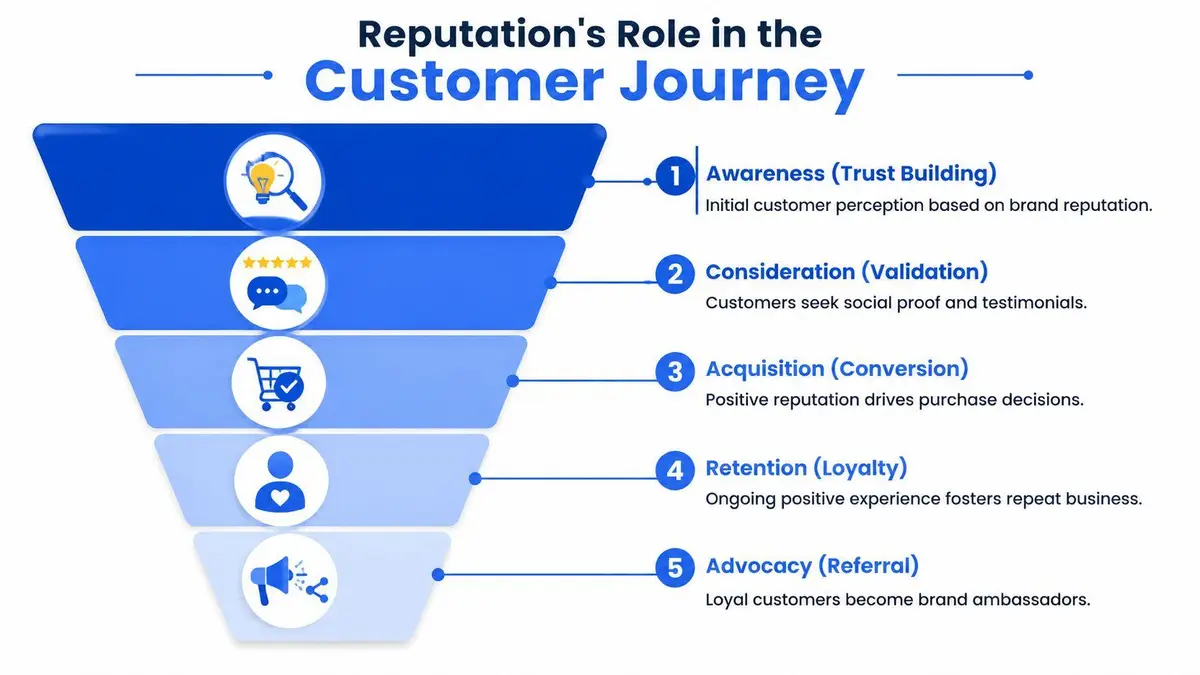
A prospect is ready to buy. Then they search your company name, your founder, your reviews, and your recent press. If the first page raises doubts, the sale gets more expensive or disappears. That is why brand reputation matters. It controls who enters the pipeline, how much persuasion sales needs, and how long customers stay once they sign.
In a 2024 survey, 77% of consumers in Germany said it was important that brands they buy or use have a good reputation, while the share was 92% in both Brazil and China, according to Statista’s survey on the importance of brand reputation before purchase. For management teams, that is not a branding anecdote. It is evidence that reputation acts as a commercial filter in major markets before product, price, or pitch can do their work.
Acquisition cost rises when credibility slips
Weak reputation pushes customer acquisition cost up through several channels at once. Search traffic converts worse because brand queries surface objections. Paid media underperforms because prospects click, investigate, and hesitate. Sales cycles lengthen because representatives must spend time defending the company before they can sell the offer.
The commercial effect is immediate:
- Lead-to-meeting rates fall because early trust breaks before a conversation starts.
- Close rates weaken because buyers choose the lower-risk option, even at a higher price.
- CAC increases because more spend and more labor are required to produce the same revenue.
- Channel partners hesitate because they do not want your reputation risk transferred to them.
Executives frequently make avoidable mistakes. They treat declining conversion as a messaging issue or a funnel issue. In many cases, the underlying problem sits outside the campaign. The market has already formed a view of your credibility.
Retention is a trust equation
Reputation also determines how much tolerance customers give you after the first transaction. Companies with credible public standing get more room to fix service failures, price increases, shipping delays, and product defects. Companies with visible reputational baggage do not get that room. Customers interpret ordinary friction as confirmation that they backed the wrong supplier.
That changes revenue quality. Retention weakens. Expansion slows. Referral volume drops. Churn becomes harder to reverse because the objection is no longer limited to the product. It extends to management judgment and corporate conduct.
This matters acutely for firms trying to navigate venture funding. Investors may accept temporary inefficiency in acquisition or retention if management can prove the issue is operational and fixable. They assign a different level of concern when poor commercial performance is tied to a damaged reputation visible to every prospect, customer, employee, and reporter.
Reputation lowers the cost of persuasion and raises the margin for error. Once trust erodes, both acquisition and retention become materially more expensive.
Leaders should manage reputation as a revenue defense system. Audit branded search results. Track review velocity and sentiment. Identify the objections prospects raise before the first sales call. Measure whether trust issues are inflating CAC, suppressing conversion, or increasing churn. If you cannot quantify the drag, you cannot contain it.
Securing Capital and Attracting Top Talent
At 9:00 a.m., your banker says the process is on track. By noon, a lender has flagged adverse search results on the company and its CEO. By close of business, the discussion has shifted from growth to controls, indemnities, and pricing. That is how reputation destroys negotiating power. It turns a financing event or executive search into a referendum on judgment.

Capital providers screen for narrative risk
Investors and lenders do not underwrite a company in isolation. They underwrite management credibility, governance discipline, and the probability that public controversy will disrupt performance or reduce exit value. A business can post solid operating results and still face a weaker deal if branded search results surface lawsuits, allegations, executive misconduct, or unresolved complaints.
The financial consequence is straightforward. Reputation concerns give the counterparty room to demand more. They can slow diligence, widen representations, tighten covenants, lower valuation, or raise the cost of capital. In a live process, that shift is expensive because time pressure works against the company, not the investor.
Founders trying to navigate venture funding usually spend heavily on narrative, metrics, and introductions. They should put the same discipline into pre-deal reputation review. Audit search results for the company, founders, and board. Identify attack points before diligence begins. If negative material is controlling page one, use a documented plan for removing negative content from Google’s first page before you ask the market to price your future.
Commercial strength matters here, but the board-level issue is broader. Capital providers treat reputation as a proxy for durability. If public trust looks unstable, they assume future revenue, recruiting, partnerships, and exit options are less predictable.
Talent performs the same diligence
Top candidates run their own diligence before they return a call. They search the company, the founder, and the leadership team. They review press coverage, litigation history, employee commentary, and any pattern that suggests instability or poor judgment.
They rarely announce their conclusion. They withdraw, stall, or accept a safer offer.
That creates three operating problems at once:
- Hiring cycles get longer because the strongest candidates self-select out early.
- Compensation pressure rises because reputation risk has to be offset with cash or title.
- Execution weakens because the company enters a critical period without the leadership bench it needs.
The second media asset below addresses the broader business context.
A damaged reputation constrains financing and leadership supply at the same time. That is not a marketing issue. It is a control issue with direct consequences for valuation, deal terms, and recovery capacity.
How Search Engines Amplify Reputational Risk
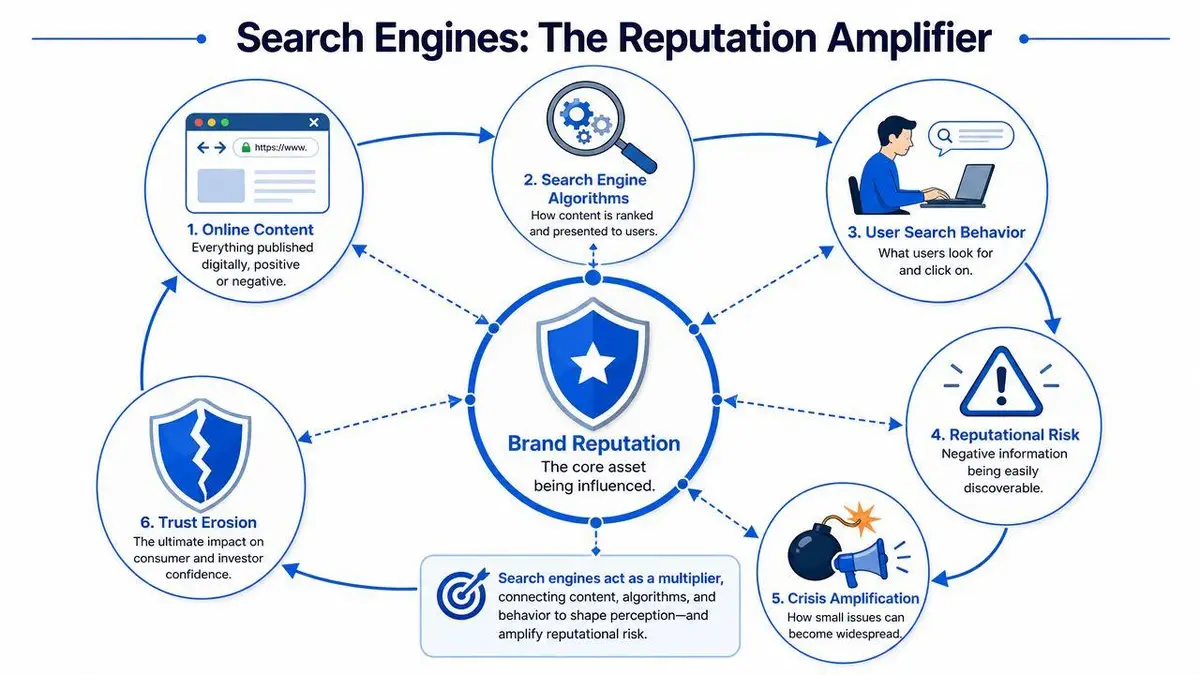
Search engines turned reputation into a persistent infrastructure problem. Before search, damaging information spread unevenly and often faded with time. Now a single article, review cluster, forum thread, or social post can become the default reference point for your name or brand.
That durability is what makes the issue so dangerous. Search doesn’t just display information. It organizes credibility.
Why one negative result can dominate
Search engines rank content partly by perceived relevance, authority, freshness, and user behavior. If a negative article appears on a domain the algorithm already trusts, it can hold visibility for long periods. If users click it because the headline is inflammatory, that behavior can reinforce its prominence. The result becomes self-sustaining.
Executives often underestimate this mechanism. They assume false or outdated material will disappear because it lacks merit. Search doesn’t evaluate fairness the way counsel does. It evaluates signals. If those signals support visibility, the content stays discoverable.
Three consequences follow:
- Negative content becomes searchable at scale because anyone can find it through a simple branded query.
- Third parties treat ranked content as credible even when the underlying claim is weak, partial, or wrong.
- Every fresh search recreates the damage because the issue is reintroduced to new buyers, employees, and counterparties.
Removal and suppression require specialized action
Once harmful content ranks well, passive waiting is a losing strategy. You need a technical and legal assessment of what can be removed at the source, what can be de-indexed, what requires platform enforcement, and what must be countered through suppression or replacement content. That work is specialized because the right response depends on the content type, the publisher, the jurisdiction, and the search footprint.
If you’re dealing with visible first-page damage, this guide to removing negative content from Google’s first page outlines the practical options executives should evaluate.
Search visibility turns a local issue into a repeating global diligence event.
That is the core problem. Search engines don’t merely report reputational harm. They institutionalize it.
The Uncapped Costs of a Reputation Crisis
A reputation crisis starts with a trigger and quickly turns into a capital allocation problem. The first invoice is rarely the main loss. The larger exposure comes from delayed deals, weaker pricing power, disrupted hiring, heavier legal spend, and leadership time pulled away from operations.
That is why waiting is the most expensive strategy. Once the issue is visible, the company is forced to respond on the market’s timetable. Costs rise fast. So does the probability of poor decisions.
Controlled spend versus uncontrolled loss
Boards should treat reputation defense as a financial control, not a discretionary communications expense. Proactive work has a budget, a scope, and an escalation plan. Reactive work has none of the three.
In a live crisis, one problem becomes six. Counsel expands the review. Communications advisors are hired under pressure. Internal teams stop planned work to brief leadership and respond to stakeholders. Sales leaders revise forecasts. Recruiters start managing objections. Business development slows because counterparties ask for reassurance before they commit.
A practical comparison looks like this:
| Response posture | Financial profile |
|---|---|
| Proactive defense | Planned cost, defined scope, faster escalation path |
| Reactive crisis response | Unplanned cost, moving scope, wider business disruption |
The right question is simple. Do you want to fund prevention on your terms, or absorb open-ended losses on someone else’s?
The hidden bill executives miss
The largest unbudgeted cost is executive distraction.
Senior leaders should be deciding pricing, capital deployment, hiring, and growth priorities. In a reputation event, they end up reviewing screenshots, approving statements, joining emergency calls, and answering concern from investors, employees, and key customers. That time has a direct cost. It also creates an opportunity cost that never appears on a vendor invoice.
Then the long tail begins. Harmful coverage, copied posts, reviews, forum threads, and stale search results continue to surface in diligence long after the public attention fades. The headline may disappear. The economic drag does not.
For high-value individuals and companies, this persistence changes the risk profile. A temporary controversy becomes a recurring obstacle in financing discussions, enterprise sales cycles, partnership reviews, and talent recruitment. If harmful material remains visible, every new search recreates the issue for a new decision-maker.
That is why response speed matters. In many cases, the first priority is to assess whether the material can be removed, de-indexed, or challenged at the source. Teams facing active exposure should review their options for removing online content before the problem hardens into a permanent search liability.
The true cost of a reputation crisis isn’t the first invoice. It is the extended loss of confidence, time, and negotiating power.
Treat reputation defense like legal risk management and cyber readiness. The downside is open-ended. The market does not cap the loss for you.
Implementing a Framework for Proactive Digital Defense
The correct response to reputation risk is not panic and it isn’t passivity. It is a standing operating framework. High-value individuals and companies need a disciplined system that detects exposure early, assesses it accurately, and acts before the market fixes the narrative in place.
I use a simple standard. Monitor. Assess. Act. The sequence is simple. The execution is not.
Monitor continuously
Annual brand reviews are useless for fast-moving digital threats. By the time a quarterly report identifies an issue, counterparties may have been seeing it for weeks. Monitoring needs to cover branded search results, executive-name queries, review platforms, social platforms, forums, news pickup, impersonation signals, and repost activity.
Professional tooling plays a critical role. Real-time alerts, search environment tracking, review monitoring, and platform-specific watchlists give leadership an early warning system. For sensitive matters, many clients also need dark web monitoring and leak detection because reputational harm increasingly intersects with privacy, extortion, and stolen material.
Assess severity, not just visibility
Not every negative item warrants the same response. A disciplined assessment should answer four questions:
- Is the content false, unlawful, manipulated, or policy-violating?
- Is it ranking for branded or executive-name searches?
- Is it likely to affect customer decisions, financing, hiring, or legal posture?
- Is the issue isolated, or is it being copied and amplified across platforms?
A weak but highly ranked article can be more dangerous than a severe allegation buried deep in discovery. Leaders need a risk model based on visibility, credibility, and business impact together.
Act with the right remedy
Different threats require different interventions. Defamatory content may support removal demands or legal escalation. False reviews may require platform enforcement and evidence packages. Impersonation often calls for rapid takedown and account tracing. Search-first issues may require de-indexing analysis, suppression planning, and publisher engagement in parallel.
Many organizations fail by assigning the problem to the wrong function. PR can’t remove unlawful content. Generalist agencies often can’t handle platform enforcement or de-indexing pathways. Traditional legal counsel may identify causes of action but not the fastest operational route to reduce visibility. Firms such as ContentRemoval.com’s online content removal service handle source removal, de-indexing, false review takedowns, impersonation issues, and related digital enforcement work when the problem sits across search engines, websites, and platforms.
Governance matters more than improvisation
The strongest programs assign ownership before a crisis. They define escalation paths between legal, communications, security, and executive leadership. They preserve evidence, centralize decision-making, and avoid the internal chaos that turns a manageable event into a credibility failure.
A sound framework usually includes:
- Named decision-makers so no one wastes time debating authority during an active issue.
- Evidence protocols that preserve URLs, screenshots, timestamps, and platform identifiers immediately.
- Response mapping that matches each threat type to the proper remedy.
- Executive search audits because leadership names often become the primary attack surface.
- Post-incident monitoring to catch reposts, mirrors, and renewed ranking pressure.
If you’re still asking why brand reputation is important, ask a narrower and more useful question. What happens to valuation, demand, financing, hiring, and negotiation power when public trust becomes uncertain? That question gets answered every day in search results, diligence calls, and silent withdrawals from deals that should have closed.
Reputation is an asset. Treat it like one. Monitor it like one. Defend it before someone else defines it for you.
If a negative article, false review campaign, impersonation, leak, or first-page search result is putting your company or name at risk, ContentRemoval.com can assess the exposure confidentially and outline the available removal, de-indexing, and containment options with a clear action plan.
Frequently asked questions
How does a negative search result affect company valuation?
It lowers confidence in future cash flow, management judgment and risk containment, so buyers, lenders and investors reduce the multiple, extend diligence, add protections or step back. The article notes that repricing happens before slower sales or churn appear in the financials.
Why do good candidates withdraw without explaining?
Because they run their own diligence. Top candidates search the company, the founder and the leadership team, review press, litigation and employee commentary, and if something suggests instability they stall or accept a safer offer. The result is longer hiring cycles and higher compensation pressure.
Why does one bad article stay on page one for years?
Search engines rank on authority, relevance, freshness and user behavior, not fairness. A negative story on a trusted domain with an inflammatory headline attracts clicks that reinforce its position. The article says passive waiting loses and recommends assessing removal, de-indexing, platform enforcement and suppression together.