
Reputation management is the discipline of controlling what people find, believe and act on when they search your name, business or principals. It has two arenas: proactive fortification of the assets that should represent you, and reactive remediation that removes, de-indexes, suppresses and contains harmful material using legal, technical and strategic methods when a threat is already live.
Key facts
- The five levers are monitoring, source removal and de-indexing, suppression, asset control, and legal action.
- Removal solves the origin, de-indexing solves discoverability, suppression solves visibility, and clients often need all three.
- A remediation engagement runs assessment and triage, containment, search restructuring, then monitoring for relapse.
- Triggers include coordinated review attacks, defamatory search results, impersonation, leaked material and cross-platform spread.
Where ContentRemoval.com comes in. ContentRemoval.com works the remediation arena described here for executives, founders and family offices, removing or de-indexing the false, private or impersonating material that is already ranking and then watching for its return. General counsel, a chief of staff or the family office director usually makes the first contact. A free 15-minute Exposure Scan maps what can come down and by which route, and the report is yours to keep. Get a Free, Confidential Exposure Scan or read how our reputation management work is done.
If you’re reading this because your name, company, or family office has started surfacing in the wrong places, you don’t need another vague article about “building trust online.” You need a precise answer to a harder question. What is reputation management when the threat is already live, ranking, spreading, and affecting decisions made about you in real time?
The short answer is this. Reputation management is the discipline of controlling what people find, believe, and act on when they search your name, your business, or your principals. Sometimes that means fortifying a strong digital presence before trouble starts. In more serious matters, it means removing, de-indexing, suppressing, and containing harmful material with legal, technical, and strategic methods.
That distinction is where most public guidance fails. Generic guides describe monitoring reviews and posting positive content. That is only half the field. High-value clients usually come to us for the other half. They are dealing with defamation, impersonation, leaks, hostile press, false reviews, data exposure, or a search presence that no longer reflects reality. In those situations, reputation management stops being a marketing exercise and becomes a control problem.
Reputation Management Is Not Public Relations
At 7:15 a.m., your office sees a defamatory page climbing page one, a fake account is contacting counterparties, and screenshots from a leak are spreading across repost networks. In that moment, press handling is a side issue. The immediate task is containment.
PR manages narrative with approved messages, media access, and audience sequencing. Serious reputation work handles exposure across search, platforms, publishers, and data sources you do not control. The objective is operational: reduce visibility, stop replication, preserve evidence, and regain command of what decision-makers find first.
PR broadcasts. Reputation management intervenes.
Communications teams are useful when the issue turns on explanation. Earnings pressure, a leadership transition, a product failure, a public apology. Those situations call for disciplined wording and careful stakeholder management.
A hostile search result requires a different response. Someone has to map where the content lives, how it is being indexed, whether it breaches platform rules, whether the publisher is vulnerable to legal pressure, and which assets can outrank it if removal is delayed. That is remediation work. It is technical, procedural, and often legal.
Practical rule: If the threat is ranking, persistent, or tied to false allegations, privacy exposure, impersonation, or leaked material, treat it as a remediation matter first and a communications matter second.
The primary objective is control
Discerning clients do not ask for vague reputation improvement. They ask for a plan. What can come down. What can be de-indexed. What must be answered. What should be left untouched to avoid giving it oxygen. What is likely to reappear through mirrors, scraper sites, or copycat accounts.
That is the correct frame. What is reputation management? It is a strategic control function for digital risk. It covers monitoring, search result management, account and profile control, evidence preservation, policy escalation, suppression strategy, and legal coordination where the facts support it.
This field stands on its own because the work is distinct. Brand management builds presence over time. Reputation remediation addresses active harm under pressure. If an adviser treats those as the same service, you should question whether they have handled a live attack before.
What serious buyers should reject
You should be wary of any proposal built around posting more content, collecting a handful of positive reviews, or “changing the conversation.” Those tactics support brand presence. They do not resolve a hostile article, a doxxing thread, a fabricated review campaign, or an impersonation account targeting your contacts.
A competent strategy answers three questions:
- What can be removed: source takedowns, policy enforcement, de-indexing requests, rights-based claims
- What can be contained: suppression, asset reinforcement, platform escalation, repost tracking
- What can recur: reuploads, syndication, scraper domains, affiliate amplification, copycat profiles
If those questions are absent, there is no control plan. There is only commentary.
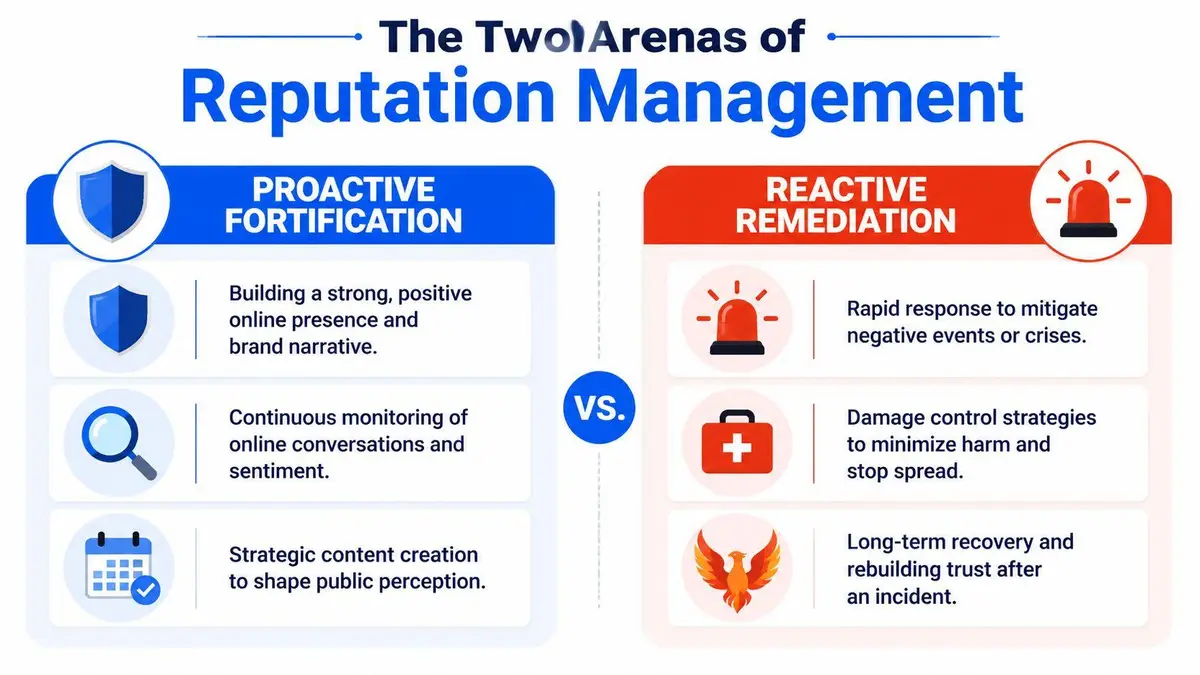
The Two Arenas of Reputation Management
Most confusion around what is reputation management comes from a basic failure to separate two very different operating environments. One is calm, deliberate, and preventative. The other is urgent, adversarial, and often legally sensitive.
Proactive fortification
Fortification is the work you do before there is a visible problem. The aim isn’t vanity. The aim is resilience.
That means securing and optimizing the digital assets that should represent you first. Executive bios. company profiles. verified social accounts. authoritative websites. knowledge panels. review profiles. media pages you can influence. If a crisis appears tomorrow, these assets become your defensive perimeter.
A mature fortification program also monitors perception continuously. Practitioners track review volume, average star rating, sentiment, and responsiveness, then segment those signals by customer journey stage or demographic to isolate where perception is changing and where intervention works best, as described in this guide to ORM measurement.
Reactive remediation
Remediation starts when the threat is already active. The issue is no longer “How do we present well?” It becomes “How do we stop further damage and reverse visible harm?”
In these situations, generic content often falls silent. One widely cited industry explainer identifies the core gap clearly: most definitions focus on proactive monitoring and ignore high-stakes cases involving false allegations, leaks, or impersonation. The same guide notes that 85% of people trust online reviews as much as personal recommendations, which is why negative visibility can’t be treated as a minor marketing inconvenience according to Igniyte’s discussion of proactive versus reactive reputation work.
The difference in practice
The two arenas look similar from a distance because both involve search, reviews, profiles, and public perception. Operationally, they have almost nothing in common.
| Arena | Primary objective | Typical tools | Standard owner |
|---|---|---|---|
| Fortification | Build defensible visibility | Profiles, content, reviews, monitoring, branded search assets | Marketing, communications, specialist ORM advisers |
| Remediation | Remove or contain harm | Takedowns, legal notices, de-indexing, suppression, escalation workflows | Specialist ORM, counsel, investigators, platform specialists |
Fortification is scheduled. Remediation is triage.
Fortification improves optionality. Remediation preserves it.
The worst time to discover you don’t control your search landscape is the day a false allegation starts ranking.
Which arena are you in
You are in fortification mode if your concern is exposure management, review quality, search polish, or executive visibility. You are in remediation mode if any of the following is already true:
- A false or malicious result is ranking: Especially for a name, brand, or leadership query.
- Your identity is being imitated: Fake social accounts, copycat websites, fabricated review profiles.
- Private or stolen material is circulating: Leaks, scraped data, unauthorised images, internal documents.
- A coordinated attack is underway: Review bombing, forum brigading, hostile amplification across platforms.
An advanced program often includes both. But they require different skills, different timelines, and different tolerance for legal risk. Confusing them is how clients lose time.
The Five Levers of Strategic Reputation Control
When clients ask what is reputation management in operational terms, I answer with five levers. Not services. Levers. Each one changes the balance of control in a different way. Serious engagements use several at once.
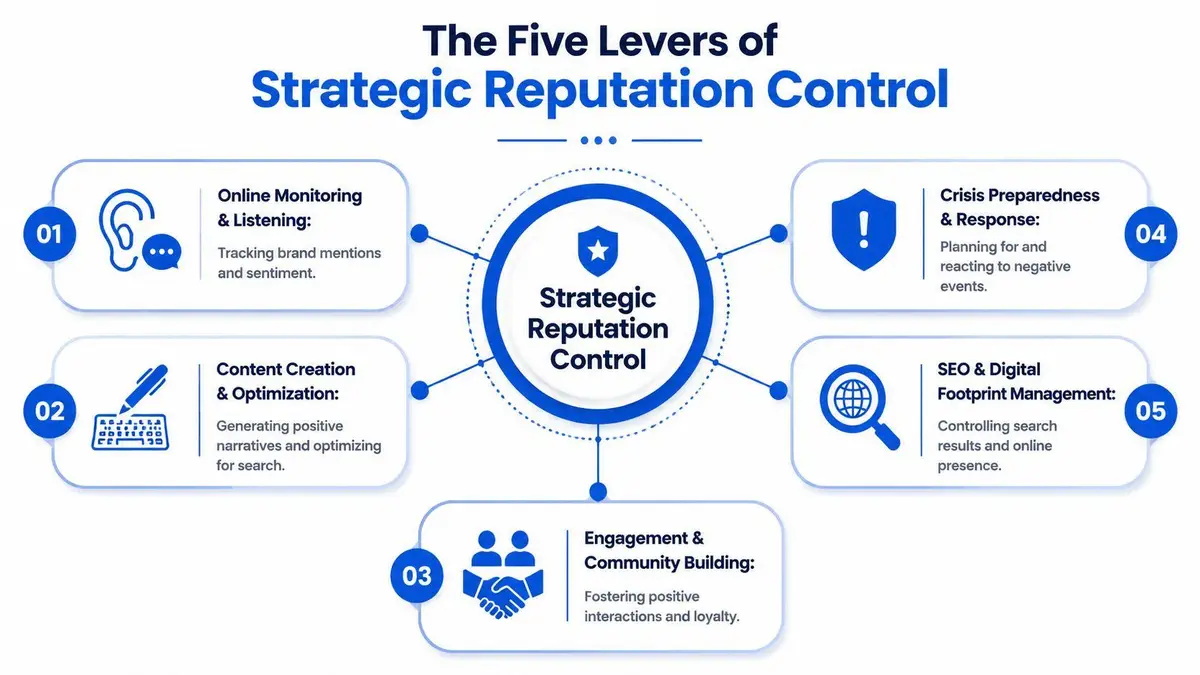
Monitoring and threat intelligence
You can’t manage what you don’t see early. Monitoring is more than alerts for brand mentions. It is structured surveillance of search results, review platforms, social handles, news mentions, repost patterns, and complaint vectors.
The useful question isn’t “Who said something negative?” It is “Which asset is gaining visibility, who is amplifying it, and what intervention path applies first?”
A mature ORM program treats search-engine visibility as part of the reputation surface and combines real-time monitoring with branded SEO, profile management, and rapid response to negative content so controllable assets can outrank harmful material, as outlined in this overview of search-led reputation management.
For internal teams building that visibility layer, tools such as AI SEO software can help map and strengthen the branded assets that need to hold first-page ground.
Source removal and de-indexing
This is the cleanest remedy when it works. Remove the content at the source, and the downstream search problem usually weakens with it. De-indexing is different. The content may remain online, but search engines stop surfacing it for relevant queries.
These are distinct tactics with distinct requirements. Source removal usually relies on policy violations, rights-based arguments, contractual power, legal notices, or direct publisher negotiation. De-indexing depends on search engine rules, technical status, or content characteristics that justify exclusion.
Removal solves the origin. De-indexing solves discoverability. Suppression solves visibility. Clients often need all three.
Search result suppression and SERP engineering
Not every harmful page can be erased. Some are lawful, stubborn, or published by operators who profit from conflict. In those cases, you change what ranks around them and above them.
That isn’t guesswork. It involves engineering a stronger search environment using assets you own, control, influence, or can credibly develop. Executive sites, corporate pages, professional bios, interviews, trusted directory listings, social profiles, legal notices where appropriate, and topic-specific content all serve a purpose if they are built correctly.
Digital asset and profile control
Many crises worsen because the client never secured the obvious assets. Unclaimed profiles. Inconsistent business listings. Weak executive bios. Dormant social accounts. Bare company pages. Search engines read that disorder as a lack of authority.
A defensive program standardizes and hardens those assets. It claims profiles, updates metadata, aligns identity signals, and creates a clean hierarchy of official sources. This doesn’t look glamorous. It matters enormously when a platform, journalist, or search engine tries to determine which version of you is credible.
Legal and jurisdictional action
Some matters are too serious for marketing-led handling. Defamation, impersonation, extortion, privacy invasion, leaked intimate media, forged documents, and targeted harassment often require legal framing from the outset.
A specialist may coordinate with counsel, platform policy teams, investigators, and technical operators. One option in this category is ContentRemoval.com’s content removal service, which focuses on removing harmful material from source sites and search environments. What matters is not the label. What matters is whether the team can match the claim, platform, and jurisdiction to a viable enforcement path.
Anatomy of a Remediation Engagement
At 8:15 a.m., a board member forwards a search result, a client asks for clarification, and your legal team still has not seen the full spread of the material. That is the point where brand management stops and remediation begins. One protects visibility over time. The other contains an active threat, preserves evidence, and removes or suppresses harmful material before it shapes commercial, regulatory, or personal outcomes.
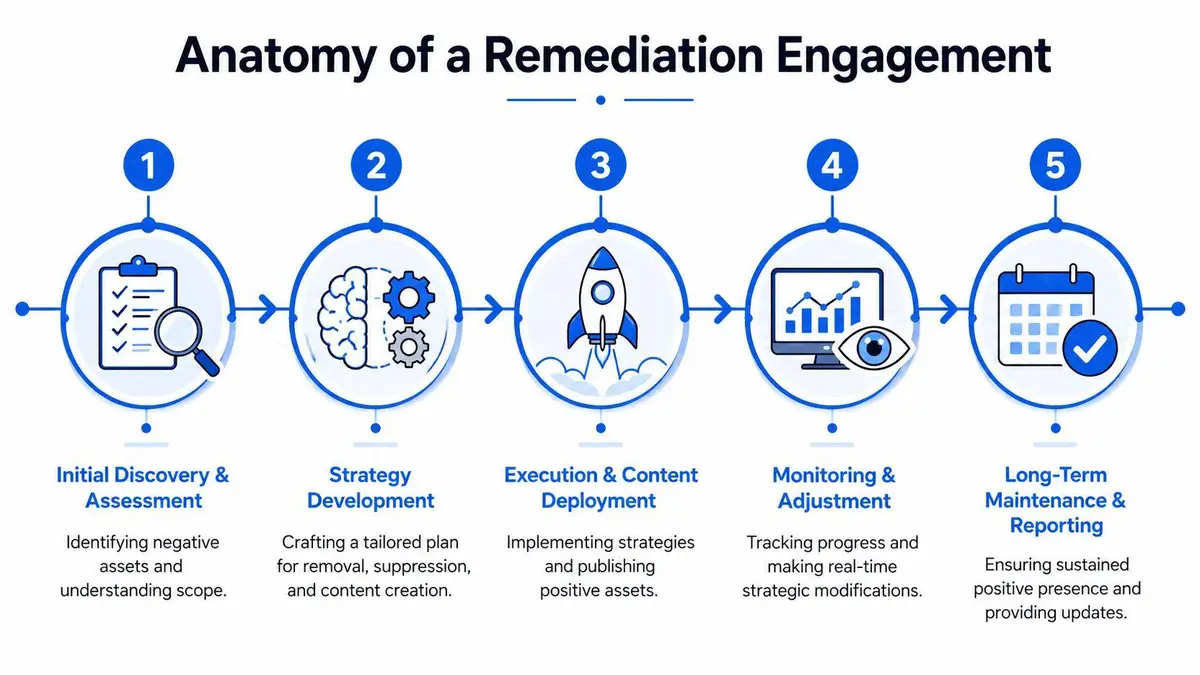
Phase one assessment and triage
Start with a map of the attack surface.
Identify the exact URLs, search queries, platforms, repost paths, and named individuals involved. Separate what is false from what is private, stolen, manipulated, or damaging but lawful. That distinction governs everything that follows, including whether the right route is platform enforcement, publisher negotiation, legal demand, court action, or search suppression.
Evidence comes first. Preserve screenshots, timestamps, source code where relevant, account identifiers, indexing status, and any signs of coordination. If you skip this step and rush into outreach, you lose proof, weaken legal options, and give the other party room to deny, edit, or relocate the material.
Phase two containment and first actions
Containment is a sequencing problem. The objective is to slow spread, reduce visibility, and avoid mistakes that expand the record.
That usually means drafting notices, reporting through the correct policy channels, contacting publishers where a direct approach is justified, locking down exposed accounts, and deciding who is permitted to speak internally and externally. In impersonation, leak, and defamation matters, a loose response creates fresh screenshots and fresh indexing. Silence is often safer than a public argument.
Set priorities in this order:
- Stop reposting on channels with the fastest replication.
- Address the highest-visibility assets first, especially branded search results, major platforms, and authoritative profiles.
- Match the argument to the violation. Privacy, impersonation, copyright, falsity, harassment, contractual breach, and court-backed claims each require different framing.
- Keep internal communications controlled and limited to people with decision-making authority.
Teams that want practical guidance on preventing social media brand crises should treat that work as prevention, not remediation. Once a coordinated attack or leak is live, the standard playbook is too soft.
Phase three search restructuring and removal work
After immediate containment, you reshape what stakeholders can find and what platforms are willing to keep indexed.
This phase combines removal action with search control. Official profiles are strengthened. Weak or inconsistent assets are corrected. Clarifying pages are published where the facts support publication. Existing authority signals are consolidated so residual negative pages lose prominence faster. This is disciplined remediation, not reputation theater.
For matters involving persistent articles, copied posts, review spam, or invasive personal content, source-level action often determines whether the problem recedes. Professional online content removal services are relevant here because they focus on getting harmful material addressed at the publisher, platform, and search level rather than relying only on counter-content.
Quiet structural changes usually reduce risk more effectively than visible rebuttals.
Phase four monitoring and relapse prevention
A matter is not closed because one URL disappears. It is closed when recurrence becomes difficult and early warning is in place.
Monitor for reuploads, mirror domains, syndication, review bursts, and ranking reversals. Then fix the internal weaknesses that allowed the issue to spread. Secure account ownership. Reduce exposed personal data. Tighten approval rights. Standardize profile control. If those controls are missing, the same actor will return through a different platform or a different search result.
The best engagements leave the client harder to target, faster to respond, and far less dependent on public explanation.
Indicators That Mandate Professional Intervention
At 6:30 a.m., your general counsel sees a false allegation ranking for the founder’s name, a cloned executive profile is soliciting messages from customers, and a private document is circulating in screenshots across two platforms. That is not a branding problem. It is a live exposure event.
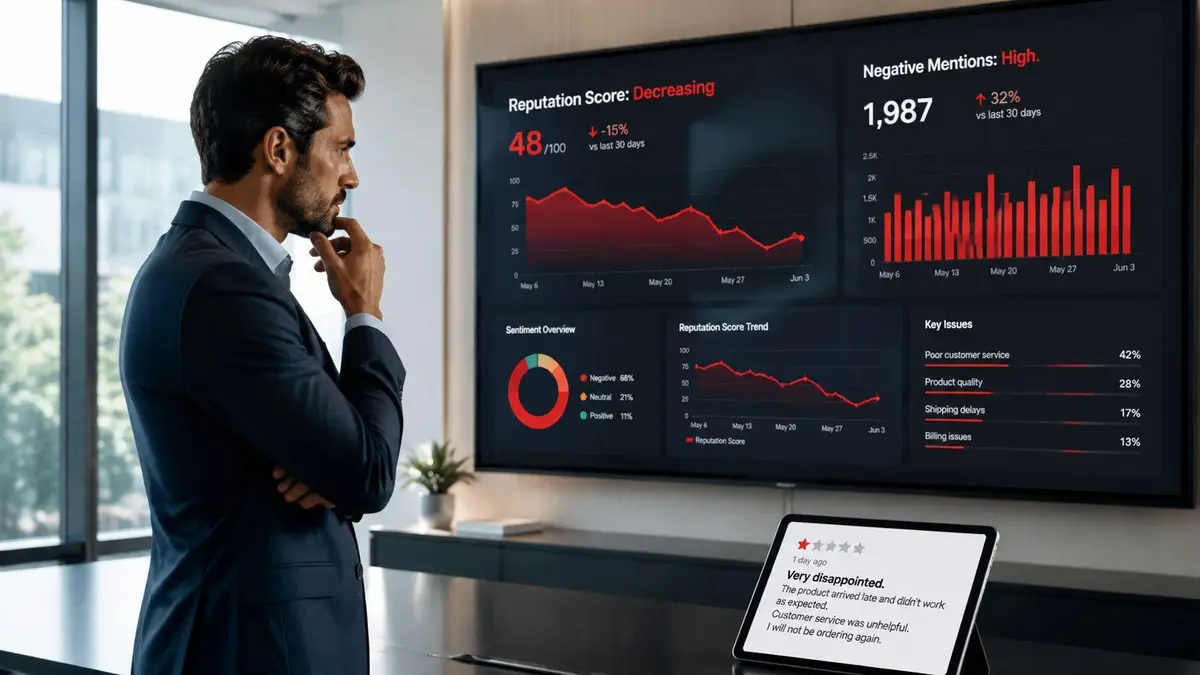
The line between routine brand management and professional reputation intervention is simple. Brand management shapes perception under normal conditions. Professional intervention contains harm when an adversary, a leak, or a false narrative is already gaining traction. One belongs with marketing and communications. The other belongs with specialists who understand removal routes, evidence handling, escalation strategy, and legal risk.
You should bring in specialist support when the matter shows structure, scale, or persistence. Those three factors determine whether the problem stays containable or turns into a commercial, legal, or personal security issue.
Five situations where delay gets expensive
Some triggers are clear on day one.
- Coordinated review attacks: A sudden wave of hostile reviews across multiple profiles, often using repeated language, disposable accounts, or suspicious timing.
- Defamatory search results: False allegations ranking for a company, executive, or family name. Once they settle on page one, they influence investors, prospects, journalists, and counterparties before you speak to any of them.
- Impersonation and account cloning: Fake executive profiles, spoof brand pages, or lookalike accounts seeking money, credentials, or confidential information.
- Leaked or stolen material: Internal memos, private images, recordings, legal documents, or scraped personal data posted without authorization.
- Cross-platform spread: One post becomes a thread, then a video, then a search result. At that stage, you are dealing with an attack path, not an isolated mention.
What internal teams miss
Communications teams can draft a response. They usually cannot assess whether a public reply will validate a false claim, preserve a harmful URL, trigger republication, or weaken a later legal position.
The same goes for social channels. If your team is formalizing escalation rules before a dispute turns hostile, guidance on preventing social media brand crises is useful for setting thresholds and tightening response discipline.
Senior leadership changes the risk profile. A founder, CEO, investor, or family office principal does not face reputational harm alone. They face impersonation, harassment, extortion pressure, privacy loss, and targeted attempts to force a public reaction.
Outside counsel is warranted when the issue touches defamation, privacy, confidential information, platform abuse, or personal safety. Specialist reputation firms are warranted when the matter also requires removals, de-indexing, suppression strategy, search control, and coordination across platforms. If you are assessing providers, this guide to reputation management companies for executives and high-net-worth individuals is a practical benchmark because it distinguishes generic review-response vendors from firms built for sensitive remediation.
For a broader perspective on escalation signals, this video is worth your time.
Measuring Outcomes and Defining Your Next Step
A board member calls after a leak, a smear post, or a coordinated hit piece starts ranking for their name. The first question is usually wrong. The critical issue is not whether someone can “fix” it. The issue is whether you can regain control, reduce exposure, and prevent the next escalation.
Measure that directly.
For routine brand management, teams often watch reviews, sentiment, and response speed. That is useful, but it is not the standard for a remediation matter. In a targeted attack, the scorecard is stricter. You measure which harmful assets were removed, which URLs were de-indexed, which false claims were contained, which official properties recovered visibility, how quickly new incidents were detected, and whether the same attack path can be used again.
What success actually looks like
Success means control under pressure, not public praise.
| Outcome | What it means |
|---|---|
| Threat reduction | Harmful content is removed, de-indexed, contained, or pushed out of decision-critical visibility |
| Search stabilization | Official, accurate, and defensible assets hold the positions that matter for due diligence |
| Operational clarity | Your team knows what to escalate, what to document, what to answer, and what to leave untouched |
| Early detection | Active reputation monitoring catches new exposure before it gains traction |
A capable firm should be able to name the assets that matter, the remedies that are realistic, the deadlines that matter, and the evidence required for each intervention route. If they cannot, you are not looking at strategy. You are looking at motion without control.
The next step
If the matter is live, act fast. Delay gives hostile content time to spread, rank, get copied, and shape due diligence.
If the matter is not live, use that advantage. Build a response plan before a journalist calls, before an impersonation account appears, and before a private dispute becomes searchable. That is brand management at its most disciplined. Remediation starts later, costs more, and usually involves legal coordination because the threat has already escaped containment.
The right next step is a confidential assessment. Map the threat surface. Separate nuisance from legal exposure. Identify the assets, platforms, search queries, and counterparties that control the risk. Then decide whether the problem calls for monitoring, suppression, removals, de-indexing, legal escalation, or a full remediation engagement.
If you need a discreet assessment of a live reputation threat, or you want a clear plan before one develops, speak with ContentRemoval.com. The engagement should start with scope, evidence, and a controlled response.
Frequently asked questions
What is the difference between reputation management and PR?
PR manages narrative through approved messages and media access. Reputation management intervenes on exposure across search, platforms, publishers and data sources you do not control, mapping where content lives, whether it breaches rules or law, and what can outrank it. The article says to treat ranking, persistent or false material as remediation first.
How do I know if I need remediation rather than brand building?
You are in remediation mode if a false or malicious result is ranking for your name, your identity is being imitated, private or stolen material is circulating, or a coordinated attack is under way across platforms. Fortification is scheduled work, remediation is triage.
What does a successful reputation remediation look like?
Harmful content removed, de-indexed or pushed out of decision-critical visibility, official assets holding the positions that matter for due diligence, a team that knows what to escalate and what to leave alone, and monitoring that catches new exposure early. The article measures control under pressure, not public praise.