
Online reputation is the sum of public digital material that influences how a third party prices your risk: search results, reviews, social profiles, forum threads, data broker records, news coverage, leaked documents and copied content. Lenders, boards, journalists and clients read it as a due diligence file, so it belongs in your risk register rather than in a marketing bucket.
Key facts
- Three surfaces matter: search results, third-party platforms you cannot control, and owned assets you can.
- A professional audit pairs your name with terms like lawsuit, fraud, arrest, leak and address.
- Classify each result by legal exposure, visibility, removability and audience impact, not just positive or negative tone.
- Doxxing, leaked data and intimate imagery should be treated as security incidents, not branding problems.
Where ContentRemoval.com comes in. ContentRemoval.com runs the exposure review this post describes and then acts on it, removing or de-indexing the results that create legal, financial or safety risk for executives, public figures and the families behind them. A general counsel, chief of staff or family office director usually opens the conversation. A free 15-minute Exposure Scan maps what ranks, what can be challenged and by which route, and the report is yours to keep. Get a Free, Confidential Exposure Scan or read how our reputation management work is done.
A board member is about to vet your name. A lender is reviewing the company. A journalist is checking background before publishing. A prospective client has your firm open in one browser tab and search results in another. They won’t call to ask for context. They’ll make a decision from what they can see.
That is what online reputation means in practice. It’s not vanity. It’s not a soft marketing concern. It is the visible record that other people use to assess your credibility, stability, and risk.
If you’re asking what is online reputation, you’re probably already feeling pressure from a specific problem. A hostile article. False reviews. An old allegation that still ranks. A fake profile. Exposed personal data. The mistake many people make is treating these as separate nuisances. They are not. They are manifestations of the same issue: your digital footprint is being used as evidence against you.
Defining Online Reputation as a Matter of Risk
A lender opens your branded search results during underwriting. Counsel for the other side reviews old allegations before settlement talks. An investor committee scans reviews, archived coverage, and executive profiles before a vote. In each case, the decision is shaped by what is easy to find, easy to misread, and hard to rebut in real time.
Online reputation is the sum of public digital material that influences how a third party prices your risk. That includes search results, reviews, social profiles, forum threads, data-broker records, news coverage, leaked documents, and copied content that persists long after the original event. The issue is not whether the record is fair. The issue is whether it changes a legal, financial, or operational outcome.
That is the correct frame. Reputation should sit beside insurance exposure, litigation exposure, and counterparty due diligence. If inaccurate or hostile material can affect financing terms, hiring decisions, deal certainty, customer acquisition, personal safety, or regulator attention, it is a business risk.
The wrong frame and the right one
The term “reputation” often gets pushed into a marketing bucket. Serious operators should reject that.
| Issue | Marketing frame | Risk frame |
|---|---|---|
| Negative review | Brand perception problem | Revenue and conversion risk |
| Defamatory article | Bad press | Legal, financing, and deal risk |
| Doxxing or leaked data | Privacy concern | Personal security and extortion risk |
| Impersonation account | Social annoyance | Fraud and identity abuse risk |
The internet now functions as a permanent due diligence layer. Search visibility determines what enters the room before you do. Social signals add context, including patterns drawn from creator social data insights. Archived posts, scraped mentions, and stale profiles can distort that context enough to influence a credit decision, a board appointment, or a journalist’s framing.
This is why reputation work belongs in asset protection. A poor public record increases friction with counterparties. It weakens negotiation position, slows approvals, invites extra scrutiny, and raises the cost of trust. If your exposure is already spread across search, reviews, and data brokers, a formal digital footprint cleanup process is a risk-control measure, not a branding exercise.
Practical rule: If a search result can change a counterparty’s willingness to hire you, fund you, insure you, partner with you, or trust you, it belongs in your risk register.
Stop treating online reputation as sentiment management. Treat it as evidence management. The public record will be used against your interests unless you govern it.
The Anatomy of Your Digital Footprint
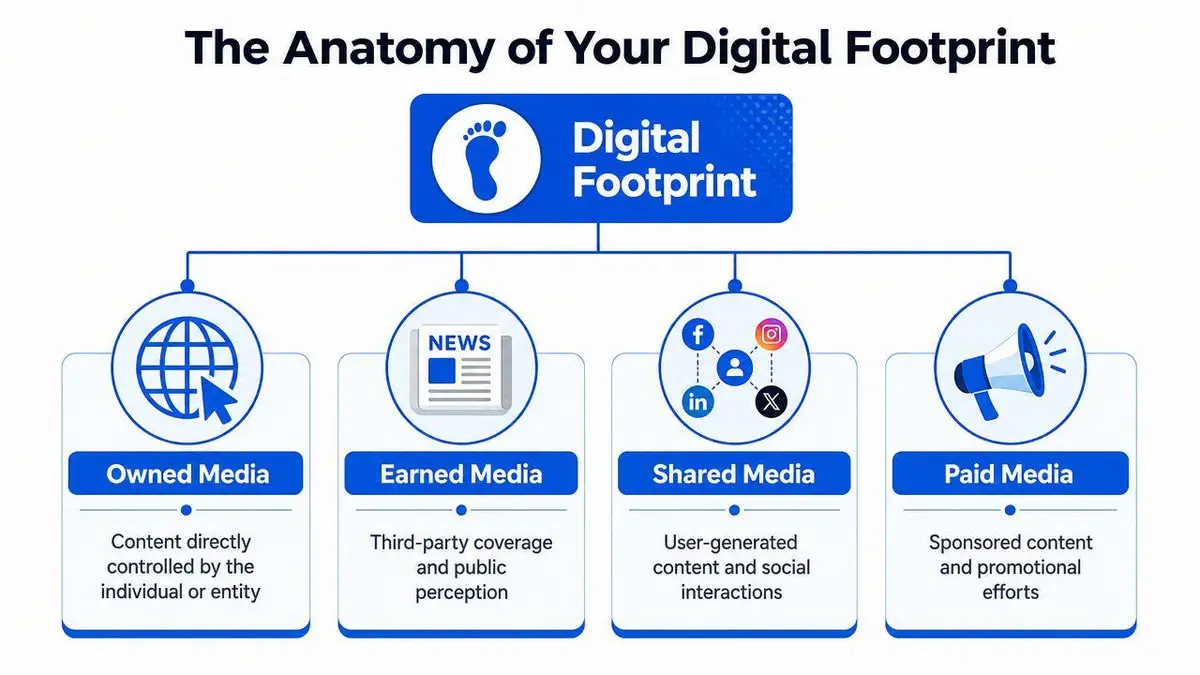
People often ask what is online reputation as if it were a mood. It isn’t. It’s a system of surfaces. Some you control. Some you influence. Some you must challenge directly.
Search surfaces decide what counts
Your reputation is shaped first by search engine results pages, because they act as the filing cabinet people open before they contact you. The technical problem is visibility. As Business.com’s explanation of online reputation management notes, reputation is the aggregate of what appears across high-visibility digital touchpoints, and its practical effect is determined by the ranking and prominence of those surfaces.
That means a harmless mention buried on page six is usually irrelevant, while a misleading headline in a top result becomes your public record. A proper analysis tracks branded searches, related entity queries, misspellings, image results, video results, and autocomplete behavior. Anything less is amateur work.
Third-party platforms carry concentrated risk
The second pillar is the set of platforms you don’t control. Review sites. Reddit threads. news archives. People-search databases. Forum discussions. Publisher pages. Marketplace profiles. These are dangerous because they often combine high visibility with limited editorial cooperation.
This is also where specialist intelligence matters. If your exposure is tied to creators, affiliate publishers, commentators, or viral social accounts, creator social data insights can help map which public actors and channels are amplifying a narrative before it hardens into search visibility.
Use this classification when you assess third-party risk:
- High-authority publishers carry legal and reputational weight. They’re harder to remove and more likely to persist in search.
- Platform-native attacks such as review abuse or impersonation can spread quickly because the platform itself supplies credibility.
- Data broker and index pages may look trivial, but they often expose addresses, relatives, or contact details that create privacy and security problems.
Owned assets are your defensive perimeter
The third pillar is what you directly control. Corporate sites. Executive bios. LinkedIn. verified social profiles. Press pages. Personal domains. Controlled thought leadership. These aren’t decoration. They are ranking assets, evidence assets, and identity anchors.
If your owned footprint is thin, search engines fill the vacuum with whatever third parties have published. That is why many clients start with a structured digital footprint cleanup program before they attempt suppression or legal escalation.
A weak owned footprint doesn’t stay empty. It gets occupied by other people.
The strategic mistake is to think in terms of “mentions.” Specialists think in terms of surfaces. Which surfaces rank. Which surfaces persuade. Which surfaces create legal or financial harm. That’s the anatomy that matters.
Reputation as a Primary Financial and Operational Asset
A lender is reviewing your file. Counsel on the other side is preparing an advantage for a dispute. A procurement team is deciding whether to advance your company to final diligence. Before any call, they search. What they find affects pricing, timing, deal appetite, and risk assumptions.

This is why online reputation should be treated as an operating asset with direct exposure to financial loss and legal friction. A damaged search profile can reduce conversion, trigger deeper diligence, weaken negotiating position, and extend sales cycles. In more serious cases, it increases the perceived probability of fraud, instability, regulatory trouble, or poor governance.
Where losses appear in practice
The first impact is rarely booked under a line item called reputation. It shows up as lower-quality inbound demand, delayed approvals, weaker terms, and counterparties who stop returning calls.
That pattern matters.
A private investor does not need to explain why they paused. A candidate with options will not always disclose that unresolved complaints changed their decision. A referral partner may choose a lower-risk alternative. By the time revenue impact is obvious, the underlying narrative has usually been indexed, repeated, and trusted by people you will never hear from.
The legal consequences are just as real. Adverse content can influence settlement posture, attract claimant firms, and create discoverable material that opposing counsel will use to frame intent, credibility, or control failures. If the online record suggests disorder, weak oversight, or unresolved accusations, it changes how risk is priced around you.
The asset-protection view
Reputation belongs in the same conversation as insurance, governance controls, and key-person risk. It affects enterprise value because it affects trust at the point of decision.
| Protected reputation asset | Exposed reputation asset |
|---|---|
| Accurate executive and company records | Outdated, fragmented, or contradictory public information |
| Verified profiles and controlled identity signals | Impersonation, confusion, and avoidable fraud exposure |
| Stable review and local search presence | Unanswered review abuse and preventable credibility gaps |
| Defined response protocols | Delayed action that allows harmful content to harden |
For location-dependent businesses, one practical control is to optimize your Google Business Profile. That will not resolve a defamatory article or a litigation-driven narrative, but it does secure a public-facing asset that influences customer trust, call volume, and review credibility.
Why this belongs outside marketing
Marketing can support the work. Marketing should not own the risk.
Reputation issues create operational load across the business. Sales teams spend longer rebuilding confidence. HR loses candidates during background checking. Legal spends time on corrections, takedowns, and platform complaints. Security inherits the fallout when stale profiles, exposed personal data, or impersonation accounts create attack surface.
The right response is formal control. Build a documented reputation management process with ownership, escalation criteria, legal review points, and platform-specific response procedures. Without that structure, each incident is handled late, inconsistently, and at a higher cost than necessary.
Your online reputation is not a vanity metric. It is part of the file that counterparties use to assess whether you are safe to hire, fund, appoint, insure, or sue.
How to Conduct a Professional Reputation Audit
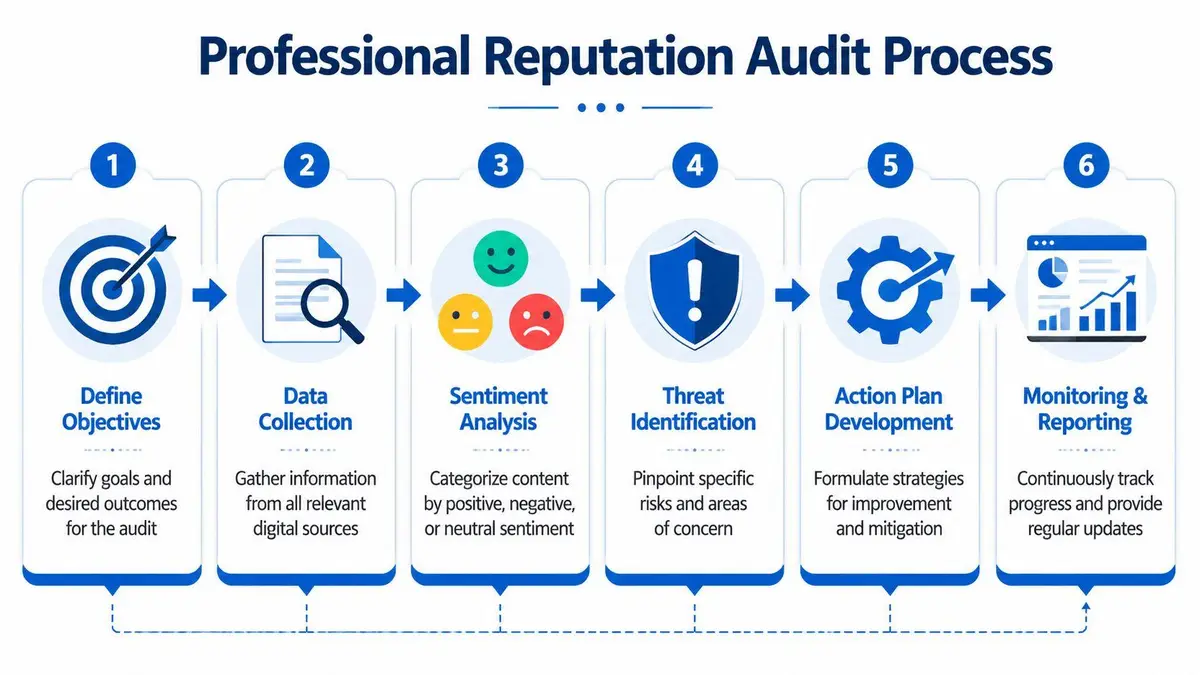
A serious reputation audit is closer to legal discovery than casual brand monitoring. Typing your name into Google once a month tells you almost nothing. It won’t reveal query variations, regional differences, image indexing, stale profiles, syndication patterns, or the source pages that are feeding search visibility.
Start with the audit framework below.
Define the scope before you collect anything
The first question isn’t what appears online. It’s what would harm you if discovered by the wrong audience.
A founder raising capital needs one audit scope. A surgeon facing review manipulation needs another. A public figure dealing with impersonation, leaks, and gossip forums needs a broader one. Define the relevant entities, search terms, jurisdictions, and threat categories before you begin.
Use a structured query list such as:
- Core identity searches including legal name, common name, brand name, and frequent misspellings.
- Contextual searches pairing the name with terms like lawsuit, review, scandal, complaint, fraud, arrest, leak, address, or controversy, where relevant.
- Asset-specific searches for images, videos, social handles, executive bios, review profiles, and archived content.
Classify each result by threat, not just tone
Most in-house efforts often fail when they label content positive, negative, or neutral and stop there. That’s too crude.
A neutral page can still expose private data. A negative review may be manageable. A technically false article on an authoritative domain may be severe. The classification model has to reflect legal exposure, search visibility, removability, and likely audience impact.
A practical working table looks like this:
| Content type | Typical issue | Priority question |
|---|---|---|
| News article | Defamation, stale allegations, misleading framing | Can it be corrected, removed, or displaced? |
| Review profile | False reviews, unresolved complaints | Is response, reporting, or suppression the best path? |
| Social account | Impersonation, harassment, copied content | Can platform policy support takedown? |
| Data broker page | Address, family, phone, age | Does it create privacy or security risk? |
A useful primer on process sits here:
Build a closed-loop response model
A proper program doesn’t stop at discovery. As SentiOne’s ORM guidance explains, the system should detect mentions, classify severity, decide whether to respond, suppress, or remove, and then measure whether visibility improves. For high-stakes cases, that means defined alert thresholds, playbooks for takedown requests, and outcome tracking based on removal, de-indexing, or ranking displacement.
Operational view: If you can’t say who owns the alert, who decides the remedy, and how success is measured, you don’t have a reputation program. You have a search habit.
Common Threats and Strategic Remediation Paths
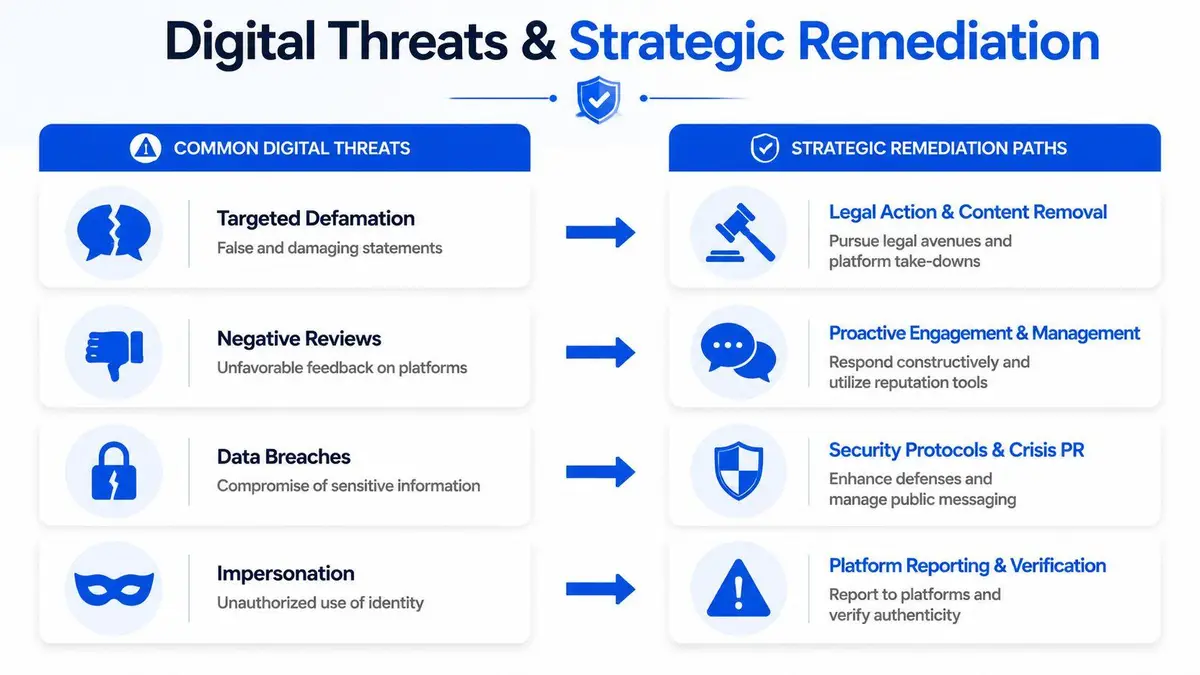
A lender finds adverse search results during underwriting. A prospective acquirer sees an old allegation on page one. A former employee posts doxxing material that exposes a home address. None of these is a branding problem first. Each is a risk event with financial, legal, or security consequences.
Threats that distort the public record
False allegations, defamatory statements, and manipulated narratives require disciplined triage because the wrong first move can harden the record. Establish what you are dealing with before you act. Is the statement false fact, protected opinion, privileged reporting, a republication, or a clear platform-policy breach? That classification determines the remedy and preserves options for counsel.
The response path usually falls into five buckets: publisher correction requests, platform complaints, legal notices, search de-indexing requests where available, or suppression using controlled assets that can outrank the material. Pick one based on evidence, jurisdiction, and the publisher’s incentives. Sending broad threats to everyone at once is lazy and often counterproductive.
Old but accurate reporting is a separate class of problem. The legal issue may be weak while the commercial harm is still real. In those cases, focus on context, incompleteness, staleness, and disproportionate search visibility. Update requests, negotiated amendments, and strategic search displacement often produce better results than confrontation.
Threats that spread through platforms
Platform-driven attacks move fast because distribution is built in. Reviews, social posts, forum threads, and copied snippets can alter buying behavior, hiring decisions, partnership diligence, and investor perception within days.
Review abuse is especially dangerous because it sits close to revenue. Fake reviews, coordinated one-star campaigns, and unresolved complaints do not just injure credibility. They can reduce lead conversion, trigger contract hesitation, and create discoverable evidence of inaction if the underlying issue points to a real compliance or service failure. Remove the unsupported attacks. Fix the operational issue where the criticism is true.
Use the right remedy for the platform and the record:
- False reviews call for evidence preservation, policy-based reporting, a restrained public reply where needed, and a deliberate review recovery program to restore rating integrity.
- Impersonation accounts require immediate reporting under identity, fraud, or trademark rules, plus profile verification and consolidation of official channels.
- Harassing social content requires documentation, safety-policy escalation, and monitoring for reposts, mirrors, and account rotation.
Threats involving privacy and intimate harm
Doxxing, leaked personal data, hacked content, family exposure, and non-consensual intimate imagery are security incidents. Treat them that way. The priority is containment, evidence capture, source removal, de-indexing where available, and persistent monitoring for reuploads and scraped copies.
Time matters here. Once the material is indexed, copied to aggregator sites, or reposted across forums, removal becomes slower and more expensive.
Remove what can be removed. Suppress what cannot. Document everything.
For individuals or organizations facing active exposure across websites, social platforms, and search results, a targeted online content removal strategy is often the cleanest route because it combines takedown requests, platform-specific enforcement, and search remediation in one documented process. That is stronger than sending improvised emails that create a poor record and achieve nothing.
The governing rule is simple. Match the remedy to the threat, the platform, and the legal posture. Precision protects assets. Volume creates noise.
When to Engage a Specialist Firm
You can handle some issues internally. A routine customer complaint with a truthful basis and a reasonable platform can often be resolved by disciplined response and service recovery. Most serious matters don’t look like that.
They involve multiple platforms, indexed copies, anonymous publishers, legal exposure, or personal safety implications. At that point, DIY stops being economical.
Why amateur intervention often makes the problem worse
People under pressure tend to do the same three things. They send emotional messages to publishers. They argue publicly in comments or reviews. They create hurried content with no ranking strategy and no legal review. All three can damage the record.
A badly worded removal request can be ignored, forwarded, or published. A defensive reply can validate the attacker’s framing. A sloppy outreach trail can complicate later legal action. In some cases, direct confrontation increases attention to the material.
This is one reason broad online advice is inadequate. As SMOWL’s analysis of online reputation management points out, many introductory articles never provide a practical decision tree for what to monitor, remove, or suppress, even as platform algorithm changes make generic guidance less useful for executives, founders, and public figures.
Clear triggers for specialist intervention
Bring in a specialist firm immediately when any of the following is true:
- Legal risk exists because the content is defamatory, extortionate, privacy-invasive, or likely to affect litigation, employment, financing, or regulatory matters.
- Sensitive personal information is exposed including home address, family details, intimate material, or identifying information that increases security risk.
- The content sits on authoritative platforms such as major publishers, legal databases, high-trust review platforms, or entrenched first-page results.
- The attack is distributed across reviews, search, social media, forums, and copied pages rather than a single removable post.
- You need discretion because internal teams, assistants, or public-facing staff should not be handling outreach tied to your name.
The standard to look for
A competent specialist should think like counsel, investigator, and search strategist at the same time. They should preserve evidence, classify the platform, choose the right procedural path, and avoid unnecessary visibility. If they talk only about branding, they’re not equipped. If they talk only about lawsuits, they’re too narrow.
The right question isn’t “Can someone improve search results?” It’s “Can someone reduce exposure, remove what’s actionable, and build a durable defensive perimeter without creating new problems?”
A Call for Proactive Digital Risk Management
The proper answer to what is online reputation isn’t “what people think about you online.” That’s too soft and too incomplete. A better answer is this: it is the public digital record that influences whether other people trust you, transact with you, investigate you, or avoid you.
That record has to be managed like any other exposed asset. Monitored continuously. Strengthened deliberately. Defended when attacked. Reviewed before moments that matter. Waiting until a crisis appears on page one is a poor governance model.
For leaders who want a clearer view of the specialist field, these expert insights from ReachLabs.ai are a useful external reference point when evaluating what serious reputation firms do and where standard agency advice falls short.
If you hold a senior role, manage substantial assets, advise high-profile clients, or protect a family office, a reactive approach isn’t enough. You need a standing digital risk posture. That means knowing what ranks, what can be challenged, what must be suppressed, and where your next point of exposure is likely to come from.
The internet is already underwriting your reputation. You should do the same.
If you need a discreet assessment of your current exposure, ContentRemoval.com handles confidential online reputation reviews, content removal matters, and search-risk remediation for executives, public figures, legal professionals, and high-net-worth individuals. The sensible next step is a private review of what currently ranks, which assets create real liability, and which remedies are viable now.
Frequently asked questions
Why is online reputation a risk issue rather than a marketing issue?
Because it changes decisions before you are in the room. A negative page-one result can affect financing terms, hiring, deal certainty and regulator attention. The article frames it as evidence management alongside insurance, litigation exposure and counterparty diligence.
How do I audit my own online reputation properly?
Define the scope first, then run core identity searches, contextual searches pairing your name with risk terms, and asset-specific searches for images, videos, handles and archived content. Classify each result by threat type and decide who owns the alert, who picks the remedy and how success is measured.
When should I stop handling reputation problems myself?
When legal risk exists, sensitive personal information is exposed, the content sits on authoritative platforms or entrenched first-page results, the attack is spread across several surfaces, or discretion matters. The article warns that emotional outreach and public arguments often make the record worse.