
Management by crisis is the systemic failure that occurs when leadership mistakes constant firefighting for decisive action, ignoring underlying problems until they erupt into emergencies. It leaves an organization off-balance, so a leak, negative article or smear campaign lands on a company already unable to mount an effective defense, and the executive becomes the face of the failure.
Key facts
- Indicators include chronic executive exhaustion, the loudest problem winning attention and celebrated heroics for preventable disasters.
- Southwest’s cancellation of over 2,700 flights led to a $75 million FAA fine and 12% stock drop.
- A crisis-ready framework needs threat identification, scenario planning, pre-approved communications and a pre-vetted response team.
- Management by crisis is the opposite of agility, which is a planned, strategic pivot made with foresight.
Where ContentRemoval.com comes in. ContentRemoval.com is the external layer described in this post, the specialists who find and remove damaging content, impersonation accounts and leaked material before it defines the narrative. Executives and their general counsel usually engage us to build that defense in advance, or to contain a live attack when the cycle has already started. A free 15-minute Exposure Scan maps your current online vulnerabilities and what can be removed, and the report is yours to keep. Get a Free, Confidential Exposure Scan or read how our reputation management work is done.
Management by crisis is not a strategy. It is the systemic failure that occurs when leadership mistakes constant firefighting for decisive action. In this operational state, underlying problems are ignored until they erupt into emergencies, forcing the organization to lurch from one self-inflicted disaster to the next.
This is not a high-performance environment; it is a dangerous cycle driven by adrenaline, not foresight. For executives, this reactive posture constitutes a direct and personal threat to their careers and reputations.
The Dangers of Reactive Leadership
Operating in a reactive mode is akin to running a company on a treadmill set to sprint, with no off-button. Leaders trapped in this cycle confuse the constant rush of extinguishing fires with genuine productivity. Instead of anticipating risks, they react to them, making every decision under duress. This is not a sign of a resilient culture; it is a symptom of systemic weakness that leaves the company and its leaders dangerously exposed.

This chaotic environment is extraordinarily costly. Data indicates that 70% of executives admit that daily “firefighting” is a regular part of their role. This constant state of emergency contributes to 15-20% higher turnover rates as top talent inevitably burns out.
Worse, this internal instability makes the organization a prime target for external attacks. When a damaging leak, negative article, or online smear campaign materializes, a reactive company is already off-balance and ill-equipped to mount an effective defense.
In a reactive state, a single viral smear campaign can erase 25% of brand value in 48 hours. Reactive fixes in these scenarios often prove catastrophically expensive, highlighting the immense cost of failing to plan.
Ultimately, this firefighting posture guarantees that when a genuine, unavoidable crisis strikes, the organization will buckle. The fallout is predictable: severe financial losses, operational chaos, and permanent damage to an executive’s personal brand.
Learning how to manage your online reputation proactively is the first step toward breaking this cycle. Shifting from reactive chaos to strategic preparedness is not a matter of preference. It is fundamental for survival and the protection of your legacy.
The Anatomy of a Reactive Organization

An organization that lurches from one emergency to the next exhibits the clear symptoms of a reactive system. This is not a high-energy workplace; it is a fundamentally broken one. The constant chaos is not a signal of agility but a glaring indicator of systemic weakness. For any leader, recognizing these patterns is the first critical step toward pulling the company back from the brink.
This chaos almost invariably stems from a leadership failure to anticipate future challenges. When no one is charting a course or identifying risks, every problem escalates to the level of a catastrophe. This fosters a culture where short-term heroics, the all-night scramble to resolve a sudden disaster, are praised, while the quiet, methodical work of preventing problems is ignored.
The Culture of Constant Firefighting
Once this cycle begins, it is incredibly difficult to break. Teams become so accustomed to operating on adrenaline that a state of high alert becomes the new normal. Worse, executives begin to confuse the frantic energy of extinguishing fires with effective leadership. The organization progressively loses its capacity for deep strategic thinking and long-term planning.
The most obvious indicator is the absence of a concrete plan for adverse events. If the response to a “what if” query is, “we’ll cross that bridge when we come to it,” you can be certain that bridge will be on fire upon arrival.
This refusal to prepare manifests throughout the organization. Critical decisions are made hastily with incomplete information because there is never sufficient time for proper due diligence. Long-term strategic objectives are perpetually deferred as the “crisis of the day” consumes all available resources, leaving your most valuable personnel drained and demoralized.
Key Indicators of a Reactive System
An experienced leader can diagnose the symptoms of this pathology by observing the organization’s operational patterns. These are not isolated incidents but recurring behaviors that point to a deep-seated structural problem.
An executive team that is chronically exhausted is not a badge of honor; it is a sign that they lack the systems to manage workloads and delegate effectively, forcing them to personally absorb every shock to the business. In a reactive company, the loudest problem commands attention, meaning a minor but noisy issue can easily divert resources from a quiet but existential threat. Furthermore, when a single person or team is constantly celebrated for “saving the day,” it is a symptom of a system designed to fail. A truly robust organization prevents fires; it does not build monuments to its firefighters.
Recognizing these signs for what they are is critical. They reveal that what is management by crisis is, at its core, a complete failure of leadership and governance, one that makes severe operational and reputational damage almost a certainty.
The High Cost of Reactive Leadership
When leaders only react to problems, the true cost is not the resolution of a single incident but the cascading failures that follow. For executives, high-net-worth individuals, and family offices, understanding what is management by crisis means recognizing how this approach systematically destroys value across financial, operational, and personal domains.

The most immediate costs manifest on the balance sheet: regulatory fines, expensive litigation, and a decline in market share as dissatisfied customers migrate to competitors. However, the latent costs are often the ones that inflict the most lasting harm.
This includes the slow erosion of brand trust built over decades, the sudden collapse of investor confidence, and the permanent stain on an executive’s personal reputation. In a constant firefighting mode, a single operational slip-up can rapidly metastasize into a public relations disaster, erasing billions in value and defining a leader’s entire career.
Direct Financial Hemorrhaging
The airline industry provides a stark lesson. Southwest Airlines’ cancellation of over 2,700 flights in a single weekend was not a string of bad luck; it was the inevitable consequence of neglecting to invest in resilient systems. The financial repercussions were swift and severe: a $75 million fine from the FAA and a 12% stock plunge within days.
Ultimately, the chaos cost the airline a staggering $420 million in direct losses. Meanwhile, competitors with more robust operational foundations were largely unaffected. Further details about these successful crisis management examples are available for review.
This demonstrates that operational neglect is never merely an internal problem. It bleeds directly into financial reports and shareholder value, inviting intense regulatory scrutiny. Every dollar spent cleaning up a preventable mess is a dollar that could have been invested in innovation, growth, or securing the company’s future.
A reactive posture forces an organization to perpetually play defense with its capital. Instead of investing in the future, it is forced to pay for the mistakes of its past, trapping it in a cycle of financial decline.
The Irreversible Reputational Collapse
Beyond the balance sheet, the deepest wounds are often reputational. For the CEO or public figure in charge, an operational meltdown becomes a very public and personal failure. The narrative quickly shifts to one of incompetence and poor judgment, a label that is incredibly difficult to shed.
Once stakeholders, investors, and the public lose faith in a leader’s ability to manage risk, that confidence is permanently compromised. This loss of trust has tangible consequences. High-performing employees will not remain in a chaotic workplace; they will seek stable organizations with a clear strategic vision. Potential investors and business partners will view the organization as unreliable, foreclosing valuable opportunities for growth. The executive becomes the face of the failure, which can haunt their future career prospects, from board appointments to new ventures.
The Southwest incident was not just a logistical challenge; it became a textbook case of failed leadership. This is the ultimate price of management by crisis: it transforms solvable operational issues into permanent blemishes on a leader’s legacy, underscoring the critical importance of proactive intervention.
Building a Proactive and Resilient Governance Model
Escaping a constant state of emergency requires a fundamental redesign of how an organization perceives and addresses risk. Instead of treating risk management as a compliance checkbox, a resilient company integrates it directly into its core strategy. This approach is the antithesis of management by crisis. It is about building a system designed to anticipate and neutralize threats, not merely react to their impact.
The objective is to build an organization that operates on foresight and structured defense, not adrenaline. This entails moving away from the chaotic, knee-jerk responses that define reactive leadership and toward a deliberate system of governance. Such a model will not render you immune to problems, but it will transform potential disasters into manageable incidents, protecting both your bottom line and your reputation.
The Core Components of a Crisis-Ready Framework
A robust crisis framework is not a document on a shelf; it is a dynamic system embedded within the company, composed of interconnected components that work in concert to defend against multifaceted threats. It is the mechanism by which you shift from a position of vulnerability to one of control.
A truly resilient governance model doesn’t just react to the loudest alarm. It is built on a foundation of quiet competence, where the most significant victories are the crises that never happen.
The pillars supporting this framework include Advanced Threat Identification, which involves continuously scanning for operational, financial, and reputational risks. This early-warning system monitors everything from supply chain weaknesses to online sentiment to detect faint signals before they become deafening alarms.
Another pillar is Rigorous Scenario Planning. Effective leaders relentlessly stress-test their organizations by running drills for plausible “worst-case” scenarios, such as a major data breach, a product recall, or an executive scandal. This process reveals weaknesses in response plans when the stakes are low.
Secure Stakeholder Communications are also essential. A pre-approved communication plan must be in place, including templated statements, “dark” websites ready for instant activation, and a clear chain of command for disseminating information to employees, investors, and the public. This is about controlling the narrative from the first minute.
Finally, a Pre-Vetted Crisis Response Team is non-negotiable. This is not an ad-hoc committee but a designated group of internal leaders and external specialists (legal, PR, forensic investigators, reputation managers) on standby. When a crisis is declared, this team can assemble and act in minutes, not days, because they already possess the authority and a clear mission.
Part of building this model is ensuring you have effective social media crisis management strategies in place to shield your brand from online attacks. Investing in these systems is how leaders transform their companies from victims of circumstance into masters of their own fate, building a legacy of stability and foresight.
Your Framework for Transitioning to Proactive Defense
Breaking the cycle of constant firefighting requires a framework that fundamentally changes how your organization identifies and neutralizes threats before they escalate. This is how you build a resilient organization instead of lurching from one crisis to the next.
The starting point is a brutally honest vulnerability audit. This is more than a standard risk assessment; it involves mapping your entire operational and digital footprint to identify weak points. You must ask the difficult questions: Where is an attack most likely to originate? A disgruntled former employee? A vulnerability in the supply chain? An unsecured server? Once you know the ‘where,’ you can map the potential reputational fallout.
The goal is to build a continuous, proactive governance model, not a one-time checklist.
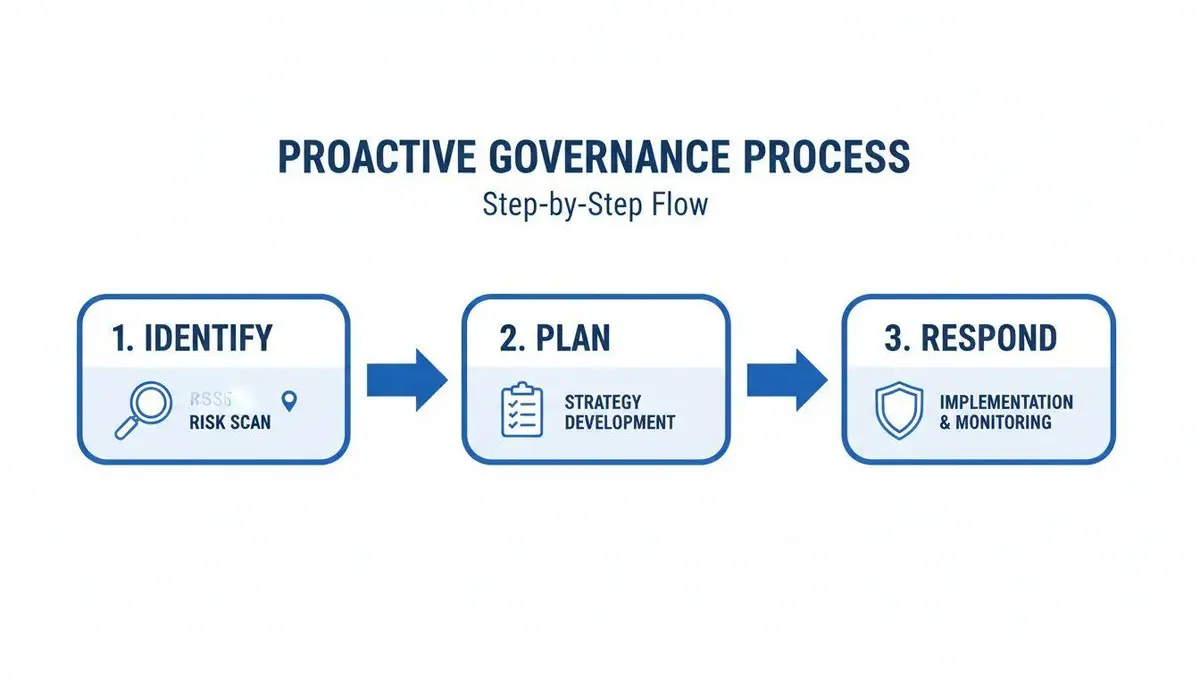
This is a living process. Intelligence gathered from identifying new threats informs and improves planning, while refined responses sharpen your ability to detect the next threat on the horizon.
Implementing a Formal Crisis Response Plan
Once you have mapped your vulnerabilities, the next step is to build and stress-test a formal crisis response plan. This is not a binder that collects dust. It must be a living, functional system your team can activate at a moment’s notice. Relying on improvisation, even when it appears successful, carries severe hidden costs.
Consider Walmart’s response to Hurricane Katrina. On the surface, it was heroic, delivering 2,500 truckloads of essential aid and beating FEMA to the scene. Yet this ad-hoc effort came at a staggering price. Reports on the true costs of crisis management reveal that this reactive scramble exposed major supply chain gaps, costing the company $100 million in unplanned logistics and resulting in 40% inefficient resource allocation.
This is a powerful reminder that even “successful” reactive crisis management is unsustainable and financially draining without a formal plan. A proper framework would have pre-assigned roles, secure communication channels, and vetted partners, protecting both your bottom line and your brand. This is a core component of how to properly invest in your online reputation before a crisis forces your hand.
Engaging Specialized External Defense
Finally, a truly proactive defense recognizes the limits of in-house capabilities. For most organizations, that line is drawn at the digital frontier, where online threats move with a speed and complexity that internal teams cannot match.
A crisis response plan is only as strong as its weakest link. For most executives, that weakness is the inability to control the online narrative when an attack (such as defamation, a content leak, or impersonation) goes public.
This is where you engage specialists. A dedicated reputation defense firm provides access to capabilities that are otherwise out of reach, offering a critical shield for your most valuable asset.
This external layer of defense typically includes:
- Real-time Threat Monitoring: Using advanced tools to find negative content, impersonation accounts, or data leaks the second they appear online.
- Rapid Content Removal: Executing swift, legally-sound takedowns to get damaging material off search results, social media, and websites before it can gain traction.
- Proactive Suppression: Pushing down negative search results and building up a defensive wall of positive digital assets to insulate your reputation from future attacks.
Integrating this expertise is the final element of a comprehensive defense. It is how you transition from being a reactive target to a fortified leader, prepared for any eventuality.
Moving Beyond Survival to Strategic Advantage
Operating in a constant state of crisis is not a leadership style; it is a trap. The endless cycle of firefighting may feel like high-stakes action, but it masks a deep-seated organizational pathology. For any executive or public figure, remaining in a reactive state is a certain path to financial and reputational ruin.
Every emergency “solved” in this manner is merely a symptom of a larger, systemic failure, a failure that quietly erodes trust, burns through resources, and pushes your entire operation closer to a catastrophic collapse.
However, breaking free from this survival mode unlocks tremendous strategic value. True resilience is not just about dodging bullets; it is about turning risk management into a competitive advantage. This concept is a cornerstone of professional disciplines like enterprise risk management. When you build a proactive organization, you are no longer just playing defense.
Preparedness does more than prevent adverse events. It creates the stable foundation necessary for genuine innovation, sustained growth, and long-term value creation to flourish.
Proactive reputation management is not an expense: it is a direct investment in preserving the value of your most critical assets: your name and your legacy. It is the definitive line between perpetual vulnerability and enduring strength.
The choice is clear. You can continue to lurch from one predictable emergency to the next, or you can build a fortified, resilient organization.
The first step is obtaining a clear, confidential picture of your true vulnerabilities, both online and off. Learning how to control your online narrative before a crisis hits grants you the power to secure your reputation and transform potential threats into a source of strategic strength. We strongly advise executives, public figures, and their legal counsel to seek a confidential assessment. It is time to move beyond survival and start building a lasting advantage.
Frequently Asked Questions
For leaders grappling with the fallout from constant crises, these are the most common questions we address, answered from years of high-stakes experience.
Is ‘Management by Crisis’ the Same as Being Agile?
No. They are polar opposites. Agility is a planned, strategic pivot. An agile company anticipates a changing environment and adjusts its course with foresight.
Management by crisis is being constantly capsized by foreseeable events. True agility is impossible when an organization is perpetually bailing water simply to stay afloat.
My Team Seems to Thrive Under Pressure. Is That a Problem?
Yes, it is a significant problem. A culture that celebrates constant “firefighting” often masks deep, systemic failures. It creates a dangerous feedback loop where personnel are rewarded for resolving emergencies, not for preventing them.
Rewarding heroics for preventable disasters ensures that those disasters will continue to happen. This is not a sign of a strong team but of a flawed system that makes failure inevitable.
This adrenaline-fueled environment leads to burnout, high turnover of top talent, and a total loss of long-term strategic direction. When a genuine, unavoidable crisis does occur, your team will be too exhausted and disorganized to respond effectively.
When Should I Engage an External Reputation Firm?
Ideally, specialists should be engaged before a crisis erupts. Proactive engagement allows a firm to audit vulnerabilities, identify digital weaknesses, and build defenses to neutralize threats before they can inflict real damage.
However, if you are already caught in a reactive cycle, the time to act is now. The mission shifts from prevention to containment. An experienced firm will work to stop the bleeding, stabilize the situation, and help you rapidly build the resilience needed to break the cycle and protect your remaining reputational capital.
When your reputation is on the line, you need specialists who operate with speed and precision. ContentRemoval.com offers confidential assessments to help executives and public figures defend against digital threats and move from a reactive posture to a fortified one. Protect your most valuable asset by visiting ContentRemoval.com.